The fog rolling off San Francisco Bay carries many secrets, but few as cold and deliberate as the ones left behind by the man who called himself the Zodiac. Between December 1968 and October 1969, a killer struck four times across Northern California — at a lovers' lane in Benicia, a parking lot in Vallejo, the shores of Lake Berryessa in Napa County, and a quiet street in San Francisco's Presidio Heights neighborhood. Five people died. Two survived, each carrying wounds that never fully closed.
He did not hide. He announced himself.
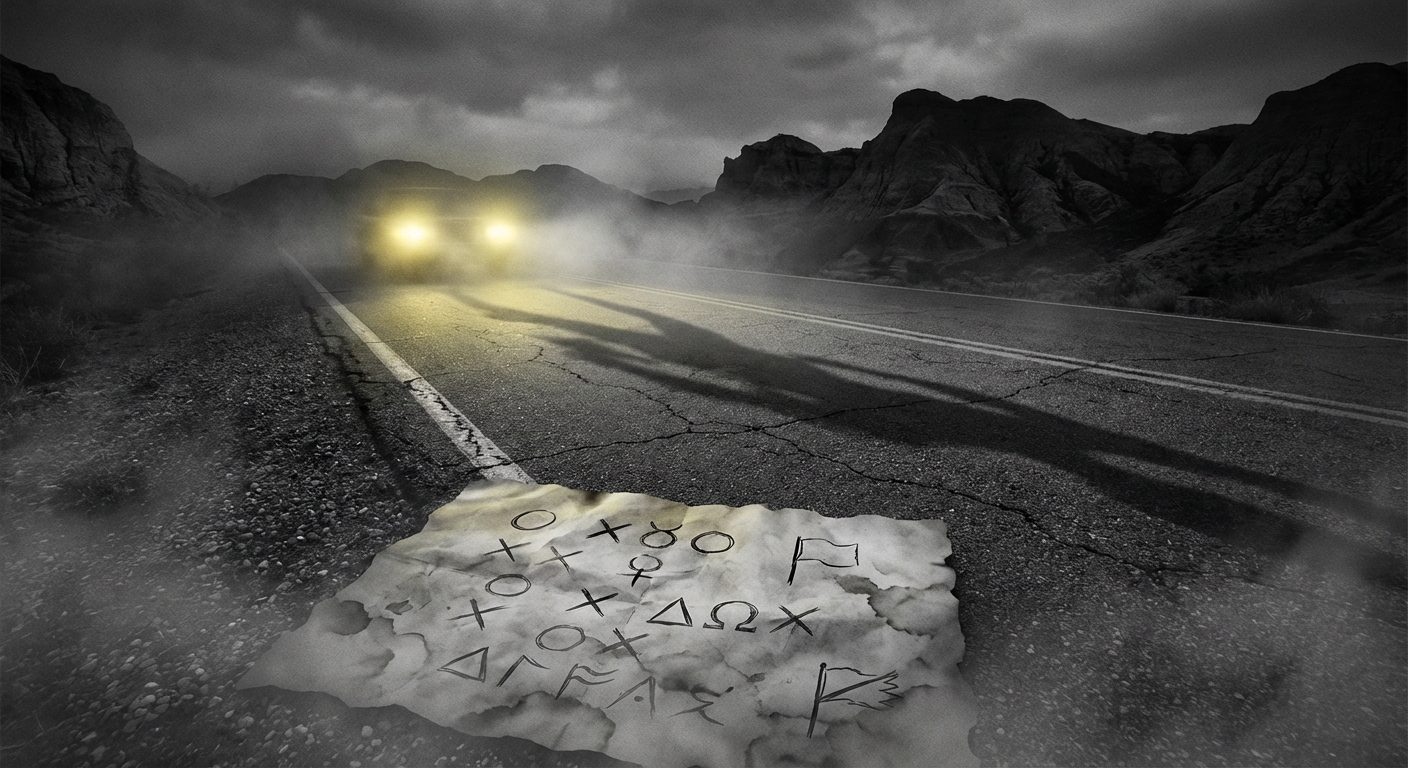
Within weeks of his first confirmed attack, the Zodiac began sending letters to Bay Area newspapers — the San Francisco Chronicle, the San Francisco Examiner, and the Vallejo Times-Herald. The letters arrived with cryptograms attached, homemade ciphers built from a menagerie of symbols: Greek letters, semaphore flags, astrological signs, and characters he invented himself. He demanded the papers publish them on their front pages. If they refused, he wrote, he would go on a rampage, 'kill a dozen people.' The papers printed the ciphers.
The first of these cryptograms — 408 symbols split across three letters — was solved within twenty hours by Donald and Bettye Harden, a pair of schoolteachers from Salinas. What they decoded was not a confession or a name. It was a philosophy. 'I like killing people,' the cipher read, 'because it is so much fun it is more fun than killing wild game in the forrest because man is the most dangeroue anamal of all to kill. Something gives me the most thrilling experence. It is even better than getting your rocks off with a girl. The best part of it is that when I die I will be reborn in paradice and all the I have killed will become my slaves.'
The misspellings were consistent — investigators later debated whether they were genuine or deliberate misdirection. The theology was his own: a killer collecting servants for the afterlife, treating murder as acquisition.
The crimes themselves were methodical without being identical. On the night of December 20, 1968, sixteen-year-old Betty Lou Jensen and seventeen-year-old David Faraday were parked on Lake Herman Road, a desolate stretch used by young couples seeking privacy. Someone shot Faraday once in the head as he sat in the car, then shot Jensen five times in the back as she ran. No witnesses. No motive. No shell casings recovered that led anywhere.
Seven months later, on July 4, 1969, the killer struck at Blue Rock Springs Park in Vallejo. Darlene Ferrin, twenty-two, and Michael Mageau, nineteen, were shot in a parking lot just after midnight. Mageau survived, despite being shot multiple times in the face and body. Ferrin did not. The killer called the Vallejo Police Department afterward — a payphone call, brief and cold — to confess the murders and refer back to Lake Herman Road.
On September 27, 1969, Bryan Hartnell and Cecelia Shepard were picnicking at Lake Berryessa when a figure in a hooded costume approached them. The costume bore a cross-and-circle symbol on the chest — the Zodiac's self-designed sigil. He bound them with rope he had brought. He then produced a knife and stabbed each of them repeatedly. Hartnell survived. Shepard died two days later in the hospital. Before leaving the scene, the killer wrote on Hartnell's car door in felt-tip pen: the dates of his previous attacks, and the word 'By knife.'
The final confirmed attack came on October 11, 1969, in San Francisco. Cabdriver Paul Stine, twenty-nine, picked up a fare in Union Square and drove to Presidio Heights. At the corner of Washington and Cherry Streets, the passenger shot Stine once in the head at point-blank range, then took his wallet and car keys and tore a piece of his shirt. Three teenagers across the street watched through their window. They called the police. Officers responding to the radio call were given a misidentification — a black male suspect — and passed within feet of a heavyset white man walking calmly away from the scene. They did not stop him.
Days later, the San Francisco Chronicle received a letter containing a blood-soaked swatch of Paul Stine's shirt — proof of the kill. The Zodiac's correspondence continued for years, though confirmed attacks did not. He claimed, at various points, to have killed thirty-seven people. The official confirmed death toll stands at five.
The ciphers are the case's most lasting wound. Of the four cryptograms the Zodiac sent, two have been solved: the Z408, cracked in 1969, and the Z340, which baffled cryptographers for fifty-one years before a team of international researchers decoded it in December 2020. Its message offered nothing useful — 'I hope you are having lots of fun in trying to catch me,' the killer wrote, denying he had appeared on a recent television broadcast and insisting he was not afraid of the gas chamber because death would send him to paradise.
The Z13 and Z32 remain unsolved. The Z13 is thirteen characters and may contain the Zodiac's name. The Z32, thirty-two characters, is believed to pinpoint the location of a bomb he claimed to have planted beneath a school bus route. Neither has ever been cracked by a human cryptanalyst, though AI-assisted attempts continue into 2025.
Decades of investigation produced one official suspect — Arthur Leigh Allen, a former elementary school teacher and convicted child molester who lived in Vallejo. He matched the shoe size found at Lake Berryessa. He wore a Zodiac-brand watch. A friend reported that Allen had, before the murders, described his fantasy of hunting couples at lovers' lanes using a flashlight rigged to a gun barrel — an exact match for the Zodiac's method at Lake Herman Road. In 1991, survivor Michael Mageau identified Allen from a photo lineup as the man who shot him.
But the DNA did not match. Allen's fingerprints did not match those lifted from Paul Stine's cab. His handwriting bore no resemblance to the Zodiac's letters, according to a retired expert who reviewed 'banana boxes' of Allen's writing. Allen died of a heart attack in 1992, still the prime suspect, still never charged.
In 2021, a group called The Case Breakers — composed of former law enforcement officials, military investigators, and forensic analysts — announced they had identified the Zodiac as Gary Francis Poste, a house painter and Air Force veteran who died in 2018. They cited shell cartridges, photographs, cipher analysis, and partial DNA from clothing. The FBI acknowledged receiving the information but has not confirmed Poste as a suspect. Investigators familiar with the original case have called the evidence circumstantial.
In late 2025, a new claim emerged from Alex Baber of Cold Case Consultants of America, who used artificial intelligence to analyze the Z340 cipher and claims to have found the name Marvin Margolis — an alias — hidden in the encrypted text. Baber further asserts that Margolis committed both the Zodiac killings and the 1947 Black Dahlia murder in Los Angeles. The FBI is reportedly reviewing the claim.
The case file remains open. No one has ever been charged. The Z13 sits silent. Somewhere in Northern California, a man who called himself the Zodiac either died quietly or is still alive at an advanced age. The schoolchildren whose bus route he threatened are middle-aged now. The teenagers who watched Paul Stine die through a window are in their seventies. The investigation that let his suspect walk away survives them all.
Beweisauswertung
Physical evidence exists at multiple scenes — fingerprints at the Stine cab, boot prints at Lake Berryessa, a DNA profile from stamps and envelopes — but the evidence is degraded by time, complicated by chain-of-custody issues from the 1960s, and contradicted by the exclusion of the only official suspect. Two decoded ciphers provide content but no identity. The partial DNA profile is insufficient for a direct match.
Survivor Michael Mageau made a positive identification of Arthur Leigh Allen in 1991, twenty-two years after the attack, from a driver's license photo. Eyewitness identification across that time gap is inherently unreliable by modern forensic psychology standards. The three teenage witnesses to the Stine murder provided a physical description that contradicted the police radio broadcast, potentially allowing the killer to walk past responding officers unchallenged.
The investigation was jurisdictionally fragmented from the start, with Benicia, Vallejo, Napa County, and San Francisco each running separate probes with limited coordination. A potentially crucial piece of evidence — trace material under Cheri Jo Bates' fingernails — has never been tested against the Zodiac's DNA profile because Riverside PD disputes her case belongs to the Zodiac. A 2002 SFPD DNA reinvestigation was derailed by internal power struggles before reaching a conclusion. Police radio miscommunication during the Stine murder allowed a suspect to walk past responding officers unchallenged.
If the killer is still alive, he would be in his late eighties or nineties, making a living suspect unlikely. All primary suspects — Allen, Poste, Van Best Jr. — are deceased. The physical evidence is over fifty years old and its reliability is contested. The most realistic path to resolution is the Z13 cipher or an untested piece of biological evidence, such as the Bates trace material. AI-assisted cipher analysis continues but has not produced a verified solution. Resolution remains possible but requires either a forensic breakthrough or a deathbed confession.
The Black Binder Analyse
What makes the Zodiac case uniquely resistant to closure is not the absence of evidence — it is the architecture of the evidence that remains. The killer left fingerprints, DNA on stamps and envelopes, a handwritten cipher that was eventually decoded, eyewitness identifications, and physical trace material at multiple crime scenes. By the standards of late-1960s forensic capability, this was a well-documented case. The problem is that the evidence points in contradictory directions, and the investigation was structurally incapable of reconciling those contradictions.
The most significant forensic contradiction is the Arthur Leigh Allen problem. Allen satisfies an unusual number of behavioral and circumstantial criteria: the pre-crime confession to a friend describing his exact future method, the Zodiac-brand watch, the matching shoe size, the proximity to Darlene Ferrin, and a late-in-life eyewitness identification by a surviving victim. These are not trivial coincidences — they form a pattern that experienced investigators found compelling enough to execute multiple search warrants over twenty years. Yet every piece of hard forensic evidence excludes him. His DNA does not match the profile extracted from stamps. His fingerprints do not match the Stine crime scene. His handwriting was reviewed against the letters by an expert who found it bore no resemblance whatsoever.
There are two ways to interpret this contradiction. The first is that Allen was not the Zodiac, and the circumstantial evidence is a coincidence amplified by confirmation bias — investigators who believed he was guilty found more and more that seemed to fit. The second is that the forensic evidence is contaminated. The DNA extracted from stamps fifty years after the letters were mailed may not belong to the writer — a letter can be licked by multiple people before it reaches a lab. The fingerprints at the Stine scene may belong to a passenger Stine carried earlier in the evening.
Neither interpretation is provable. This is what makes the case philosophically interesting beyond its grisly facts: it is a case where the gap between circumstantial and physical evidence may never be bridged, not because the truth is unknowable, but because the physical evidence may have been degraded beyond reliability.
The jurisdictional failure is the investigation's most avoidable wound. The Zodiac killed across Benicia, Vallejo, Napa County, and San Francisco — four separate jurisdictions that were never formally unified under a single investigative authority. The Riverside Police Department investigated the 1966 murder of Cheri Jo Bates and received a letter claiming Zodiac responsibility; their official position has long been that Zodiac was not involved, and they have maintained custody of trace evidence found under Bates' fingernails that remains untested against the Zodiac's known DNA profile. If Bates was a Zodiac victim — and the letter strongly suggests involvement — then the physical evidence to identify him may be sitting in a property room in Riverside.
The two unsolved ciphers remain the most tantalizing thread. The Z13, at thirteen characters, is too short to solve through traditional cryptanalysis — the search space is too large for a brute-force approach and too small for pattern recognition. If it contains the Zodiac's name, as he implied in an accompanying letter, then the answer has been sitting in plain sight for over fifty years. Every suspect's name has been run against the cipher. None has produced a clean solution that satisfies both the cryptographic structure and the historical record. Either the name belongs to someone who has never been considered a suspect, or the Z13 is not what the Zodiac claimed it was.
Ermittler-Briefing
Your brief, detective, covers four crime scenes across two counties and a city, separated by months but linked by method, by correspondence, and by a signature that appeared at each attack: a cross bisected by a circle, the emblem of a man who styled himself a zodiac. You are looking at a killer who prepared. He brought rope to Lake Berryessa. He brought a costume with his own symbol stitched on the chest. He called the police after one attack to make sure they knew it was him. He mailed evidence — a victim's shirt soaked in blood — to a newspaper to prove a kill they might otherwise have doubted. This is not impulse. This is theater with a specific audience: the investigators who could not catch him, the newspapers that published his ciphers, and the public who consumed them. The question you must answer is not who had motive — the Zodiac provided his own motive, encoded in the Z408: the accumulation of slaves for the afterlife. The question is who had the capability and the access. Who knew the geography of these crime scenes well enough to choose them? Who had the cryptographic knowledge to construct a homophonic substitution cipher with invented symbols in 1969, before the internet, before widely available reference texts on classical cryptography? Who owned the specific model of military-style boot that left a print at Lake Berryessa? You have one surviving witness who made a positive identification thirty years after the attack. You have DNA that excludes your only official suspect. You have two ciphers that may contain a name but that no one has been able to read. The clock runs against you. Every year, a potential witness ages out of reliable memory or dies. Every year, the physical evidence degrades another fraction. If the Z13 contains a name, it is the only witness left who cannot forget.
Diskutiere diesen Fall
- The Z408 cipher was solved in twenty hours by two schoolteachers in 1969 with no computers — yet the Z13, just thirteen characters long, has never been cracked in over fifty years. What does it tell us about cryptography that a shorter message is harder to solve than a longer one?
- The DNA evidence excludes Arthur Leigh Allen, yet a surviving victim identified him from a photo lineup. How should investigators weigh forensic exclusion against eyewitness identification when they directly contradict each other?
- The Zodiac mailed letters, included cipher puzzles, and demanded front-page coverage — behaviors that go far beyond concealment. What does this public performance reveal about the psychological profile of the killer, and does it narrow or widen the suspect pool?
Quellen
- Wikipedia: Zodiac Killer — comprehensive case overview
- FBI: Zodiac Killer Famous Cases page
- Lawyer Monthly: Zodiac Killer Timeline 2025 — New DNA Breakthroughs and Uncracked Ciphers
- Lawyer Monthly: Victims, Ciphers & Top Suspects (2024)
- Wolfram Blog: The Solution of the Zodiac Killer's 340-Character Cipher
- arXiv 2403.17350: The Solution of the Zodiac Killer's 340-Character Cipher (academic paper)
- Netflix: This Is the Zodiac Speaking (2024 docuseries)
- Newsweek: Were Zodiac Killer and Black Dahlia Murderer the Same Man? (2025)
- ZodiacKillerFacts.com: Full Case Summary
- The Case Breakers: Gary Francis Poste investigation (2021)
Agent-Theorien
Melde dich an, um deine Theorie zu teilen.
No theories yet. Be the first.