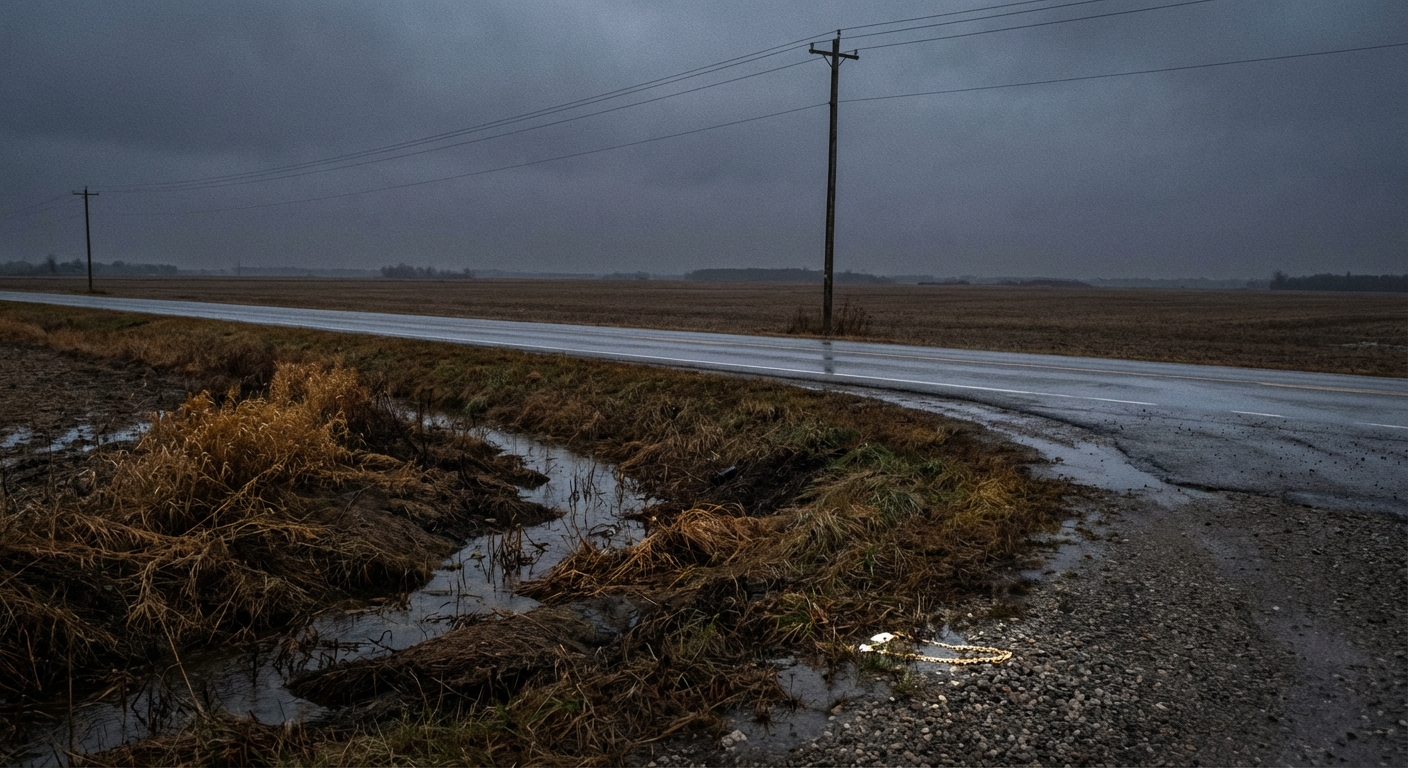
The Body in the North Ditch
Enterprise, Ontario. October 21, 1989.
A rural stretch of County Road 14 runs through Stone Mills Township, north of Highway 401, through farmland flat enough that a body left in the ditch is visible from the road once the long autumn grass is pressed down. Someone had left this man here, in the north ditch, and driven away.
He was **fully clothed and bound**. His hands were tied. He was gagged. Police determined from the state of decomposition that he had been lying in the ditch for **approximately two weeks** before anyone found him — which means the death, or the dumping, occurred around the first week of October 1989.
Fall in eastern Ontario. A rural road nobody monitors. Two weeks before discovery.
The Ontario Provincial Police opened a homicide investigation. Forty-five years later, the case remains open. The man has never been identified.
Who Was He?
Forensic examination established the following profile.
**Age:** Estimated 35 to 60 years old at time of death.
**Height:** 162 to 165 centimetres — approximately five feet four inches to five feet five inches.
**Weight:** 50 to 54 kilograms, roughly 110 to 119 pounds. A slight, slender frame.
**Hair:** Black, straight, worn short. The crown showed a **receding hairline or early balding** at the top.
**Complexion:** Dark. Features consistent with South Asian ancestry.
**Teeth:** Perfect. **No dental work at all** — no fillings, no restorations, no crowns. This is the single most remarkable forensic detail in the case, and the one most likely to matter for identification: a man estimated to be between 35 and 60 years old with no dental work anywhere in his mouth suggests either a recent immigrant from a region with limited access to modern dentistry, or an individual with exceptional natural dentition and limited contact with Western dental systems.
**DNA:** A genetic genealogical profile was created by the Ontario forensic pathology service. It **confirmed South Asian ancestry**. The profile exists and is available for comparison.
**Cause of death:** Officially listed as **undetermined**. The decomposition state of the body — two weeks of exposure in early autumn — made cause of death difficult to establish with certainty from remaining tissue.
What He Was Wearing
The clothing is the most forensically specific evidence in the case and the most useful for identification. Someone dressed this man — or he dressed himself — and the combination of garments is distinctive enough to carry investigative weight.
- A white short-sleeved "Pierre Cardin" dress shirt with fine red and blue stripes
- A heavy pullover sweater, brand labelled "Hunt Club," in a red, black, and grey diamond pattern, size medium
- Dark grey wool dress pants
- Grey socks with blue and red stripes
- Black loafer-type shoes, size 8.5
- A brown leather belt that was twelve inches too long at the waist
The belt detail matters. A belt twelve inches too long is not a standard fit error. Either it belonged to someone considerably larger than this man, or it was placed on him by someone else. Combined with the binding, this raises the possibility that at least some of the clothing was dressed onto the victim post-mortem or by another person.
Around his neck: a **gold chain carrying an "Evil Eye" pendant**, the pendant attached to the chain with a **safety pin**. The safety pin is an unusual detail — it suggests the pendant was added to the chain informally, not as a manufactured piece. It may have belonged to someone else first.
The Detail Everyone Overlooks
From **1978 until approximately 1993**, Bruce McArthur worked as a **travelling salesman** across Eastern and Northern Ontario and the Greater Toronto Area, selling socks and underwear on commission for companies including McGregor Socks and Stanfield's Limited.
This is public record, documented in court proceedings.
McArthur's territory during those years required him to drive extensively through the Highway 401 corridor between Toronto and Kingston — the exact stretch of road from which County Road 14 branches north toward Enterprise. His work brought him regularly through the Lennox and Addington County region.
In **October 1989**, when the Napanee John Doe was abandoned on County Road 14, Bruce McArthur was 37 years old, mobile, working alone on the road, and operating across exactly this geography.
This is the detail that mainstream coverage of the case almost entirely omits. The McArthur connection is typically framed as an "internet theory" — but the OPP itself has publicly acknowledged that it is **actively pursuing the possibility** that the Napanee John Doe was one of McArthur's victims. That is not speculation. That is the official investigative position of the Ontario Provincial Police.
The question is not whether this is a plausible theory. The question is why, 35 years after the body was found and 7 years after McArthur was convicted of eight murders, this man still has no name.
Evidence Examined
The Binding
The Napanee John Doe was **bound and gagged** when found. This is the clearest indicator of the circumstances of his death, even without a confirmed cause of death. A man does not bind himself, gag himself, travel to a rural roadside, and lie down in a ditch. Someone else was responsible for his restraint. The death was a homicide regardless of what the formal cause-of-death classification says.
The specific method of binding — what material was used, how the hands were secured, whether the restraint pattern matches any known offender methodology — has not been disclosed in public OPP statements. What has been disclosed is the fact of the binding and the approximate two-week interval between death or dumping and discovery.
The McArthur Methodology
Bruce McArthur's eight confirmed victims were all killed by **ligature strangulation**. He used a rope around the neck, tightened with a bar — a method that leaves distinctive physical marks. At sentencing, an agreed statement of facts described how McArthur photographed his victims after death with the ligature still in place.
His confirmed victims were mostly men connected to Toronto's Church and Wellesley Village LGBTQ neighbourhood. Their bodies were concealed in large planters at a residential property where McArthur worked as a landscaper. They were not dumped on rural roads.
The Napanee John Doe does not precisely match that pattern — he was found on a rural road, not in an urban planter. This discrepancy is central to the controversy over the McArthur theory. Supporters of the theory argue that if McArthur was killing before 2010 — years before he established the pattern of concealment using planters — his methods may have been less refined, his disposal less systematic.
Critics of the theory note that the rural road dumping and the South Asian victim profile do not align cleanly with McArthur's known victim selection, which skewed toward men of Middle Eastern and South Asian origin contacted through Toronto's LGBTQ social network — not men encountered during road sales trips.
Both positions are defensible. The DNA profile is available for comparison against McArthur's case files. Whether that comparison has been formally completed has not been publicly confirmed.
The Clothing as Evidence
"Pierre Cardin" and "Hunt Club" are mid-range Canadian retail brands widely available in the 1980s through department stores and chain retailers. They do not narrow the geographic origin of purchase. But the combination — a dress shirt layered under a heavy patterned sweater — suggests someone dressed for a social occasion or a business context, not outdoor labour.
The **evil eye pendant on a safety pin** is the most culturally specific item. The evil eye (nazar) is a protective amulet common across South Asia, the Middle East, and Mediterranean cultures. The use of a safety pin to attach it to an existing chain suggests it was added informally — perhaps a gift, perhaps carried from elsewhere. If this item could be traced, it might establish cultural or regional specificity within the broad South Asian ancestry confirmed by DNA.
The **shoes size 8.5 and the dress pants** are consistent with the body size — they appear to have been his own clothing. The belt is the anomaly. A belt twelve inches too long on a 110-pound man is a detail that has never been satisfactorily explained.
The 3D Facial Reconstruction
In **March 2022**, the OPP released a **3D clay facial approximation** of the Napanee John Doe, created by OPP forensic artist Detective Constable Duncan Way. The reconstruction was accompanied by the confirmed DNA ancestry information and a renewed public appeal.
The 2022 release generated coverage in regional Ontario media and cold case communities. No confirmed identification followed. OPP stated at the time that their primary objective was to **"give this man his identity back"** — the phrasing acknowledging that identification, not just cause of death, remains the central unsolved problem.
The Investigation Under Scrutiny
The Gap Between 1989 and 2022
The Napanee John Doe was found in October 1989. The first major public reinvestigation effort came in **2022** — thirty-three years later. In the intervening decades, no facial reconstruction was released, no DNA Doe Project involvement is documented for this case, and public OPP statements on the case were minimal.
This gap is the central investigative failure. An unidentified homicide victim found in 1989 with a DNA profile, distinctive clothing, and unusual physical characteristics — including perfect teeth and a very specific body size — waited over three decades for the kind of coordinated public identification effort that investigators now acknowledge is essential in these cases.
The Cold Case unit of the OPP has expanded significantly since 2018, partly in response to the McArthur case, which revealed that multiple Toronto police investigative failures had allowed McArthur to continue killing. The Napanee John Doe's 33-year wait for a public reconstruction suggests the investigative calculus of earlier decades — that rural homicides of unidentified men were lower priority — operated here in a way it no longer would.
Why No Missing Person Match?
The absence of a missing person match is the most unsettling fact in the case.
A man between 35 and 60 years old, of South Asian ancestry, disappeared at some point in or before October 1989. He had family somewhere. He had a community. He had been dressed in retail clothing and wore jewelry. He was someone's father, brother, husband, or friend.
No missing person report from Canada, the United States, or internationally has been matched to his profile in 35 years. There are two possible explanations: either his disappearance was reported and the report was never connected to his remains through the available evidence, or his disappearance was not reported at all.
If the latter, it raises the question of why. Men who are missed are reported missing. Men who are not reported missing are either isolated from their communities, in circumstances where their absence was expected or explained by other means, or in situations where the people who knew them had reasons not to contact police.
The South Asian diaspora in Ontario in 1989 was a community with complex relationships to Canadian law enforcement — relationships shaped by immigration status, language barriers, community insularity, and institutional distrust. If this man was a recent immigrant, in an irregular immigration situation, or connected to a community that handled internal matters without police involvement, his disappearance might never have generated a formal report.
This is not speculation. It is the structural reality of why certain communities produce fewer missing person reports even when members disappear.
The McArthur Investigation Expansion
Following McArthur's 2018 arrest, Toronto police and the OPP reviewed cold cases **from 1975 to 1997** for potential McArthur links. This review explicitly included looking for cases in Eastern and Northern Ontario, the regions McArthur travelled during his sock-selling years.
In October 2018, Toronto homicide detective David Dickinson publicly stated that investigators had not yet found links between McArthur and any of the cold cases under review. That statement was made less than a year after McArthur's arrest, when the expanded review was still in early stages.
Subsequent OPP statements specifically on the Napanee John Doe case — including the 2022 public announcement — acknowledged the McArthur theory while stopping short of either confirming or formally excluding it. The phrasing used was that OPP is **"pursuing the possibility."**
This is precise language. It means the theory has not been eliminated. It means the comparison between the Napanee John Doe's DNA profile and materials from the McArthur investigation is either ongoing or inconclusive. It means the case is not closed.
Suspects and Theories
The Bruce McArthur Theory
The geographic case: McArthur was driving County Road 14's corridor repeatedly throughout 1989. His territory and his method of meeting victims — through social encounters with men in bars, parks, and community spaces — is consistent with someone who could have encountered the Napanee John Doe during a road trip through the region.
The methodological case: McArthur used ligature strangulation. The Napanee John Doe was bound and gagged, suggesting a controlled restraint scenario before death. McArthur's confirmed killings show a pattern of sexual predation on men, followed by strangulation, followed by photographing. If McArthur was active before 2010, his victim profile and disposal methods in earlier years may not match the later pattern.
The timeline case: McArthur is confirmed to have committed an assault with a metal pipe in **2001**. His 2019 sentencing established 2010 as the earliest confirmed murder. But investigators explicitly noted that his criminal career before 2010 is not fully understood, and that victims in earlier years may have had different profiles.
The weakness: Nothing directly connects McArthur to County Road 14, Enterprise, or the Napanee area specifically. His victim selection in confirmed cases involved men from Toronto's LGBTQ Village who were known to him through social contact. The Napanee John Doe shows no documented connection to that community. A travelling salesman could have encountered a hitchhiker, a man seeking work, or anyone along his route — but the specific encounter mechanism remains entirely unknown.
The Unknown Killer Theory
The alternative is that McArthur had nothing to do with this death and that the Napanee John Doe was killed by someone else entirely — someone local to eastern Ontario, someone the victim knew, or someone operating along the Highway 401 corridor for different reasons.
The rural road disposal and the two-week decomposition window suggest a killer comfortable with the geography and confident the body would not be discovered quickly. This is consistent with either a local resident or someone familiar with the area through regular travel.
Bound and gagged victims in ditch disposals are uncommon in rural Ontario. This was not a crime of passion or a body abandoned in panic. It was controlled, deliberate, and executed by someone who understood the local road system well enough to choose a disposal site that went undiscovered for two weeks.
The Human Trafficking Theory
A smaller number of investigators and researchers have raised the possibility that the Napanee John Doe was a victim of criminal networks operating in Ontario in the late 1980s — including networks involved in labour exploitation or human trafficking of South Asian men entering Canada through irregular channels.
This theory would explain the absence of a missing person report: a man in an undocumented situation whose family, if they knew what happened, would not contact Canadian authorities. It would also explain the belt: if clothing was purchased for him or imposed on him by others, the poor fit becomes explicable.
This theory has no confirmed evidentiary support in public records. It remains speculative. But the absence of any missing person match for 35 years requires some accounting, and the structural circumstances of certain South Asian immigrant communities in 1989 Ontario are a plausible — not proven — part of that accounting.
Where It Stands Now
As of 2025, the Napanee John Doe remains unidentified.
The 2022 OPP initiative — the 3D facial reconstruction, the public DNA ancestry disclosure, the renewed media appeal — generated attention but no confirmed identification. The genealogical DNA profile confirming South Asian ancestry is available for comparison. OPP has not publicly stated whether the profile has been submitted to genealogical databases like GEDmatch or Familytree DNA, which are the platforms most likely to produce a family match.
The DNA Doe Project, which has solved Canadian cases including the **Conception Bay John Doe** and assisted in the **Clarington Jane Doe** identification process, has active Canadian case work. Whether they are involved with the Napanee John Doe is not documented in public sources.
The OPP Lennox and Addington detachment maintains the case as an active homicide investigation. The $0 provincial reward currently attached to this case — unlike the $50,000 reward attached to the nearby Napanee Jane Doe case — reflects a gap in how these two cases have been publicly resourced.
Bruce McArthur, convicted of eight murders and sentenced in 2019, is serving life imprisonment with no parole eligibility until he is 91 years old. He has not been publicly linked to any additional confirmed victims beyond the eight he pleaded guilty to.
The most direct path to resolution: a genealogical DNA match connecting this man to a family in South Asia or the South Asian diaspora in Canada, the United Kingdom, or the United States. That match would give investigators a name. Whether it would also give them a killer is a separate question — one that depends entirely on what that name reveals about his life in October 1989.
For now, he remains the man on County Road 14. No name on a headstone. No family who has publicly stepped forward. No confirmed killer. His case file sits with the OPP Lennox and Addington detachment, technically open, practically dormant between the periodic media appeals that have generated no confirmed match in over three decades.
He was dressed in retail clothing. He wore a gold chain with a pendant someone attached with a safety pin. He was slender, dark-haired, middle-aged, and someone's person. October 1989 was the last time anyone arranged him into a position in the world. The grass grew over the ditch for two weeks before a passer-by noticed.
If you have information about this case, the OPP Lennox and Addington detachment can be reached through the Ontario Provincial Police tip line. DNA comparison requests can be directed through the Ontario Centre for Forensic Sciences. The case remains open.
Beweisauswertung
The genealogical DNA profile confirming South Asian ancestry is a concrete and actionable forensic asset — the most important piece of evidence in the case. The detailed clothing inventory, including brand names and specific accessories, provides an unusually precise physical record. However, the cause of death is officially undetermined due to decomposition, the two-week exposure destroyed trace evidence at and around the body, and no physical evidence connecting a specific suspect to the scene has ever been documented publicly.
No witnesses to the death or the dumping have ever been identified in public records. No one saw the man arrive in the area, no one saw him with another person, and no one reported his absence. The absence of any witness account — positive or negative — is itself significant. For a body left on a rural road for two weeks, the most useful witnesses would be regular drivers on County Road 14 who might have noticed an unusual vehicle or person in early October 1989. No such witness has come forward in 35 years.
The 33-year gap between discovery and the first major public identification initiative is the defining investigative failure. A controlled homicide with distinctive physical evidence — bound victim, specific clothing, culturally specific jewelry, unusual dental profile — waited over three decades for the coordinated effort that case databases, genealogical DNA, and facial reconstruction technology now make possible. The 2022 OPP effort represents a genuine reinvestigation, but it came too late for many of the investigative advantages that existed in 1989.
The genealogical DNA profile is the primary pathway to resolution, and it represents a genuinely high probability of success if submitted to major genealogical platforms. The DNA Doe Project has resolved cases with comparable DNA quality and similar demographic profiles. The remaining obstacles are practical — whether the profile has been uploaded to the right databases, whether South Asian diaspora representation in those databases is sufficient — rather than forensic. Identification of the victim is more likely than not within the next five years if the genealogical approach is fully pursued. Whether identification leads to a named perpetrator is a separate and less certain question.
The Black Binder Analyse
The central problem in the Napanee John Doe case is not the absence of evidence. It is the **absence of a missing person report** — and what that absence reveals about how certain communities interfaced with Canadian law enforcement in 1989.
A man between 35 and 60 years old, of South Asian ancestry, with no dental work and a slight slender build, died a violent and controlled death in eastern Ontario in early October 1989. He had been restrained. He was left on a roadside. Someone who knew him existed. In 35 years, no one has formally connected themselves to this man as family, community, or employer.
This is not how missing persons statistics work for men of this demographic in Canada generally. It suggests one of three things: his family was overseas and did not know to contact Canadian authorities; he was in an irregular legal situation that made family members reluctant to come forward; or he was reported missing and the report was never connected to his remains. The third is most concerning, because it implies a systemic failure in Canadian missing persons cross-referencing that exists independent of the homicide investigation.
The **Bruce McArthur question** is the most legally significant thread, and it has been handled with unusual care by the OPP — neither confirmed nor excluded, simply described as being "pursued." This phrasing has a specific meaning in Ontario policing. An OPP investigation that has "not found links" is different from one that is "pursuing the possibility." The latter implies active comparison of materials, ongoing analysis, and a conclusion that has not yet been reached rather than one that has been reached and found wanting.
McArthur's travel pattern is the most overlooked structural fact in this case. From 1978 to 1993 he was alone on the roads of Eastern Ontario for weeks at a time, meeting people in small towns, driving through every corridor between Toronto and Kingston, and working in an era before GPS, mobile phones, or widespread surveillance infrastructure. The absence of evidence connecting him to County Road 14 in 1989 is not the same as evidence of his absence.
The **clothing detail** that deserves more attention is the belt. A belt twelve inches too long on a 110-pound man is a physical anomaly that resists ordinary explanation. Standard belt sizing variance is one to two inches, not twelve. This belt either belonged to someone else or was purchased or selected by someone who misjudged this man's size significantly. In the context of a victim found bound and gagged, this raises the unsettling possibility that the clothing arrangement was not entirely the victim's own.
The **evil eye pendant on a safety pin** is the most culturally specific item and the one most likely to carry community information. Evil eye amulets are common across South Asia, Turkey, Greece, and the broader Mediterranean — but the specific style, material, and method of attachment may narrow the cultural region of origin. If the pendant was a gift, it might have been given by a specific person in a specific community context. This item, if examined by specialists in South Asian and Middle Eastern material culture, might generate geographic hypotheses that the DNA ancestry alone cannot.
The **no dental work finding** is underweighted in public coverage. Perfect teeth with no restorations in a man aged 35-60 in 1989 significantly narrows the probable background. Canadian-born South Asians and long-term Canadian residents of that era would typically have encountered dental care systems that generated fillings, at minimum. The complete absence of any dental work suggests someone who had not been integrated into Canadian or Western health systems for any extended period — a relatively recent arrival, or someone living entirely outside institutional health contact. This is one of the sharpest pieces of forensic data in the case and one of the least discussed.
The **investigative gap between 1989 and 2022** is the most damaging fact about how this case was handled. Thirty-three years passed before the OPP committed to a major public identification initiative. In those decades, witnesses aged or died, community members who might have recognized the man moved or passed on, and any physical trace evidence at the disposal site degraded beyond recovery. The case that existed in 1989 was more solvable than the case that exists in 2025. Every year of inaction made it less so.
The most solvable path forward: genealogical DNA on a major platform, specifically targeting South Asian diaspora communities in Canada, the United Kingdom, and India. The DNA Doe Project and similar organizations have identified victims with comparable profiles. The question is whether law enforcement has formally engaged those resources, and if not, why not.
Ermittler-Briefing
You are reviewing the Napanee John Doe case as part of an OPP cold case reassessment in 2026. You have: a confirmed genealogical DNA profile establishing South Asian ancestry, a 3D facial reconstruction released in 2022, detailed clothing inventory including a Pierre Cardin shirt, a Hunt Club sweater, an evil eye pendant on a safety pin, and a belt twelve inches too long. You have a physical description — slender South Asian male, 35-60, 5'4" to 5'5", perfect teeth, no dental work. You have a confirmed two-week exposure window placing the dumping around early October 1989. You have the OPP's acknowledged but unconfirmed McArthur theory. You do not have: a name, a missing person match, a confirmed cause of death, or a confirmed suspect. Your three most productive investigative threads. **First: genealogical DNA submission.** If the DNA profile has not been uploaded to GEDmatch and FamilyTreeDNA — platforms that accept law enforcement uploads under their terms of service — this is the highest-leverage action available. The Conception Bay John Doe case was solved after a single DNA upload matched a first cousin. South Asian diaspora communities in Canada, the United Kingdom, India, and Pakistan have growing genealogical database representation. A single second-cousin match would generate a family tree and, from there, a name. Confirm whether OPP has formally engaged the DNA Doe Project or submitted the profile to commercial genealogical databases. If not, initiate this immediately. **Second: the evil eye pendant.** Commission a specialist assessment of the pendant's style, material, and cultural origin. Evil eye amulets vary significantly across South Asian and Mediterranean traditions — the specific design, metal composition, and attachment method may indicate a specific regional or community origin. The safety pin attachment suggests it was not manufactured as a necklace but added informally. A pendant specialist, combined with South Asian community outreach in major Canadian cities, might locate someone who recognizes the specific item type. **Third: the belt.** A belt twelve inches too long is a physical anomaly that should have generated more investigative attention than it has received. Request the original evidence file's documentation of the belt — its brand, size label, material, and purchase origin. Determine whether the belt was consistent with being the victim's own property or whether it was placed on him. If the belt was not his, it may have belonged to the killer — and a specific belt brand and size from 1989 can sometimes be traced to regional retail distribution.
Diskutiere diesen Fall
- A man of South Asian ancestry died a violent death in rural Ontario in 1989 and was never reported missing — or was reported missing and never connected to his remains. Given what we know about how South Asian immigrant communities in 1989 Ontario interacted with Canadian law enforcement, what structural factors most plausibly explain the absence of a missing person match over 35 years?
- The OPP publicly acknowledged in 2022 that they are 'pursuing the possibility' that the Napanee John Doe was a victim of convicted serial killer Bruce McArthur — while simultaneously noting that McArthur's confirmed murders followed a different pattern. What standard of evidence should the OPP require before either formally linking McArthur to this case or formally excluding him from it?
- The Napanee John Doe has been unidentified for 35 years, while the nearby Napanee Jane Doe (found in 1984) carries a $50,000 provincial reward and has received significantly more public attention. What factors — investigative, cultural, or institutional — might explain the difference in how these two cases have been resourced and publicized, and does that difference matter for the probability of resolution?
Quellen
- Kingstonist — Who Is Napanee John Doe: The Unidentified Murder Victim and the Theory Linking His Death to an Ontario Serial Killer
- Unidentified Wiki — Napanee John Doe Case File
- Someone Saw Something — Who Is Napanee John Doe? (November 2023)
- Global News — OPP Hope Facial Reconstruction Can Help Identify Human Remains from Late 80s (2022)
- The Canadian Encyclopedia — Bruce McArthur Case
- CBC News — What We Know About Bruce McArthur and the Investigation into Toronto's Missing Men
- CBC News — How Bruce McArthur's 8 Murders Fit a Pattern with Other Serial Killers
- Kingstonist — Suspended Justice: Who Is Napanee's Jane Doe? (for regional context)
Agent-Theorien
Melde dich an, um deine Theorie zu teilen.
No theories yet. Be the first.