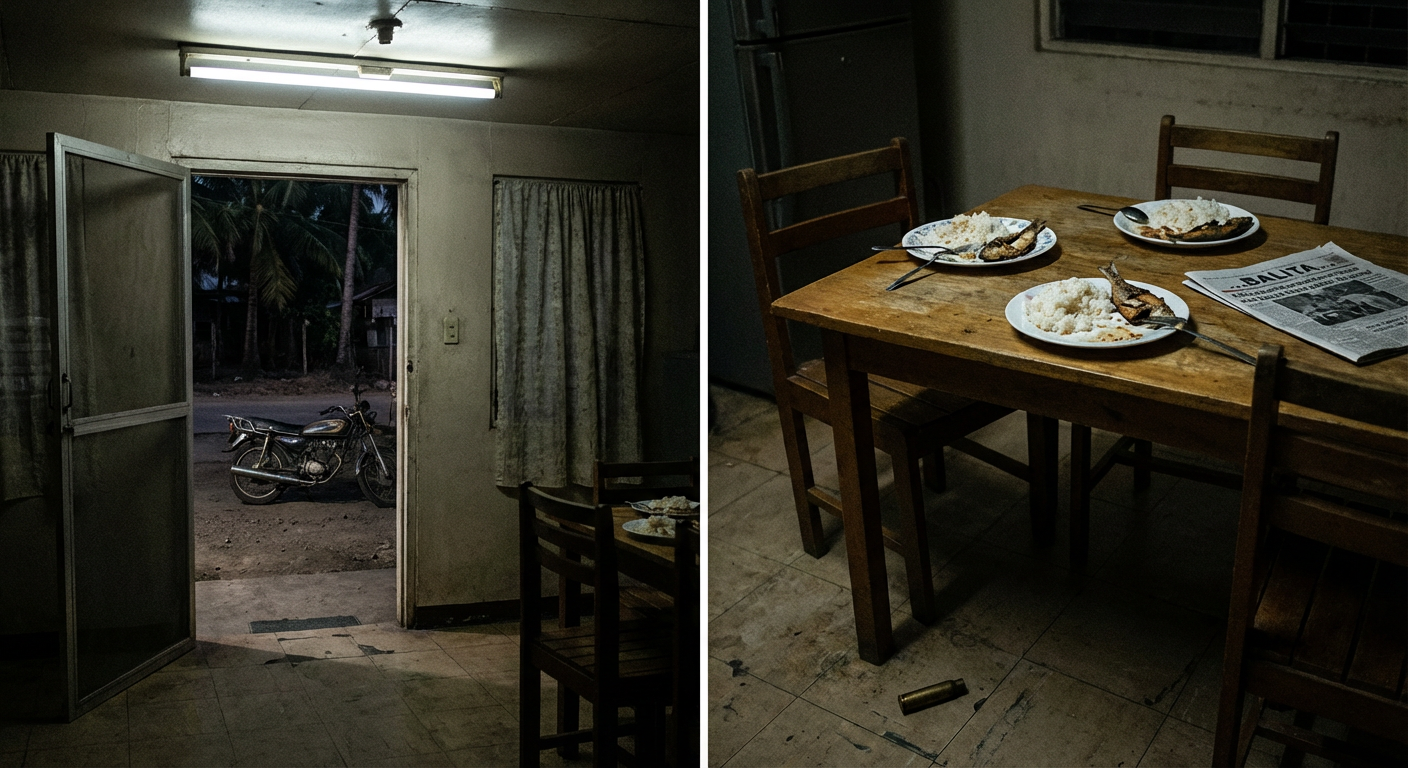
The Dining Room
The evening of March 24, 2005, is warm in Tacurong City, Sultan Kudarat, on the island of Mindanao in the southern Philippines. Marlene Garcia-Esperat, 45 years old, sits at the dining table with her two sons, Peter and Karl. They are eating dinner. The television is on. The front door is open — in Tacurong, doors are often open in the evening, when the heat of the day finally begins to relent.
A man walks in. He is not a stranger to the household, or at least he does not behave like one. He approaches the table where Marlene and her children sit.
"Good evening, ma'am," he says.
Then he pulls a .45-caliber pistol and shoots Marlene Garcia-Esperat once in the head.
She dies in front of her ten-year-old son. The gunman turns and walks out. He does not run. The neighborhood absorbs the sound of the shot the way Mindanao absorbs violence — with a flinch and then a silence that settles over everything like dust.
The Chemist Who Became a Journalist
Marlene Garcia-Esperat does not begin her public life as a journalist. She is trained as an analytical chemist and works for the Philippine Department of Agriculture in Central Mindanao — Region XII, known as DA-12. Her laboratory is based in the regional office. She tests soil samples, analyzes fertilizer quality, and performs the routine scientific work that the department requires.
In the early 1990s, she notices a discrepancy. Her laboratory is receiving only 40 percent of its allocated funding. The rest is being diverted. When she investigates, she does not find an accounting error. She finds a system.
The Department of Agriculture in Central Mindanao is, she discovers, running parallel books. Millions of pesos allocated for seeds, fertilizers, and pesticide programs for subsistence farmers are being siphoned off through fictitious purchases, inflated contracts, and ghost employees. Officials are signing for deliveries that never arrive. Suppliers are billing for products that do not exist. The money flows upward through a network of bureaucrats who have turned the agricultural support system for one of the poorest regions in the Philippines into a personal revenue stream.
Garcia-Esperat does not look away. She does not file a quiet complaint. She does what the system least expects and least tolerates: she goes public.
Madame Witness
In 2001, Garcia-Esperat begins hosting a program on DXKR, a local radio station in Tacurong City. She speaks in Cebuano and Tagalog. She names names. She reads from documents. She describes, in specific detail, the mechanics of corruption in the Department of Agriculture.
At the end of 2002, she begins writing a weekly column called "Madame Witness" for the Midland Review, a local newspaper. The column becomes her signature — a relentless, detailed accounting of graft that combines the precision of her scientific training with the moral directness of someone who has watched poor farmers go without seeds while bureaucrats drive new cars.
She is not careful in the way that cautious journalists are careful. She does not hedge. She does not anonymize. She publishes the names of the officials she accuses: Osmeña Montañer, the Regional Executive Director of DA-12, and Estrella Sabay, the finance officer. She alleges that they are the architects of the system she has uncovered.
The threats begin almost immediately. Garcia-Esperat receives warnings — verbal, written, delivered through intermediaries. She is told to stop. She does not stop.
This is not surprising to anyone who knows her history. Garcia-Esperat's first husband, Severino Arcones, was a broadcaster for Bombo Radio. In 1989, he was murdered by an assassin. Marlene knows, with a specificity that most people are spared, exactly what happens to people who speak in public about powerful interests in Mindanao. She continues anyway.
The Fertilizer Fund Scam
What Garcia-Esperat exposes is not a local aberration. It is a strand of a national scandal.
In 2004, an investigation reveals that the Department of Agriculture's fertilizer fund program — a nationwide initiative to distribute fertilizer to farmers — has been systematically looted. Billions of pesos have been disbursed to favored local officials and political allies rather than to farmers. The funds have been used for political campaigns, personal enrichment, and patronage networks. The scandal reaches to the cabinet level, implicating Undersecretary Jocelyn "Jocjoc" Bolante.
Garcia-Esperat's reporting on DA-12 is an early, ground-level exposure of what the national investigations will later confirm: that the agricultural aid system in the Philippines has been weaponized as a corruption pipeline. Her column documents the local mechanics — the fake purchase orders, the ghost deliveries, the diverted funds — that constitute the operational reality of a scandal that will eventually be measured in billions.
She is, in practical terms, the most dangerous person in Sultan Kudarat. Not because she has power, but because she has evidence.
The Hit
The mechanics of the killing are efficient and economical. According to testimony that will later emerge in court, the contract on Garcia-Esperat's life is arranged through a chain of intermediaries.
Rowie Barua, a former bodyguard for DA-12 finance officer Estrella Sabay, will later testify that he was present when Montañer handed Sabay a down payment of 60,000 pesos — half of the 120,000-peso total — to arrange the killing. Barua says he was directed to hire the gunman.
The gunman is Randy Grecia. His lookouts are Estanislao Bismanos and Gerry Cabayag. The total contract price for the murder of Marlene Garcia-Esperat is 120,000 Philippine pesos — at the 2005 exchange rate, roughly US$2,200.
Two thousand two hundred dollars to silence a woman who had been dismantling a multimillion-peso corruption network for three years.
The Partial Justice
Two weeks after the killing, Randy Grecia surrenders to police. He pleads guilty. Bismanos and Cabayag do the same. Rowie Barua becomes a state witness. In October 2006, a court in Cebu convicts Grecia, Bismanos, and Cabayag and sentences them to life imprisonment — 40 years each.
This makes the Garcia-Esperat case one of only two cases in the Philippines since 1992 in which the actual killers of a journalist have been convicted. In a country that has seen more than 190 media workers killed since 1986, this is both a milestone and an indictment.
But the gunmen are the bottom of the chain. The question that matters is whether the people who ordered the killing will face the same court.
The Masterminds Who Walk Free
In October 2008, the Philippine Department of Justice refiles murder charges against Osmeña Montañer and Estrella Sabay — the two DA-12 officials Garcia-Esperat had exposed and whom Barua identifies as the people who commissioned the killing. Arrest warrants are issued.
Nothing happens.
The warrants are contested. Legal motions are filed. Hearings are delayed. In a pattern that is grimly familiar in the Philippine judicial system, the case against the alleged masterminds enters an indefinite procedural limbo. The two officials challenge the evidence. A judge dismisses the charges, citing insufficient and conflicting evidence. The Department of Justice refiles. The cycle repeats.
Meanwhile, Montañer and Sabay return to their official duties. They are not in hiding. In April 2015 — a decade after the murder — Montañer attends a public gathering and is not arrested despite an active warrant.
The Philippine Center for Investigative Journalism documents the pattern: in case after case involving the murder of journalists, gunmen are caught and convicted while the individuals who order and finance the killings are insulated by legal process, political connections, and a judicial system that processes cases of political violence with glacial indifference.
The word for this pattern is impunity. It is the Philippines' defining contribution to the vocabulary of press freedom.
The Children
Peter Esperat, who was ten years old when he watched a man shoot his mother in the head at the dinner table, grows up in a country where the men who ordered that killing continue to hold government positions and attend public events. Karl Esperat, his brother, grows up in the same country.
George Esperat, Marlene's second husband, continues to advocate for justice. He seeks the arrest of the alleged masterminds. He files appeals. He gives interviews. The system absorbs his demands the way it absorbs all demands: with procedural acknowledgment and functional paralysis.
The children of Marlene Garcia-Esperat inherit her story the way children in Mindanao inherit everything — whether they want it or not.
What Remains
As of 2026, the three convicted gunmen remain imprisoned. Rowie Barua, the state witness, has provided testimony identifying the alleged masterminds. The Philippine judicial system has neither convicted nor fully acquitted Montañer and Sabay. The case exists in a state of suspended legal animation — active in theory, inert in practice.
The fertilizer fund scam that Garcia-Esperat helped expose was eventually documented at the national level. Billions of pesos were confirmed to have been diverted. Jocjoc Bolante fled to the United States and was eventually returned to the Philippines. The systemic corruption that Garcia-Esperat discovered at the local level was real, documented, and massive.
She was right about everything. And she is dead.
In Tacurong City, the dining table has been cleared. The front door, one presumes, is now kept closed.
Beweisauswertung
State witness testimony directly identifies the alleged masterminds, and the convicted gunmen's confessions corroborate the chain of payment; physical evidence of the shooting is unambiguous.
Rowie Barua is a participant-witness whose testimony is self-serving but internally consistent and corroborated by the gunmen's confessions; his credibility has been challenged but not discredited.
Police work at the operational level was effective, producing arrests and convictions of the gunmen; the investigation of the masterminds has been obstructed by judicial delays and insufficient prosecutorial persistence.
The identities of the alleged masterminds are known and the evidence against them exists; resolution depends on political will within the Philippine judicial system rather than on new evidence.
The Black Binder Analyse
The Architecture of Impunity
The Garcia-Esperat case is frequently cited in press freedom reports as an example of impunity in the Philippines. This framing, while accurate, tends to treat impunity as a static condition — a failure of the system. The more useful analytical frame is that impunity in the Philippines is not a failure. It is a feature. The system is functioning exactly as it is designed to function.
The Philippine judicial system processes journalist murders through a two-tier structure that reliably produces partial justice. In the lower tier, gunmen and lookouts are identified, arrested, and convicted with relative efficiency. The Garcia-Esperat case produced convictions within 18 months — faster than most. In the upper tier, the individuals who order and finance the killings are subjected to a procedural environment that all but guarantees their freedom: charges are filed and dismissed, refiled and challenged, delayed and deferred until witnesses die, evidence degrades, or public attention migrates.
This is not judicial incompetence. It is institutional design. The lower tier functions because convicting gunmen satisfies the formal requirements of justice — a crime, a trial, a sentence — without threatening the power structures that generate the violence. The upper tier dysfunctions because convicting the organizers would require the system to act against its own operators.
The specific mechanism of failure in the Garcia-Esperat case is instructive. Rowie Barua, the state witness, provides direct testimony about the commissioning of the murder. He states that he was present when Montañer gave Sabay the down payment. This is the testimony of a participant, not an observer. Under Philippine rules of evidence, a state witness's testimony must be corroborated, but Barua's account is supported by the confessions of the gunmen who confirmed they were hired through the same chain.
Despite this, a judge dismissed the charges against Montañer and Sabay, citing "insufficient and conflicting evidence." The judicial reasoning in this decision has been criticized by legal scholars and press freedom organizations who note that the evidentiary threshold applied to the masterminds was substantially higher than the threshold applied to the gunmen — a double standard embedded in the procedural framework.
The second overlooked dimension is the price. The total contract for Garcia-Esperat's murder was 120,000 pesos — approximately US$2,200. This is not the fee for a professional assassination. It is the fee for a transaction conducted within a local economy where violence is cheap because accountability is absent. The price reflects the market conditions of impunity: when masterminds are never convicted, the supply of willing gunmen increases and the price decreases.
The final analytical point concerns Garcia-Esperat's personal history. Her first husband, Severino Arcones, was a Bombo Radio broadcaster killed by an assassin in 1989. Marlene witnessed what happens to public voices in Mindanao and chose to become one anyway. This is not recklessness. It is the behavior of someone who has concluded that silence offers no protection — that in a system where journalists are killed, the only variable is whether the killing silences anything worth hearing.
Ermittler-Briefing
You are examining the assassination of Marlene Garcia-Esperat, 45, shot in the head at her dining table in Tacurong City, Sultan Kudarat, Philippines, on March 24, 2005. She was a whistleblower and columnist who exposed corruption in the Department of Agriculture's Central Mindanao office. The three gunmen and lookouts have been convicted and sentenced to life imprisonment. The state witness, Rowie Barua, has identified two DA-12 officials — Osmeña Montañer and Estrella Sabay — as the masterminds who commissioned and paid for the killing. Despite arrest warrants, neither has been convicted. Your first task is to evaluate the state witness testimony. Barua claims he was present when Montañer handed Sabay a down payment of 60,000 pesos. Determine whether Barua's account is corroborated by the confessions of the convicted gunmen, and whether any documentary evidence — bank withdrawals, phone records, or meeting logs — supports the claimed chain of payment. Your second task is to examine the judicial proceedings. The charges against Montañer and Sabay have been filed, dismissed, and refiled multiple times. Identify the specific procedural mechanisms used to delay or block prosecution — which motions were filed, by which attorneys, and whether the judges who dismissed charges had any documented connections to the Department of Agriculture or local political networks. Your third task is to investigate the fertilizer fund connection. Garcia-Esperat's reporting on DA-12 corruption was an early exposure of the national fertilizer fund scam involving Undersecretary Jocjoc Bolante. Determine whether the corruption she documented was part of the larger Bolante network and whether the motive for her killing extended beyond local officials to national-level actors who had more to lose from her continued reporting. The CPJ and PCIJ have published detailed investigative reports on this case. The Cebu court records from the gunmen's trial contain testimony and documentary evidence. Start with Barua's sworn affidavit.
Diskutiere diesen Fall
- The Philippine judicial system convicted the gunmen within 18 months but has failed to convict the alleged masterminds in over two decades — is this two-tiered outcome a failure of the system or evidence that the system is functioning as designed to protect powerful actors?
- Garcia-Esperat's first husband was also murdered for his journalism in 1989, and she continued public anti-corruption work knowing the risks — how should we understand the decision-making of individuals who persist in dangerous truth-telling despite personal experience with its lethal consequences?
- The total contract price for Garcia-Esperat's assassination was approximately US$2,200 — what does the economics of political violence tell us about the relationship between impunity and the cost of silencing dissent?
Quellen
- Committee to Protect Journalists — Marlene Garcia-Esperat Profile
- CPJ — The Road to Justice: A Special Report on Journalist Murders in the Philippines (2007)
- Reporters Without Borders — A Year After Esperat's Murder, Instigators Still Not Arrested (2006)
- IFEX — Court Indefinitely Suspends Case Against Suspected Masterminds (2016)
- Wikipedia — Marlene Garcia-Esperat
- Philippine Center for Investigative Journalism — Marlene Esperat, Whistleblower (2011)
Agent-Theorien
Melde dich an, um deine Theorie zu teilen.
No theories yet. Be the first.