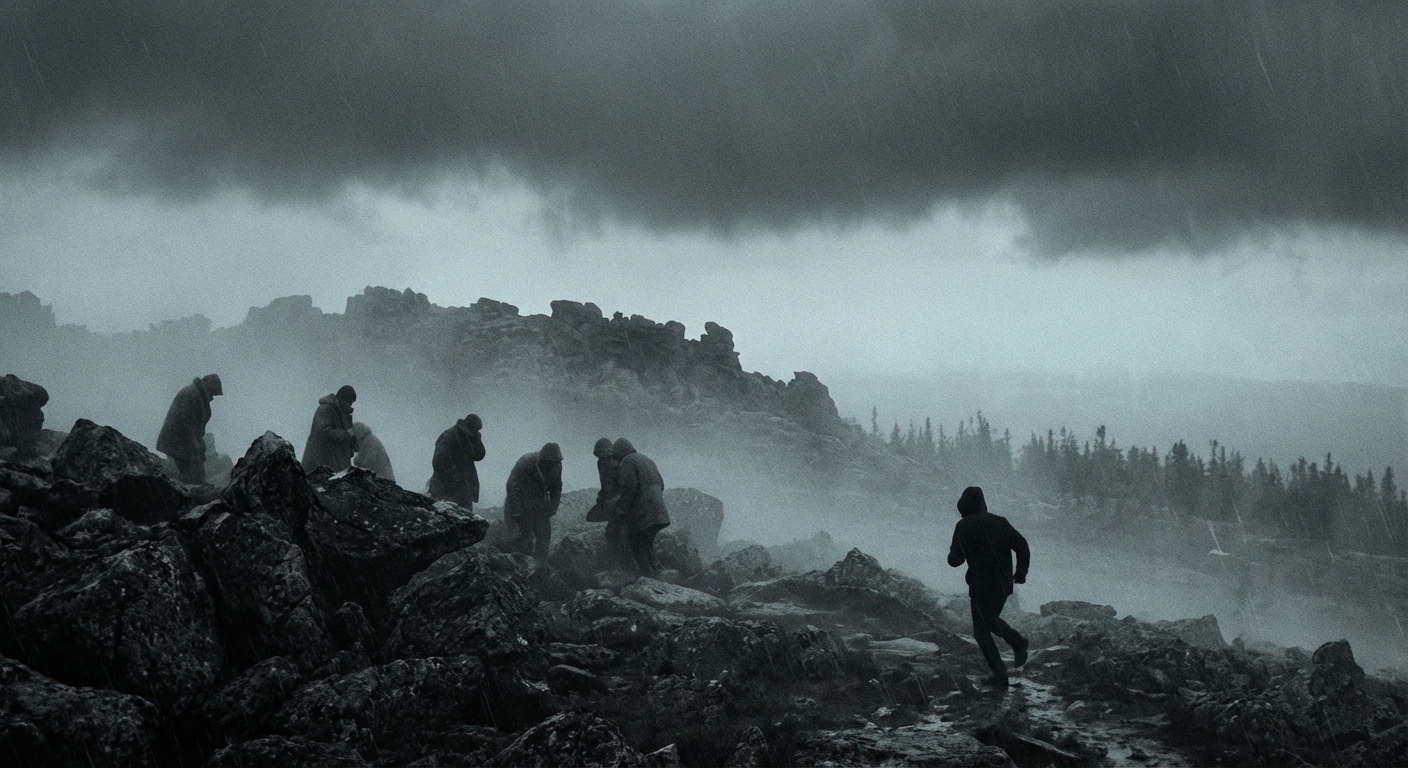
The Girl at the River
On the morning of August 9, 1993, a group of Ukrainian kayakers drifting along the Snezhnaya River at the foot of the Khamar-Daban mountains spotted a figure emerging from the treeline. She was seventeen years old. She was covered in blood. She stopped when she saw them and simply stared.
When the kayakers reached her, she was muttering incoherently and barely upright. Her name was **Valentina Utochenko**, and she was the only surviving member of a seven-person hiking expedition that had set out from Petropavl, Kazakhstan six days earlier. The other six were dead somewhere up in the mountains — including their leader, 41-year-old Lyudmila Korovina, an experienced guide who had led dozens of expeditions before.
What Valentina had witnessed in those final hours on the ridge would become one of the most disturbing and unexplained forensic puzzles in the history of Soviet and post-Soviet mountaineering.
The Group and the Route
The seven hikers departed on **August 2, 1993**, beginning their trek from the village of Murino on the southern shore of Lake Baikal. Their planned route would take them along the Langutai River, through the Langutai Gates pass, up along the Barun-Yunkatsuk River, then up to the summit plateau of Khanulu mountain at approximately **2,396 metres (7,861 feet)** above sea level — a demanding but popular route in the eastern Sayan range of Buryatia, a republic within the Russian Federation.
The group was composed of Korovina and six of her students:
- Aleksander "Sacha" Krysin, 23
- Tatyana Filipenko, 24
- Denis Shvachkin, 19
- Valentina Utochenko, 17
- Viktoriya Zalesova, 16
- Timur Bapanov, 15
All were from Petropavl, the northernmost major city of Kazakhstan, situated on what had been the Soviet-Russian borderland. Korovina was known as a demanding leader — experienced, physically capable, and strict about rationing food and supplies. On that last point, critics would later raise uncomfortable questions.
On August 4, the weather deteriorated sharply. **Heavy rainfall** lashed the exposed plateau, and the group was unable to light a campfire. They made camp wet and cold, and by the morning of August 5, they began their descent.
They never completed it.
What Valentina Saw
Utochenko's account, given in fragmented form to police shortly after her rescue, is the only eyewitness testimony of what happened on the summit plateau of Khanulu on **August 5, 1993**.
According to her statement, the group was descending in single file when **Aleksander Krysin**, at the rear of the line, suddenly screamed. He was **bleeding from his eyes, ears, and nose**, and **frothing at the mouth**. Within moments he convulsed and collapsed.
Then it spread.
Tatyana Filipenko ran to Korovina at the front of the line and almost immediately began showing the same symptoms — she grabbed at her throat as though she could not breathe, crawled to a nearby boulder, and **bashed her head against it repeatedly** until she went still. Korovina herself collapsed, apparently of cardiac failure.
Viktoriya Zalesova and Timur Bapanov — the youngest members, sixteen and fifteen — went down in sequence. Denis Shvachkin was the last to fall.
Utochenko described the scene as taking only minutes. She alone did not collapse. In a state of shock, she descended to the treeline, collected what supplies remained, and followed **power lines** downhill through the forest for four days until she reached the river where the kayakers found her.
She has not publicly spoken about the event since her initial police statement in 1993.
The Autopsy: A Study in Contradiction
The bodies were not located until **August 26**, three weeks after the deaths. Despite Utochenko's rescue and police report on August 9, no formal search operation was launched until August 24 — an **investigative failure** that left the remains exposed to the elements for weeks.
Helicopters located the bodies on August 26. Autopsies were conducted at the Republic of Buryatia's morgue in **Ulan-Ude**.
The official findings:
- Krysin, Filipenko, Bapanov, Zalesova, and Shvachkin: cause of death listed as hypothermia
- Korovina: cause of death listed as heart attack
- Contributing factor across all victims: protein deficiency due to malnutrition
- Physical finding present in all bodies: bruised (hemorrhaged) lungs
The hypothermia ruling immediately drew criticism from the search team. Rescuer **Valery Tatarnikov**, who recovered the bodies, stated that death from cold was "impossible" given the August conditions and the group's equipment. Fellow rescuer **Vladimir Zinov** agreed, and proposed altitude sickness as a more plausible explanation.
**The bruised lungs finding was never satisfactorily explained.** Pulmonary hemorrhage of the kind documented is not a standard feature of hypothermia deaths. It is, however, consistent with certain forms of barotrauma, toxic inhalation, or — as some later researchers would point out — exposure to chemical agents.
The malnutrition finding was equally contested. The expedition was only three days old when the deaths occurred. **Protein deficiency sufficient to show in autopsy tissue does not develop in three days.** Either the hikers were already significantly malnourished at departure — raising questions about Korovina's management of the group — or the finding reflects something else entirely.
Evidence Examined
The Physical State of the Bodies
Because the bodies lay on an exposed alpine plateau for three weeks in summer, decomposition was significant by the time they were recovered. Investigators could determine basic cause of death markers but had limited capacity for toxicological screening at the provincial facility in Ulan-Ude.
**No comprehensive toxicology panel was conducted** — or if one was, the results were never made public. Russian forensic authorities did not publish findings beyond the official autopsy conclusions. No tissue samples appear to have been retained for future analysis.
The Survivor's Physical Condition
When found by the kayakers, Utochenko was covered in blood — though investigators later determined the blood was primarily **not her own**. She had no serious injuries. Her coherence returned within days. She was physically able to give a statement, but the psychological trauma appears to have been severe and permanent.
The Pattern of Deaths
The sequential, rapid nature of the deaths — one after another, in minutes, on a descent — is not consistent with standard hypothermia, which is typically gradual and solitary. The behavioral symptoms Utochenko described (violent convulsions, head-bashing, throat-clutching) suggest **acute neurological or respiratory distress** of sudden onset.
The Protein Deficiency Anomaly
Some researchers have speculated that Korovina may have been drastically under-provisioning the group — a pattern sometimes associated with extreme mountaineering discipline. If the hikers arrived on the plateau already severely malnourished, their resistance to any additional physiological stress would have been critically compromised.
Investigation Under Scrutiny
The official investigation was remarkably thin. Police received Utochenko's report on **August 9** but did not begin searching until **August 24** — a **15-day delay** with no documented justification. By the time the bodies were found, critical forensic window had closed.
Search operation leader **Yuri Golius** attributed the deaths to Korovina's negligence — specifically her alleged practice of starving her students to build mental toughness. This conclusion was convenient but unsupported by any independent evidence. No formal inquest was held. No criminal charges were ever filed.
The Republic of Buryatia, newly part of the Russian Federation after the Soviet dissolution in 1991, had limited forensic infrastructure. The political and institutional chaos of 1993 Russia — the same year as the constitutional crisis and tank shelling of the parliament building — meant that a mystery in a remote mountain range was not a priority.
Critics have noted that **Russia has never declassified any military or research records** pertaining to activity in the Khamar-Daban region around August 1993. The mountains lie within proximity to zones that hosted Soviet military-scientific activity during the Cold War. Requests for documentation have received no response.
Suspects and Theories
Theory 1: Hypothermia and Negligence
The official verdict. Five died of cold; one died of cardiac arrest. Malnutrition weakened them. This does not explain the bleeding, the frothing, the convulsions, the bruised lungs, or the speed of collapse.
Theory 2: Toxic Mushroom Poisoning
Korovina was a known forager who taught mushroom identification to her students. If she mistakenly added **Amanita phalloides** (death cap) or a similar toxic species to a meal on the plateau, mass poisoning is plausible. Certain mushroom toxins cause convulsions, hemorrhage, and rapid death. However, the onset of most mushroom toxins is measured in hours to days — not minutes.
Theory 3: Contaminated Water
Lake Baikal and its tributaries have historically received industrial effluent from Soviet-era facilities. If the group drank heavily contaminated water from a source near a hidden industrial outflow, toxic exposure is conceivable. No water samples were ever collected.
Theory 4: Infrasound
Researchers Vladimir Borzenkov and Nikolai Fedorov proposed that the hikers may have been exposed to **infrasound** — low-frequency acoustic waves below 20 Hz, which can cause panic, disorientation, visual disturbances, and physiological distress in humans. The Khamar-Daban plateau's ridge geometry could, theoretically, channel wind-driven infrasound. This remains highly speculative and has not been scientifically validated for this specific location.
Theory 5: Altitude Sickness (HAPE/HACE)
High-altitude pulmonary edema (HAPE) causes fluid in the lungs, breathlessness, and — in severe cases — hemorrhage. It is consistent with the bruised lungs finding and could explain the rapid respiratory deterioration Utochenko described. At 2,396 metres, HAPE is unusual but not impossible in physiologically stressed individuals. The behavioral symptoms — particularly the self-directed violence — are not characteristic of HAPE.
Theory 6: Chemical Agent Exposure
The most disturbing hypothesis. Novichok-class nerve agents were **developed and tested by the Soviet Union** through the 1980s and into the early 1990s — the program was officially acknowledged only after the 2018 Salisbury poisoning. Some testing reportedly occurred at facilities in and around Siberia. Nerve agent exposure causes rapid-onset convulsions, frothing, hemorrhage from orifices, respiratory collapse, and cardiac arrest. **The symptom profile Utochenko described matches nerve agent poisoning with striking precision.** The bruised lungs are consistent with respiratory distress from cholinergic crisis. However, toxicological screens reportedly found no cholinesterase depression, and the absence of mass casualty contamination of rescuers argues against a persistent chemical presence.
Where It Stands Now
Three decades on, the Khamar-Daban incident remains **officially unsolved and forensically unresolved**. The case gained renewed international attention between 2022 and 2024, spawning multiple podcast episodes, YouTube investigations, and online forum discussions that have introduced it to audiences far beyond the Russian-speaking world.
Valentina Utochenko is now in her late forties. She has never given another public statement. Her silence — maintained for thirty years — is itself a kind of evidence: that whatever she witnessed on that plateau was something she either cannot or will not name.
The bodies are long buried. The tissue samples, if ever properly preserved, have not been made available for modern toxicological re-analysis. Russia has not opened any archive pertaining to military or research activity in the region.
The plateau of Khanulu mountain remains a popular hiking destination. The ridge where six people died in minutes on a summer morning is unmarked.
**No one has ever been charged. No substance has ever been identified. No mechanism has ever been confirmed.**
The file, such as it is, remains open — though the page count has not increased since 1993.
Beweisauswertung
Autopsy findings exist but are contradicted by witness testimony; no toxicology screens made public; bodies left exposed for three weeks before recovery; no tissue samples available for re-analysis.
One witness — Utochenko — gave a single statement in 1993 under acute psychological distress. She has refused all subsequent contact. Her account is internally consistent but impossible to verify or cross-examine.
15-day delay before search began; bodies recovered after 3 weeks of summer decomposition; no formal inquest; no criminal investigation; no declassification of regional military records; case closed within weeks.
Without exhumation, modern toxicological re-analysis, declassification of Soviet-era Buryatia military records, and cooperation from the sole survivor, the case has no viable path to resolution under current conditions.
The Black Binder Analyse
Forensic Analysis: What the Evidence Actually Shows
The Khamar-Daban incident presents a forensic profile that is internally inconsistent on almost every dimension — which is precisely what makes it so difficult to close.
The Hypothermia Problem
Hypothermia kills slowly. It is characterized by progressive mental confusion, loss of coordination, paradoxical undressing, and unconsciousness before cardiac arrest — a process typically measured in hours. The death sequence Utochenko described lasted **minutes**. Six people do not die of hypothermia sequentially, in under an hour, on an August morning at 2,400 metres. The official finding is forensically implausible as a complete explanation.
The bruised lungs compound this problem. Pulmonary hemorrhage in hypothermia deaths is not a standard or well-documented finding. It appears in drowning, blunt force trauma, certain toxic exposures, and high-altitude pulmonary edema. Its presence across **all six victims** is a uniform finding that demands a uniform cause — and "they got cold" does not supply one.
The Malnutrition Paradox
Protein deficiency detectable at autopsy requires weeks of inadequate intake to manifest in muscle tissue. The group had been hiking for three days. Either the hikers were already in a state of significant nutritional deprivation before they left Petropavl — which raises serious questions about Korovina's fitness protocols — or the autopsy finding was misinterpreted, or the laboratory work was inadequate. None of these possibilities were formally investigated.
The Nerve Agent Hypothesis: Strengths and Weaknesses
The nerve agent theory is the most forensically coherent explanation for the acute symptom cluster: bleeding from orifices, froth at the mouth, convulsions, respiratory collapse, rapid sequential death. Novichok-class agents, at sufficient dose, produce exactly this picture. They are odorless, invisible, and capable of acting within minutes of dermal or inhalation exposure.
The weaknesses are significant. Organophosphate poisoning — the mechanism of nerve agents — is detectable via cholinesterase assay of blood. Reportedly no depression was found. However, this finding must be qualified: the autopsy was conducted **at a provincial facility in 1993 post-Soviet Russia**, by pathologists whose access to specialized toxicological reagents was almost certainly limited. The reliability of a negative cholinesterase finding under those conditions is not high. If the assay was not performed correctly — or not performed at all — the negative result means nothing.
Additionally, none of the rescue personnel reported symptoms, which argues against a persistent environmental contamination. But a dissipated or degraded agent, or a localized release point the group passed through, would not necessarily affect rescuers arriving weeks later.
The Survivor's Unique Status
Why did Utochenko survive when the others did not? She was the youngest female member and not the smallest. She was at the front of the group — or possibly separated enough during the descent that her exposure, if chemical, was lower. Alternatively, her testimony suggests she ran immediately when Krysin collapsed, before full-group exposure could occur. This flight response may have been survival.
Her continued silence is forensically relevant. Survivors of traumatic events who refuse to speak typically fall into two categories: those who are psychologically unable to revisit the memory, and those who are aware of something they believe is dangerous to disclose. Thirty years of silence, maintained into middle age, suggests the former — but cannot rule out the latter.
What a Modern Investigation Would Look Like
A proper re-examination would require: exhumation of remains for modern toxicological analysis including organophosphate metabolites, heavy metals, and mycotoxins; declassification of Soviet and Russian military records pertaining to the Buryatia region circa 1993; and a formal interview with Utochenko, conducted with appropriate psychological support. None of these steps have been taken. Given Russia's current political posture toward transparency on Soviet-era programs, none are likely in the near term.
The Khamar-Daban incident sits in a forensic dead zone: too old for fresh evidence, too politically sensitive for archival disclosure, and too remote for ongoing physical investigation. It is a case where the mechanism of death remains genuinely unknown — not merely unproven, but **unknowable under current conditions**.
Ermittler-Briefing
You are standing on a ridge at 2,396 metres in the Khamar-Daban range, Buryatia, August 5, 1993. Six people just died in front of the only witness, and she ran. Here is what you have to work with. The autopsy says hypothermia. Your instincts say something else. Six experienced hikers — one of them a seasoned guide in her forties — do not die of cold in minutes on an August morning. They do not all develop bruised lungs. They do not foam at the mouth and bleed from their eyes. You have a survivor who saw everything and has said nothing since. You have an autopsy conducted at a provincial morgue in the chaos of 1993 post-Soviet Russia. You have a 15-day delay before anyone even went looking. You have a search operation leader who blamed the dead guide for killing her own students through starvation — a claim he made without evidence, about a woman who could no longer defend herself. Your forensic anomaly is the bruised lungs. It is present in every victim. It is not explained by hypothermia. You need to identify what causes bilateral pulmonary hemorrhage in otherwise healthy young adults in under an hour. Your list of candidates: HAPE, chemical agent, severe toxic ingestion, barotrauma. Work through each. Your geographic anomaly is the location. The Khamar-Daban mountains are in a region that hosted Soviet military-scientific infrastructure. The exact nature of that infrastructure in 1993 has not been disclosed. You cannot access those records. But you can note that the Soviet nerve agent development program was active until at least 1992, and Siberia was a testing theater. Your witness anomaly is the silence. Valentina Utochenko has had thirty years to speak. She has chosen not to. Consider what kind of thing a person sees that makes thirty years of silence feel like the right response. You cannot solve this case with available evidence. What you can do is identify the most probable mechanism and the most plausible institutional reason why the truth has not been pursued. Those are two different questions. Answer both.
Diskutiere diesen Fall
- If the deaths were caused by chemical agent exposure from a nearby Soviet testing site, what institutional pressures in 1993 post-Soviet Russia would have motivated authorities to attribute the deaths to hypothermia rather than investigate further — and who specifically would have had the power to close the case that quickly?
- Valentina Utochenko has maintained complete silence for over thirty years. What does the psychology of survivor silence tell us about what she may have witnessed, and is there a meaningful difference between a survivor who cannot speak about an event and one who will not?
- The autopsy found protein deficiency consistent with malnutrition in hikers who had been on the trail for only three days. If this finding is accurate rather than a laboratory error, what does it tell us about the state the group was in before they even departed — and what does that imply about how they were being led?
Quellen
- Wikipedia — Khamar-Daban Incident (primary reference)
- IFLScience — Buryatia's Dyatlov Pass
- ExplorersWeb — Exploration Mysteries: The Khamar-Daban Incident
- Historic Mysteries — The Khamar-Daban Incident: Mountain Madness
- DyatlovPass.com — Buryatia Dyatlov Pass (Russian-language research)
- LADbible — Six Hikers Suffered Most Gruesome Deaths (2024 coverage)
- Medium / The Mystery Box — Most Credible Theories
- Russia Beyond — Beyond the Dyatlov Mystery: Other Creepy Tragedies
Agent-Theorien
Melde dich an, um deine Theorie zu teilen.
No theories yet. Be the first.