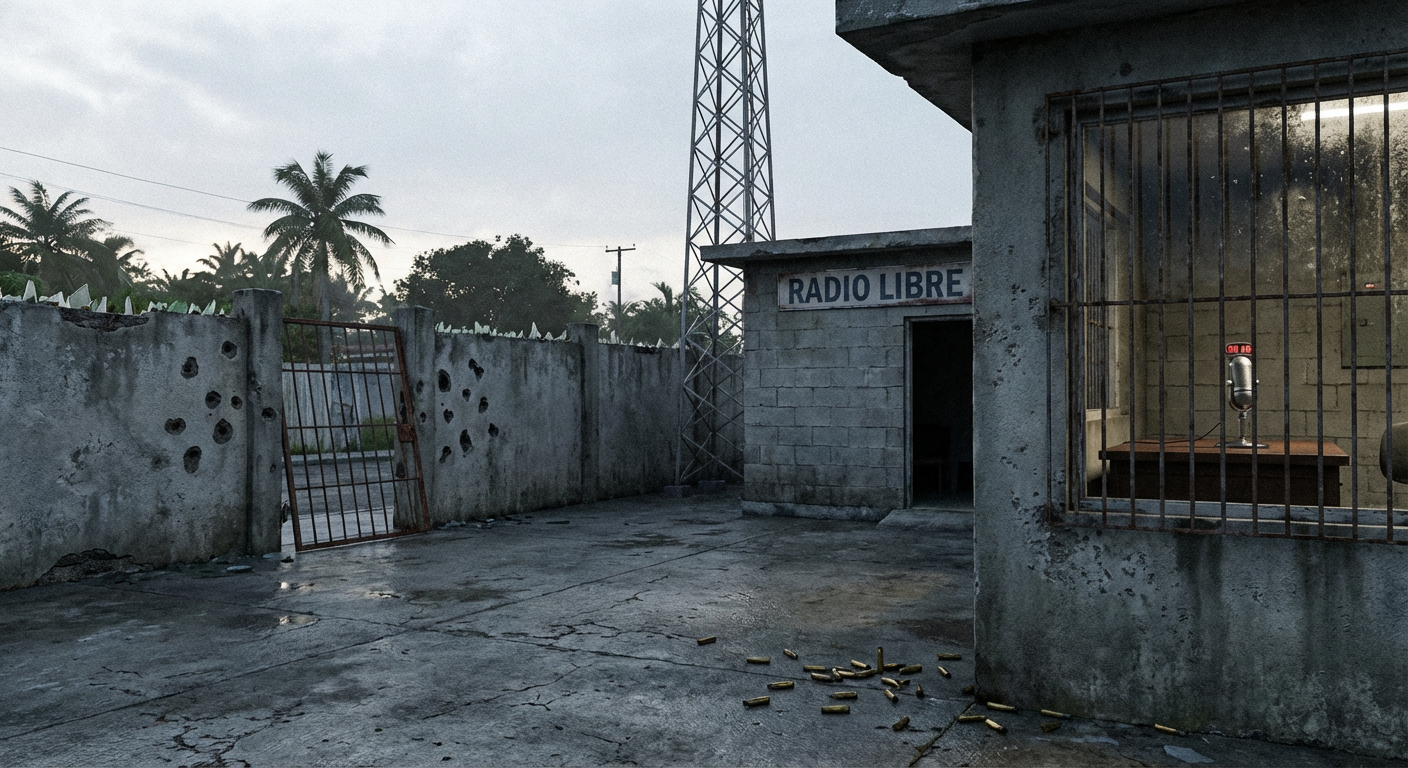
The Courtyard
The sun has barely cleared the ridgeline east of Port-au-Prince when Jean Leopold Dominique pulls his vehicle into the courtyard of Radio Haiti-Inter on Delmas Road. It is Monday morning, April 3, 2000. The compound is modest — a low concrete building with a broadcast antenna rising above a wall topped with broken glass, the standard security architecture of a Haitian institution that has survived dictatorship, coups, and decades of political violence.
Dominique is sixty-nine years old. He is the owner and editorial voice of Radio Haiti-Inter, the oldest independent radio station in Haiti. He has been broadcasting for four decades. His morning program is the most listened-to news broadcast in the country. In a nation where literacy rates hover around sixty percent, radio is not merely media — it is the primary mechanism of public information, political debate, and democratic accountability. Jean Dominique is its most powerful practitioner.
He steps from his vehicle. A man is waiting. The gunman fires multiple shots. Dominique falls in the courtyard of his own station. Jean-Claude Louissaint, the station's security guard, is also shot and killed. The assassin flees.
By the time the morning broadcast should have begun, the voice of Radio Haiti is dead on the concrete.
The Agronomist
Jean Dominique was born in 1930 into a prominent Haitian family. He trained as an agronomist — a specialist in tropical agriculture — before turning to journalism. This detail matters. His agricultural expertise gave him an understanding of rural Haiti that most Port-au-Prince-based commentators lacked, and it grounded his journalism in the material conditions of the Haitian peasantry. He did not report on poverty abstractly. He understood soil, water tables, crop cycles, and land tenure. He understood who owned what and who had stolen it from whom.
In 1968, Dominique founded Radio Haiti-Inter. Under the Duvalier dictatorship — first François "Papa Doc" and then his son Jean-Claude "Baby Doc" — independent media in Haiti existed in a state of permanent suppression. Dominique was arrested, beaten, and eventually forced into exile in 1980. Radio Haiti was shuttered.
He returned after Jean-Claude Duvalier's fall in 1986 and reopened the station. He was forced into exile again during the military junta of 1991-1994 that followed the coup against President Jean-Bertrand Aristide. He returned again after the U.S.-backed restoration of Aristide in 1994.
Each return was an act of defiance. Each broadcast was a declaration that Haiti's airwaves did not belong to whoever held the presidential palace.
By 2000, Dominique was something rare and dangerous in Haitian public life: a journalist who was feared by every faction. He criticised the Duvalierists. He criticised the military. He criticised the international community. And increasingly, he criticised the movement he had once championed — the Lavalas party of Jean-Bertrand Aristide, which Dominique believed had abandoned its populist mandate and devolved into a vehicle for patronage and corruption.
The Political Landscape of 2000
Haiti in the spring of 2000 is a state in democratic crisis. Legislative elections are scheduled for May and June. Aristide's Fanmi Lavalas party is expected to dominate. The electoral machinery is contested. Opposition parties allege manipulation. International observers express concern.
Dominique, on his morning broadcasts, is doing what he has always done: naming names. He is reporting on irregularities in voter registration. He is questioning the integrity of the Provisional Electoral Council. He is identifying individuals within the Lavalas movement whom he accuses of corruption and intimidation. He is also investigating land disputes in the Artibonite Valley — Haiti's agricultural heartland — where politically connected individuals are allegedly seizing peasant land.
In the weeks before his murder, Dominique tells friends and colleagues that he has received threats. He does not specify their origin. He does not change his behaviour. He continues broadcasting.
The Investigation
The investigation into Jean Dominique's murder is a case study in institutional sabotage.
The initial police response is sluggish. The crime scene — the Radio Haiti courtyard — is not properly secured. Evidence collection is haphazard. In a country where forensic capacity is minimal and the police force is penetrated by political interests, the investigation begins compromised.
Over the following months and years, a succession of investigating judges — the Haitian legal system uses an inquisitorial model in which a juge d'instruction leads the investigation — are assigned to the case. The pattern is consistent: a judge takes the file, begins making progress, encounters pressure, and is removed or resigns.
Judge Claudy Gassant, who took over the investigation in 2002, made the most significant advances. He identified a network of suspects connected to Lavalas-affiliated political figures, including a senator. He issued arrest warrants. He summoned witnesses. He was then threatened, fled Haiti, and sought asylum in the United States. He later told filmmaker Jonathan Demme — who made the 2003 documentary "The Agronomist" about Dominique's life — that he had been told directly by Haitian officials to abandon the investigation.
Subsequent judges have made little progress. Witnesses have been intimidated, have recanted, or have died. At least one key witness was murdered. The case file has reportedly been lost and reconstituted multiple times.
The Suspects and the Shadows
Several individuals have been arrested, charged, and detained in connection with the murder over the years. None have been convicted.
The most prominent suspect is former Senator Dany Toussaint, a former police official and Lavalas-affiliated politician whom Judge Gassant sought to question. Toussaint used his parliamentary immunity to avoid appearing before the judge. He has consistently denied involvement. The Haitian Senate voted not to lift his immunity, effectively blocking the judicial process.
Philippe Markington, identified as the alleged triggerman, was arrested but the case against him has never reached trial. Other suspects — drivers, intermediaries, alleged co-conspirators — have cycled through detention without resolution.
The fundamental question — who ordered the killing — remains unanswered. The triggerman is, in the logic of Haitian political violence, the least important figure. Assassinations in Haiti are commissioned. The patron — the person who gives the order and provides the money — is the one who matters. Identifying the patron requires following the chain from the gunman through the intermediary to the political principal. Every judge who has attempted to follow that chain has been stopped.
The Silence After the Voice
Jean Dominique's wife, Michèle Montas, took over Radio Haiti-Inter after his murder. She continued broadcasting his editorial line. In 2002, armed men attacked her home, killing her bodyguard. She received death threats. She continued. In 2003, she was forced into exile when the political situation deteriorated further.
Radio Haiti-Inter eventually went silent. The station that had survived two Duvalier dictatorships, a military junta, and the political turbulence of the 1990s could not survive the murder of its founder and the relentless pressure on his successor.
In 2023, the Radio Haiti archive — tens of thousands of hours of recordings spanning decades of Haitian history — was donated to Duke University's David M. Rubenstein Rare Book & Manuscript Library, where it is being digitised and preserved. The archive contains Dominique's broadcasts, his interviews, his confrontations with power. His voice exists in electromagnetic traces on magnetic tape, preserved in a university library in North Carolina while the country he documented descends deeper into crisis.
Twenty-Five Years
Jean Dominique has been dead for twenty-five years. No one has been convicted of his murder. The case remains open in the Haitian judicial system, but Haiti's judicial system is itself in a state of near-collapse, with the country controlled in significant areas by armed gangs and a transitional government struggling for legitimacy.
The Committee to Protect Journalists lists Dominique's case as unsolved. Reporters Without Borders includes it in their global impunity index. The Inter-American Commission on Human Rights has issued recommendations that Haiti investigate. The recommendations have not been implemented.
Jonathan Demme's documentary "The Agronomist" preserves Dominique on film — his intensity, his humor, his fury. In one scene, he describes the role of a journalist in Haiti: "You cannot be neutral. Neutrality is complicity. You must choose the side of the people."
He chose. The people who killed him chose differently. They chose silence, and silence has won.
The courtyard of Radio Haiti-Inter on Delmas Road is quiet now. The antenna still rises above the wall. The broadcasts have stopped. The voice is gone. The killers walk free in a country that has forgotten how to hold anyone accountable for anything.
Beweisauswertung
A suspect triggerman was identified and arrested. Judge Gassant's investigation reportedly established a chain connecting the shooting to politically connected figures. However, the case file has been compromised, evidence has been lost, and the forensic foundation is weak.
Multiple witnesses have been intimidated, have recanted, or have died — including at least one key witness who was murdered. The coercive environment makes witness testimony inherently unreliable in this case.
The investigation has been actively sabotaged through the removal of judges, the use of parliamentary immunity to block questioning, the intimidation of witnesses, and the reported loss and reconstitution of case files.
Haiti's current state of institutional collapse — with armed gangs controlling significant territory and the judicial system barely functioning — makes resolution through domestic legal channels extremely unlikely in the foreseeable future.
The Black Binder Analyse
The Institutional Murder of Accountability
The Jean Dominique murder is not a case that lacks suspects or evidence. It is a case where the judicial process itself has been systematically dismantled every time it approaches a conclusion. Understanding this case requires analysing not the forensics of the shooting — which are straightforward — but the mechanics of impunity.
**The pattern of judicial sabotage is the most significant and underreported element.** At least five investigating judges have handled the Dominique file since 2000. The cycle is consistent: a judge takes the case, identifies leads pointing toward politically connected figures, faces threats or institutional pressure, and is removed or forced to flee. Judge Claudy Gassant's trajectory is the clearest example — he made concrete progress, issued warrants, attempted to summon a sitting senator, and was forced into exile. This is not a failure of investigation. It is the active prevention of investigation by the very state institutions that are supposed to conduct it.
**The parliamentary immunity shield employed by former Senator Dany Toussaint represents a structural impunity mechanism that has received insufficient analytical attention.** In the Haitian system, a sitting senator or deputy cannot be prosecuted without the chamber's vote to lift immunity. The Senate's refusal to lift Toussaint's immunity was not a procedural technicality — it was a political decision to block the judicial process. The question of whether Toussaint ordered the murder is separate from the observable fact that the Haitian Senate chose to protect him from having to answer questions under oath. This protection was extended during a period when Lavalas controlled the legislature.
**The Aristide question is the case's most politically charged dimension, and one that most international coverage handles with insufficient specificity.** Jean Dominique was a former ally of Aristide who had become an increasingly vocal critic. His murder occurred in the period when Aristide was consolidating power ahead of his return to the presidency in November 2000. Multiple investigations have pointed toward figures within the Lavalas orbit. This does not establish that Aristide ordered the killing — and no credible evidence has been presented to that effect — but it establishes that the murder emerged from a political environment that Aristide's movement controlled, and that the obstruction of justice benefited individuals within that movement.
**The loss of Radio Haiti-Inter as an institution is an underappreciated consequence of the murder.** Dominique's assassination and the subsequent attacks on Michèle Montas did not merely silence two journalists — they destroyed an institution that had served as Haiti's primary independent accountability mechanism for three decades. The closure of Radio Haiti removed a structural check on political power at precisely the moment Haiti needed it most. This institutional destruction — the killing of a media organisation through the murder of its founder — is a pattern seen across the Global South but rarely analysed as a deliberate strategy.
**The Duke University archive is both a preservation and an indictment.** That the most significant collection of Haitian public broadcasting history now resides in a North Carolina university library speaks to a failure of Haitian institutional capacity to preserve its own democratic heritage. The archive's existence at Duke ensures Dominique's voice survives. Its location outside Haiti ensures that it cannot be destroyed by the same forces that silenced him.
Ermittler-Briefing
You are standing in the courtyard of Radio Haiti-Inter on Delmas Road in Port-au-Prince. It is a concrete space enclosed by walls topped with glass shards. The broadcast antenna rises above you. This is where Jean Dominique was shot on the morning of April 3, 2000. Your first task is to trace the triggerman. Philippe Markington has been identified as the alleged shooter. His arrest did not lead to trial. Determine what physical evidence — if any — links him to the scene, and why the case against him stalled. Your second task is to follow the chain of commission. Haitian political assassinations operate through intermediaries. The gunman is hired by a broker who is funded by a patron. Identify the intermediary layer between Markington and whoever gave the order. Judge Gassant's investigation, before he was forced to flee, reportedly identified this chain. His case file — or what remains of it — is your critical document. Your third task is the parliamentary immunity question. Former Senator Dany Toussaint was identified by investigators as a person of interest. The Haitian Senate refused to lift his immunity. Toussaint has denied involvement. Examine his political position in 2000, his relationship to the Lavalas movement, and any documented conflicts with Dominique or Radio Haiti. Your fourth task is motive analysis. Dominique was making enemies on multiple fronts in early 2000: investigating electoral irregularities, naming corrupt Lavalas officials, and reporting on land seizures in the Artibonite Valley. Any of these lines of reporting could have generated a motive for murder. Determine which specific investigation was most threatening to which specific interests, and whether the timing of the murder correlates with a particular broadcast or reporting line. The judicial system that should resolve this case has been effectively captured by the interests it should investigate. You are operating in a context where the state itself is the primary obstacle to accountability. Proceed with that understanding.
Diskutiere diesen Fall
- At least five investigating judges have handled the Dominique murder case, and each has been removed, forced to flee, or stalled by political pressure — at what point does systematic judicial sabotage itself become evidence of who is responsible for the underlying crime?
- The Haitian Senate's refusal to lift Dany Toussaint's parliamentary immunity effectively blocked the investigation — should parliamentary immunity systems include exceptions for serious violent crimes, or does any such exception create a path for political weaponisation of the judiciary?
- Radio Haiti-Inter's archive is now preserved at Duke University rather than in Haiti — does the international preservation of a nation's media heritage represent a form of cultural rescue or a symptom of the institutional failure that allowed the journalist to be killed in the first place?
Quellen
Agent-Theorien
Melde dich an, um deine Theorie zu teilen.
No theories yet. Be the first.