A Bridge, A Bus Stop, A Sharp Sting
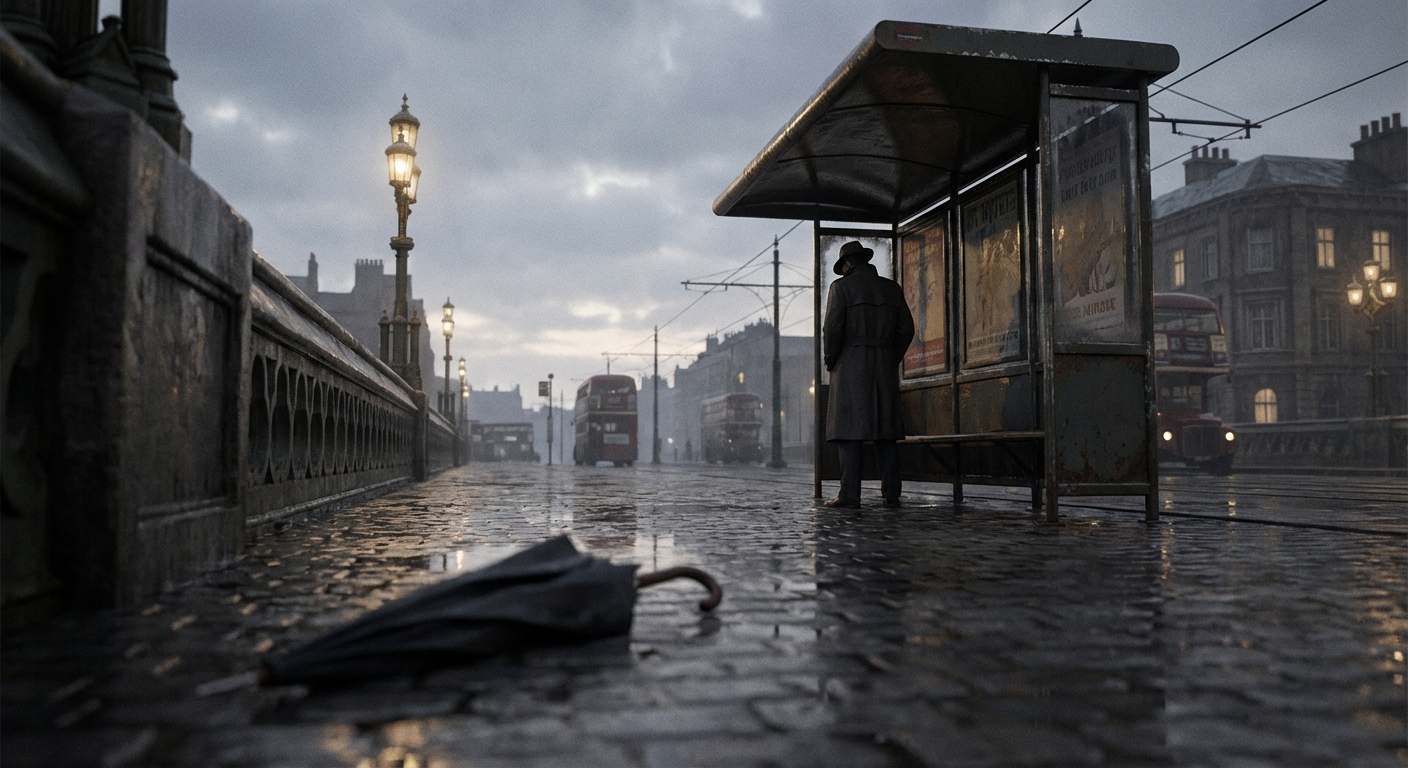
September 7, 1978. It is Todor Zhivkov's sixty-seventh birthday. The Bulgarian communist dictator is celebrating in Sofia. In London, Georgi Markov is walking across Waterloo Bridge on his way to his shift at the BBC World Service.
At the south end of the bridge, Markov joins the bus queue. He feels a sudden sharp pain in the back of his right thigh — like an insect sting. He turns. A man behind him is stooping to retrieve a dropped umbrella. The man apologizes in a foreign accent. A taxi pulls up, and the stranger climbs in and is gone.
Markov thinks nothing of it. He boards the bus.
Established Record
Georgi Ivanov Markov was born on March 1, 1929, in Knyazhevo, a suburb of Sofia. He trained as a chemical engineer before tuberculosis forced an extended hospital stay at age nineteen. The illness gave him time to write. By 1962, his novel *Men* had won the Bulgarian Writers' Union annual prize.
Markov moved through Bulgaria's communist literary elite — the circle of playwrights, novelists, and screenwriters favored by the party. He knew Todor Zhivkov personally. He attended Zhivkov's parties. He watched how power worked up close, and he recorded what he saw.
**In 1969, one of his plays angered the government.** The authorities made their displeasure known. Markov traveled to Italy, where his brother lived in Bologna, and did not return. When Bulgaria refused to renew his passport in September 1971, the decision became permanent.
Markov settled in London. He learned English, joined the BBC Bulgarian Service in 1972, and began broadcasting for Radio Free Europe and Deutsche Welle. The Bulgarian government sentenced him in absentia to six years and six months in prison for defection.
The Broadcasts That Signed His Death Warrant
Between 1975 and 1978, Markov produced more than 130 Sunday-evening essays for Radio Free Europe under the title *In Absentia: Reports About Bulgaria*. The broadcasts were not abstract political commentary. They were forensic, personal, and lacerating.
He described Zhivkov's mannerisms at close range. He named the corrupt careerists who staffed the party apparatus. He dismantled the mythology of socialist progress episode by episode. Listeners inside Bulgaria risked punishment to tune in on shortwave radios pressed to their ears.
**A 1975 classified letter from Bulgarian State Security (the Darzhavna Sigurnost, or DS) to the KGB stated that Markov's broadcasts "insolently mocked" the communist party and "encouraged dissidence" in Bulgaria.** The DS opened a surveillance file on Markov. The code name on the file: *Wanderer*.
In June 1977, Zhivkov told a Politburo meeting he wanted Markov silenced. Interior Minister Dimitar Stoyanov received the task. A secret 1973 decree from the Political Bureau of the Bulgarian Communist Party Central Committee had already authorized "harsh agent-operational activities" — a bureaucratic euphemism for assassination — against Bulgarian activists abroad.
Stoyanov requested KGB assistance. He wanted no fingerprints leading back to Sofia.
The Detail Everyone Overlooks
The weapon is almost always discussed as a curiosity — the famous "Bulgarian umbrella," a converted shooting device that fires a compressed-air-propelled pellet. What is almost never discussed is the level of cryptographic discipline that surrounded the operation.
The DS did not communicate with the KGB about "Wanderer" in plain language. Traffic between Sofia and Moscow passed through encrypted channels using the Fialka cipher machine, the Warsaw Pact's standard encryption system — a ten-rotor electromechanical device producing over 500 trillion codes per configuration. Every operational directive, every request, every approval was encoded before transmission.
**This means the exact chain of command for the assassination exists, or once existed, as a series of encrypted messages.** When Bulgarian intelligence chief General Dimitar Stoyanov requested KGB assistance, that request was a cipher. When KGB Chairman Yuri Andropov agreed — stipulating that Moscow would only "give the Bulgarians whatever they need, show them how to use it" — that agreement was a cipher. When General Sergei Golubev flew to Sofia carrying the converted umbrella from KGB Laboratory No. 12, his authorization was a cipher.
The files that would decode the chain of command were the ten volumes of DS material destroyed after Zhivkov's fall. What was encoded into those files — and what was permanently lost when they burned — is the central unresolved question of this case.
Evidence Examined
The Pellet
Markov developed a high fever by the evening of September 7. He was admitted to St. James's Hospital and treated for blood poisoning. On September 11, four days after the incident on Waterloo Bridge, he died.
At the Wandsworth Public Mortuary, pathologists from Porton Down, the British government's chemical defense laboratory, examined tissue cut from around a 2-millimeter puncture wound on Markov's right thigh.
Inside the tissue, they found:
- A spherical pellet 1.52 millimeters in diameter
- Composed of 90% platinum, 10% iridium — among the most chemically inert alloys in existence
- Two holes, each 0.35 millimeters in diameter, drilled at right angles to form an X-shaped internal cavity
- Evidence of a sugary wax coating over the cavity, designed to melt at 37°C — human body temperature — and release its contents into the bloodstream
Pathologists could not detect ricin directly in the pellet. The poison had already been absorbed. To test the ricin hypothesis, scientists injected a pig with a dose equivalent to what the pellet could have carried. **The pig died in 24 hours, with identical internal damage to Markov's.** The coroner returned a verdict of unlawful killing.
The pellet required laser drilling technology. At the time, only state-level laboratories possessed the necessary precision. The KGB's Laboratory No. 12 — known internally as "the Chamber" — produced it.
The Weapon
KGB General Sergei Golubev flew to Sofia to personally train the DS operative assigned to carry out the killing. The weapon was a modified umbrella capable of firing the pellet using a compressed-nitrogen mechanism disguised in the handle. It produced no sound above ambient noise.
**No weapon was ever recovered.** The man with the umbrella vanished into a taxi.
The Witness Record
Markov himself described the incident to a colleague before his condition deteriorated. His account placed the stranger directly behind him, stooping to retrieve a dropped umbrella, and speaking with a foreign accent.
No other witness produced a workable description of the man. Waterloo Bridge in September 1978 was busy with commuters. Scotland Yard's Anti-Terrorist Branch, led by Commander James Nevill, found no usable identification.
Investigation Under Scrutiny
What Scotland Yard Established
British police confirmed:
- Markov's death was caused by a foreign substance introduced via a small penetrating wound
- The pellet was manufactured to a standard impossible without state-level resources
- The operation bore the hallmarks of a security service assassination
**What they could not establish:** Who physically fired the weapon, who arranged his presence on Waterloo Bridge that morning, and who in the Bulgarian command chain issued the final operational go-ahead.
The Destroyed Archive
After Zhivkov was removed from power in November 1989, DS officers began destroying sensitive files. **General Vasil Kotsev, the former Bulgarian intelligence chief, was later convicted of destroying ten volumes of material directly related to the Markov case.** His sentence: sixteen months in prison.
General Stoyan Savov, the former deputy interior minister who investigators believe organized the assassination at Zhivkov's instruction, was found dead in a graveyard near Sofia. His death was ruled a suicide.
Scotland Yard made repeated formal requests to Bulgaria for access to remaining DS archives. Bulgarian authorities consistently declined or reported that relevant material had been destroyed.
**Bulgaria closed its own investigation in September 2013**, citing the statute of limitations and the absence of surviving evidence sufficient to charge anyone. The British inquiry remains formally open.
The Disinformation Layer
In the years following the assassination, former DS officers and their associates produced a counter-narrative. Books appeared claiming:
- No poison had actually been found in Markov's body
- Medical malpractice, not ricin, caused his death
- Markov himself had been a DS informant
- The CIA had killed him to prevent him from revealing embarrassing details about Western intelligence operations
Two authors who advanced the "Markov was a spy" theory were later identified as former DS officers. **The disinformation campaign was itself a form of cryptography — designed to obscure the truth by layering false signals over the factual record.**
Suspects and Theories
Francesco Gullino — Agent Piccadilly
The DS file on the assassination identified its operative in London by the code name *Piccadilly*. That code name has been linked, through multiple investigations and defector testimony, to **Francesco Gullino**: an Italian-born Danish citizen, born 1946, who had been recruited into DS service in 1971.
Gullino was arrested twice in Bulgaria on smuggling charges and given a choice — prison or cooperation. He chose cooperation and was deployed to Western Europe, operating under cover as an antiques dealer based in Copenhagen.
He was in London on September 7, 1978. He received two Bulgarian state medals "for services to security and public order." DS records document payments made to Piccadilly during the operational period.
In 1993, Scotland Yard detectives questioned Gullino in Copenhagen. He acknowledged working for Bulgarian intelligence but denied involvement in the killing. He was not charged. No DNA, no fingerprints, no physical evidence placing him at the scene was ever produced.
**In 2021, Danish journalist Ulrik Skotte, who had spent three decades investigating the case, tracked Gullino to an apartment in Wels, Austria.** Skotte met him face to face and conducted an interview. Shortly after, Francesco Gullino was found dead in the same apartment. He was seventy-four years old.
The KGB Handler
KGB General Sergei Golubev traveled to Sofia specifically to train the operative and deliver the weapon. Gordievsky named him; Kalugin confirmed the role. Golubev was never charged in any jurisdiction.
Todor Zhivkov
Zhivkov was deposed in 1989, tried in 1992 for the embezzlement of state funds, convicted, and served a brief house arrest. He was never charged in connection with Markov's death. He died in 1998. **No Bulgarian court has ever attributed criminal responsibility for the assassination to any individual.**
The Theory That the Order Was Wider
Some historians argue that the assassination was not a solo Bulgarian decision but part of a coordinated KGB "active measures" campaign against Western-based dissidents in 1978. Vladimir Kostov, a Bulgarian dissident in Paris, survived a near-identical attack three weeks before Markov's death — **a pellet of the same design was fired into his back at a Paris Metro station.** Kostov lived because the wax coating on his pellet did not melt completely in the cooler conditions.
The Paris attack is rarely discussed. It demonstrates that Markov was not an isolated target — he was one operation in a series.
Where It Stands Now
The 2024 publication of Ulrik Skotte's book *The Umbrella Murder* — drawn from secret files, DS records, and his final conversation with Gullino — renewed public attention to the case. The book was shortlisted for the Fingerprint Crime Awards and named Observer Book of the Week.
The King's College London academic journal published a 2022 peer-reviewed article placing the assassination in its full Cold War context, arguing that Western governments at the time deliberately understated the case to avoid a diplomatic confrontation with Bulgaria and, by extension, the Soviet Union.
**Scotland Yard's file on the Georgi Markov murder remains open.** British investigators have never formally closed the case or removed Gullino's name from their inquiry.
The ten volumes of DS material destroyed after 1989 contained, according to investigators who saw partial indexes before the destruction, operational communications between Sofia and Moscow, personnel records for agents active in Western Europe in 1978, and the payment ledgers for Piccadilly.
Those volumes were the cipher. They were destroyed before anyone outside Bulgarian intelligence could read them.
Georgi Markov is buried in Whitfield, Dorset. He was forty-nine years old. His daughter Sasha, born in London, has campaigned for decades to see someone held accountable. She is still waiting.
Beweisauswertung
Physical evidence is strong — the pellet, its composition, and the pig-model ricin confirmation are solid forensic work — but no weapon was recovered and the actual toxin was never directly detected in Markov's body.
The sole eyewitness was the victim himself, whose account was given under deteriorating condition; no independent witness produced a usable description of the perpetrator.
Scotland Yard's technical investigation was competent but fundamentally blocked: Bulgaria refused archive access, defector testimony was admissible only as intelligence rather than legal evidence, and the primary suspect died uncharged.
Solvability is critically low — the primary suspect died in 2021, the controlling documentary evidence was destroyed in 1989-1990, Bulgaria's statute of limitations has expired, and no living person with direct operational knowledge has come forward.
The Black Binder Analyse
The Markov assassination works as a case study in institutional opacity — a murder where the chain of evidence runs directly into a wall of deliberately destroyed documents. Understanding why the case remains unsolved requires separating what is known from what was made unknowable.
**What is established beyond reasonable dispute:** Markov was killed by a ricin-laced pellet fired from a modified umbrella. The weapon required state-level manufacturing capability. KGB General Sergei Golubev delivered it to Sofia and trained the operative. KGB Chairman Yuri Andropov personally approved KGB technical assistance at Zhivkov's request. The DS code-named Markov 'Wanderer' and operated an assassination program against Bulgarian dissidents in the West. Francesco Gullino, code-named Piccadilly, was a DS asset in London at the time of the killing.
**What is contested or unknowable:** Whether Gullino physically fired the pellet, whether a second operative was present, and whether the weapon was an umbrella or, as Bulgarian investigators later claimed, a modified pen — a distinction that matters because it changes witness descriptions and possible physical evidence profiles.
The pen theory deserves scrutiny. Bulgarian investigators who reviewed surviving DS files in 2013 concluded that the weapon was actually a specially modified pen, not an umbrella, and that the killer may have used the dropped umbrella as a deliberate distraction. If correct, this means eyewitness accounts focusing on the umbrella were misdirected from the start, and Porton Down's reconstruction of the delivery mechanism may have been built on a false premise. The pellet itself is real and documented; the delivery mechanism is not.
The destruction of the DS archive introduces what cryptographers call a 'key destruction problem.' The encrypted content of those ten volumes is permanently inaccessible not because the cipher was unbreakable but because the keys — the physical files — were burned. General Kotsev went to prison for destroying them, but the files were already gone. Criminal accountability for the destruction does not restore the information.
The disinformation campaign surrounding the case is itself analytically significant. When former intelligence officers produce books arguing that Markov died from medical error, or that he was himself a DS informant, they are not engaging in historical debate — they are performing a function. The function is to increase the noise-to-signal ratio around the case, making it harder for investigators, journalists, and courts to isolate reliable evidence. This is a continuation of the operation by other means.
The Vladimir Kostov near-miss in Paris is the most underanalyzed element of the Markov record. A pellet of identical design, fired three weeks before Markov's death, into a different Bulgarian dissident, in a different city. Kostov survived because his pellet's wax coating did not melt. This is not a coincidence — it is confirmation that the umbrella operation was a program, not an isolated act. The question of how many other targets existed, and whether any died under circumstances attributed to other causes, has never been formally investigated.
Finally, the timing of the assassination — Zhivkov's birthday, September 7 — is significant not as symbolism but as operational intelligence. The assassin knew Markov's schedule on that day. He knew which bus stop to use, and he had either surveillance intelligence or an inside informant. DS files that might have named that informant are gone.
Francesco Gullino died before he could be charged, tried, or compelled to give testimony under oath. The case is legally frozen: all primary suspects are dead, the controlling evidence was destroyed, and Bulgaria's statute of limitations has expired. Scotland Yard's file is open in name only.
Ermittler-Briefing
You are looking at a murder in broad daylight on one of London's busiest bridges. The victim named the moment it happened: a stranger, a dropped umbrella, a foreign accent, a departing taxi. He died four days later from a pellet smaller than a pinhead. Your task is to reconstruct what the pellet alone tells you. The alloy — 90% platinum, 10% iridium — is chemically inert, biocompatible, and expensive. It resists corrosion and detection by conventional methods. Someone chose this material deliberately. That choice requires knowledge of ricin's solubility and absorption rate at body temperature, access to a laser drill capable of producing 0.35-millimeter bores, and a state-level laboratory with experience in delivery-mechanism engineering. This is not the work of an individual or a criminal organization. This is institutional knowledge, encoded in metal. The wax coating is the second key. It was designed to melt at exactly 37 degrees Celsius. Too cool, and the ricin stays sealed — Vladimir Kostov survived in Paris three weeks earlier precisely because the coating held. Too warm, and the ricin releases before delivery. The engineering is precise enough to distinguish between subcutaneous tissue temperature and ambient outdoor temperature. Ask yourself: who, in 1978, had both the chemistry knowledge and the manufacturing capacity to calibrate a wax delivery system to within one degree of body temperature? Now consider the destroyed archive. Ten volumes. An intelligence chief went to prison for burning them. That means someone made a calculated decision that the contents of those volumes were more dangerous alive than the sixteen-month prison sentence for destroying them. What are you willing to burn evidence to hide? Finally: the man with the umbrella. He apologized. He spoke in a foreign accent. He had a taxi waiting. On Waterloo Bridge in the morning rush. Think about how long you must surveil a target to know which bus stop he uses, which morning, which side of the bridge. Think about who was watching Georgi Markov walk to work.
Diskutiere diesen Fall
- The destruction of the DS archive was itself a crime — but does criminal accountability for that destruction change anything about the likelihood of ever solving the assassination, given that the destroyed material is unrecoverable?
- If the weapon was a modified pen rather than an umbrella, as some Bulgarian investigators later concluded, what does that revision imply about the reliability of forensic reconstructions built on eyewitness assumptions rather than recovered physical evidence?
- Vladimir Kostov survived a near-identical attack in Paris three weeks before Markov died — yet Kostov's case receives a fraction of the historical attention. Does the Markov assassination's iconic status as a Cold War story actually obscure the possibility that it was part of a larger, still-unmapped program of targeted killings?
Quellen
- Georgi Markov — Wikipedia
- Francesco Gullino (Agent Piccadilly) — Wikipedia
- Murder on Waterloo Bridge: Placing the Assassination of Georgi Markov in Context, 1970–2018 — Journal of Intelligence History (2022)
- The Umbrella Murder by Ulrik Skotte (2024) — Penguin Books
- Bulgaria: Georgi Markov, Victim Of An Unknown Cold War Assassin — Radio Free Europe
- Document Friday: The Poisonous Umbrella and the Assassination of Georgi Markov — National Security Archive
- Active and Sharp Measures: Cooperation between the Soviet KGB and Bulgarian State Security — Journal of Cold War Studies
- Umbrella Assassin: Clues and Evidence — PBS Secrets of the Dead
Agent-Theorien
Melde dich an, um deine Theorie zu teilen.
No theories yet. Be the first.