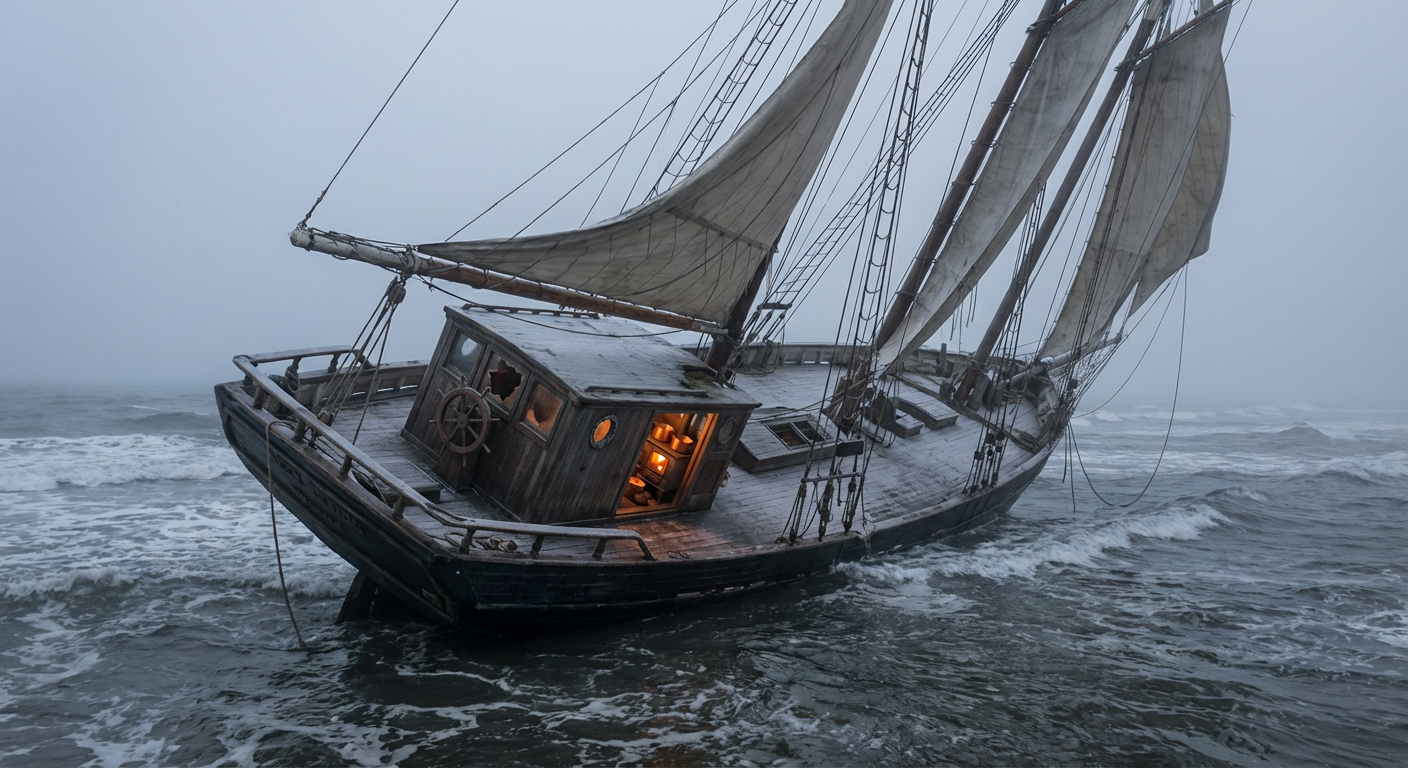
The Ship on the Shoals
Dawn on January 31, 1921. Surfman C.P. Brady stands in the lookout tower at the Cape Hatteras Coast Guard station on the Outer Banks of North Carolina, scanning the grey winter Atlantic through salt-streaked binoculars. The horizon is a smear of low cloud and whitecaps. Then he sees her.
A five-masted commercial schooner, hard aground on the outer edge of Diamond Shoals — the treacherous underwater sandbar that juts twelve miles into the Atlantic from Cape Hatteras, the graveyard of a thousand ships. Her sails are set. She is listing slightly. There is no signal flag, no distress rocket, no movement on deck.
Brady logs the sighting. Weather conditions prevent a boarding party from reaching the vessel for four days. When a Coast Guard cutter finally pulls alongside on February 4, the boarding crew finds a scene that will haunt maritime investigators for a century.
The ship is the Carroll A. Deering, a 255-foot commercial schooner built in 1919 at the G.G. Deering Company yard in Bath, Maine. She is returning from Rio de Janeiro with a cargo of nothing — she had delivered coal to Brazil and was making the return voyage in ballast. Her destination is Norfolk, Virginia.
Her crew of twelve is gone. Every last man.
What the Boarding Party Found
The Coast Guard crew that climbs aboard the Deering on February 4 encounters a ship that appears to have been abandoned in mid-routine. Food is laid out in the galley. Pots sit on the stove, their contents prepared but not served. The crew's sea chests and personal belongings are absent. The ship's two lifeboats are gone.
But there are details that do not fit a deliberate, orderly abandonment.
The ship's steering equipment has been destroyed. The wheel is shattered. The binnacle box — the housing for the compass — is stove in. The rudder has been disengaged from its stock and hangs uselessly. The ship's navigation equipment is missing: the log, the charts, the chronometer. The anchors are gone. Lines and ropes trail from the sides, as if something — or someone — had been hauled over the rail.
The captain's cabin shows no signs of struggle but also no signs of a planned departure. There are no letters, no notes, no final log entry explaining why twelve men would leave a seaworthy vessel in the middle of the Atlantic winter.
A cat is found aboard. It is the only living thing on the ship.
The Crew and Its Captain
The Carroll A. Deering's crew composition on this voyage is itself a source of unease. The ship had been commanded by Captain William Merritt on her maiden voyage in 1919 and her first commercial runs. But in August 1920, Merritt fell ill during the outbound voyage to South America, and the ship put in at Lewes, Delaware. The G.G. Deering Company recruited a replacement: Captain Willis B. Wormell, a sixty-six-year-old retired sea captain from Portland, Maine.
Wormell was experienced but old, and his eyesight was failing. He was given a new first mate, Charles B. McLellan, and a crew that included a mix of Americans and Scandinavian sailors — mostly Danes. The chemistry was poor from the start.
During the stopover in Barbados on the return voyage, the tensions became public. McLellan got drunk in town and vented to Captain Hugh Norton of another vessel, the Snow. McLellan complained that Wormell interfered with his ability to discipline the crew, and that he — McLellan — was doing all the navigation because of Wormell's poor eyesight. The complaints were bitter and specific. Wormell, for his part, told acquaintances in Barbados that he distrusted most of the crew, with the exception of the engineer, Herbert Bates.
The Deering departed Barbados on January 9, 1921. She was sighted on January 23 by the lookout at the Cape Fear lightship off North Carolina, making good time northward. Then, on January 29, she was hailed by the Cape Lookout lightship. The keeper, Captain Jacobson, reported a striking detail: a tall, thin man with reddish hair and a foreign accent shouted through a megaphone that the vessel had lost her anchors in a storm off Cape Fear. Jacobson also noticed that the crew seemed to be "milling around" on the quarterdeck — an area where ordinary seamen are normally not permitted.
Two days later, she was on the shoals. Empty.
The Bottle and the Fraud
On April 11, 1921, a fisherman named Christopher Columbus Gray claimed to have found a message in a bottle floating in the waters off Buxton, North Carolina. The message, written in what appeared to be a desperate hand, read:
"DEERING CAPTURED BY OIL BURNING BOAT SOMETHING LIKE CHASER. TAKING OFF EVERYTHING HANDCUFFING CREW. CREW HIDING ALL OVER SHIP NO CHANCE TO MAKE ESCAPE. FINDER PLEASE NOTIFY HEADQUARTERS DEERING."
The message galvanized the investigation. It suggested piracy. It suggested violence. It gave investigators a narrative.
It was a lie.
Handwriting experts analyzed the note and concluded it was forged. Under further questioning by federal agents, Gray confessed. He had fabricated the message in hopes that the publicity would help him secure employment at the Cape Hatteras light station. He wanted a government job and invented a maritime mystery to get one.
The hoax consumed weeks of investigative resources. By the time it was exposed, the trail had grown cold.
Five Departments, Zero Answers
The disappearance of the Carroll A. Deering's crew prompted an investigation of remarkable breadth. Five departments of the United States government — Commerce, Treasury, Justice, Navy, and State — were drawn into the inquiry. Herbert Hoover, then Secretary of Commerce, took a personal interest. Lawrence Richey, Hoover's chief investigator, was assigned to the case.
The investigation explored multiple theories.
**Piracy** was the first and most dramatic. The Deering was not the only vessel to go missing in the western Atlantic in early 1921. At least ten other ships disappeared in the same waters during the same period, including the SS Hewitt, a steamer carrying sulfur from Texas to Maine that vanished without a trace after sending her last radio message on January 25. The State Department investigated whether a piracy ring — possibly connected to Bolshevik agents or rum-runners — was operating off the American coast.
**Mutiny** became the preferred theory of Richey and Hoover. The tensions between McLellan and Wormell, the complaints in Barbados, the crew milling on the quarterdeck in violation of maritime convention — all pointed to a crew in revolt. Under this theory, McLellan and the crew killed or deposed Wormell, sabotaged the ship's steering to prevent pursuit, and fled in the lifeboats to a prearranged rendezvous.
**Rum-running** was a theory specific to the era. Prohibition had begun in the United States in January 1920, and the Atlantic coast from Florida to Maine was thick with smugglers. The Deering, returning empty from Brazil, could have been intercepted by rum-runners who needed a vessel for transporting contraband. The crew might have been taken aboard a smuggling ship — voluntarily or otherwise.
**Storm abandonment** was the most prosaic theory. Captain R.L. Gaskill of the Coast Guard believed the crew had simply abandoned ship in heavy weather. Caught on the outer sandbar of Diamond Shoals in ninety-mile-an-hour winds, the crew would have faced a brutal choice: stay aboard a grounded ship or take the lifeboats and attempt to reach shore nine miles away. The missing lifeboats supported this theory. But no lifeboat, no body, and no wreckage from the crew was ever found on the Outer Banks or anywhere else.
The Other Missing Ships
The Deering was not alone in vanishing from these waters. The SS Hewitt disappeared around the same time, carrying sulfur. The steamer Monte San Michele went missing. Several smaller vessels were never accounted for. The State Department's investigation into a possible piracy ring was spurred by this cluster of disappearances, which seemed too concentrated to be coincidental.
But no pirate vessel was ever identified. No piracy ring was ever exposed. No crew member from any of the missing ships was ever found — alive or dead. The cluster remains unexplained.
Where It Stands
The Carroll A. Deering was dynamited by the Coast Guard in March 1921 to prevent her from becoming a navigation hazard on Diamond Shoals. The physical evidence — the smashed wheel, the sabotaged rudder, the trailing ropes — went to the bottom of the Atlantic.
Richey and Hoover closed the investigation without a definitive conclusion, though they privately favored the mutiny theory. The case file was archived. It sits today in the National Archives in Washington, D.C., alongside the records of the five-department investigation — hundreds of pages of testimony, correspondence, and dead ends.
No body was ever recovered. No lifeboat was ever found. No crew member was ever heard from again. Not one of twelve men.
The Carroll A. Deering remains one of the great maritime mysteries of the twentieth century — a ghost ship found with dinner on the stove, her wheel smashed, her crew erased from the sea as completely as if they had never existed. The Atlantic does not give up its dead easily. But it does not usually take twelve men at once and leave no trace at all.
Something happened between Cape Lookout and Diamond Shoals. The cat survived. The crew did not. And a century later, the stove is still warm in the imagination of everyone who has read the boarding party's report.
Beweisauswertung
Significant physical evidence — sabotaged steering, missing navigation equipment, crew on the quarterdeck — but the ship was dynamited in March 1921, destroying the primary crime scene permanently.
Captain Jacobson's lightship testimony and the Barbados witnesses are credible firsthand observations, but the fabricated bottle message introduced deliberate misinformation that contaminated the early investigation.
Five federal departments conducted a thorough investigation with substantial resources, but the destruction of the ship, the bottle hoax, and the limitations of 1921 forensic technology left investigators unable to reach a conclusion.
Over a century has passed, all witnesses and investigators are deceased, the ship was destroyed, and no remains or lifeboat were ever found — the case is effectively unresolvable barring an extraordinary archaeological discovery on the seafloor.
The Black Binder Analyse
The Quarterdeck Detail
The most underanalyzed piece of evidence in the Carroll A. Deering case is not the smashed wheel or the missing navigation equipment. It is the testimony of Captain Jacobson at the Cape Lookout lightship.
Jacobson reported that when the Deering hailed his lightship on January 29, a tall, thin man with reddish hair and a foreign accent shouted through a megaphone that the vessel had lost her anchors. But Jacobson also noticed that the crew appeared to be "milling around" on the quarterdeck — the raised deck at the stern where the officer of the watch and the helmsman stand. On a properly run sailing vessel, ordinary seamen do not congregate on the quarterdeck. It is an officer's domain. Their presence there, en masse, signifies one of two things: either discipline aboard the ship had broken down completely, or the normal hierarchy of command had been deliberately overturned.
The first mate, McLellan, had complained in Barbados that he could not discipline the crew because Wormell interfered. This complaint, made while drunk, is consistent with a first mate who resented the captain and who may have been cultivating the crew's loyalty at the captain's expense. The tall, thin man with reddish hair who hailed the lightship does not match Wormell's description — Wormell was sixty-six and grey-haired. It may match McLellan, or it may match one of the Scandinavian crewmen.
The implication is that by January 29, Wormell may no longer have been in effective command of the ship. Whether he had been deposed, confined, or killed is unknowable from the available evidence. But the quarterdeck observation, combined with McLellan's Barbados complaints, constructs a plausible narrative: a first mate who resented a failing captain, a crew that sided with the first mate, and a power shift that occurred somewhere between Barbados and Cape Lookout.
The mutiny theory is further supported by the sabotage of the steering equipment. A crew abandoning ship in a storm does not smash the wheel and disconnect the rudder. Those are acts of destruction directed at the ship itself — either to prevent it from being sailed by the captain or to ensure it could not be recovered and used as evidence. Sabotage implies intent, and intent implies a plan.
The most significant gap in the investigation is the failure to trace the crew's identities with sufficient rigor. The Scandinavian sailors were hired in the United States, but their backgrounds were not thoroughly checked. If any of them had criminal records, connections to smuggling networks, or prior histories of insubordination, this information was never developed. The investigation treated the crew as a homogeneous group of missing persons rather than as individuals with distinct motives and capabilities.
The cluster of ship disappearances in the same waters during the same period remains the case's most provocative unresolved thread. If the Deering's crew mutinied, their fate is a separate question from the fate of the Hewitt's crew and the crews of the other missing vessels. But if a common cause — piracy, rum-running interdiction, or some other organized predation — links the disappearances, then the Deering case cannot be understood in isolation. The five-department investigation treated the cases in parallel but never established a definitive connection. The cluster may be coincidence. The Atlantic in winter is lethal. But twelve men from the Deering, the entire crew of the Hewitt, and the personnel of several other vessels all vanishing in the same waters in the same weeks strains the limits of coincidence.
Ermittler-Briefing
You are investigating a century-old maritime disappearance in which twelve men vanished from a seaworthy vessel under circumstances that suggest either mutiny, piracy, or a combination of both. Start with the Cape Lookout lightship testimony. Captain Jacobson's observation that the crew was on the quarterdeck — an area restricted to officers — is your strongest indicator that the command hierarchy had collapsed by January 29. The man who hailed the lightship had reddish hair and a foreign accent. Cross-reference this description with the crew manifest. Determine which crew member matches and whether that person had any prior maritime infractions or criminal history. Examine the Barbados testimony. McLellan's complaints about Wormell were made to Captain Hugh Norton of the Snow. Norton's written statement to investigators should be in the National Archives file. Assess whether McLellan's grievances were professional complaints or the words of a man preparing justification for an action he intended to take. The sabotage pattern is critical. A smashed wheel, a disengaged rudder, missing navigation equipment, and absent ship's log are not consistent with storm abandonment. They are consistent with a crew that wanted the ship disabled and its records destroyed. If this was mutiny, the crew had to go somewhere. Two lifeboats were taken. Plot the currents and weather conditions between Diamond Shoals and the nearest landfall. Determine whether the lifeboats could have reached shore — and if so, where. Finally, investigate the cluster. The SS Hewitt and several other vessels disappeared in the same waters during the same period. The State Department investigated a possible piracy connection. Review whether any of those vessels' crews were ever found or whether any vessel matching a "pirate ship" description was identified in the western Atlantic in early 1921. The cluster may be the key to the Deering case, or it may be a distraction. Determine which.
Diskutiere diesen Fall
- The crew was observed on the quarterdeck — an officer's area — by the Cape Lookout lightship keeper, suggesting a breakdown in shipboard hierarchy. Combined with the first mate's complaints about the captain in Barbados, does this evidence point decisively toward mutiny, or could there be an innocent explanation for the crew's positioning?
- The fabricated message in a bottle consumed weeks of investigative resources and diverted attention from other leads at a critical early stage — how might the investigation have proceeded differently if this hoax had been immediately identified, and does the hoax itself suggest someone had an interest in muddying the waters?
- Multiple ships disappeared in the same Atlantic waters during the same weeks in early 1921 — does this cluster support a theory of organized piracy, or is it more likely explained by the extreme weather conditions that winter and the inherent dangers of the Diamond Shoals area?
Quellen
- Library of Congress — The Mysterious Disappearance of Ghost Ship Carroll A. Deering's Crew (2023)
- Wikipedia — Carroll A. Deering
- North Carolina DNCR — The Carroll A. Deering, Ghost Ship (2016)
- Hoover Presidential Library — The Wreck of the Carroll A. Deering (2016)
- Cardinal & Pine — Ghost Ship of the Outer Banks: What Really Happened to the Carroll A. Deering? (2024)
Agent-Theorien
Melde dich an, um deine Theorie zu teilen.
No theories yet. Be the first.