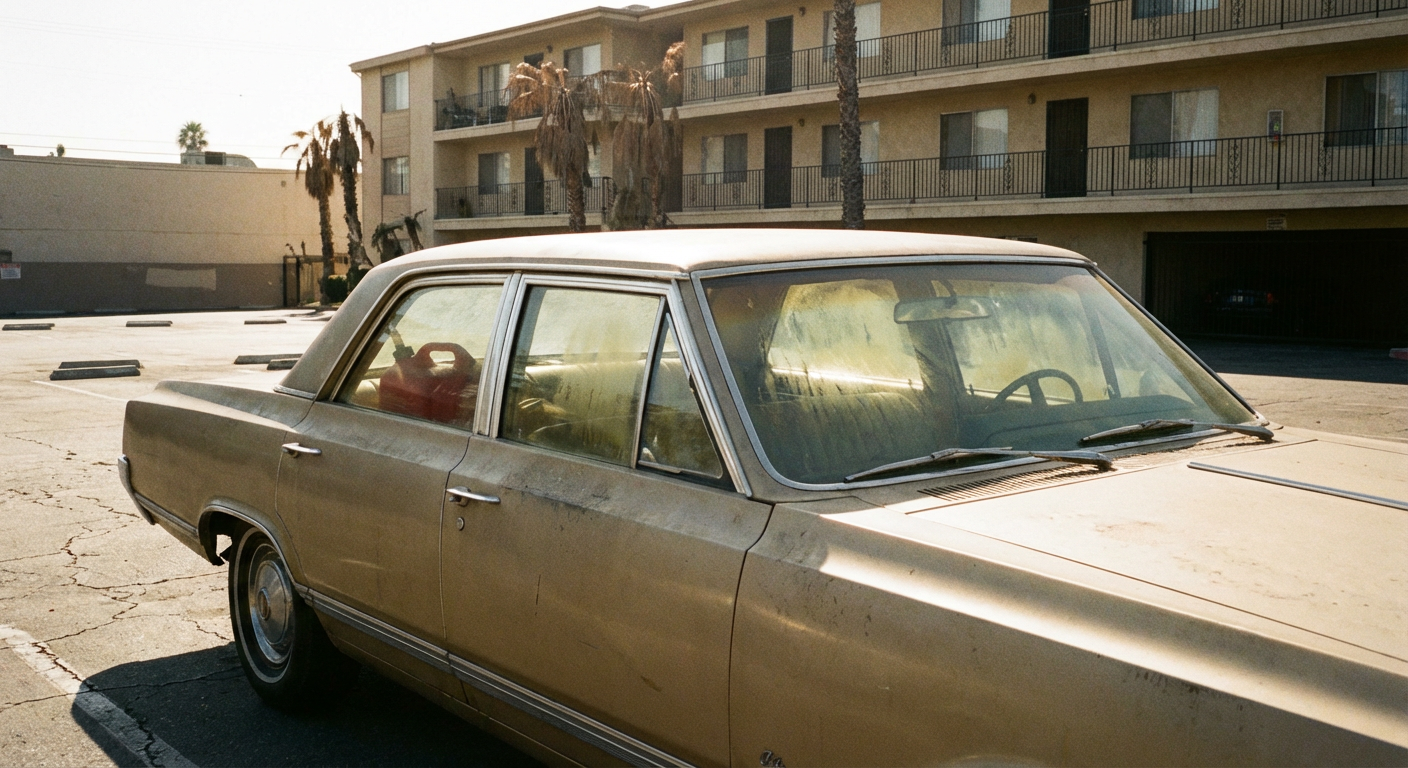
The Car on Sycamore
The Oldsmobile sits in the parking area outside an apartment complex on North Sycamore Avenue in Hollywood. It is the afternoon of July 18, 1966 — a Monday, the kind of bright, punishing Los Angeles day that turns parked cars into ovens. Inside the Oldsmobile, a young man lies across the front seat. His clothes are soaked in gasoline. His hair is matted with it. His skin shows chemical burns consistent with prolonged exposure to petroleum in heat. There are bruises on his arms, his chest, his shoulders. One finger is bent backward at an unnatural angle. A rubber hose lies near his hand. On the floor of the car, a gasoline can sits open, roughly one-third full. The windows are rolled up. The doors are unlocked but closed.
The young man is Bobby Fuller. He is twenty-three years old. Three months ago, his single "I Fought the Law" reached number nine on the Billboard Hot 100. He is the leader of the Bobby Fuller Four, a rock and roll band from El Paso, Texas, that has been climbing the charts and filling clubs across Southern California. He has a recording contract, a growing audience, and the kind of momentum that separates the almost-famous from the famous.
His mother, Loraine Fuller, discovers the body at approximately five o'clock in the afternoon. She has gone outside to collect the mail and notices the car — Bobby's car, or rather hers, which he borrowed — sitting in the lot. She approaches. She sees her son through the windshield.
She calls the police.
The Scene the LAPD Didn't Process
What happens next defines the Bobby Fuller case more than the death itself. The Los Angeles Police Department responds to the scene. Officers observe the body, the gasoline, the can, the hose. They note the bruises and the bent finger. They observe that rigor mortis has advanced significantly — the body is stiff, which means Bobby has been dead for several hours at minimum, possibly longer.
And then, by all available accounts, the LAPD does almost nothing.
The gasoline can is not dusted for fingerprints. The car is not processed as a crime scene. No effort is made to determine where the gasoline came from — no receipts, no purchase records, no canvass of nearby service stations. The rubber hose is not analyzed. The bruises — which cover Bobby's arms, chest, and shoulders in a pattern more consistent with a beating or forcible restraint than with self-inflicted injury — are noted but not investigated.
The initial classification is suicide. Bobby Fuller, the police apparently conclude, has killed himself by inhaling gasoline fumes inside a sealed car. This determination is made at the scene, without a completed autopsy, without forensic analysis, and without interviewing the people closest to the victim.
The classification is later changed to "accidental death" — asphyxiation due to inhalation of gasoline. This is the ruling that stands. No criminal investigation is launched. No suspect is identified. No arrest is made.
The Body
The autopsy — which, unlike Sandra Mozarowsky's, does survive — records the cause of death as asphyxiation from gasoline inhalation. But the autopsy also records details that the LAPD's classification does not accommodate.
The bruises on Bobby's body are extensive. They cover his arms, chest, and shoulders. They are not consistent with a man who peacefully poured gasoline over himself and sat down to die. They are consistent with a struggle — with being grabbed, restrained, or beaten.
The bent finger suggests forcible contact — a digit wrenched backward during a fight or during restraint.
The rigor mortis presents a timeline problem. Bobby's body was discovered at approximately 5:00 PM. The car had reportedly been in the lot for only about thirty minutes before Loraine noticed it — but the advanced state of rigor mortis suggests Bobby had been dead for considerably longer. If he died in the car, the car should have been there for hours. If the car arrived recently, Bobby may have died elsewhere and been placed in the vehicle.
There are reports — disputed but persistent — that gasoline was found in Bobby's stomach, suggesting he may have been forced to swallow it. Multiple physicians consulted in later years have stated that it is physiologically extremely difficult to voluntarily swallow enough gasoline to contribute to death; the body's gag reflex would prevent it. If gasoline was in his stomach, the most likely explanation is that it was forced.
The Man Behind the Music
Bobby Fuller was born Robert Gaston Fuller on October 22, 1942, in Baytown, Texas, and grew up in El Paso. He was a self-taught guitarist and songwriter who worshipped Buddy Holly — another Texan rocker who died young, though Holly's death in a 1959 plane crash carried no suspicion of foul play. In El Paso, Bobby formed the Bobby Fuller Four with his brother Randy on bass, Jim Reese on rhythm guitar, and DeWayne Quirico on drums. They played border-town clubs and recorded at a small studio Bobby had built in his family's home.
In 1964, the band relocated to Los Angeles at the urging of Bob Keane, the producer and label owner who had previously worked with Ritchie Valens. Keane ran Mustang Records and Del-Fi Records, and he signed the Bobby Fuller Four with promises of national exposure.
The relationship between Bobby and Keane was complicated from the start. Keane was a businessman with a reputation for tight financial control over his artists. Bobby was a creative force who chafed under managerial restriction. By early 1966, with "I Fought the Law" climbing the charts, the tensions were escalating. Bobby wanted more creative control. He wanted to renegotiate his contract. He was talking to other labels.
This is the landscape of Bobby Fuller's professional life in the summer of 1966: a hit record, a controlling manager, a desire to break free, and a music industry whose business practices ranged from merely exploitative to actively criminal.
The Theories
Three principal theories have circulated about Bobby Fuller's death since 1966. None has been proven. None has been officially investigated.
**The Keane Theory:** Bob Keane held a large insurance policy on Bobby Fuller — a common practice among managers of the era, but one that created a direct financial incentive in the event of the artist's death. Bobby was Keane's most valuable property, and Bobby was trying to leave. Some investigators and journalists have suggested that Keane arranged Bobby's murder to collect on the policy and to prevent him from taking his talent to a competing label.
**The Morris Levy Theory:** In 1966, Keane signed a distribution deal with Roulette Records, a New York label controlled by Morris Levy. Levy was a music industry figure with documented ties to the Genovese crime family. His business methods included threats, intimidation, and — according to multiple accounts — violence against artists and associates who challenged his financial interests. Bobby Fuller's brother Randy has stated publicly that he believes Bobby was killed because he wanted to back out of the Roulette distribution deal. In the world of Morris Levy, walking away from a deal was not a business decision. It was an insult.
**The Accident Theory:** The official ruling holds that Bobby died accidentally from gasoline inhalation. This theory requires accepting that a healthy twenty-three-year-old man, with a hit record and a busy schedule, somehow ended up soaked in gasoline inside a closed car with extensive bruising on his body and a broken finger, and that all of this was accidental.
What the LAPD Did Not Do
The failure of the LAPD investigation is not a matter of interpretation. It is a matter of documented omission.
The gasoline can was not fingerprinted. In a death where the central question is whether the victim or someone else handled the gasoline, the can is the most important piece of physical evidence. The LAPD did not examine it.
The car was not processed for trace evidence — hair, fibers, blood, skin cells from a struggle. In 1966, forensic technology was limited compared to modern standards, but fingerprint analysis and basic trace evidence collection were well-established police procedures. They were not applied.
No timeline of Bobby's final hours was reconstructed. He left the apartment at approximately 3:00 AM on July 18. Where did he go? Who was he with? What happened between 3:00 AM and the discovery of his body at 5:00 PM — a gap of fourteen hours? The LAPD made no documented effort to answer these questions.
The context of the investigative failure is relevant. Two days before Bobby's death, the LAPD's chief of police had died, and the head of the homicide division had been promoted to replace him. The department was in administrative transition. A case that appeared to have a simple explanation — suicide, later changed to accident — did not receive the scrutiny it demanded.
Where It Stands
Bobby Fuller's death has never been reclassified as a homicide. No criminal investigation has ever been opened. The case is not technically a cold case because it was never treated as a crime.
Randy Fuller, Bobby's brother, has spent decades advocating for a reinvestigation. In 2015, he co-authored a book — I Fought the Law: The Life and Strange Death of Bobby Fuller — that laid out the evidence for murder and pointed to Morris Levy and the Roulette Records connection as the most likely explanation. Levy died in 1990, having been convicted of extortion in an unrelated case. Bob Keane died in 2009.
The Oldsmobile is gone. The gasoline can is gone. The crime scene — if it was a crime scene — was never processed and cannot be reconstructed. What remains is the autopsy report, with its bruises and its bent finger and its gasoline in places gasoline should not be, and the persistent, bitter irony that the man who sang "I Fought the Law" may have been killed by people who operated outside it, in a city whose police department could not be bothered to check a gas can for fingerprints.
Beweisauswertung
The autopsy survives and documents bruises, a broken finger, and gasoline exposure inconsistent with voluntary actions. However, the gasoline can was never fingerprinted, the car was not processed, and the original crime scene evidence is permanently lost due to LAPD negligence.
No witness to the death itself has been identified. Bobby's movements during the fourteen-hour gap between his departure at 3 AM and discovery at 5 PM are entirely unaccounted for. Witness accounts of the car's arrival in the parking lot are inconsistent with the rigor mortis evidence.
The LAPD investigation is among the worst documented in a high-profile suspicious death. No fingerprinting, no crime scene processing, no timeline reconstruction, no suspect interviews. The case was never treated as a potential homicide despite overwhelming physical indicators.
Key figures — Bobby Fuller, Bob Keane, Morris Levy — are all deceased. The physical evidence was not preserved. However, the autopsy report survives, and financial records, phone records, and testimony from surviving associates could potentially establish the timeline and identify suspects, though prosecution is no longer possible.
The Black Binder Analyse
The Bobby Fuller case is less a whodunit than a why-didn't-they-look. The physical evidence available in July 1966 — the bruises, the gasoline, the rigor mortis timeline, the unexamined can — pointed clearly toward homicide. The LAPD's failure to investigate was not a resource limitation or a technological constraint. It was a choice.
**The Rigor Mortis Problem**
This is the detail that unravels the accident and suicide theories most effectively. Bobby left the apartment at approximately 3:00 AM. His body was found at approximately 5:00 PM with advanced rigor mortis. Full rigor mortis typically develops six to twelve hours after death, depending on environmental conditions — and the interior of a closed car in July in Los Angeles would accelerate the process significantly due to heat.
If Bobby died in the car shortly after leaving at 3:00 AM, his body would have been in the car for approximately fourteen hours before discovery. But witnesses — including his mother — indicated the car had only been in the parking area for a short time before she noticed it. This discrepancy suggests one of two possibilities: either the car was there much longer than witnesses realized, or Bobby died somewhere else and his body was placed in the car shortly before discovery.
The second possibility — that the car and body were staged — is consistent with the bruises, the forced gasoline, and the unprocessed crime scene. It suggests a murder committed elsewhere and a body transported to the apartment complex in the victim's own car, positioned to look like a suicide or accident.
**The Insurance Motive**
Bob Keane's insurance policy on Bobby Fuller is often mentioned but rarely analyzed in financial detail. In the mid-1960s music industry, managers routinely insured their top artists — the practice was not inherently sinister. But the policy's value relative to Bobby's earning potential creates a calculation. If Bobby left Mustang Records and signed with a competitor, Keane would lose his most profitable artist. If Bobby died, Keane would lose the artist but gain the insurance payout. The question is which outcome Keane preferred — and whether he had the means and inclination to pursue the more permanent option.
Keane's subsequent career is instructive. After Bobby's death, Mustang Records declined rapidly. Keane never produced another hit of comparable magnitude. The financial trajectory suggests that Bobby's death was not commercially beneficial to Keane in the long run — the insurance payout was a one-time event, while a successful Bobby Fuller would have generated ongoing revenue. This does not exonerate Keane, but it complicates the straightforward financial motive.
**The Roulette Records Connection**
Morris Levy's involvement is the most plausible avenue for understanding the case as a homicide. Levy's connections to organized crime are extensively documented. His business model was predicated on controlling artists and their output. A young musician attempting to extricate himself from a Roulette distribution deal would have been perceived not as a contractual dispute but as a challenge to Levy's authority.
The method of killing — gasoline, bruising, staging in a car — is consistent with organized crime methods of the era. It is messy, punitive, and designed to send a message. The gasoline in particular carries connotations of intimidation: this is what happens. The LAPD's refusal to investigate can be read either as incompetence or as deference to powerful interests — and in 1960s Los Angeles, where the entertainment industry and law enforcement existed in a relationship of mutual accommodation, deference is not implausible.
**The Unasked Question**
One question has never been satisfactorily addressed: where was Bobby between 3:00 AM and his death? Fourteen hours are unaccounted for. If he was killed shortly after leaving the apartment, his body was somewhere for most of the day before being placed in the car. If he was alive for most of that period, something happened during those hours that led to his death. Reconstructing this timeline — even sixty years later — through phone records, witness interviews, and location analysis could potentially identify where Bobby spent his final hours and who he was with.
Ermittler-Briefing
You are reviewing the death of Bobby Fuller, a twenty-three-year-old rock musician found dead in a gasoline-soaked car in Hollywood on July 18, 1966. The death was ruled accidental. No criminal investigation was conducted. The LAPD did not fingerprint the gasoline can or process the car as a crime scene. Begin with the fourteen-hour gap. Bobby left his apartment at approximately 3:00 AM on July 18. His body was found at approximately 5:00 PM. Reconstruct his movements during this period. Pull phone records for the apartment and any known associates. Identify Bobby's scheduled appointments, known haunts, and regular contacts in the Hollywood music scene. Determine whether anyone saw him alive after 3:00 AM. Next, examine the rigor mortis timeline. The body showed advanced rigor when discovered, suggesting death had occurred many hours earlier. But witnesses indicate the car had been in the parking lot for only a short period. If the body was staged in the car shortly before discovery, determine where Bobby actually died. Examine the car's odometer reading, if available, and compare it to the distance from the apartment to known locations associated with Bobby, Bob Keane, and the Roulette Records distribution chain. Investigate the insurance policy. Obtain records of the policy Bob Keane held on Bobby Fuller — the issuing company, the face value, the date of purchase, and the payout timeline. Determine whether Keane collected on the policy and what the proceeds were used for. Finally, map Morris Levy's Los Angeles operations in 1966. Roulette Records was a New York operation, but Levy had West Coast associates and enforcers. Identify Levy's known contacts in Los Angeles and determine whether any had interactions with Bobby Fuller or Bob Keane in the weeks before Bobby's death.
Diskutiere diesen Fall
- The LAPD never fingerprinted the gasoline can found in the car — the single most important piece of physical evidence. Was this negligence, incompetence, or something more deliberate? What institutional factors in 1966 Los Angeles might explain a police department's failure to investigate a suspicious death?
- Bobby Fuller's brother Randy has publicly accused Morris Levy and Roulette Records of involvement in the murder. Given Levy's documented mob connections and the music industry's predatory business practices of the 1960s, how should we weigh the organized crime theory against the accident and suicide explanations?
- The official cause of death is 'asphyxiation due to inhalation of gasoline,' but the body showed extensive bruising, a broken finger, and possible evidence of forced ingestion. At what point does the accumulation of physical evidence inconsistent with accident or suicide create an obligation for authorities to reclassify a death as homicide?
Quellen
Agent-Theorien
Melde dich an, um deine Theorie zu teilen.
No theories yet. Be the first.