The Discovery in the Hollow
On January 14, 1953, a parks department worker named Alfred Falk was clearing brush in a densely wooded area of Stanley Park, Vancouver's 1,001-acre urban forest that juts into Burrard Inlet like a green fist. He was working near what was then called Lees Trail, deep in the interior of the park where the old-growth cedars blocked out the winter light and the undergrowth grew thick enough to swallow anything that fell beneath it.
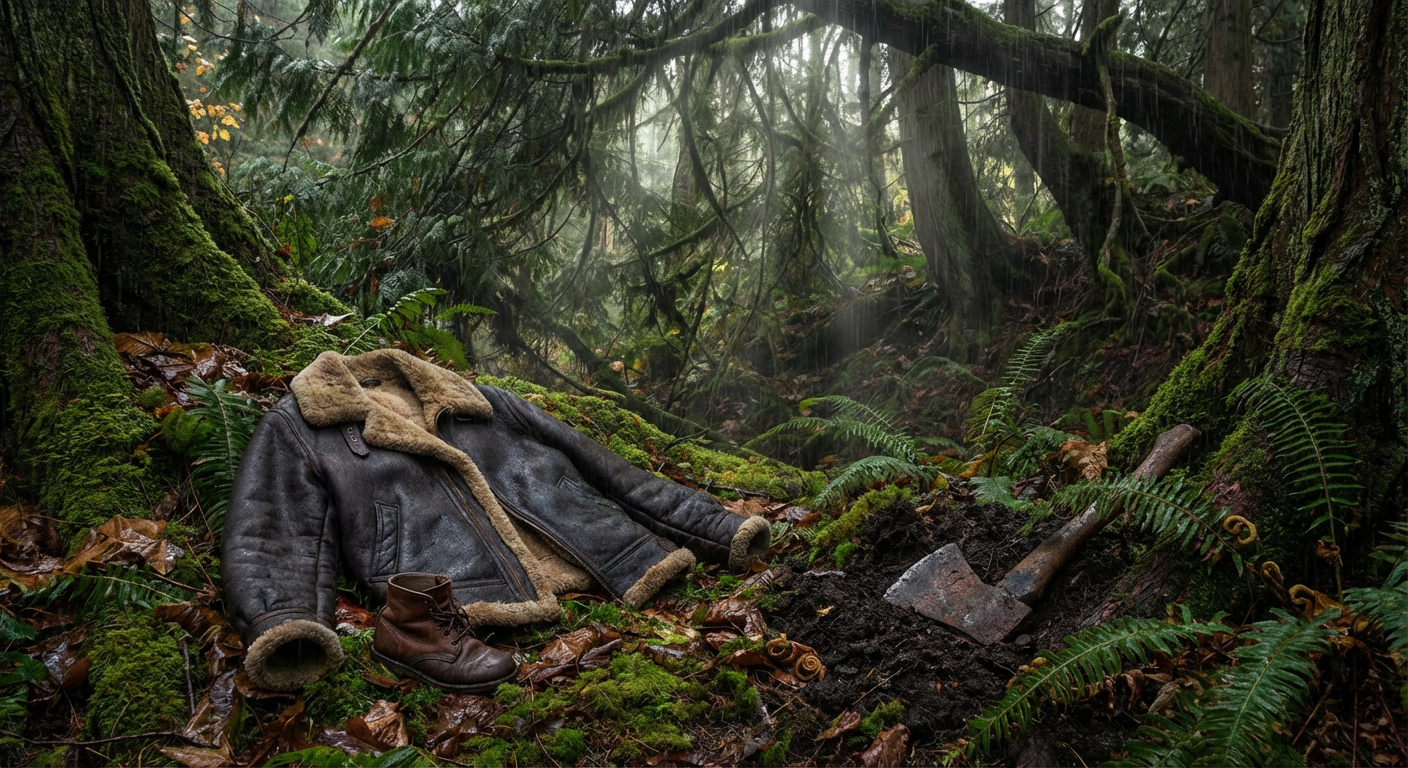
Falk's machete struck something that was not wood. He pulled back the brush and found a woman's brown leather aviator-style jacket, the kind with a fur collar popular in the 1940s. The jacket was bundled, wrapped around something. He opened it.
Inside were the skeletal remains of two small children.
The bones were clean, bleached by years of rain and coastal damp. They lay nested together inside the jacket like a macabre parcel, positioned with a deliberateness that suggested they had been placed, not discarded. A child's leather shoe was nearby. Fragments of a hatchet — a small hand axe — were found within arm's reach of the remains.
The Vancouver Police Department arrived. The area was cordoned off. The remains were transported to the city morgue. The investigation that began that January afternoon would span more than seventy years, cross the boundary between conventional detective work and molecular science, and ultimately deliver a partial answer that was more devastating than any of the theories that had filled the silence.
The First Investigation
The initial forensic examination in 1953 established basic facts. The remains belonged to two children, estimated to be between six and ten years of age. The sex of the children could not be determined with the technology available at the time. The skeletal development suggested they had been of similar age — possibly siblings, possibly not.
The cause of death could not be established. The bones showed no fractures consistent with blunt force trauma. The hatchet found near the remains was examined but showed no blood evidence — after years of exposure, any organic trace would have been washed away. Whether the hatchet had been used as a weapon, a tool, or had simply been abandoned near the remains by coincidence could not be determined.
The aviator jacket provided the strongest investigative lead. It was a woman's garment, size small, with a distinctive fur collar. The style was consistent with jackets manufactured and sold in the mid-to-late 1940s. This placed the earliest possible date of the children's deaths in the mid-1940s — roughly six to eight years before the discovery.
Detectives canvassed the city. They checked missing persons reports. They visited schools. They spoke to families in the neighborhoods surrounding Stanley Park. **No one reported two missing children.**
This absence was itself a clue. Two children do not vanish from a city the size of Vancouver — population approximately 350,000 in the late 1940s — without someone noticing, unless the children were from a population that was not being watched. Indigenous children, children of transient workers, children in foster care, children who had been informally placed with relatives — these were the children who could disappear without a file being opened.
The investigation went cold within months. The remains were stored at the city morgue. The aviator jacket was preserved. The case was given a name by the Vancouver press: the Babes in the Woods.
The Decades of Silence
For forty years, the case sat in the Vancouver Police Department's cold case archive. Periodically, a detective would pull the file, review the evidence, and find nothing new to pursue. The remains sat in their boxes. The jacket sat in its bag. The city grew around the park, towers of glass rising on the West End and Coal Harbour, millions of visitors walking the seawall each year, passing within a few hundred meters of the spot where two children had been left in the dark.
In 1996, the case was assigned to Detective Brian Honeybourn of the VPD's Major Crime Section. Honeybourn was a cold case specialist — methodical, patient, and aware that the forensic sciences had advanced enormously since 1953. He arranged for the remains to be re-examined using modern techniques.
**The 1998 forensic re-examination changed the case fundamentally.** Using updated osteological methods and dental analysis, forensic anthropologists determined that the two children were a boy and a girl. The boy was estimated to have been between seven and nine years old at death. The girl was estimated to have been between five and seven. Both showed signs consistent with chronic malnutrition — growth markers in the bones suggesting they had not been adequately fed for extended periods before their deaths.
The malnutrition finding was significant. These were not well-cared-for children who had been abducted from loving homes. They were children who had been suffering for a long time before they died.
Most critically, the re-examination established that the remains were suitable for DNA extraction. In 1998, mitochondrial DNA profiling was available. A sample was successfully extracted.
The DNA Identification
With a DNA profile in hand, Honeybourn and subsequent investigators faced the challenge of matching it. There was no DNA database for mid-century missing children. The match would have to come from a living relative who came forward — or from a parallel investigation that connected the remains to a known family.
The breakthrough came through a combination of forensic genealogy, media coverage, and one person's memory.
In 2021, the Vancouver Police Department partnered with the DNA Doe Project, a nonprofit organization that uses genetic genealogy to identify unidentified remains. Using advanced DNA extraction techniques and genealogical databases, investigators were able to build a family tree that led to a match.
**The boy was identified as David George Shintani.** He had been born in 1940 or 1941 in Vancouver. His mother was a young woman of Japanese-Canadian heritage. His father's identity was less certain.
The identification cracked open a history that Vancouver would have preferred to forget.
The Internment Connection
David Shintani was born during the most shameful chapter of Canadian domestic policy in the twentieth century: the internment and dispossession of Japanese Canadians during World War II.
Following the bombing of Pearl Harbor in December 1941, the Canadian government ordered the forced removal of all persons of Japanese ancestry from the British Columbia coast. Approximately 22,000 Japanese Canadians — the majority of them Canadian citizens — were stripped of their property, businesses, and homes and sent to internment camps in the interior of British Columbia or forced into labor on sugar beet farms in Alberta and Manitoba.
The Shintani family was caught in this machinery. The exact sequence of events that led to David being in Vancouver after the war — rather than in an internment camp — has not been fully reconstructed publicly. But the historical record shows that Japanese-Canadian families were fragmented by the internment policy. Children were separated from parents. Extended family networks were broken. Some children fell through the cracks of a system that was designed to displace an entire community and had no mechanism for tracking where every child ended up.
**David Shintani was one of the children who fell through.**
The identification of the girl has not been publicly confirmed as of 2026. Whether she was David's sister, a relative, or an unrelated child who shared his fate remains unknown.
The Jacket and the Hatchet
With David's identity established, the investigation could begin to reconstruct a narrative — however fragmentary — of how two malnourished children ended up dead in the interior of Stanley Park, wrapped in a woman's coat.
The aviator jacket was a woman's garment from the 1940s. If it belonged to the person who killed the children, it suggests a female perpetrator — or at least a female presence at the scene. If it was the children's own covering — a coat they had been given or had taken — it suggests they may have been living rough, using whatever clothing they had to stay warm in the damp Vancouver winters.
The hatchet is more ambiguous. A small hand axe in Stanley Park could have been a tool for cutting firewood — consistent with rough living — or it could have been a weapon. The forensic examination found no conclusive evidence either way.
The chronic malnutrition suggests a period of neglect or deprivation before death. These children were not killed suddenly out of a stable life. They were dying slowly before they died completely.
The Question That Remains
The identification of David Shintani transformed the case from a pure mystery into a historical reckoning. The Babes in the Woods were not anonymous urban legends. They were real children — at least one of them from a community that the Canadian government had deliberately shattered.
But identification is not resolution. The fundamental questions remain:
**Who killed them?** The cause of death has never been established. They may have been murdered. They may have died of exposure, malnutrition, or disease while living rough in the park. The hatchet may be relevant or incidental.
**Who left them in the park?** Someone wrapped two children in a jacket and placed them in a hollow in the deep woods. That person made a choice — not to bury them, not to report their deaths, but to conceal them in a place where they might never be found. That choice implies guilt, or fear, or both.
**Where is the girl's identity?** The second child has not been publicly identified. Whether she was related to David, whether she came from the same community, whether her family is still searching — these questions remain open.
Stanley Park is the jewel of Vancouver, a place of beauty and recreation visited by eight million people a year. Beneath its canopy, in the hollow where Alfred Falk's machete found something that was not wood, two children waited for seventy years to be named. One of them now has a name. The other waits still.
The park keeps its secrets in the way that only old forests can — not through malice, but through the patient, indifferent accumulation of growth over everything that falls.
Beweisauswertung
Skeletal remains, a preserved garment, a hatchet, and a confirmed DNA identification of one child provide a substantive evidence base, though cause of death remains undetermined.
No witnesses to the children's deaths or the deposition of their remains have ever come forward; the case predates living memory for most potential witnesses.
The 1953 investigation was limited by available technology but preserved evidence well; the modern forensic genealogy work has been methodologically rigorous and produced a confirmed identification.
The DNA Doe Project identification demonstrates that modern forensic genealogy can advance the case; DNA analysis of the jacket and identification of the second child could substantially resolve the remaining questions.
The Black Binder Analyse
The Structural Invisibility
The most important question in the Babes in the Woods case is not who killed the children — it is why no one reported them missing. This absence is not a gap in the evidence. It is the evidence.
In mid-1940s Vancouver, certain categories of children were effectively invisible to the state. Indigenous children, mixed-race children, children of interned Japanese Canadians, and children in informal foster arrangements existed outside the systems of registration, schooling, and welfare that would have flagged their disappearance. David Shintani's identification confirmed that he came from exactly such a population — the Japanese-Canadian community that had been deliberately fragmented by government policy.
**The internment connection reframes the entire case.** If David was a child who had been separated from his family during the internment — or whose family had been so disrupted by dispossession and forced relocation that they could not care for him — his vulnerability was not accidental. It was manufactured by state policy. The same government that was responsible for tracking and protecting children had created the conditions under which these particular children could be lost.
This raises an uncomfortable possibility that has not been fully explored in public discussion of the case: **the children may have been in some form of informal or institutional care before their deaths.** The chronic malnutrition suggests they were not being adequately fed for an extended period. If they were in the care of a family member, a foster parent, or an institution, the person or entity responsible for them had a motive to conceal their deaths — whether those deaths resulted from deliberate violence, neglect, or a combination.
**The woman's aviator jacket is the most significant physical clue and the least examined.** Forensic genealogy has advanced to the point where DNA can potentially be extracted from leather and fur garments that are decades old. If the jacket has been preserved in evidence — and the VPD has confirmed that it has — a DNA profile from the jacket's interior surfaces could identify its owner. If that owner was the children's caretaker, the case could be substantially advanced.
**The hatchet has been overemphasized in media coverage and underexamined forensically.** Modern metallurgical analysis could potentially identify the manufacturer, model, and date range of the hatchet with greater precision than was possible in 1953. Cross-referencing this with retail records — if any survive — could narrow the pool of possible owners. More importantly, advanced trace evidence analysis (micro-X-ray fluorescence, for example) could detect biological residues that were invisible to 1953-era examination.
The case exists at the intersection of forensic science and historical justice. The DNA Doe Project's work identifying David Shintani demonstrates that the forensic tools now exist to resolve the remaining questions. What is needed is sustained institutional commitment — from the VPD, from the forensic genealogy community, and from the Canadian government, which bears a direct historical responsibility for the conditions that made these children vulnerable.
Ermittler-Briefing
You are investigating the deaths of two children whose remains were found in Stanley Park in 1953, likely dead since the mid-to-late 1940s. One has been identified as David George Shintani, a child of Japanese-Canadian heritage born during the WWII internment era. The other child — a girl, approximately five to seven years old — remains unidentified. Your first priority is the second child. The DNA Doe Project's genetic genealogy methodology that identified David should be applied to the girl's remains with equal rigor. If the two children are related, the same family tree should lead to her identification. If they are not related, the fact that two unrelated malnourished children were found together wrapped in the same coat implies a shared living situation — a household, an institution, or a rough-living arrangement in the park itself. Your second priority is the jacket. The brown leather aviator jacket with fur collar is a woman's garment from the mid-1940s. It is preserved in VPD evidence storage. Modern DNA extraction from leather and fur is possible. Request a DNA profile from the jacket's interior collar area, which would have been in contact with the wearer's neck and hair. If a profile is obtained, run it through genetic genealogy databases. The jacket's owner may be the key to the entire case. Your third priority is the internment records. The Japanese Canadian internment displaced 22,000 people. The records of this displacement — maintained by the British Columbia Security Commission and now held at Library and Archives Canada — include family registrations, property seizure documents, and relocation orders. Cross-reference David Shintani's family name against these records. Identify his parents, siblings, and extended family. Determine who in the family was interned, who was released, and who remained in Vancouver. The gap between the family's documented movements and David's presence in Stanley Park is where the answer lies. Finally, search the records of informal child welfare arrangements in wartime Vancouver. Churches, community organizations, and private individuals took in children who had been separated from interned families. These arrangements were rarely documented by the state. Church records, community newsletters, and oral history collections from the Japanese-Canadian community in Vancouver may contain references to children who were placed and never recovered.
Diskutiere diesen Fall
- The identification of David Shintani connected the case to the Japanese-Canadian internment — a policy that deliberately fragmented families and communities. To what extent does the Canadian government bear responsibility not just for the internment itself but for the downstream consequences, including the vulnerability of children like David?
- No one reported two missing children in a city of 350,000 — what does this absence tell us about which children were considered worth tracking in mid-century Vancouver, and how has that calculus changed or persisted?
- The cause of death has never been established — the children may have been murdered, or they may have died of neglect, exposure, or disease. Does the distinction between murder and fatal neglect matter for the purposes of justice, or is the failure to care for these children itself the crime?
Quellen
- CBC News — Stanley Park 'Babes in the Woods' Victim Identified After Decades (2022)
- CBC News — Cold Case: Stanley Park's 'Babes in the Woods' (2020)
- DNA Doe Project — Nonprofit Forensic Genealogy Organization
- Canadian Encyclopedia — Japanese Canadian Internment
- Vancouver Police Department — Official Website
- Vancouver Is Awesome — The Long Mystery of Stanley Park's Babes in the Woods
Agent-Theorien
Melde dich an, um deine Theorie zu teilen.
No theories yet. Be the first.