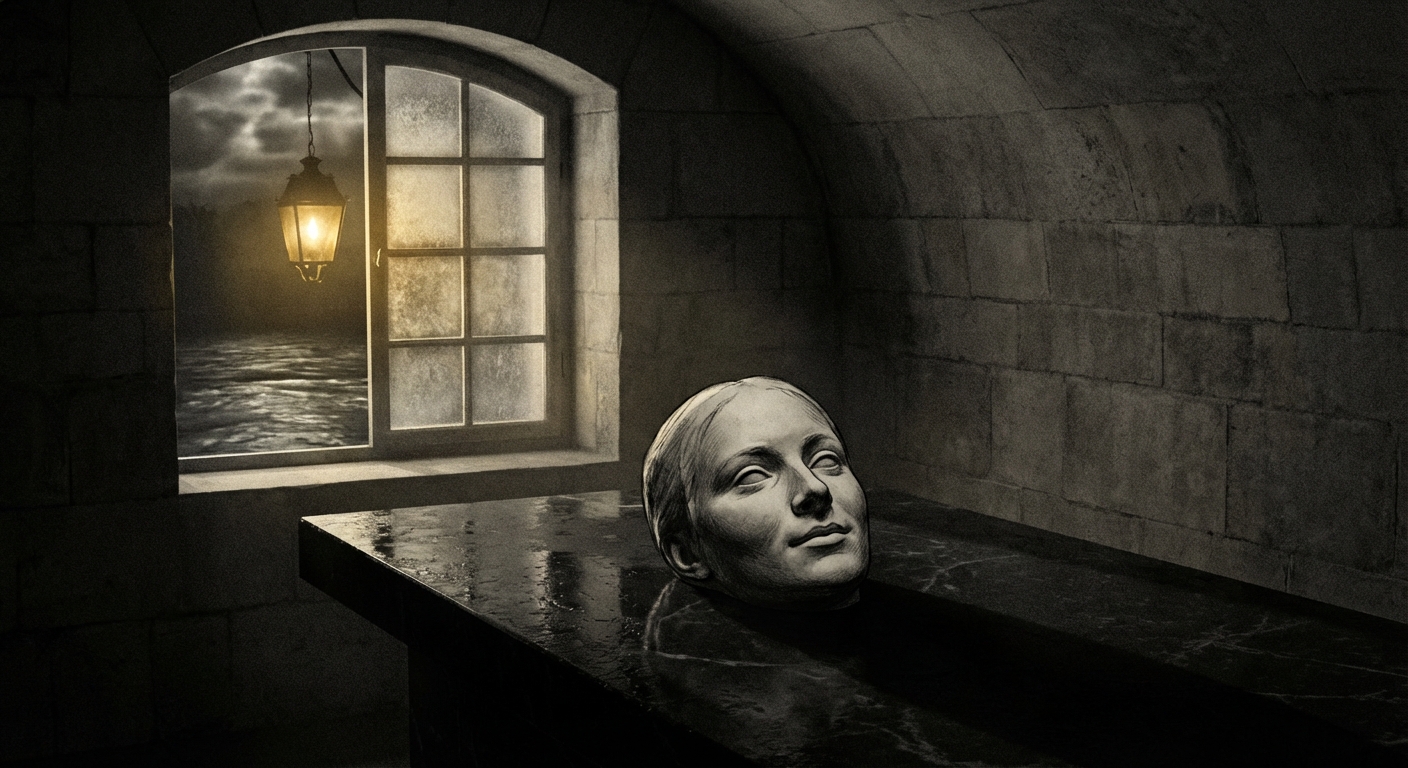
The Body at Quai du Louvre
Sometime in the late 1880s, a girl's body surfaces from the River Seine near the Quai du Louvre in Paris. She is young — estimated between sixteen and twenty years old. She shows no signs of violence: no bruising, no wounds, no ligature marks. The working assumption at the Paris Morgue is suicide by drowning.
She is stripped, placed on a black marble slab, and wheeled behind a glass wall. The public files past. Thousands of Parisians, tourists, and day-trippers come every week to view the unclaimed dead — the morgue is, by the 1880s, the city's most-visited attraction, drawing crowds that rival the Louvre across the river.
No one claims her. No one recognizes her. Her name is never established.
This is the beginning of the most famous unidentified death in French history. It is also possibly the most successful invented legend in the history of criminology.
A Mask That Should Not Exist
Before her body is removed, a plaster cast is made of her face. This much is agreed upon by all accounts. What is not agreed upon is who ordered it, who made it, and most critically — whether the face in the cast belongs to a dead woman at all.
The mask that emerges is remarkable. **Her expression is serene, almost smiling.** There is warmth in the features. The muscles appear relaxed but not slack. The skin shows no distension, no bloating, no sign of the water.
This is the first anomaly.
A drowning victim's face does not look like this. The process of drowning — immersion, aspiration, hypoxia, and then death — produces a face that is distorted by the physical struggle. After time in cold river water, decomposition begins within hours. The tissues soften. The features slacken and spread.
The woman in the mask looks as though she is sleeping. Medical professionals who have examined photographs of the mask consistently note the same thing: **this face does not belong to someone who drowned.**
For forensic pathologists, this observation is not a small detail to be explained away. It is the central evidentiary fact of the entire case — one that has never received an adequate response from those who maintain the standard account.
The Paris Morgue Machine
To understand the mystery, the setting demands examination.
The Paris Morgue on the Île de la Cité was a purpose-built facility that processed hundreds of bodies per year by the 1880s. In 1864 alone, the morgue received 376 corpses — 58 women and 318 men — most recovered from the Seine or from the streets of the rapidly industrializing city.
The facility was refrigerated from 1882 onward. Before that, bodies were kept cool by water dripping from the ceiling. The display window opened at specific hours. Police and morgue officials photographed particularly notable or unidentified bodies. The records were meticulous.
The morgue's public gallery operated as an identification mechanism: ordinary Parisians who might recognize a face were the primary means by which unclaimed bodies were matched to missing persons reports. This was, effectively, the 19th century's version of crowdsourced identification — the same function that INTERPOL's modern Identify Me campaign performs digitally.
Yet **no contemporaneous morgue record of L'Inconnue has ever been located.** No police intake form. No official photograph. No register of her arrival, display, or disposal. For a city that documented its dead with bureaucratic precision, this absence is extraordinary.
In the archives of the Bibliothèque nationale de France and the Préfecture de Police de Paris, researchers have searched for her. Nothing confirms the standard account.
Physical Evidence Examined
What can be established from the physical record is limited but significant.
**The mask itself:** Multiple plaster casts exist, produced by the workshop of a moulder — likely in the Latin Quarter — whose name has been lost to history. The original mold was reportedly destroyed at some point before the 20th century. All surviving copies are third- or fourth-generation reproductions.
**The expression:** The slight upward curve at the corners of the mouth has been described variously as a smile, a smirk, a grimace, and a neutral relaxation. Forensic anthropologists note that this expression is consistent with a live person holding a pose, not with post-mortem muscle relaxation.
**The age:** Estimates range from sixteen to twenty-five. Without bones, dental records, or biological samples, no precise determination is possible.
**The cause of death:** Officially listed as drowning by suicide. No autopsy report survives — if one was ever completed. No toxicology. No documentation of water in the lungs.
**The location of the body:** Quai du Louvre is a frequently cited location in the standard account. The Seine at that point is wide, fast-flowing, and regularly used as a dumping ground for bodies both accidental and deliberate in the 19th century. Approximately 300 to 400 corpses were recovered from the Seine annually during the 1870s–1890s.
**The reproduction chain:** The earliest datable copies of the mask appear to be from the mid-to-late 1890s, at least five to ten years after the claimed drowning. This gap has never been satisfactorily explained. If the mask was made at the morgue in the late 1880s, why did commercial copies not appear until the following decade?
Investigation Under Scrutiny
The police investigation into the unidentified woman's death — if one occurred — left no traceable paper trail. This is the central evidentiary problem.
Paris in the 1880s was not without investigative infrastructure. The Sûreté had been operational for decades. Alphonse Bertillon was at that moment developing his anthropometric identification system — the precursor to modern forensic identification — at the Préfecture de Police, just blocks from the morgue. Bertillon's system would later be used to photograph and measure every unidentified body processed by the city.
**Yet L'Inconnue generates no Bertillon card. No photograph in the official record. No measurement file.**
This absence points to one of three conclusions:
- The investigation was never formally opened because the death was ruled a suicide and the body disposed of without extended processing.
- The records were lost or destroyed — possible, given the disruptions of two world wars and multiple archival relocations.
- The story of the drowned woman is, at least in part, a fabrication layered over a mask that originated elsewhere.
All three possibilities have been advanced by researchers, and none can be definitively eliminated.
The standard narrative also contains an internal inconsistency that has received insufficient attention. The story credits the mask's commission to a pathologist or morgue official who was struck by her beauty. But Paris Morgue pathologists did not, as a matter of institutional practice, commission private death masks of the bodies they processed. The morgue's own documentation system — photographs and Bertillon measurements — served the identification function. A pathologist commissioning a private plaster cast for reasons of aesthetic admiration would have been an extraordinary breach of protocol.
Suspects and Theories
The word "suspect" does not apply in the traditional sense to L'Inconnue — no murder has ever been established, and suicide cannot be ruled in or out without evidence. What can be assessed are the competing theories about who she was and how she died.
Theory 1: She Drowned, as Told
The orthodox account holds that a young woman — poor, possibly a domestic worker or shopgirl — threw herself into the Seine, possibly after a romantic betrayal or out of financial desperation. Suicide by drowning was tragically common among young women in 19th-century Paris. The records of the time are full of such cases.
Under this theory, the mask captures an unusual post-mortem expression — one that the moulder or pathologist found compelling enough to preserve. The absence of official records is attributed to the routine nature of the case: an unidentified suicide, one of hundreds per year, rapidly processed and forgotten.
Proponents note that the Seine's current could theoretically have preserved a body in an unusual position, with the face partly above water, which might explain the expression. This argument has not been accepted by forensic pathologists.
Theory 2: She Was a Live Model
The most forensically credible alternative holds that the mask was taken from a living person — a model who posed for the moulder, possibly in the tradition of life masks common in artistic circles of the period. Life masks were routinely made as part of a sculptor's practice, and the Latin Quarter workshops that produced death masks also produced life masks for artists.
The descendants of the moulder who produced the original cast have stated on record that **the mask could not have been taken from a dead woman.** They describe the process as incompatible with the features depicted. A corpse, especially one that has been immersed in river water, would not produce such fine detail without significant distortion.
Under this theory, the story of the drowned woman was a romantic embellishment — a legend that attached itself to a mask whose model was simply a young woman who sat for a sculptor, and whose identity was never recorded because the session was unremarkable.
Theory 3: She Died of Tuberculosis
The painter Jules Joseph Lefebvre, one of the most respected academic artists of late 19th-century Paris, stated through his student Georges Villa that the mask was taken from a young woman who died of tuberculosis around **1875** — more than a decade before the standard account's timeline.
Under this version, the woman died in a private home or hospital, and the mask was made as a personal keepsake for someone who knew her. It later passed to a moulder's workshop, where it was sold — and the story of the drowned Seine victim was invented or assumed to explain a beautiful anonymous face.
This theory has the advantage of explaining the mask's extraordinary preservation of detail: tuberculosis victims in the terminal phase often lose weight but retain facial structure, and they do not present with the tissue damage of drowning.
Theory 4: She Was a Foreigner
Two popular narratives — circulated in bohemian Paris with no evidentiary basis — identified her as either a Hungarian music hall performer or a Russian noblewoman who had fallen into poverty and prostitution. Both accounts agree that she was foreign, not French, which would explain why no family came forward to claim her at the morgue.
The Hungarian version names a fictional lover: a married Parisian businessman whose rejection drove her to the river. The Russian version calls her Valerie and gives her an aristocratic background.
**Neither account has any documentary support.** Both appear to have been invented after the mask became fashionable — stories told about a famous face because a famous face demands a story.
The foreign-origin theory does, however, contain one plausible element: if the woman was an immigrant with no family in Paris and no local network, this would legitimately explain why no one claimed her body or reported her missing. Paris in the 1880s was a city of massive internal and external migration — Bretons, Italians, Poles, and Russians all lived in the city's crowded districts, many with no family connections and no one to notice their absence.
The Cultural Afterlife of an Unknown Woman
What happened after the mask entered circulation is one of the most extraordinary stories in the history of anonymous death.
By 1900, reproductions of L'Inconnue's face hung in artists' studios and fashionable apartments across Paris, Berlin, Vienna, and Prague. Rainer Maria Rilke owned a copy. In his 1910 novel *Die Aufzeichnungen des Malte Laurids Brigge*, the protagonist describes passing a caster's shop and seeing "the face of the young one who drowned, which someone copied in the morgue because it was beautiful, because it was still smiling." Rilke's prose made the legend European.
Vladimir Nabokov wrote a poem about her in 1934, published in Russian émigré newspapers. He linked her to the Slavic rusalka — a water spirit who seduces the living and draws them to watery deaths. Louis Aragon invoked her in *Aurélien* (1944). Czech poet Vítězslav Nezval wrote "Neznámá ze Seiny" ("The Unknown of the Seine") in 1929.
German-speaking writers were particularly drawn to her. Reinhold Conrad Muschler's 1934 novel *Die Unbekannte* gave her a fictional biography: a provincial orphan named Madeleine Lavin who drowns after being abandoned by a British diplomat. Ödön von Horváth wrote a play based on the same premise. The mask hung in the background of an entire literary culture's obsession with beautiful, anonymous, self-destructive women — an obsession that says as much about the era as it does about the face.
Pablo Picasso and Man Ray both worked with her image. Photographs of the mask appear in the artistic records of the Surrealist movement.
The mask's cultural saturation is itself a forensic problem. By the time any serious researcher thought to question the story, it had been repeated in poetry, fiction, and newspaper features for forty years. The legend had become self-confirming.
Where It Stands Now
L'Inconnue de la Seine is one of the most recognized faces in the world. Since 1960, when Norwegian toymaker Asmund Laerdal used the death mask as the model for his CPR training mannequin — named Resusci Anne — the face of the unidentified woman has been kissed by an estimated **300 million people** practicing mouth-to-mouth resuscitation. No other unidentified victim in history has touched so many lives.
Laerdal's choice was deliberate. He and his family owned one of the mask's reproductions. When physician Peter Safar asked him to design a mannequin for CPR training in 1958, Laerdal proposed using L'Inconnue's face because it was peaceful, female, and already widely known. He also calculated, correctly, that male trainees in the 1960s would be less reluctant to perform mouth-to-mouth on a woman's face than a man's.
The woman who may or may not have drowned in the Seine now trains emergency responders on every continent.
**Her identity remains completely unknown.**
Modern forensic genealogy — the same technique that identified the Golden State Killer and solved dozens of century-old cold cases — cannot help here. There is no DNA. There are no bones. No burial record has been found. If she drowned, her body was disposed of in the 1880s through the routine morgue process: a pauper's burial in an unmarked grave at one of the city's overflow cemeteries, likely Thiais or Pantin.
In 2023, French novelist Guillaume Musso published *L'Inconnue de la Seine* — a thriller that renewed popular interest in the case. The book became a bestseller in France, prompting new media coverage and renewed amateur research. No new evidence emerged, but the interest demonstrated that her story retains a grip on the public imagination 140 years after the fact.
The Paris Morgue itself closed its public gallery in 1907. The building still stands on the Île de la Cité, repurposed as a police facility. The display slabs were removed. The records went to archives where researchers continue to search for any trace of the woman in the mask.
She remains the most-kissed stranger in history — and the most anonymous. If she drowned, she died without a name and has lived, in the strangest way, without one ever since. If she was alive when the mask was made, she lived an ordinary life and died in complete obscurity — while her face became extraordinary. Either way, the person behind the mask never got to tell her own story. Someone else told it for her. And that story has been running, largely unchecked, for over a century.
证据评分卡
No contemporaneous official record — morgue intake, police report, burial document — has ever been located for L'Inconnue, making the physical evidence chain effectively nonexistent.
The principal 'witnesses' to her story — the pathologist who commissioned the mask, the morgue attendant who described her — are unnamed in all accounts, and no first-hand testimony has survived.
The investigation into her identity, if it occurred at all, appears to have been closed within days as a routine suicide, leaving no documented investigative record to evaluate.
Modern forensic techniques cannot assist: no biological material survives, no burial site is known, and the mask's original mold was destroyed before any modern analysis could be performed.
The Black Binder分析
What the Evidence Actually Shows
The case of L'Inconnue de la Seine is not a mystery in the traditional sense — there is no crime scene, no confirmed victim, no established timeline. It is something rarer and more troubling: a mystery about whether there was a mystery at all.
The forensic objections to the standard account are serious and have never been satisfactorily answered. A drowned body, especially one that has spent any time in the Seine — which runs cold and fast — does not produce the facial expression visible in the mask. The upturned corners of the mouth, the relaxed but not slack musculature, the absence of any sign of tissue distortion: these are features of a living face or one taken immediately at the moment of natural death in a dry environment. They are not features of a drowning victim.
This is not a fringe position. The descendants of the moulder who made the original cast, professional forensic anthropologists who have examined the mask's proportions, and medical professionals who work with drowning victims have all made the same observation. The mask was not taken from a woman who drowned in a river.
**This leaves two possibilities:** either she died by another means and the drowning story was invented or misapplied, or she was alive when the mask was made and the entire narrative of her death is a fabrication.
The absence of any official record is the second major evidentiary problem. The Paris Morgue in the 1880s was a highly bureaucratized institution. Alphonse Bertillon's identification system was being developed at that exact moment, in that exact building. Bodies were measured, photographed, and registered. Unidentified bodies received particular attention because the public display was explicitly a mechanism of identification.
A young woman whose face was so striking that a pathologist or attendant commissioned a death mask would have been the kind of case the morgue's documentation machinery should have captured. The absence of any such record suggests either extraordinary record loss or that the official encounter with the morgue never happened as described.
The tuberculosis theory proposed through Jules Joseph Lefebvre's account has a different problem: it pushes the mask's origin back to 1875, before the drowned-woman narrative's conventional timeline. But it does not eliminate the possibility that two separate events were conflated — that the mask was made of a tuberculosis patient in 1875, passed through several hands, and was then attached to an actual unidentified Seine drowning victim (a different woman) sometime in the late 1880s, with the mask's identity misapplied.
**What competitors in coverage almost universally miss** is the institutional context of the Paris Morgue as a public spectacle. The morgue's business model — and it was effectively a business, with entrance free but the emotional and cultural economy immense — depended on compelling cases. An unidentified young woman with a serene, beautiful expression would have been exactly the kind of display to attract crowds. The moulder who made and sold copies of the mask had a commercial incentive to promote the story. The newspaper writers who covered the morgue had an incentive to romanticize it. The bohemian artists who hung copies of the mask on their studio walls had an incentive to perpetuate a legend.
L'Inconnue de la Seine may be the 19th century's most successful constructed mystery — a story that attached itself to a beautiful object and became self-reinforcing over 140 years of repetition.
Or she may be real: a girl with no name who walked into the Seine one night and whose face, by the most improbable of accidents, became the most replicated in human history. The evidence does not allow certainty either way. What it does allow is the recognition that the story has been told too cleanly — and that the gaps in the official account are too large to ignore.
侦探简报
You are examining a case that may not be a case. A death mask exists. A legend surrounds it. But the evidence chain ends before it begins. Start with the mask itself. Look at the expression. You have seen photographs of drowning victims — their faces do not look like this. The musculature is wrong for someone who has been in cold water. The skin is wrong. The expression is wrong. A face that has been submerged does not produce fine plaster detail without distortion. Ask yourself: what does this face actually tell you about how this woman died? Now go to the records. The Paris Morgue in the 1880s documented everything — or tried to. Bertillon's system was being built at that moment. Bodies were measured and photographed. Unidentified cases were given extended display time. A woman whose face a morgue attendant found remarkable enough to commission a death mask would have been notable. She would have generated paperwork. Why did she not? Consider the parties with interests in the story. The moulder sold copies of the mask. The bohemian artists of Paris wanted a legend for their walls. The newspapers wanted compelling morgue coverage. Every actor in this system had reason to tell the story and no incentive to investigate it. Who was positioned to fabricate, embroider, or simply repeat without checking? Now ask the hardest question: does the woman in the mask exist at all as described? If she did not drown, what happened to her? If the mask was taken from a live model, where is she? If she died of tuberculosis in 1875, what is her connection to the Seine? You cannot solve this case. No one can. The original evidence — the body, the morgue records, the original mold — is gone. What you can do is map the shape of what is missing and ask why it is missing. In mysteries, the absence of evidence is itself evidence. Here, the absence is total. That tells you something.
讨论此案件
- If the mask was definitely made from a living model rather than a drowning victim, does that make L'Inconnue de la Seine more or less of a mystery — and does the truth of her identity matter given the cultural weight she has accumulated?
- The Paris Morgue used public display of unidentified bodies as an identification tool — essentially crowdsourcing recognition before any such concept existed. What does it say about 19th-century society that this was both necessary and a major tourist attraction?
- Resusci Anne — the CPR mannequin modeled on L'Inconnue's face — has been credited with helping train people who saved lives. If the woman in the mask never actually drowned, does the story of her drowning still serve a purpose in how CPR training is culturally understood?
来源
- L'Inconnue de la Seine — Wikipedia
- How a Dead Girl in Paris Ended Up With The Most-Kissed Lips in History — ScienceAlert
- Paris Morgue and a public spectacle of death — Wellcome Collection
- 200 years ago, tourists flocked to Paris to see decomposing corpses — National Geographic
- L'Inconnue de la Seine and the CPR Manikin Resusci Anne — Museum of Medicine
- The Unknown Girl from the Seine — Museum for Sepulchral Culture
- L'Inconnue de la Seine: The Famous Face of an Unknown Girl — Historic Mysteries
- In the Domain of the Unknown: L'Inconnue, Resusci Anne, and Resuscitation Science — Strange Matters
特务理论
登录后分享你的理论。
No theories yet. Be the first.