The Lake
Lake Storsjön lies in the heart of Jämtland, in central Sweden, a body of water so large and so old that it has its own monster legend — the Storsjöodjuret — and its own peculiar weather systems, microbursts of wind and fog that can turn a calm morning into a navigational crisis within minutes. The lake stretches roughly thirty kilometers north to south and six kilometers east to west, with depths exceeding seventy meters in places. In winter, it freezes — not always uniformly, not always safely — and in the transitional weeks of March and early April, the ice is at its most treacherous: thick enough to walk on in some areas, rotting and fragile in others, with open leads of dark water appearing without warning where currents run beneath.
The town of Östersund sits on the eastern shore, a municipality of roughly sixty thousand people that serves as the administrative center of Jämtland County. For the people of Östersund and the surrounding villages, the lake is not a scenic backdrop. It is a working landscape — fished commercially and recreationally, crossed by boat and by foot depending on the season, respected for its capacity to kill the careless.
Göran Lundblad knew the lake as well as anyone alive. He was fifty-one years old in March 1994, a lifelong resident of Frösön — the island that sits in the lake just west of Östersund, connected to the mainland by bridges. He had fished Storsjön since boyhood. He understood the ice. He understood the currents. He understood the weather patterns that could shift from still to dangerous in the time it took to bait a hook.
On the morning of 19 March 1994, he told his wife Margareta that he was going out on the lake. The ice was beginning to break up along the southern shore, and the open water channels between the floes attracted pike and perch in numbers that made early-season fishing productive for those who knew where to go. He loaded his small aluminum boat — a flat-bottomed fourteen-footer with an outboard motor — onto its trailer, drove to the public launch at Badhusparken on the Östersund waterfront, and put the boat in the water at approximately seven o'clock in the morning.
Margareta expected him home by early afternoon. He had said he would be back for lunch.
The Boat
At 3:15 PM on 19 March, a farmer named Persson who owned land along the western shore of the lake near the village of Stocke noticed a small aluminum boat drifting in open water approximately two hundred meters offshore. The boat was moving slowly south with the current, its outboard motor tilted up out of the water. There was no one in it.
Persson watched the boat for several minutes, then called the police. The Östersund police dispatched a patrol and contacted the lake rescue service. By the time a rescue boat reached the drifting vessel at approximately 4:30 PM, it had traveled another three hundred meters south.
The boat was identified as Göran Lundblad's by its registration markings. Inside, the police found the following:
- A tackle box, open, with several lures and hooks visible
- A thermos flask, half-full of coffee, with the cap unscrewed
- A fishing rod, broken into two pieces, lying across the bow
- A life jacket, still in its plastic wrapper, tucked under the stern seat
- No keys — the outboard motor's ignition key was missing
- A single glove, left hand, navy blue wool
Göran Lundblad was not in the boat. He was not in the water nearby. He was not on any of the ice floes visible from the recovery site.
The Search
The search for Göran Lundblad began that evening and expanded over the following six days. It involved police divers, the Swedish Sea Rescue Society (SSRS), a helicopter from the Jämtland Regiment, and dozens of civilian volunteers who walked the shoreline and searched the ice on foot and by snowmobile.
The lake was in a transitional state. Large sections of ice remained solid enough to walk on, particularly in the northern basin and along the sheltered western shore. But the central channel and the southern basin were breaking up, with open water leads expanding daily. Water temperature was approximately two degrees Celsius — cold enough to cause incapacitation within minutes for an unprotected person.
Divers searched the area around the boat's recovery point and a wider radius determined by current modeling. The lake bottom in that area was approximately twenty-five meters deep, with soft sediment and poor visibility. They found nothing.
The helicopter conducted thermal imaging passes over the ice and open water. Nothing.
Shoreline searches along both the eastern and western banks, extending five kilometers in each direction from the recovery point, found no clothing, no equipment, and no tracks leading from the water's edge into the surrounding forest or farmland.
Göran Lundblad's body was never found.
What the Ice Said
The most significant evidence in the Lundblad case was not found in the boat or in the water. It was found on the ice.
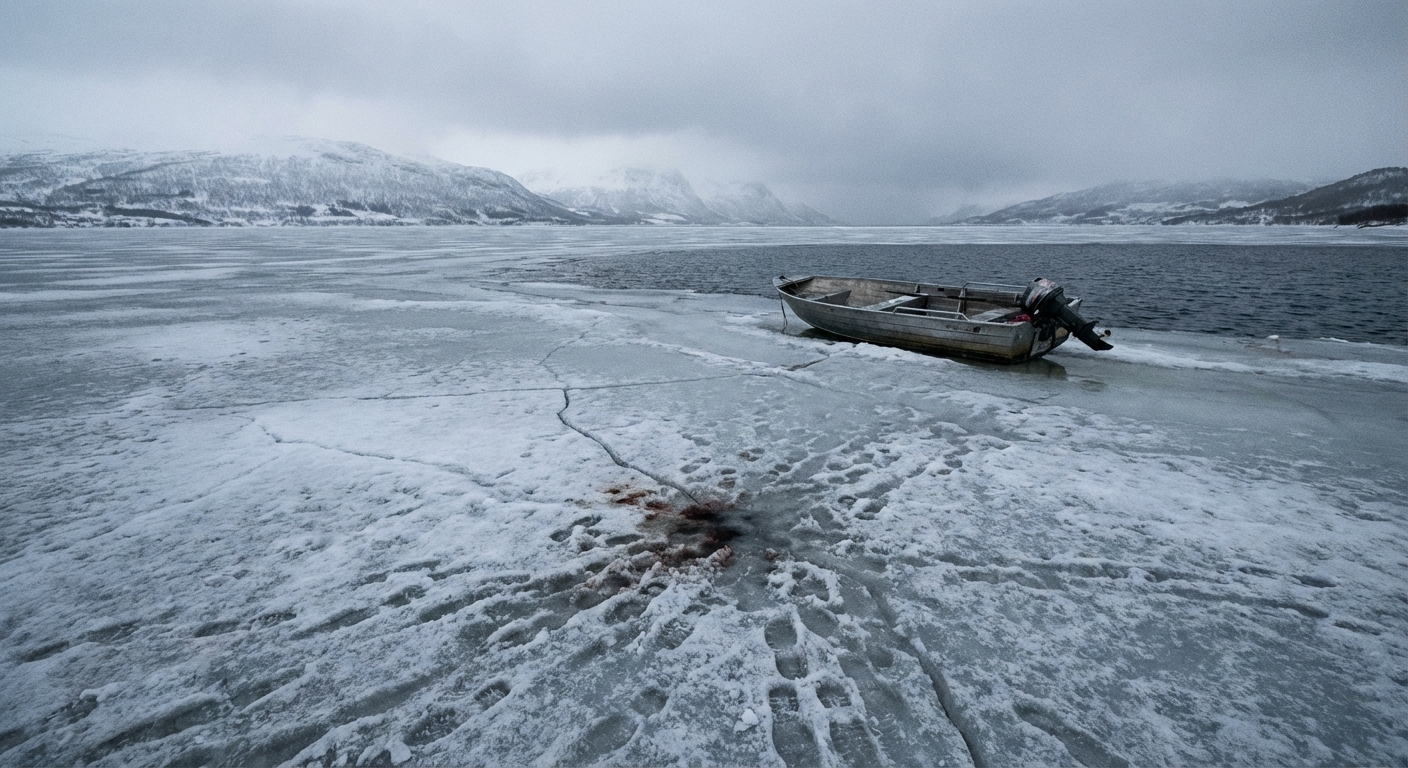
On 20 March — the day after the boat was recovered — a police search team walking the ice shelf along the western shore near Stocke discovered a set of marks on the ice surface approximately 1.2 kilometers north-northwest of the point where the boat had been spotted drifting. The marks were in an area of solid ice, roughly forty centimeters thick, bordered on the eastern side by open water.
The marks included:
- Scrape marks consistent with a boat hull being dragged or pushed across ice. The marks ran approximately fifteen meters from the edge of the open water channel onto the solid ice shelf.
- Two sets of boot prints in the thin layer of slush covering the ice surface. One set was later matched to the brand and size of boots owned by Göran Lundblad. The second set was a different size — smaller — and a different tread pattern.
- A drag mark running parallel to the scrape marks, approximately body-width, extending from a point near the boot prints toward the open water edge.
- Discoloration on the ice near the drag mark's starting point, which field testing indicated was consistent with blood. Samples were collected.
The blood samples were tested at the National Board of Forensic Medicine laboratory in Linköping. They were confirmed as human blood, type A-positive — the same blood type as Göran Lundblad. DNA analysis, which was in its early stages of adoption by Swedish police in 1994, was attempted but produced inconclusive results due to the dilution of the samples by meltwater.
The Second Person
The second set of boot prints on the ice became the central focus of the investigation. Someone had been on that ice shelf with Göran Lundblad. Someone whose boots did not match his.
Jämtland County Police established a major investigation team — an unusual step for a missing-person case, reflecting the physical evidence of a second party and blood on the ice. The team was led by Detective Inspector Lars-Erik Nilsson, who would spend the next two years on the case.
The boot prints were photographed and cast. The tread pattern was identified as consistent with a Tretorn brand rubber boot, size 41 — a common Swedish outdoor boot available in every hardware and sporting goods store in the region. The size suggested a person with relatively small feet — either a small-statured man or a woman. Göran Lundblad wore size 44 boots.
Investigators reconstructed a possible sequence of events based on the physical evidence:
- Lundblad had navigated his boat through the open water channel and pulled up onto the ice shelf, as fishermen commonly did to access fishing spots on the solid ice.
- A second person was present on the ice — either already there or arriving separately.
- An altercation occurred near the point where the blood was found.
- A body or incapacitated person was dragged from the bloodstain location toward the open water.
- The body entered the open water — either pushed, dragged, or falling through weakened ice at the channel edge.
- The boat was subsequently pushed or drifted back into the open water channel, where it floated south until spotted by farmer Persson.
This reconstruction was circumstantial but internally consistent. It transformed the case from a possible drowning accident to a probable homicide.
Suspects Investigated
The investigation examined Göran Lundblad's personal life, financial situation, and social relationships in exhaustive detail.
**Margareta Lundblad**, his wife of twenty-three years, was interviewed extensively. Their marriage was described by neighbors and friends as stable. Margareta had been at home on Frösön throughout the morning and afternoon of 19 March, confirmed by a neighbor who spoke with her at approximately 11 AM and by phone records showing a call she made to her sister at 1:15 PM. She was not a suspect.
**A business dispute** emerged as a potential avenue. Lundblad had been involved in a disagreement with a former business partner over the division of assets from a small fishing equipment retail operation they had co-owned. The partner, identified in press reports only as Erik S., had threatened legal action over what he claimed was an unfair buyout. Erik S. was interviewed. He provided an alibi — he was in Stockholm for a trade fair on 19 March, confirmed by hotel records and fair registration — and was eliminated.
**A rumored affair** was investigated but never substantiated. A colleague of Lundblad's at a local boating club mentioned that Göran had been seen in the company of a woman from Krokom — a municipality north of Östersund — on several occasions in late 1993. The woman was identified, interviewed, and denied any romantic involvement. She said she had consulted Lundblad about purchasing a used boat. There was no evidence to contradict her account, but investigators noted that she declined to provide her boot size or brand and that her Tretorn boots — visible in her front hallway during the home interview — were not collected for comparison.
**No suspect was ever charged.**
The Lake Keeps Its Own
Lake Storsjön has a documented history of failing to surrender its dead. The depth, the cold, the soft sediment bottom, and the complex current systems mean that bodies entering the lake can be carried significant distances and deposited in locations that defy systematic search. At least three other drowning victims in the lake's modern history were never recovered.
This fact provides a plausible explanation for the absence of Göran Lundblad's body even if he entered the water — whether by accident, by force, or by his own volition. The lake could have taken him and kept him.
But the boot prints and the blood on the ice resist the accident theory. The drag mark resists the accident theory. The broken fishing rod and the missing ignition key resist the accident theory. And the second person — the person in the size 41 Tretorn boots — has never come forward to explain what they were doing on the ice that morning.
Detective Inspector Nilsson retired in 2002 without solving the case. In a rare interview with the regional newspaper Östersunds-Posten in 2004, he described the Lundblad case as the one that stayed with him. He said he believed he knew what had happened on the ice. He did not say he knew who had done it. He said the lake had given them everything it could, and that the answer was not in the water. It was on the shore.
The case remains open with Jämtland County Police, classified as a suspected homicide with no active leads. Göran Lundblad was declared legally dead in 2001. His wife Margareta still lives on Frösön. The aluminum boat was returned to her after the investigation. She has never used it.
证据评分卡
Strong circumstantial physical evidence — blood, boot prints, drag marks — but no body, no DNA match, and no murder weapon. The evidence points to foul play but falls short of confirming it.
No witnesses to the events on the ice. Farmer Persson observed only the drifting boat. The Krokom woman's account is unverified and her cooperation was limited.
A dedicated task force was established and significant resources deployed, but the failure to collect the Krokom woman's boots and the limited DNA analysis of the blood samples represent missed opportunities.
Modern sonar technology could potentially locate the body. If preserved evidence allows DNA re-analysis, the blood samples and boot print casts could be re-examined. The case remains open and theoretically solvable.
The Black Binder分析
The Lundblad case is a study in how a single piece of overlooked evidence can define the trajectory of an unsolved investigation. The boot prints on the ice — specifically, the second set of prints — transformed this from a routine drowning inquiry into a homicide investigation. But the investigation's focus on the prints may have paradoxically limited its effectiveness by drawing attention away from the more telling behavioral evidence.
**The Broken Fishing Rod**
The fishing rod found broken into two pieces in the bow of the boat receives almost no analytical attention in available accounts. A fishing rod does not break in half during normal use or during a boat drifting unmanned across a lake. It breaks when subjected to lateral force — when it is stepped on, struck against something, or used as a weapon. The break point and the force required to snap the rod could indicate whether it was broken by accident (unlikely in the bow of a drifting boat) or during a physical confrontation.
If the rod was broken during an altercation in the boat — before or after the events on the ice — it suggests the confrontation may have begun on the water, not on the ice shelf. This would change the reconstructed sequence of events significantly: the perpetrator may have been in the boat with Lundblad, not waiting on the ice.
**The Missing Ignition Key**
The outboard motor's ignition key was not in the boat. It was not on the ice. It was not found during any search. Göran Lundblad's house keys and car keys were recovered from his car at the Badhusparken launch. The ignition key alone was missing.
There are two explanations. Either the key was in Lundblad's pocket when he entered the water (and is with his body on the lake bottom), or the second person took it. If the key was taken, the purpose was likely to prevent the boat from being started — to prevent Lundblad from escaping by boat after whatever happened on the ice. This would indicate premeditation: the second person planned for the possibility that Lundblad might try to flee.
**The Krokom Woman**
The woman from Krokom — interviewed once and never recalled for follow-up — presents the investigation's most conspicuous gap. She declined to provide her boot size. Her Tretorn boots were visible but not collected. Her explanation for her association with Lundblad — that she was consulting about purchasing a used boat — is plausible but unverified. And the investigation's available record does not indicate whether her alibi for 19 March was ever established.
The tread pattern on the ice was consistent with Tretorn boots, size 41 — a size consistent with many women. The association between Lundblad and this woman was recent (late 1993). The nature of their relationship was disputed. These facts do not constitute evidence of involvement, but they constitute grounds for a far more thorough investigation than the single interview that apparently occurred.
**What the Ice Evidence Actually Proves**
The physical evidence on the ice proves the following beyond reasonable dispute: a second person was present; blood consistent with Lundblad's was shed; something body-sized was dragged toward open water. It does not prove murder. The blood could have resulted from a fall on the ice. The drag mark could have been Lundblad dragging equipment. The second person could have been an innocent fisherman who left before anything happened.
But the convergence of evidence — blood, drag marks, second boot prints, missing key, broken rod, empty boat, vanished fisherman — creates a pattern that is far more consistent with violence than with accident. Detective Inspector Nilsson's cryptic comment that the answer was not in the water but on the shore suggests he believed the perpetrator was identifiable from the land-based investigation but that sufficient evidence for prosecution was never obtained.
**The Lake as Accomplice**
Storsjön's failure to surrender Lundblad's body is the decisive factor in the case's unsolved status. Without a body, the cause of death cannot be confirmed. Without confirmed cause of death, the homicide classification remains provisional. And without a confirmed homicide, the threshold for arrest and prosecution — already high in the Swedish legal system — becomes effectively unreachable.
The lake is not merely a crime scene. It is the mechanism by which the crime was concealed. Whoever was on that ice on 19 March 1994 understood that what the lake takes, it keeps. That knowledge — specific, local, intimate — is the perpetrator's most identifying characteristic.
侦探简报
You are reviewing the 1994 disappearance of Göran Lundblad from Lake Storsjön in Jämtland, Sweden. The physical evidence — blood on ice, two sets of boot prints, a drag mark toward open water, a broken fishing rod, and a missing ignition key — points to homicide. No body has been recovered. No suspect has been charged. Start with the Krokom woman. She was seen with Lundblad multiple times in late 1993. She declined to provide her boot size during her single interview. Tretorn boots matching the size 41 prints were visible in her home. Request a formal interview with boot comparison. Establish her precise whereabouts on 19 March 1994 — not through self-reporting but through independent verification: phone records, witness statements, vehicle sightings. Next, re-examine the broken fishing rod. Obtain it from the evidence archive and have it analyzed by a materials specialist. Determine the force vector and direction of the break. A rod broken by being stepped on produces a different fracture pattern than one broken by lateral impact during a struggle. Pursue the missing ignition key. It was not in the boat, not on the ice, not in Lundblad's car. If the key was taken by the second person, it may still exist — either discarded somewhere between the lake and the perpetrator's home, or retained. A search warrant for the Krokom woman's property, if she can be established as a person of interest, should include the key in the list of items sought. Finally, consider sonar technology. Modern side-scan sonar and autonomous underwater vehicles can map lake bottoms with centimeter-level resolution. Lake Storsjön has never been systematically surveyed for remains. A targeted sonar search of the area between the ice evidence site and the boat recovery point, accounting for current modeling, could locate Lundblad's remains and transform this from a suspected homicide into a confirmed one.
讨论此案件
- The second set of boot prints on the ice proves a second person was present, but not that they committed a crime. What additional physical evidence would be needed to transform the presence of a second person into evidence of homicide?
- Detective Inspector Nilsson said the answer was 'not in the water but on the shore.' What do you think he meant, and does this statement suggest he had a specific suspect in mind who could not be charged due to insufficient evidence?
- The Krokom woman declined to provide her boot size and her visible Tretorn boots were not collected for comparison. Should investigators have obtained a warrant for the boots, and what legal and ethical considerations govern that decision in the Swedish system?
来源
特务理论
登录后分享你的理论。
No theories yet. Be the first.