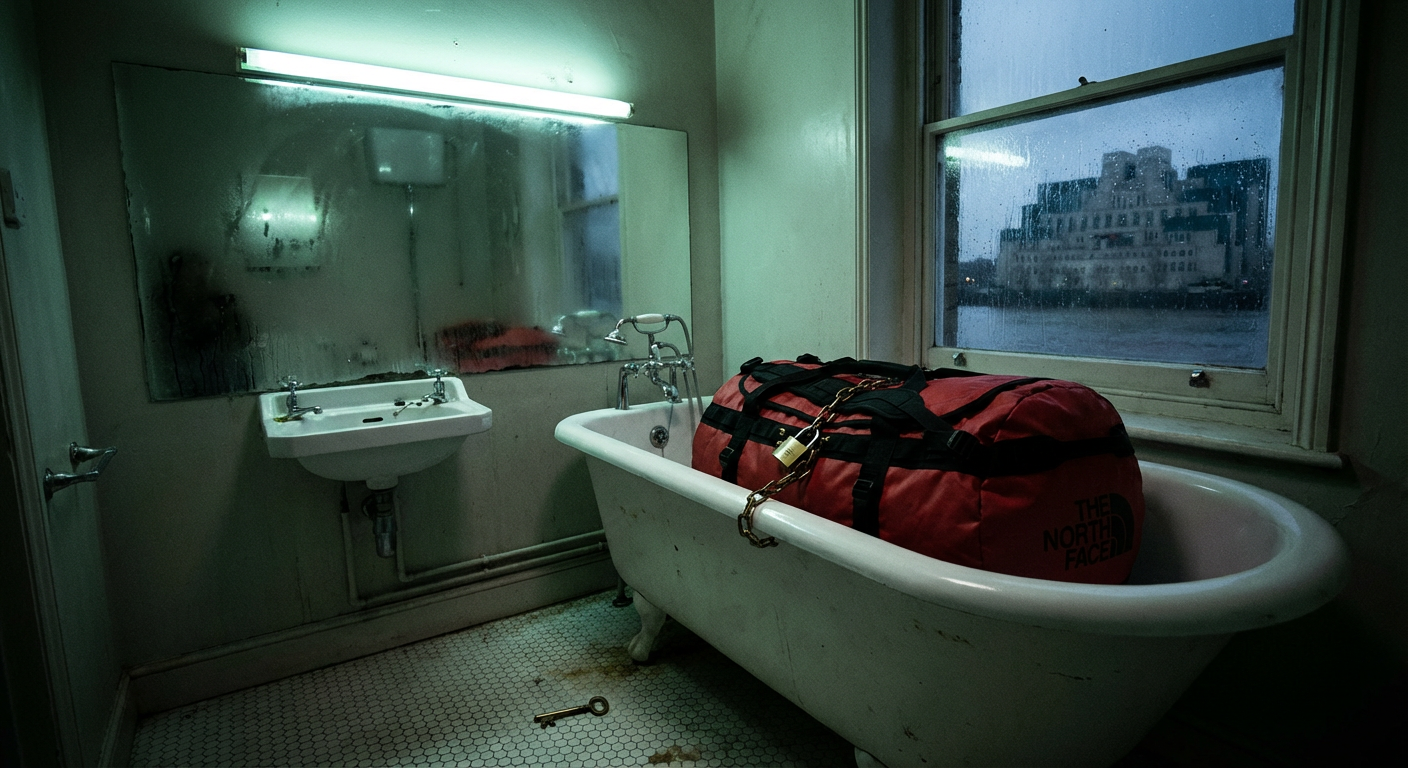
The Flat on Alderney Street
On August 23, 2010, officers from the Metropolitan Police entered a top-floor flat at 36 Alderney Street in Pimlico, central London. The flat was a safe house — a property maintained by the Secret Intelligence Service, commonly known as MI6, for use by its personnel. The officers were conducting a welfare check. No one at MI6 or GCHQ had heard from the flat's occupant in over a week.
What they found inside the bathroom would generate one of the most bizarre and contentious death investigations in modern British history.
A large red North Face holdall bag sat in the centre of the bathtub. Inside the bag, in a foetal position, was the naked, decomposing body of Gareth Wyn Williams. He was thirty-one years old. The bag was padlocked shut from the outside. The key to the padlock was underneath the body, inside the bag. The heating in the flat had been turned to maximum. There were no signs of forced entry. The flat was immaculate — obsessively so.
Gareth Williams had been dead for approximately ten days.
The Mathematician Who Cracked Codes
Williams was born in 1978 in Anglesey, Wales, the son of a farming couple. His mathematical gifts were apparent early. He passed his Mathematics A-level at the age of fourteen. He enrolled at Bangor University at seventeen and earned a first-class degree in mathematics before completing a PhD in the subject.
In 2001, at the age of twenty-two, he joined GCHQ — the Government Communications Headquarters in Cheltenham, Britain's signals intelligence and cryptography agency. His work was classified. What is publicly known is that he specialised in data clustering algorithms and mathematical techniques applicable to communications intelligence. Colleagues described him as gifted, quiet, meticulous, and intensely private.
In 2009, Williams was seconded to the Secret Intelligence Service — MI6 — at their headquarters in Vauxhall Cross, London. The secondment was to last one year. He was given the Alderney Street flat as his London residence. He commuted between London and Cheltenham, returning to Wales to visit his family regularly.
Williams lived alone. He had few close friends in London. His social life, to the extent it existed, was private and carefully compartmentalised. He was a keen cyclist, an accomplished climber, and had a notable interest in fashion and high-end clothing. His flat contained over £20,000 worth of designer women's clothing and accessories, neatly stored and apparently unworn. This detail would be leaked to the tabloid press and become a lurid fixation that obscured the more substantive questions about his death.
The Nine Days Nobody Noticed
Gareth Williams was last seen alive on August 11, 2010. He had attended a meeting at Vauxhall Cross that day. He did not report for work on August 12 or any subsequent day.
No one at MI6 contacted him. No one visited the flat. No one called his mobile phone. No one emailed. For nine full working days, a GCHQ officer on active secondment to MI6 simply failed to appear at one of the most security-conscious workplaces in the world, and not a single person raised an alarm.
It was Williams's line manager at GCHQ in Cheltenham — not anyone at MI6 in London — who eventually noticed his absence and requested the welfare check on August 23. The Metropolitan Police forced entry to the flat that evening.
This nine-day gap has never been satisfactorily explained. MI6 told the inquest that Williams had been given "informal permission" to work from home for a period. His colleagues assumed he was in Cheltenham. Cheltenham assumed he was in London. The result was a dead intelligence officer decomposing in a bathtub for nearly two weeks while two of Britain's most powerful intelligence agencies failed to notice he was gone.
The Forensic Puzzle
The central forensic question was stark: could Gareth Williams have locked himself inside the bag?
The Metropolitan Police's investigation, codenamed Operation Dogtooth, commissioned multiple expert attempts to replicate the feat. Over the course of the investigation, **more than 300 attempts were made by experts, including a yoga specialist, a professional contortionist, and military survival instructors, to lock themselves inside an identical bag from the inside. None succeeded.**
The bag was a standard North Face holdall, approximately 32 inches long. Williams was five feet eight inches tall and weighed approximately 57 kilograms. To fit inside, he would have needed to fold himself into a tight foetal position. The padlock was a combination lock positioned on the outside of the bag's zipper. The key was found beneath the body.
No fingerprints were found on the padlock. No fingerprints were found on the bathtub. No fingerprints were found on the bag's zipper. The flat had been wiped — or had never been touched by anyone other than a careful occupant wearing gloves.
No traces of drugs, alcohol, or poison were found in Williams's system, though decomposition had advanced to a point where toxicological analysis was limited. The pathologist could not definitively establish a cause of death. Suffocation was considered the most likely mechanism.
Williams's personal computers and phones had been wiped. The browsing history on his work laptop had been deleted. SIS initially told police that Williams had no work laptop. This was later corrected.
The Inquest
The inquest into Gareth Williams's death was held in April 2012, presided over by Westminster Coroner Dr Fiona Wilcox. It lasted eight days.
Dr Wilcox's narrative verdict was unambiguous: **"On the balance of probabilities, Gareth was killed unlawfully."** She stated that a third party had placed Williams in the bag and locked it. She noted the complete absence of Williams's DNA on the padlock — an impossibility if he had handled it himself. She criticised MI6 for a "lack of curiosity" about Williams's absence and for the delay in raising the alarm.
She further stated that SIS had "hampered" the investigation through a "drip-feed of information" and that their evidence to the inquest had been "deliberately misleading."
SIS issued a statement acknowledging "shortcomings" in their welfare procedures.
The Metropolitan Police's Reversal
Despite the coroner's finding of unlawful killing, the Metropolitan Police reached a strikingly different conclusion.
In November 2013, Deputy Assistant Commissioner Martin Hewitt announced the results of a review of the case. The Met's position: **the most probable explanation was that Williams had died alone in his flat, accidentally, while engaging in self-enclosure inside the bag.** The death was "most probably" an accident.
Hewitt acknowledged that experts had been unable to replicate the feat but stated that this did not make it impossible. He said there was no evidence of a third party entering the flat. He conceded that the investigation had been hampered by MI6's lack of cooperation.
The family rejected this conclusion. Kevin Williams, Gareth's father, said: "Somebody else was in that flat and they locked that bag."
The Traces That Were Never Explained
Several pieces of evidence have never been publicly reconciled.
**The heating.** The flat's heating was set to maximum in August — one of the warmest months in London. This would accelerate decomposition dramatically, degrading forensic evidence. An accidental death would not explain why the heating was turned up. A staged scene would.
**The cleanliness.** Not a single fingerprint was recovered from the bath, the bag, or the padlock. Williams's own fingerprints were absent from surfaces he would have touched daily. The flat had either been meticulously cleaned, or someone wearing gloves had been the last person to touch those surfaces.
**The phones.** Williams's personal mobile phone was found neatly placed on a table in the living room. His SIM cards — he had multiple — were found laid out in a row. His phones had been reset to factory settings.
**The computers.** His internet browsing history had been deleted. SIS initially denied he had a work computer. When pressed, they acknowledged he did. The contents were classified.
**The visitor.** A woman described as Mediterranean in appearance was seen on CCTV near the flat on a date close to Williams's last confirmed sighting. She was never identified.
What Was He Working On?
This is the question that sits behind every other question in this case.
Gareth Williams was a specialist in data analysis and mathematical cryptography, on secondment to MI6's technology division. His work was classified at the highest levels. No details of his specific projects have ever been disclosed.
What is known from investigative reporting is that Williams had attended a signals intelligence conference in the United States — at the NSA's Fort Meade facility — shortly before his death. The nature of the conference and his role in it have not been publicly confirmed.
In 2015, Russian defector Boris Karpichkov claimed that Williams had been murdered by Russian intelligence operatives because he had uncovered details of Russian agents operating within GCHQ or MI6. This claim was reported by multiple outlets but has not been corroborated by any official source.
SIS has never commented on the nature of Williams's work or whether his death could be connected to his professional activities.
The Silence
No one has been arrested. No one has been charged. No suspect has ever been publicly identified.
The Metropolitan Police closed their investigation. The coroner's verdict of unlawful killing stands but has produced no prosecution. MI6 acknowledged procedural failures and moved on.
Ellen and Ian Williams, Gareth's parents, have continued to press for answers. In a rare public statement, they described their son as "a gentle, private young man" and said the leaking of details about his personal life to the tabloid press had been "a violation of his memory."
The bag remains the case's indelible image. A red North Face holdall, padlocked from the outside, sitting in a white bathtub in a spy agency safe house. A body folded inside like a discarded secret.
The key was under the body.
Nobody's fingerprints were on the lock.
证据评分卡
Strong circumstantial evidence — locked bag, no fingerprints, wiped electronics, 300 failed replication attempts — but decomposition degraded direct forensic evidence of cause and mechanism of death.
MI6 was found to have been 'deliberately misleading' by the coroner; the unidentified woman near the flat was never traced; no witness to the death itself has come forward.
The investigation was systematically hampered by MI6's obstruction, the nine-day decomposition period, and the Met's subsequent contradictionof the coroner's unlawful killing verdict.
Resolution would require disclosure of classified MI6 and GCHQ materials, which no British government has shown willingness to provide; without institutional cooperation, the case cannot advance.
The Black Binder分析
The Institutional Architecture of Obstruction
The Gareth Williams case is not primarily a forensic mystery. The forensic evidence — the locked bag, the absent fingerprints, the impossibility of self-enclosure demonstrated over 300 attempts — points strongly in one direction. The coroner concluded unlawful killing. The physical evidence supports that conclusion.
The real mystery is institutional. Why did the Metropolitan Police contradict the coroner? Why did MI6 obstruct the investigation? And what does the pattern of obstruction reveal about who may have been responsible?
**The nine-day reporting gap is the most significant fact in this case, and it has been consistently undertreated.** MI6 is an organisation where personnel are subject to constant security monitoring. Officers carry encrypted devices. Their movements are tracked. Their communications are logged. For a seconded GCHQ officer to vanish for nine working days without triggering a single alarm is not a welfare failure. It is either a catastrophic systems breakdown at one of the world's most sophisticated intelligence agencies, or it is intentional.
If intentional, the question becomes: who benefited from the delay? The answer is straightforward. Whoever was in that flat last benefited from nine days of decomposition in a flat with the heating set to maximum. Decomposition degrades DNA evidence, toxicological evidence, and the ability to establish time and mechanism of death with precision. Nine days at elevated temperature is not an accident that favours the investigation. It is an outcome that favours concealment.
**MI6's behaviour during the investigation is consistent with an agency protecting itself, not an agency cooperating with a homicide inquiry.** They initially denied Williams had a work laptop. They drip-fed information. They were described by the coroner as "deliberately misleading." They classified all details of Williams's work. They refused to disclose what he was working on, who he was meeting, or whether his professional activities had generated any threat.
This pattern is not unique. British intelligence agencies have a documented history of obstructing investigations into deaths connected to their operations — from David Kelly in 2003 to the poisoning of Alexander Litvinenko in 2006. The pattern is consistent: acknowledge procedural shortcomings, express regret, classify the substantive evidence, and allow the case to die of bureaucratic attrition.
**The Metropolitan Police's reversal of the coroner's finding deserves particular scrutiny.** In British law, a coroner's inquest is an independent judicial proceeding. The coroner found unlawful killing. The Met's subsequent announcement that the death was "most probably" accidental directly contradicted a judicial finding without new evidence. This is not standard procedure. It suggests institutional pressure — from SIS, from the Home Office, or from within the Met itself — to close a case that was generating uncomfortable questions about intelligence agency accountability.
**The most underreported element is Williams's trip to the NSA.** If Williams attended a signals intelligence conference at Fort Meade shortly before his death, the nature of that conference and the intelligence he was exposed to there becomes directly relevant. The intersection of GCHQ and NSA operations — particularly in 2010, at the height of joint surveillance programmes that would later be exposed by Edward Snowden — is precisely the kind of operational territory where a young mathematician might encounter information that made him a target.
The question this case ultimately poses is not who killed Gareth Williams. It is whether the British state is capable of investigating the death of one of its own intelligence officers when the answer might implicate the intelligence apparatus itself.
侦探简报
You are looking at a death scene that defies the official explanation and an investigation that was systematically undermined by the very agency that employed the victim. Start with the bag. Over 300 expert attempts to replicate self-enclosure in an identical bag failed. No fingerprints were found on the padlock, the zipper, or the bathtub. The coroner concluded unlawful killing. The Met later said accident. You need to decide which institutional conclusion you trust and why. Examine the nine-day gap. Williams last attended MI6 on August 11. Nobody raised an alarm until August 23. MI6 said he had informal permission to work from home. In an organisation that monitors its officers' encrypted communications and physical access to secure facilities, a nine-day absence without any electronic check-in is not a welfare oversight. Ask yourself what that gap was actually for. Look at the flat. Heating set to maximum in August. No fingerprints on any relevant surface. Phones reset to factory settings. SIM cards laid out in a row. Browsing history deleted. Work laptop initially denied by MI6, then acknowledged. This is not the scene of an accident. This is a scene that has been prepared. Consider the woman on CCTV near the flat around the date of Williams's last sighting. Mediterranean appearance. Never identified. Never traced. In one of the most heavily surveilled neighbourhoods in London, within walking distance of MI6 headquarters, an unidentified woman near a spy's flat during the window of his death was never found. Your primary task is to establish what Williams was working on in the weeks before his death and whether his trip to the NSA exposed him to information that made him a liability. The answers are classified. The people who hold them have already demonstrated their willingness to mislead a coroner's court. Proceed accordingly.
讨论此案件
- Over 300 expert attempts failed to replicate locking oneself inside the bag from the inside, yet the Metropolitan Police concluded Williams most probably died accidentally while doing exactly that — how should we weigh institutional forensic opinions against a coroner's judicial finding of unlawful killing?
- MI6 was described by the coroner as 'deliberately misleading' during the inquest and initially denied Williams had a work laptop — does this pattern of obstruction more likely indicate an agency covering up its own involvement, or an agency reflexively protecting classified operations regardless of the circumstances?
- If Williams was murdered by a foreign intelligence service — as claimed by the Russian defector Karpichkov — would MI6's behaviour during the investigation be consistent with an agency that knows the truth but cannot disclose it without revealing intelligence sources, or with an agency that genuinely does not know what happened?
来源
- BBC News — Gareth Williams inquest: Spy's death 'probably unlawful' (2012)
- The Guardian — Gareth Williams probably died alone, Met police say (2013)
- The Guardian — MI6 'failed to act' over spy Gareth Williams's disappearance (2012)
- The Independent — Gareth Williams: The unsolved mystery of the spy in the bag
- BBC News — Gareth Williams death: Spy 'probably locked himself in bag' (2013)
- The Telegraph — 300 attempts to lock bag from inside all failed (2012)
特务理论
登录后分享你的理论。
No theories yet. Be the first.