The Radio Call
The evening of 12 March 1992 is mild in northern Alabama, the kind of early spring night that smells of damp earth and warming asphalt. Redstone Arsenal — a vast military installation sprawling across nearly forty thousand acres south of Huntsville — is winding down. The base houses the Army's missile and rocket development programs, thousands of civilian and military personnel, and its own police force.
Specialist Chad Langford is twenty years old. He has been a military police patrolman at Redstone Arsenal for approximately a year. He is on evening patrol, alone in his unit, covering one of the base's interior road circuits. At approximately 7:40 PM, his voice comes over the dispatch radio.
He needs assistance. He has stopped to help what he describes as a violent motorist — someone who turned on him. The transmission is brief. Dispatch acknowledges and sends backup.
This is the last time anyone hears Chad Langford speak.
The Scene
When military police units arrive at Chad's location, they find something that does not look like a traffic stop gone wrong. It looks like something far more deliberate.
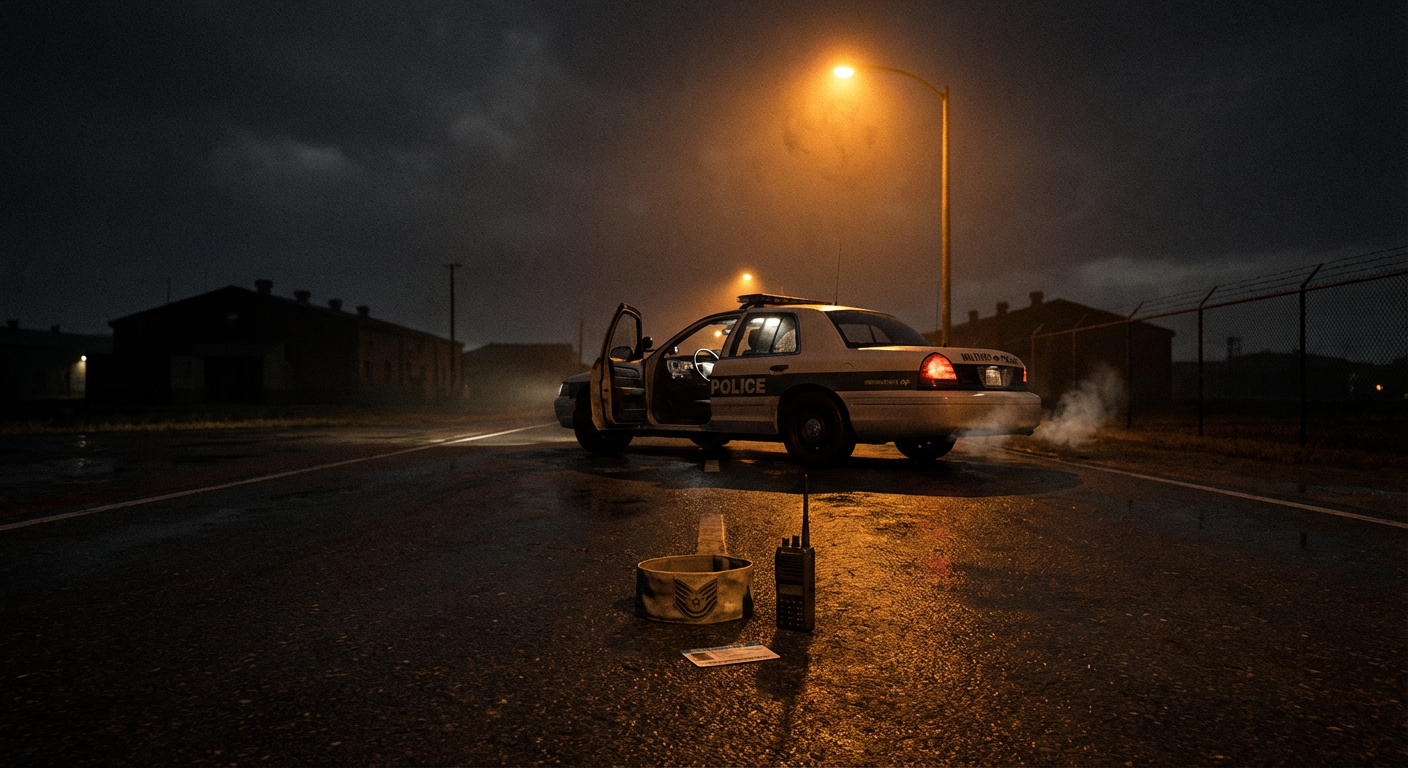
In the middle of the road, arranged with an almost ceremonial precision, lie three objects: Chad's MP armband, his portable radio, and his military identification card. They are not scattered. They are placed. Further down the road, approximately a quarter mile away, the patrol car sits with its engine running.
Chad Langford is outside the vehicle. He is on the ground. His condition is this:
His patrol cap has been stuffed into his mouth.
The lanyard from his handgun is wrapped around his ankles.
Handcuffs are locked onto his left wrist.
The unit's radar cable is wrapped around his neck.
The date "March 3" is written on his hand. The name "Robert" is also written on his hand.
His .45 caliber service pistol lies beneath his left shoulder.
There is a single gunshot wound to his head.
Chad is barely alive. He is rushed to Huntsville Hospital, where he dies a few hours later without regaining consciousness.
The Ruling
The Army's Criminal Investigation Division — CID — takes the case. Their investigation concludes within weeks. The official finding: suicide.
Chad Langford, according to the Army, bound himself with his own handcuffs, wrapped his own radar cable around his neck, tied his own ankles with his pistol lanyard, stuffed his own cap into his mouth, arranged his personal items in the road, and then shot himself in the head.
His father, Jim Langford, receives this finding and responds with a fury that has not diminished in the decades since. The ruling, he says, is not merely wrong. It is absurd.
The Evidence That Doesn't Fit
The physical evidence at the scene contains multiple elements that contradict the suicide determination, and the investigation's handling of this evidence raises questions that have never been satisfactorily answered.
Two .45 caliber shell casings are found at the scene. One is consistent with the fatal shot. The second has never been explained. A person committing suicide fires once. Two casings suggest either a missed shot — unusual with a service pistol pressed to one's own head — or a second person firing.
Lab tests on Chad's hands find no evidence that he recently fired a gun. Gunshot residue analysis — even the less sensitive tests available in 1992 — should detect residue on the hands of a person who has just fired a .45 caliber pistol. The absence of residue is consistent with someone else pulling the trigger.
Fingerprints are found on Chad's radio and handcuffs. For reasons that have never been explained, these fingerprints are not checked against any database. They are not compared to Chad's prints. They are not run through criminal records. Unknown fingerprints are also found on his MP armband and military ID card — the items placed in the road. These too are not analyzed.
The writings on Chad's hand — "March 3" and "Robert" — are never satisfactorily interpreted. March 3 is nine days before the death. The name Robert does not correspond to any known associate of Chad's in the official record. If Chad wrote these on his own hand, their meaning is unexplained. If someone else wrote them, the implications are darker still.
The Undercover Work
Chad Langford's father provides a piece of context that transforms the case from a disputed suicide into something that looks very much like a murder with a motive.
In February 1992, approximately one month before his death, Chad told his father Jim that he had been recruited for undercover work on Redstone Arsenal. The assignment, according to Chad, involved investigating drug activity on the base. He told his father that the work was dangerous and that he had received death threats as a result.
Chad did not provide specifics about who recruited him, what unit oversaw the operation, or which individuals were targets of the investigation. The Army has never confirmed that Chad was involved in any undercover work. CID's position is that no such operation existed.
But Chad's family points to behavioral changes in the weeks before his death that are consistent with his claims. He became more guarded in conversations. He expressed fear. He told his father that if anyone found out what he was doing, he could be killed.
If Chad Langford was investigating drug trafficking on Redstone Arsenal, and if the subjects of that investigation learned they were being watched by a twenty-year-old MP, the motive for murder is self-evident. And the staging of the scene as a suicide becomes not a mystery but a method — a standard technique for eliminating an informant while ensuring the investigation dies with him.
The Investigation's Failures
The CID investigation of Chad Langford's death exhibits a pattern of omissions that his family and their advocates describe as deliberate.
The unmatched fingerprints are the most damning omission. In a case where the central question is whether Chad was alone at the time of his death, fingerprints on his equipment that do not belong to him are the single most important piece of evidence. The decision not to analyze them is either incompetent or intentional. There is no third explanation.
The second shell casing receives no meaningful analysis in the official record. If Chad fired twice — once missing and once fatally — the miss should have been investigated. Where did the first bullet go? Was it recovered? If a second person fired a .45 at the scene, that bullet may be embedded in the ground or in the patrol vehicle. The record does not indicate that a search for the second bullet was conducted.
The radio call itself is a problem for the suicide theory. Chad radioed dispatch requesting assistance with a violent motorist. If he was planning to kill himself, why would he call for help first? The call makes sense only if there was actually a threatening person at the scene — someone Chad encountered, or someone who was waiting for him.
The Army reviewed the case after it was featured on the television program Unsolved Mysteries in the 1990s. The review did not change the ruling. No additional investigation was conducted. The finding remains: suicide.
The Arrangement in the Road
Return to the three objects placed in the middle of the road: the MP armband, the portable radio, the military ID card. These items were not dropped. They were not knocked from Chad's person during a struggle. They were arranged.
A suicidal person does not arrange his identification in the road before killing himself. The arrangement serves a different purpose: it marks the scene. It says, come here. It draws the responding officers to this point, where they will then look down the road and find the patrol car, and then find Chad.
This is staging. It is the behavior of someone who wants the body to be found quickly and in a specific context — the context of a suicide. It is the behavior of someone who has created a scene and needs it discovered before weather, animals, or time can alter it.
The arrangement of personal effects is inconsistent with self-harm and consistent with a perpetrator who has killed someone and is constructing a narrative around the body.
Where It Stands
Chad Langford's death remains officially classified as a suicide by the United States Army. His father, Jim Langford, spent decades fighting to have the ruling overturned. He never succeeded.
The fingerprints on Chad's equipment have never been analyzed. The second shell casing has never been explained. The name "Robert" has never been identified. The undercover drug investigation — if it existed — has never been confirmed or denied with any documentation.
In 2023, the Army established a new Cold Case Division to address unresolved deaths of service members. Whether Chad Langford's case will be among those reviewed is unknown. The family continues to advocate for reopening.
Redstone Arsenal is still operational, still home to the Army's missile development programs, still sprawling across the Alabama landscape. Somewhere on its interior roads, in the spring of 1992, a twenty-year-old military police officer called for help. Help arrived. But it arrived too late, and what it found was a scene that told one story to the Army and a very different story to everyone else.
证据评分卡
Significant physical evidence exists — fingerprints, two shell casings, restraint configuration, gunshot residue absence — but critical items were never analyzed. If preserved evidence can still be tested, the evidentiary picture could change dramatically.
Chad's radio call to dispatch is documented and confirms a second person was present. His father's account of the undercover work is consistent but unverifiable. No eyewitnesses to the actual death have come forward.
The CID investigation failed to analyze fingerprints, adequately explain the second shell casing, or reconcile the suicide ruling with the physical impossibility of the self-binding sequence. The investigation appears to have been conducted to reach a predetermined conclusion.
If fingerprints and ballistic evidence were preserved, modern analysis could identify a suspect. The Army's new Cold Case Division created in 2023 provides a potential institutional pathway for reopening. No statute of limitations applies to murder.
The Black Binder分析
The Anatomy of an Impossible Suicide
The CID's suicide ruling in the Chad Langford case requires believing a sequence of physical actions that is, when examined step by step, extraordinarily difficult to reconcile with a single individual acting alone.
**The Mechanical Problem**
Consider the physical sequence the suicide theory requires. Chad must first remove his MP armband, portable radio, and military ID card, then walk approximately a quarter mile from his patrol car to place them in the road, then walk back to the car. He must then stuff his patrol cap into his own mouth — an act that serves no purpose in a suicide and actively obstructs breathing. He must wrap the radar cable around his neck, tie his ankles together with the pistol lanyard, and lock handcuffs onto his left wrist, all while somehow retaining the manual dexterity and physical freedom to position his .45 caliber pistol and fire.
The order of operations matters. If he ties his ankles first, walking to place items in the road becomes impossible. If he handcuffs his wrist first, his ability to manipulate the other restraints is compromised. If he stuffs the cap in his mouth first, he is partially asphyxiating himself before the gun is even in position. Every sequence produces a mechanical paradox.
Forensic literature on autoerotic asphyxiation sometimes involves self-binding, but the specific combination here — cap in mouth, cable around neck, handcuffs on wrist, ankles bound, gun beneath shoulder — has no documented precedent in suicide literature. It is, however, consistent with the restraint of a victim by one or more assailants.
**The Fingerprint Omission**
In any death investigation where the central question is whether the deceased was alone, unidentified fingerprints on the deceased's personal equipment constitute primary evidence. The decision not to analyze the fingerprints found on Chad's radio, handcuffs, armband, and ID card is the single most significant investigative failure in this case.
The charitable interpretation is incompetence. The less charitable — and, given the institutional stakes, more plausible — interpretation is that running those prints risked identifying someone the Army did not want identified. If Chad was indeed investigating drug activity on the base, his death at the hands of those he was investigating would create an institutional scandal of enormous proportions. A suicide ruling eliminates that scandal.
**The Two Shell Casings**
The presence of two .45 caliber casings at the scene has received insufficient attention. In a suicide by gunshot, one casing is expected. Two casings require explanation. The possible explanations are: (1) Chad fired twice, missing once; (2) a second person fired; (3) one casing was already at the scene from a prior, unrelated event.
Explanation three is possible but unlikely on a controlled military installation where ammunition usage is tracked. Explanation one — a self-inflicted miss followed by a fatal shot — is biomechanically implausible with a .45 pressed to one's own head. Explanation two is the most parsimonious: someone else was firing.
**The Radio Call as Evidence of a Second Person**
Chad's radio call describes a violent motorist. If this person existed — and dispatch logs confirm the call was made — then a second individual was present at the scene in the minutes before Chad's death. The suicide theory requires this person to have been either imaginary (Chad fabricating a threat as a prelude to killing himself) or real but irrelevant (a genuine encounter that ended, after which Chad proceeded to bind himself and fire).
Both alternatives are strained. People planning suicide do not typically fabricate police calls for assistance. And if a violent motorist was genuinely present, his disappearance before the arrival of backup — and his failure ever to come forward — is suspicious in itself.
The simpler reading is that the person Chad described on the radio was his killer, or one of his killers.
侦探简报
You are reviewing the case file on Specialist Chad Langford, United States Army Military Police, found fatally shot on Redstone Arsenal, Alabama, on the evening of 12 March 1992. The Army has ruled the death a suicide. The physical evidence is inconsistent with this ruling. Start with the fingerprints. Unknown prints were found on Chad's radio, handcuffs, MP armband, and military ID card. These were never analyzed. Your first action is to determine whether these prints still exist in evidence storage. If so, submit them for AFIS comparison immediately. If they match any military personnel — particularly anyone connected to drug activity on Redstone Arsenal in 1991-1992 — you have your suspect. Next, investigate the second shell casing. Two .45 caliber casings were found at the scene. Locate both casings in evidence and submit them for ballistic analysis. Determine whether both were fired from Chad's service weapon or from two different firearms. If two weapons were involved, the suicide ruling is definitively disproven. Pursue the undercover angle. Chad told his father he was investigating drug activity on the base. Request all CID records related to drug investigations on Redstone Arsenal from January 1991 through March 1992. Identify any operations involving military police patrolmen as undercover assets. Cross-reference the names of any investigation targets with the personnel rosters for the area where Chad was found. Finally, decode the writings on Chad's hand. "March 3" and "Robert" were written on his hand at the time of death. Pull duty rosters for 3 March 1992 and identify anyone named Robert assigned to Redstone Arsenal. If Chad was meeting a contact — or was given a meeting time and a name — these notations may identify either an ally or a conspirator.
讨论此案件
- The CID ruled Chad Langford's death a suicide despite his body being found bound with multiple restraints, a cap stuffed in his mouth, and no gunshot residue on his hands. What institutional pressures might lead a military investigation to reach a conclusion so at odds with the physical evidence?
- Chad told his father he was working undercover investigating drugs on the base and had received death threats. The Army denies any such operation existed. If you were investigating this case, how would you determine whether the undercover operation was real — and whether its existence was deliberately concealed after Chad's death?
- Two .45 caliber shell casings were found at the scene, but only one gunshot wound was inflicted. What are the possible explanations for the second casing, and which is most consistent with the totality of the evidence?
来源
特务理论
登录后分享你的理论。
No theories yet. Be the first.