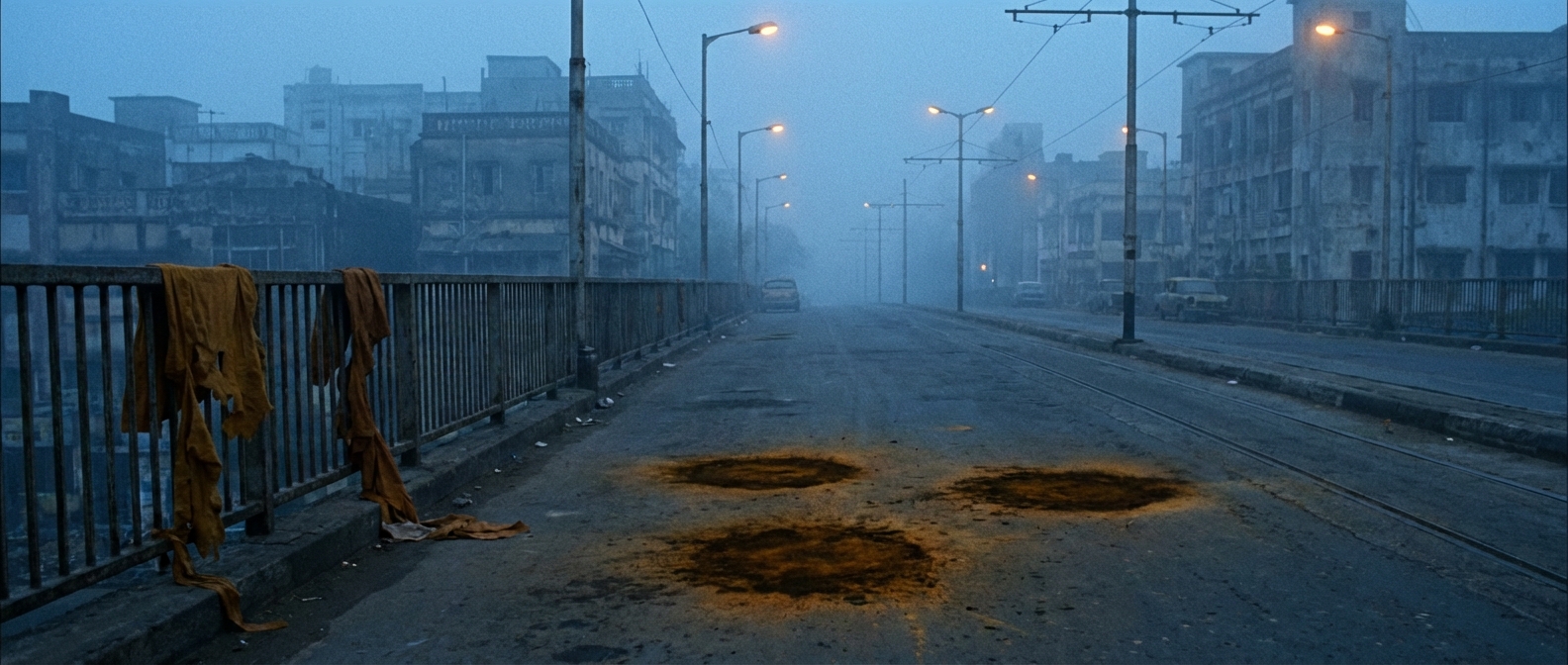
A Morning That Should Have Been Ordinary
The last thing the seventeen monks of Ananda Marga expected on the morning of April 30, 1982, was to die. They had climbed into taxis in the pre-dawn darkness, dressed in the ochre robes of their order, bound for an educational conference at their organization's headquarters in Tiljala, Kolkata. The route took them through the dense residential quarters of Ballygunge and Kasba — neighborhoods they had traveled through many times before.
By 9 a.m., all seventeen were dead. Sixteen monks and one nun had been dragged from their vehicles at three separate choke points across South Calcutta, beaten with iron rods and bamboo poles, hacked with choppers, and doused with kerosene before being set ablaze. The attacks were simultaneous, coordinated across the three locations: Bondel Gate, the Bijon Setu bridge itself, and Ballygunge railway station.
**The entire operation took approximately ninety minutes.** It unfolded in full public view, on a busy weekday morning, witnessed by thousands of passersby and residents. Police arrived after the last body had stopped burning.
Established Record
Ananda Marga — formally Ananda Marga Pracaraka Samgha, meaning "organization for the propagation of the path of bliss" — was founded in 1955 in Jamalpur, Bihar, by Prabhat Ranjan Sarkar, known to followers as Shrii Shrii Anandamurti. The organization combined tantric yoga and meditation with a sweeping socio-political philosophy called **PROUT** (Progressive Utilization Theory), which advocated decentralized economics and opposed both capitalism and Marxism.
That opposition to Marxism placed Ananda Marga on a collision course with the Communist Party of India (Marxist), which had held uninterrupted power in West Bengal since 1977 under Chief Minister Jyoti Basu. By the early 1980s, the CPI(M) had built one of the most formidable political machines in Indian history — a network of party workers, local cadres, and trade unions that penetrated every neighborhood in Calcutta.
Ananda Marga had its own history of controversy. In 1971, founder Sarkar was arrested on charges of conspiring to murder six former disciples who had defected. He was convicted in 1976 and sentenced to life imprisonment. The organization itself was banned during Indira Gandhi's Emergency (1975–1977), its assets seized, its leaders jailed. When the Emergency ended, Sarkar was retried, acquitted, and released in 1978 — a sequence that supporters argued proved the original prosecution was politically motivated.
By 1982, the group was rebuilding. It ran schools, welfare programs, and meditation centers across West Bengal. It also campaigned openly for PROUT — a direct ideological challenge to the Left Front government.
The Detail Everyone Overlooks
In the weeks before April 30, a rumor had spread through the Kasba-Jadavpur neighborhoods of South Calcutta. It was whispered in markets, passed between neighbors, discussed at tea stalls: **the saffron-robed monks of Ananda Marga were kidnapping children.** No child had been reported missing. No FIR had been filed. Not a single police record supported the allegation.
The child-lifting rumor was, in the words of The Statesman Weekly's post-incident investigation, entirely baseless. But it was the stated justification given by mob members when arrested in the days following the massacre. "We thought they were child-stealers," witnesses and arrested individuals reportedly said.
The question the investigations never satisfactorily answered: **who started the rumor, and why?**
The Justice Amitava Lala Commission, formed in 2012 to investigate the killings, uncovered a meeting that had taken place on February 6, 1982 — nearly three months before the massacre — at Colony Bazar in Picnic Garden. According to commission findings, senior CPI(M) figures from the Kasba-Jadavpur area gathered to discuss the Ananda Margis. Those reportedly present included:
- Kanti Ganguly, later a minister in the Left Front cabinet
- Sachin Sen, former CPI(M) MLA (now deceased)
- Nirmal Haldar, local CPI(M) leader
- Amal Majumdar, former councillor for ward no. 108 (Tiljala-Kasba)
- Somnath Chatterjee, then MP from Jadavpur and later Speaker of the Lok Sabha
The commission did not formally conclude that this meeting planned the massacre. But the timing — eighty-three days before seventeen people were burned alive in the same neighborhoods these leaders oversaw — has never been explained.
Evidence Examined
The physical evidence from the Bijon Setu massacre was almost entirely consumed in the fires that killed the victims. Bodies were burned severely enough that identification was difficult. No forensic investigation of crime scene traces was conducted in the immediate aftermath; the police, who arrived after the attacks had concluded, secured none of the locations as crime scenes.
More than **106 people were arrested in the first week** following the incident. Yet within months, charges against most had been dropped or allowed to lapse. No case proceeded to trial. The initial FIR registered by local police produced no charge sheet.
In 1987, five years after the killings, the Central Bureau of Investigation (CBI) was handed the case. The CBI's findings were described by multiple observers as inconclusive. No arrests followed. The investigative file effectively stalled.
The **National Human Rights Commission** took up the matter in 1996. It, too, made no progress.
When the Amitabh Lala Commission finally convened in 2012, its most striking finding was not what it discovered but what it declared absent: **"no eyewitnesses."** This conclusion — applied to killings that occurred in front of thousands of people on a busy urban morning — was widely condemned as either incompetent or deliberately obstructive.
In 2017, Justice Lala traveled to the home of Mamata Bhattacharya, widow of Gangadhar Bhattacharya, the officer-in-charge of Tiljala Police Station who died before he could give testimony. Her deposition was recorded. The commission's final report has never been made fully public.
Investigation Under Scrutiny
The Bijon Setu investigation is, by any measure, one of the most comprehensively failed inquiries in Indian legal history. Consider what was available and what was not used:
- Eyewitnesses: Thousands. No convictions.
- Arrested suspects: Over one hundred in the first week. No trials.
- CBI investigation: Launched 1987. No charge sheet.
- NHRC inquiry: Launched 1996. No progress.
- Judicial commission: Launched 2012. Concluded there were "no eyewitnesses."
Critics note that between 1982 and 2011, West Bengal was governed continuously by the Left Front — the same coalition accused of organizing or enabling the massacre. Every state institution that might have pursued justice operated under the authority of the accused party.
When the Trinamool Congress defeated the Left Front in 2011 and Chief Minister Mamata Banerjee came to power, expectations for accountability rose. The Lala Commission was her government's response. But after years of hearings, the commission's finding of "no eyewitnesses" struck many observers as a repetition of the original cover-up rather than a remedy for it.
**The state police's conduct on the day itself remains unexplained.** Officers were stationed in the area that morning. The attacks lasted ninety minutes across three locations. By all accounts, law enforcement presence at the attack sites was either absent or passive throughout.
Suspects and Theories
Theory 1: Politically Organized Communal Violence
Ananda Marga's official position, maintained for over four decades, is that the massacre was planned and executed by CPI(M) cadres who regarded the organization as an ideological and political threat. PROUT directly challenged Marxist economics; Ananda Marga ran schools and welfare programs that competed with Left Front patronage networks.
The commission's identification of the February 6 meeting, and the presence of senior CPI(M) figures including a future Lok Sabha Speaker, gives this theory its most concrete factual support. The simultaneous nature of the attacks at three locations — requiring coordination across separate groups — also suggests pre-planning rather than spontaneous mob action.
Theory 2: Spontaneous Mob Violence Inflamed by Rumor
The alternative reading, closer to the position of the original Deb Commission (1982), holds that the child-kidnapping rumor spread organically through already-tense neighborhoods and that mobs formed without central direction. Under this theory, the police inaction and investigative failures reflect bureaucratic dysfunction and political embarrassment rather than conscious cover-up.
This reading struggles to account for the simultaneity of the three attacks, the specific targeting of Ananda Marga vehicles, and the complete absence of any documentation supporting the child-kidnapping allegations.
Theory 3: Deliberate Suppression of Evidence
A third position, advanced by Ananda Marga researchers and several independent journalists, holds that the evidence was not merely absent but actively destroyed. Under this view, the early arrests and subsequent release of suspects, the CBI's inconclusive findings, and the commission's "no eyewitnesses" conclusion represent a multi-decade institutional effort to ensure no prosecution ever succeeded.
Where It Stands Now
In April 2025, on the 43rd anniversary of the massacre, BJP IT Cell chief **Amit Malviya posted publicly** about the killings, renewing calls for accountability and naming the Left Front government's role. The case has become a recurring reference point in West Bengal's ongoing political battles between the Trinamool Congress, BJP, and the now-diminished Left.
The Lala Commission's final report remains unpublished in full. No individual has ever been tried, let alone convicted, for the deaths of seventeen people killed in front of thousands of witnesses in the center of one of India's largest cities.
Ananda Marga continues to operate. Its PROUT philosophy is still taught. The bridge at Bijon Setu still carries traffic across the Tolly's Nullah canal in South Calcutta. Every April 30, a handful of monks and supporters gather there.
**No one has ever been held accountable.** The file, in the strictest legal sense, remains open.
证据评分卡
Physical evidence was almost entirely destroyed in the fires; no forensic scene preservation was conducted in 1982.
Thousands of witnesses existed but formal testimony was systematically uncollected or dismissed over four decades of institutional failure.
Multiple investigations — state commission, CBI, NHRC, judicial commission — all produced inconclusive results; the Lala Commission's 'no eyewitnesses' finding is widely regarded as an investigative failure.
Solvability is moderate: surviving witnesses, commission archives, and unreleased CBI files could theoretically support prosecution if political conditions permitted genuine inquiry.
The Black Binder分析
Analysis: The Architecture of Impunity
The Bijon Setu massacre presents one of the most instructive case studies in how a democratic state can allow mass murder to go unpunished — not through a single act of corruption but through the patient accumulation of institutional failures across four decades.
The Simultaneity Problem
The most analytically significant fact about the April 30 attacks is their coordination. Three separate mobs, at three separate locations, attacked Ananda Marga vehicles within the same ninety-minute window. This simultaneity is extraordinarily difficult to explain as spontaneous mob behavior. Spontaneous mob violence clusters — it does not branch and execute parallel operations across separate geographic nodes at the same time.
If the child-kidnapping rumor caused the violence, it must explain not only why mobs formed, but why they formed simultaneously at three different points along the route — which implies prior knowledge of the route, prior assembly of groups at each location, and some mechanism of coordination. None of these preconditions are consistent with purely spontaneous action.
The Rumor as Weapon
The child-kidnapping allegation deserves careful scrutiny as a forensic artifact. The rumor had circulated for weeks before April 30. It was entirely unsupported by any police record, missing persons report, or documented complaint. In the weeks following the massacre, it provided the legal cover that allowed arrested suspects to claim good-faith belief rather than premeditation.
Rumors of this type — circulated in advance of communal violence, focused on a vulnerable group, invoking child safety — are a well-documented feature of organized pogrom preparation in South Asia and elsewhere. The Lala Commission's failure to trace the rumor's origin represents one of the most significant investigative gaps in the entire case.
Political Capture of Institutions
Between 1977 and 2011, the Left Front governed West Bengal without interruption. Every investigative body that handled the Bijon Setu case during this period — the state police, the CBI (whose findings, though nominally independent, are subject to political pressure in India), and the NHRC — operated within a political environment controlled by the accused party.
This is not a claim that all findings were falsified. It is a structural observation: the institutional incentives for accountability were systematically misaligned. The party in power had strong reasons to ensure no prosecution succeeded, and sufficient control over state machinery to make that outcome achievable.
The "No Eyewitnesses" Finding
The Lala Commission's conclusion that there were no eyewitnesses is perhaps the most jarring single element of the post-massacre record. It flies in the face of contemporaneous reporting, survivor accounts, and the basic geography of the attack locations — busy urban intersections on a weekday morning.
Two explanations are possible. Either witnesses refused to give formal testimony (a rational response to fear of retaliation in a state where the accused party still commanded significant influence in 2012–2017), or the commission defined "eyewitness" in a procedurally narrow way that excluded available evidence. Either interpretation reflects a profound failure of justice.
The Evidence Scorecard in Context
What makes Bijon Setu unusual among cold cases is that the evidence problem is not one of absence but of suppression. Unlike many unresolved killings where physical evidence was simply never collected, here there were arrests, FIRs, news photographs, newspaper accounts, and thousands of people who saw what happened. The failure to achieve justice was not investigative — it was political.
This distinction matters for any future accountability effort. The evidentiary raw material for prosecution likely exists in the memories of surviving witnesses, in commission archives, and potentially in CBI files that have never been fully disclosed. The obstacle is not evidence. It is the political will to use it.
侦探简报
You are standing on the Bijon Setu bridge in Kolkata, forty-three years after seventeen people were burned alive here in front of thousands of witnesses. Your task is not to identify the killers — contemporaneous accounts, commission findings, and arrest records already sketch their outlines. Your task is to understand why, despite all of that, not a single person has ever faced trial. Start with the simultaneity. Three attack sites, ninety minutes, coordinated timing. Someone knew the route. Someone pre-positioned groups. Ask yourself: what kind of organization can quietly coordinate three simultaneous mob actions in a city of millions without leaving a traceable order chain? The answer points you toward an apparatus with deep local networks — not a spontaneous crowd. Next, trace the rumor. Child-kidnapping allegations circulated for weeks before April 30. No FIR. No missing child. No complaint. In India, child safety rumors have historically preceded organized anti-minority violence. Who first told the story in these specific neighborhoods? Who repeated it? The Lala Commission never answered this. You should consider why. Look at the February 6 meeting. Senior CPI(M) figures, documented by judicial commission, met to discuss Ananda Marga eighty-three days before the massacre. This is not proof of planning. But it establishes proximity — proximity of motive, proximity of authority, proximity of organizational capacity. Finally, count the bodies of failed investigations: one state commission in 1982, one CBI referral in 1987, one NHRC inquiry in 1996, one judicial commission from 2012 onward. Each produced nothing. Each operated within a political environment where the incentive structure ran against accountability. The case is not cold because the evidence disappeared. It is cold because every institution that could have acted chose not to. That is a solvable problem — if the political conditions change.
讨论此案件
- The child-kidnapping rumor that preceded the Bijon Setu massacre left no documentary trace — no police report, no missing persons filing, no complaint. What does the mechanics of how such a rumor spreads and whom it targets tell us about whether it was organic or engineered?
- The Lala Commission concluded there were 'no eyewitnesses' to killings that occurred on a busy urban bridge in front of thousands of people. What does this finding reveal about the limits of formal legal inquiry as a tool for justice in politically charged cases?
- Forty-three years on, the case has become a recurring piece of electoral ammunition in West Bengal politics, invoked by multiple parties for different purposes. When an unsolved atrocity is repeatedly instrumentalized for political ends, does that make accountability more or less likely — and why?
来源
- Bijon Setu massacre — Wikipedia
- 41 Years On, Justice Awaits Ananda Margis — The Statesman
- Bijon Setu Massacre: When 16 Monks Were Murdered and Set on Fire — OpIndia
- The Bijon Setu Massacre: A Sombre Chapter in the History of Kolkata — The Narrative World (2024)
- A 40-Year-Old Massacre Swept Under the Carpet — HinduPost
- Bijon Setu Massacre — Sarkarverse (Ananda Marga primary source wiki)
- PROUT the Reason for the Bijon Setu Massacre — Prout Globe
- Ananda Marga (1955) — Encyclopedia of Cults, Sects, and New Religious Movements (2025)
特务理论
登录后分享你的理论。
No theories yet. Be the first.