The Doorbell
The town of Nairn sits on the Moray Firth, where the Scottish Highlands meet the North Sea. It is a small place -- fewer than ten thousand people -- with the quiet rhythms of a seaside resort that has settled into off-season permanence. Georgian and Victorian houses line the streets near the harbour. The golf course runs along the beach. In late November, darkness comes early and the wind carries salt.
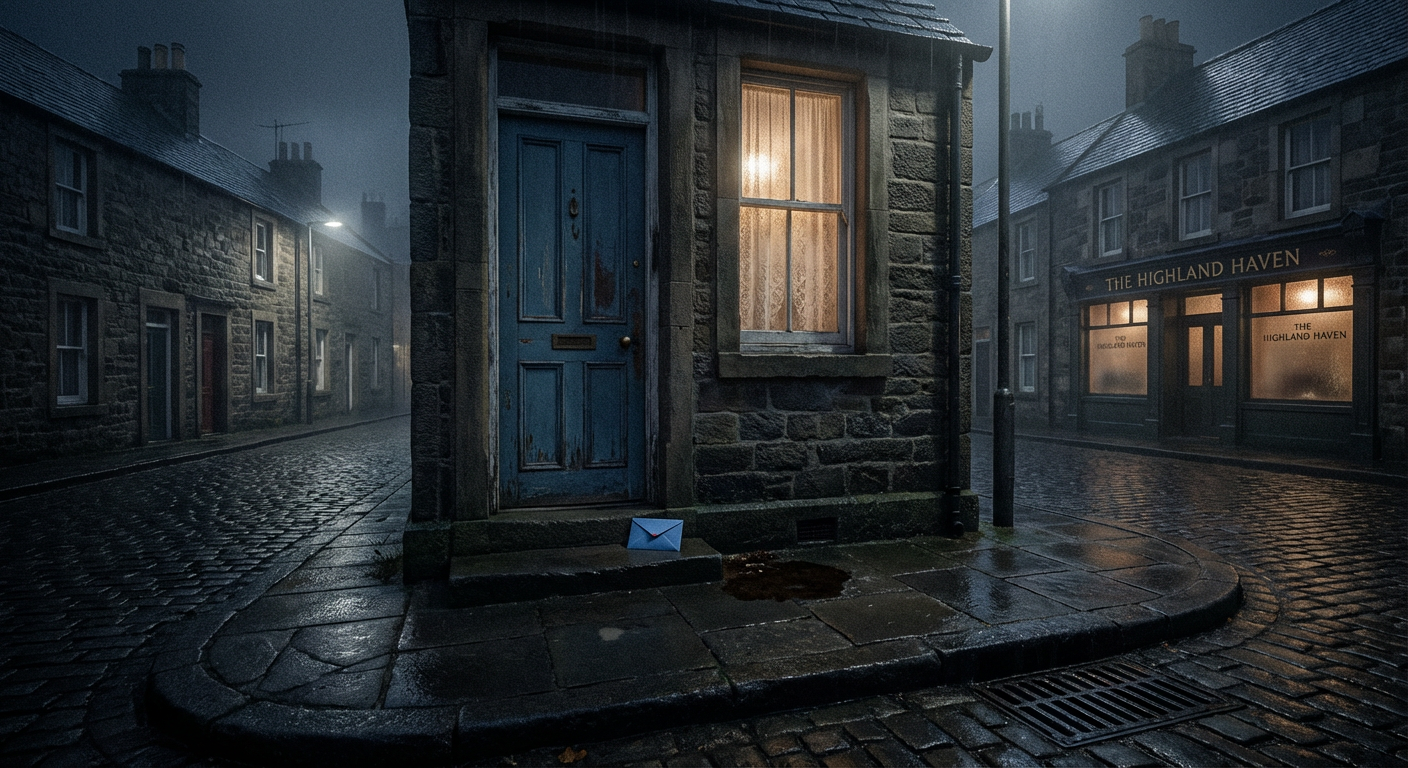
On the evening of Sunday, 28 November 2004, at approximately 7 PM, the doorbell rings at 10 Crescent Road. It is a terraced house in a residential street, unremarkable, the kind of property a young professional family occupies in a Highland town. Alistair Wilson lives here with his wife Veronica and their two young sons, aged two and four. Wilson is thirty years old. He works as a lending manager at the Bank of Scotland's branch in Inverness, a thirty-minute drive west along the A96.
Veronica answers the door. A man stands on the step. He is described, in the account Veronica will give to police and which will be repeated in every subsequent appeal, as stocky, of medium height, wearing a dark blue or black jacket and a baseball cap. He asks for Alistair Wilson by name.
Veronica goes upstairs to the bathroom, where Alistair is bathing the boys. She tells him a man is at the door asking for him. Wilson comes downstairs. He speaks to the visitor briefly. Then he comes back inside, walks partway up the stairs, and shows Veronica an object: a small blue envelope, the size that might contain a greeting card, with the word "Paul" handwritten on it. Wilson appears puzzled. He does not seem alarmed. He says something to the effect that he does not know what it is about.
He goes back down to the front door.
Veronica hears three gunshots.
She runs downstairs and finds her husband lying on the doorstep, fatally wounded. He has been shot in the head. He dies from his injuries. The shooter has disappeared into the November darkness.
The blue envelope is found on the ground near the body. It is empty.
The Weapon in the Drain
Ten days after the murder, on 8 December 2004, Nairn council workmen clearing storm drains find a handgun in a gully on Seabank Road, approximately half a mile from the Wilson family home. Forensic testing confirms it is the murder weapon.
The gun is a Haenel Suhl Model 1 Schmeisser, a small semi-automatic pistol manufactured in Germany between the 1920s and 1945. It is what collectors and firearms experts call a "pocket pistol" -- compact, easily concealed, the kind of weapon that German officers carried as a backup during the Second World War. Many were brought back to Britain by returning servicemen as war souvenirs. They circulated in the margins of British gun culture for decades afterward.
The ammunition used to kill Alistair Wilson is more recent than the gun itself. Forensic analysis dates the cartridges to the 1980s or 1990s. Someone obtained an antique German pistol and loaded it with relatively modern ammunition. This is not the arsenal of a professional hitman. It is the weapon of someone who had access to a war-era souvenir and sourced compatible rounds -- an unusual but not impossible combination in rural Scotland, where old firearms occasionally surface in attics and estate clearances.
The Haenel Schmeisser fires .25 ACP (Automatic Colt Pistol) ammunition, a small-caliber round with limited stopping power at any distance. It is not a reliable killing weapon beyond point-blank range. At the doorstep of 10 Crescent Road, the shooter would have been standing within arm's length of Wilson. Three shots to the head at contact distance ensured lethality despite the weapon's modest ballistic profile.
The Envelope
The blue envelope is the case's most distinctive and most bewildering element. It is small. It is empty. It bears the name "Paul" written on the front.
No one in Alistair Wilson's known circle of family, friends, and colleagues has been identified as someone whose connection to Wilson would be signified by the name Paul and a blue envelope. Wilson did not appear to recognize its significance. His reaction, as described by Veronica, was confusion rather than fear.
The envelope serves an apparent tactical purpose: it provides a pretext for the doorbell call and ensures Wilson comes to the door and stands exposed. But its specificity -- a particular name, a particular color -- suggests it may also carry meaning beyond simple lure. If the envelope was a message, its meaning died with Wilson. If it was purely a ruse, any blank envelope would have served equally well.
The name Paul has generated extensive speculation. Was the shooter named Paul? Was the envelope intended for a different Paul, and Wilson's murder a case of mistaken identity? Was Paul a reference to someone or something known to both Wilson and his killer? These questions have been asked for two decades and none has produced a verifiable answer.
The Investigation
Northern Constabulary -- the police force responsible for the Highlands region in 2004, later merged into Police Scotland -- launched one of the largest murder investigations in Scottish history. Officers conducted thousands of interviews. They went door to door across Nairn. They reviewed CCTV footage from the limited number of cameras in the town center. They appealed repeatedly for witnesses.
The investigation explored multiple theories in its early years. One line of inquiry examined whether the murder was connected to Wilson's work at the Bank of Scotland. As a lending manager, Wilson made decisions that affected people's financial lives -- approving and declining loan applications. Had a disgruntled borrower, a failed businessman, or someone denied credit turned to violence? This theory was investigated extensively but produced no viable suspect.
Another theory examined possible connections to organized crime. The Highlands, despite their tranquil image, are not immune to drug trafficking. Could Wilson have inadvertently become involved in something through his banking work? Again, no evidence linked Wilson to any criminal enterprise.
A mistaken identity theory circulated for years. Had the killer intended to murder someone else? Nairn is small; everyone knows everyone. But the killer asked for Alistair Wilson by name. If it was mistaken identity, the mistake was not random -- it was deliberate targeting of the wrong person.
The Decking Dispute
In April 2022, eighteen years after the murder, Police Scotland made a significant announcement. Investigators stated that they now believed the motive for Wilson's murder lay within his personal life, not his professional activities. Specifically, they pointed to a planning dispute involving the Havelock Hotel, a pub located directly across the street from the Wilson family home on Crescent Road.
In the summer of 2004, the Havelock Hotel had constructed a large decking area in its car park, creating an outdoor drinking and socializing space. The decking generated noise and litter that affected the neighboring residents. Alistair Wilson objected to the development and lodged a formal planning objection with the Highland Council on Thursday, 25 November 2004 -- just three days before his murder.
Police believe Wilson's objection was discussed in the hotel bar on the Friday and over the weekend leading up to the Sunday night killing. The theory is that someone in the pub -- a customer, a builder involved in the construction, or someone connected to the hotel's management -- reacted to Wilson's objection with lethal violence.
Police were careful to state that the hotel's owner at the time was not a suspect. But the connection between the planning objection filed on Thursday and the murder on Sunday suggests a chain of events compressed into seventy-two hours: objection filed, objection discussed in the pub, anger escalated, killing carried out.
In 2023, Police Scotland announced they believed two people had carried out the shooting and that one of them was likely a local individual who had spent time in prison for drug offences. They stated that they had identified this person but had not made an arrest.
The Antique Gun Problem
The Haenel Schmeisser introduces a complication to the decking dispute theory. If the murder was a spontaneous act of rage by a pub customer angry about a planning objection, where did the antique German pistol come from? And where did the compatible ammunition come from?
The weapon suggests premeditation beyond a weekend's anger. Someone had to possess the gun, source the ammunition, and bring both to the Wilson doorstep. This is not the profile of a drunken pub argument that escalated to murder over a Friday-to-Sunday timeline. Either the gun was already in someone's possession -- a war souvenir kept in a drawer -- and the decision to use it was made rapidly, or the murder involved a level of planning that extends the timeline backward beyond the planning objection.
The gun was discarded in a storm drain, not taken away or hidden. This suggests the shooter wanted to be rid of it quickly -- not the behavior of someone who valued the weapon or intended to use it again. It is consistent with someone disposing of an object that linked them to a murder, ditching it in the nearest available concealment.
Twenty Years of Silence
Nairn is a small town. The murder happened on a Sunday evening in a residential street. Someone in Nairn knows something. The population is small enough that a stocky man in a baseball cap walking through the streets before and after the shooting would have been seen by someone. The antique German pistol would have been known to someone -- perhaps the family of a veteran who noticed it missing, perhaps a collector who sold or gave it away.
In 2024, on the twentieth anniversary of the murder, Police Scotland launched an online portal for anonymous information. Wilson's sons, who were two and four when their father was killed on the doorstep while they sat in the bathtub upstairs, are now young men. His elder son has spoken publicly, asking anyone with information to come forward.
The Lord Advocate of Scotland ordered a complete reinvestigation of the case. A new team of prosecutors from the Crown Office and Procurator Fiscal Service, and a new team of Police Scotland officers, are working through the evidence. The forensic capabilities available in 2024 are vastly superior to those of 2004. DNA technology, digital forensics, and enhanced ballistic analysis may yet extract information from the physical evidence that earlier examination missed.
But the blue envelope sits in an evidence locker, still empty, still bearing the name Paul in handwriting that no one has been able to match. And the doorstep of 10 Crescent Road, where Alistair Wilson fell on a November night, still faces the Havelock Hotel across the street.
证据评分卡
The murder weapon was recovered and forensically confirmed. The blue envelope is preserved as evidence. However, no DNA or fingerprint matches have been publicly announced, and the weapon's provenance chain remains unestablished.
Veronica Wilson's account of the evening is detailed and consistent. She provided a physical description of the shooter. However, no other eyewitness to the shooting itself has come forward, and the description is generic enough to match many individuals.
The investigation has been extensive and has undergone a complete reinvestigation ordered by the Lord Advocate. However, the eighteen-year delay before focusing on the Havelock Hotel decking dispute suggests earlier investigative focus may have been misdirected.
Police Scotland has publicly stated they believe two people were involved and have identified one. Modern DNA technology applied to the gun and envelope could yield results. The case is actively being reinvestigated with significantly greater resources and forensic capability.
The Black Binder分析
The Seventy-Two-Hour Timeline
The most striking analytical element of the Wilson case is the compressed timeline between the planning objection and the murder. Wilson lodged his formal objection to the Havelock Hotel decking on Thursday, 25 November 2004. He was killed on Sunday, 28 November. If the police theory is correct that the objection was discussed in the hotel bar and triggered the killing, then the decision to commit murder was made within approximately forty-eight to seventy-two hours of the objection becoming known.
This timeline creates a tension with the weapon. A Haenel Schmeisser pocket pistol with 1980s or 1990s ammunition is not something you purchase at short notice. Either the gun was already accessible to the shooter -- readily available, perhaps stored at home -- or the decision to kill Wilson predates the planning objection. If the former, it suggests someone with existing access to an illegal firearm, which aligns with the police's identification of a suspect with drug convictions. If the latter, the planning objection may have been the final provocation in a longer-running grievance, not the sole cause.
The Blue Envelope as Operational Tool
The envelope deserves more analytical attention than it typically receives. Its function was tactical: it guaranteed that Wilson would come to the door and stand in the open. A stranger asking for someone by name is unusual but not alarming. A stranger handing over an envelope with a name on it creates a moment of cognitive engagement -- the recipient examines the object, tries to make sense of it, and in doing so drops his guard. Wilson's behavior confirms this: he took the envelope inside, showed it to Veronica, expressed puzzlement, and then returned to the door. During that return trip, he was not approaching with caution. He was approaching with curiosity.
This suggests the killer understood Wilson's likely reaction. The envelope was not random. It was designed to produce a specific behavioral response: confusion followed by re-engagement. This indicates either that the killer knew Wilson personally -- knew he would examine the envelope rather than refuse it -- or that the killer had a more sophisticated understanding of human behavior than a pub regular angry about a decking dispute.
The Two-Person Theory
Police Scotland's 2023 statement that they believe two people were involved opens important analytical territory. If two people carried out the shooting, what were their respective roles? The most obvious configuration is one person at the door and one person as a driver or lookout. But in a town as small as Nairn, a getaway driver parked on Crescent Road would have been conspicuous. The alternative -- two people approaching on foot -- suggests both lived locally and could walk home without attracting attention.
The identification of one suspect as a local individual with drug convictions is significant because it connects the case to a social network within Nairn that might include people with access to illegal firearms. In rural Scotland, the overlap between drug distribution networks and the circulation of unregistered firearms is well-documented. A war-era pistol that had been circulating in the margins of Highland gun culture could easily have ended up in the possession of someone involved in the drug trade.
Why No Arrest
Perhaps the most important question is why Police Scotland has identified a suspect but not made an arrest. The most likely explanation is that identification is not the same as evidence sufficient for prosecution. Scottish law requires corroboration -- evidence from two independent sources for each material fact. If the police believe they know who pulled the trigger but cannot corroborate this belief with physical evidence, witness testimony, or documentary proof, they cannot prosecute. The public identification of a suspect's profile (local, drug convictions, one of two people) may itself be a strategic move designed to pressure associates into providing the corroborating evidence needed for an arrest.
侦探简报
You are reviewing the cold case file of Alistair Wilson, shot dead on his doorstep at 10 Crescent Road, Nairn, Scotland, on 28 November 2004. The file contains witness testimony from his wife Veronica, a small blue envelope with the name 'Paul' on it, and the murder weapon -- a Haenel Suhl Model 1 Schmeisser pocket pistol recovered from a storm drain. Begin with the weapon. The Haenel Schmeisser was manufactured between the 1920s and 1945 and is believed to have entered the UK as a war souvenir. Trace the provenance of this specific weapon through firearms registry records, wartime unit histories for soldiers from the Nairn and Moray area, and estate records for deceased veterans in the Highlands. Someone's family once possessed this gun. Next, examine the ammunition. The cartridges used were dated to the 1980s or 1990s. Identify suppliers of .25 ACP ammunition in Scotland and northern England during that period. Cross-reference with any known purchases by individuals in the Nairn area. Investigate the planning objection. Wilson filed his objection to the Havelock Hotel decking on 25 November 2004. Obtain the Highland Council planning file for the hotel's retrospective application. Identify every other party who submitted objections or comments. Determine who was informed of Wilson's objection and how quickly the information spread. Finally, pursue the two-person theory. Police believe two people carried out the shooting and have identified one as a local with drug convictions. Map the social network around the Havelock Hotel bar in November 2004. Identify individuals with both connections to the hotel and criminal records for drug offences. Cross-reference with anyone known to have access to unregistered firearms.
讨论此案件
- The blue envelope with the name 'Paul' is the case's most distinctive feature. Does it function purely as a tactical lure to get Wilson to the door, or does it carry additional meaning? What interpretive frameworks could explain the choice of a specific name on a specific-colored envelope?
- Police Scotland has stated they believe they know who committed the murder but have not made an arrest. Under Scottish law, which requires corroboration of evidence, what types of new evidence could break the evidentiary deadlock?
- The murder weapon was an antique German pistol from the World War II era loaded with ammunition from the 1980s or 1990s. What does this unusual combination tell you about the social and economic world the shooter inhabited?
来源
- Wikipedia -- Murder of Alistair Wilson
- The Scotsman -- Theories, a Blue Envelope and the Hotel Wrangle (2022)
- Police Scotland -- Further Appeal for Information (2022)
- Press and Journal -- Was Wilson Murdered Because of a Planning Application? (2022)
- NationalWorld -- Timeline of Investigation Into Nairn Murder (2022)
特务理论
登录后分享你的理论。
No theories yet. Be the first.