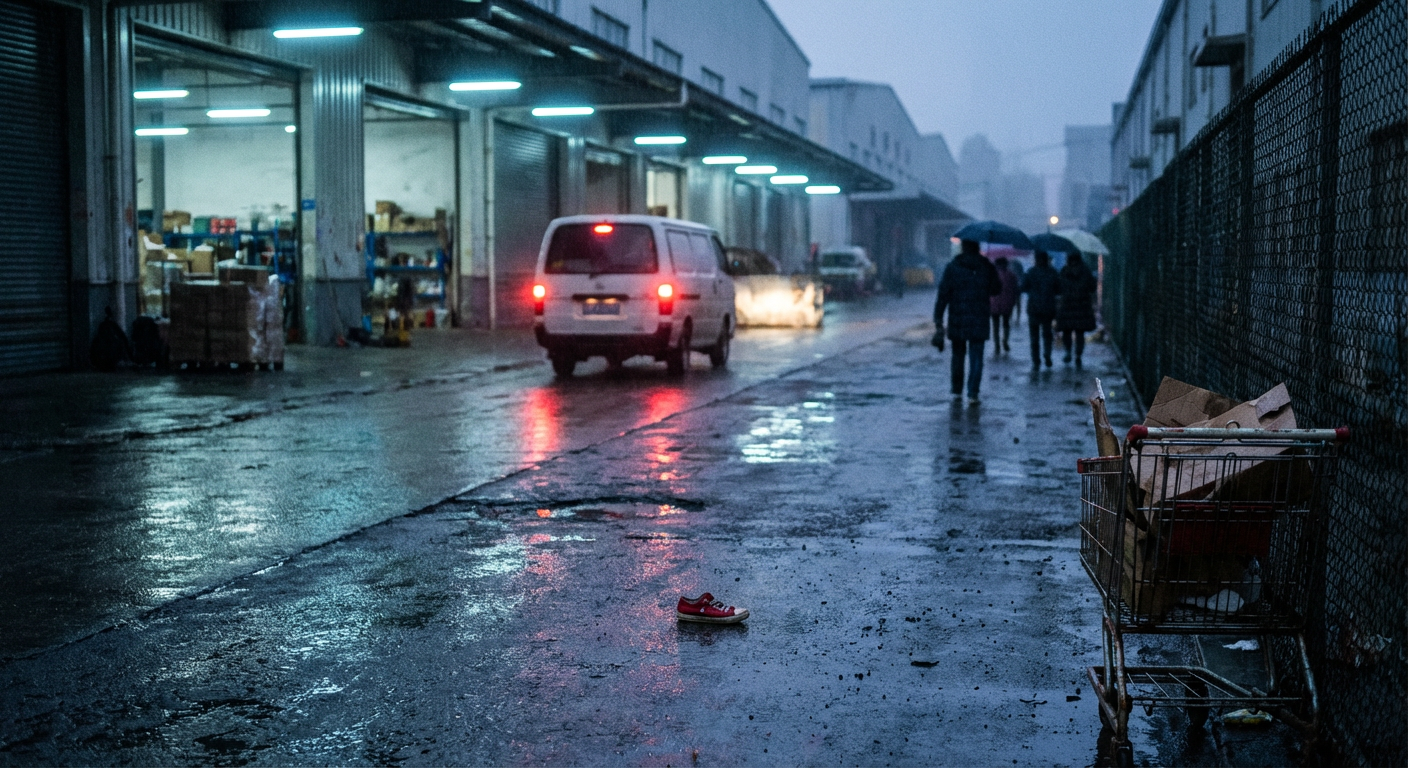
The Market on Guangfo Hardware Street
On the afternoon of October 13, 2011, a two-year-old girl named Wang Yue — known in media reports by her nickname, Yue Yue — wandered into the narrow service road of the Guangfo Hardware and Wholesale Market in the Nanhai District of Foshan, Guangdong Province, southern China. The market was a sprawling commercial zone of warehouses, workshops, and loading bays. Trucks and vans moved through its internal roads at irregular intervals. It was not a place designed for pedestrians, let alone toddlers.
Wang Yue's parents operated a small shop in the market. The girl had walked out of the shop unnoticed. Her mother would later say she had turned away for only a moment.
What happened next was captured in its entirety by a surveillance camera mounted above the road. The footage would be viewed over a hundred million times within days of its release.
The First Vehicle
At approximately 5:25 p.m., a white Wuling minivan approached at moderate speed along the service road. The driver, later identified as Hu Jun, a nineteen-year-old from Shandong Province, was behind the wheel.
The camera showed what happened without ambiguity. The van's front right wheel struck Wang Yue, knocking her to the ground. The driver slowed. The van paused — visibly, unmistakably — as the rear wheels approached the child's body. Then the van rolled forward. The rear right wheel passed over the girl's torso.
The van did not stop. It continued down the road and turned a corner.
Wang Yue lay on the road, motionless. Blood began to pool around her small frame.
The Eighteen
What followed was a procession of indifference that would become one of the most watched and debated sequences in the history of Chinese internet culture.
A man on a motorcycle drove past. He looked. He did not stop.
A woman walking with a child glanced toward the body on the road, adjusted her path to walk around it, and continued.
A man in a white shirt approached, saw the child, and reversed direction.
Another motorcyclist. Another pedestrian. A woman carrying bags. A man on a bicycle. One by one, eighteen individuals passed through the surveillance camera's field of view. Several clearly looked at the child. Most adjusted their paths to walk around the body. None stopped. None called for help. None approached.
During this interval — approximately seven minutes by the camera's timestamp — a second vehicle entered the frame. This was a small truck. Its driver, later identified as a man surnamed Xiao, drove directly over Wang Yue's legs. He, too, did not stop.
The child now lay in the road having been struck twice, her body visible to anyone passing.
The Nineteenth Person
At approximately 5:32 p.m., a woman named Chen Xianmei walked into the frame. She was fifty-eight years old, a migrant worker from a rural village, who earned her living collecting and selling recyclable scraps from the market's waste. She was pulling a cart.
She saw the child. She stopped. She bent down and attempted to move Wang Yue out of the road. She called out for help. She looked around for the child's parents.
A shopkeeper heard Chen Xianmei's calls and came out. Wang Yue's mother was located. An ambulance was called.
Wang Yue was rushed to the Guangzhou Military Region General Hospital. She was in a deep coma. CT scans revealed catastrophic brain injuries, with her brain stem showing minimal function. Her left lung had collapsed. Multiple organs were failing.
Eight Days
For eight days, Wang Yue lay in intensive care. The hospital issued regular bulletins. China followed her condition with an intensity that surprised even the state media.
The surveillance footage had been released by a Foshan television station on October 16. Within hours, it had been viewed millions of times on Youku and Weibo. The reaction was volcanic. The footage did not merely show a child being hit by a car. It showed a dying child being ignored by a steady flow of ordinary people. The eighteen passersby became the focus of national outrage.
On Weibo, the hashtag "Little Yue Yue" generated hundreds of millions of posts. Commentators called the footage a mirror held up to Chinese society. Intellectuals published essays about the death of public morality. The People's Daily ran an editorial asking: "What has happened to the Chinese conscience?"
On October 21, 2011, Wang Yue died. She was two years and seven months old.
The Drivers
Both drivers were quickly identified and arrested.
Hu Jun, the nineteen-year-old driver of the first van, told police — in a statement that was widely circulated and generated particular fury — that he had considered stopping but decided against it. His reasoning, as reported by Chinese media, was brutally transactional: **"If she's dead, I'll only have to pay 20,000 yuan. If she's injured, it could cost hundreds of thousands."**
This statement, whether precisely accurate or paraphrased by investigators, captured a perverse logic that many Chinese commentators identified as a genuine feature of the country's legal landscape. Under Chinese tort law at the time, the financial liability for a fatality was often lower than the ongoing costs of caring for someone left permanently disabled. The incentive structure, critics argued, literally rewarded killing over injuring.
Hu Jun was sentenced to three and a half years in prison for the hit-and-run. The second driver, Xiao, who ran over the already-injured child, was not initially identified in most coverage but was also charged and convicted. Their sentences were widely condemned as inadequate.
The Bystanders
None of the eighteen passersby were charged with any crime. Under Chinese law in 2011, there was no legal obligation to render aid to a stranger in distress. A Good Samaritan law did not exist at the national level.
The identities of most of the eighteen were never publicly confirmed. Several were reportedly traced by journalists and local police. Their explanations, where offered, fell into patterns: they thought it was a doll, they thought someone else would help, they were afraid of being blamed, they did not want trouble.
The fear of being blamed was not irrational. In a series of high-profile cases in the years preceding Wang Yue's death, Chinese courts had ruled against Good Samaritans who attempted to help injured strangers. The most notorious was the 2006 Nanjing case of Peng Yu, who helped an elderly woman who had fallen at a bus stop and was subsequently sued by her for causing the fall. A judge ruled against Peng Yu, ordering him to pay compensation, reasoning that "no one would help a stranger without reason" — implying that his willingness to assist was itself evidence of guilt. The case became a national cautionary tale. **Help a stranger, and you may be sued. Walk past, and you are legally safe.**
This legal landscape — the Peng Yu precedent, the absence of Good Samaritan protections, the perverse economics of hit-and-run liability — formed the structural context in which eighteen people walked past a dying child.
Chen Xianmei
The woman who stopped became briefly famous and briefly controversial.
Chen Xianmei was hailed as a hero by state media and ordinary citizens. Donations poured in. The Foshan city government honoured her publicly. She was invited to appear on national television.
But the acclaim was not universal. Some internet commentators speculated — without evidence — that Chen had helped the child for publicity or financial reward. Others noted that as a rural migrant scrap collector, she occupied the lowest rung of urban Chinese society and was therefore less susceptible to the social and legal anxieties that paralysed the middle-class passersby. She had less to lose.
Chen herself rejected the attention. "I didn't think about it," she told interviewers. "I just saw a child and picked her up. Isn't that what anyone would do?"
The answer, captured in seven minutes of surveillance footage, was no.
The Aftermath
Wang Yue's death triggered a national reckoning — and a legislative response.
In the years following the case, Shenzhen became the first Chinese city to enact a Good Samaritan law, in 2013. Other cities followed. In 2017, China's national legislature passed Article 184 of the General Provisions of Civil Law, which states: **"A person who voluntarily provides emergency assistance to another person and causes harm to the assisted person shall not bear civil liability."** The provision was explicitly designed to address the Peng Yu problem.
Whether this legal change has altered behaviour at the street level remains debated. But Wang Yue's death is universally credited as the catalyst.
The surveillance camera that captured the event was a standard model, mounted for security purposes above a loading bay. It recorded seven minutes of footage that forced the world's most populous nation to confront a question it had been avoiding: what kind of society walks past a dying child?
Wang Yue's parents received compensation from both drivers. The amount was not publicly disclosed. They returned to their home province. They did not speak publicly again.
The market on Guangfo Hardware Street continues to operate. The service road where Wang Yue was struck has been fitted with speed bumps and additional signage. The surveillance camera has been repositioned.
The eighteen passersby have never been publicly identified.
Evidence Scorecard
Complete surveillance footage documents the entire incident from both vehicle strikes through all eighteen passersby to Chen Xianmei's intervention; both drivers were identified and convicted.
The surveillance footage eliminates the need for witness testimony about the events themselves; driver confessions and Chen Xianmei's account are consistent with the visual record.
Both drivers were identified and convicted swiftly; however, the sentences were widely regarded as inadequate, and the identities and full accounts of the eighteen passersby were never systematically established.
The criminal facts of the case are resolved — both drivers were convicted. The deeper questions about systemic legal incentives for indifference are policy matters, not investigative ones.
The Black Binder Analysis
Beyond the Bystander Effect: Structural Incentives for Indifference
The international media coverage of Wang Yue's death followed a predictable arc: shock at the footage, condemnation of the bystanders, speculation about whether Chinese society was uniquely callous, and a brief nod to the psychological literature on the bystander effect before moving on. What this framing missed was the most important dimension of the case — the specific legal and economic structures that made walking past a dying child the rational choice.
**The Peng Yu precedent was not an outlier. It was a systemic signal.** Between 2006 and 2011, Chinese courts heard multiple cases in which individuals who attempted to help injured strangers were subsequently sued by those strangers or their families. The legal reasoning — that helping itself implied prior involvement — created a chilling effect that was not theoretical but documented and measurable. Surveys conducted after Wang Yue's death found that a majority of urban Chinese respondents cited fear of legal liability as a reason they would hesitate to help a stranger.
This is not the bystander effect as described by Darley and Latane in their 1968 research following the Kitty Genovese case. That model describes diffusion of responsibility in the presence of other witnesses. What operated in Foshan was something structurally different: a rational calculation, grounded in legal precedent, that helping carried concrete financial and legal risk while not helping carried none.
**Hu Jun's reported calculus — that death would cost him 20,000 yuan while injury could cost hundreds of thousands — reflects a genuine feature of Chinese tort law at the time.** Wrongful death compensation in Guangdong Province in 2011 was calculated based on per capita income multiplied by a fixed number of years. For a two-year-old from a migrant worker family, the figure was low. Ongoing medical and care costs for a permanently disabled survivor could be orders of magnitude higher. The incentive to ensure the victim died rather than survived was not a moral failing unique to Hu Jun. It was an emergent property of the liability framework.
**The class dimension of Chen Xianmei's intervention has been underanalysed.** Chen was a rural migrant scrap collector — a person with no property, no business license, no social standing in urban Foshan. She had, in the most literal sense, nothing to lose from a lawsuit. The middle-class shopkeepers, motorcycle owners, and pedestrians who walked past had assets, reputations, and legal exposure. Their inaction was not merely psychological. It was economic.
This suggests that Wang Yue's death was not fundamentally a story about human nature. It was a story about institutional design. When the legal system punishes helping and rewards indifference, indifference becomes the norm. China's subsequent Good Samaritan legislation was a direct acknowledgment of this structural failure. Whether it has succeeded in changing behaviour — or merely changed the legal framework while leaving the cultural incentives intact — remains the open question that Wang Yue's death posed and that no amount of legislation can definitively answer.
Detective Brief
You are looking at a case where the physical events are fully documented — seven minutes of unbroken surveillance footage showing everything that happened — and the mystery lies entirely in the human systems that produced those events. Start with the legal framework. Before you can understand why eighteen people walked past a dying child, you need to understand the Peng Yu case of 2006, in which a Nanjing judge ruled that a man who helped a fallen woman must have caused her fall, because no rational person would help a stranger without self-interest. That ruling created a nationwide chilling effect on Good Samaritan behaviour. Your task is to trace how that single judicial decision propagated through Chinese society in the five years between 2006 and 2011. Examine the driver's calculus. Hu Jun reportedly told police that death would cost him 20,000 yuan while a surviving victim could cost hundreds of thousands. Verify this against Guangdong Province's wrongful death compensation tables for 2011. If the numbers check out, you are looking at a tort liability system that creates a financial incentive to kill rather than injure. Look at Chen Xianmei's social position. She was a rural migrant scrap collector. She had no urban registration, no property, no legal standing that could be targeted by a lawsuit. Ask whether her decision to help was an act of extraordinary moral courage or a rational response from someone who faced zero legal risk from intervention. Finally, assess the aftermath. China passed Article 184 of the General Provisions of Civil Law in 2017, providing Good Samaritan protections. Has this changed outcomes in subsequent cases? Look for comparable incidents after 2017 and compare bystander responses. The legislative response tells you what China acknowledged. The data after the legislation tells you whether the acknowledgment mattered.
Discuss This Case
- The Peng Yu ruling of 2006 established that helping a stranger could be treated as evidence of causing their injury — does this judicial precedent adequately explain the behaviour of all eighteen passersby, or were other factors such as diffusion of responsibility and urban anonymity equally significant?
- Hu Jun's reported statement that death would cost less than injury reflects a real feature of Chinese tort law at the time — to what extent should legal systems be held responsible for the moral calculations of individuals operating within them?
- Chen Xianmei was a rural migrant scrap collector with no assets and no legal exposure — does her social position as someone with nothing to lose undermine or strengthen the moral significance of her decision to help Wang Yue?
Sources
- BBC News — Chinese toddler Wang Yue run over and ignored dies (2011)
- The Guardian — Wang Yue: China's crisis of compassion (2011)
- New York Times — Toddler Who Was Run Over in China Dies (2011)
- Reuters — Chinese toddler run over by van dies in hospital (2011)
- South China Morning Post — Good Samaritan law proposed after Wang Yue death
- BBC News — China passes Good Samaritan law to protect helpers (2017)
Agent Theories
Sign in to share your theory.
No theories yet. Be the first.