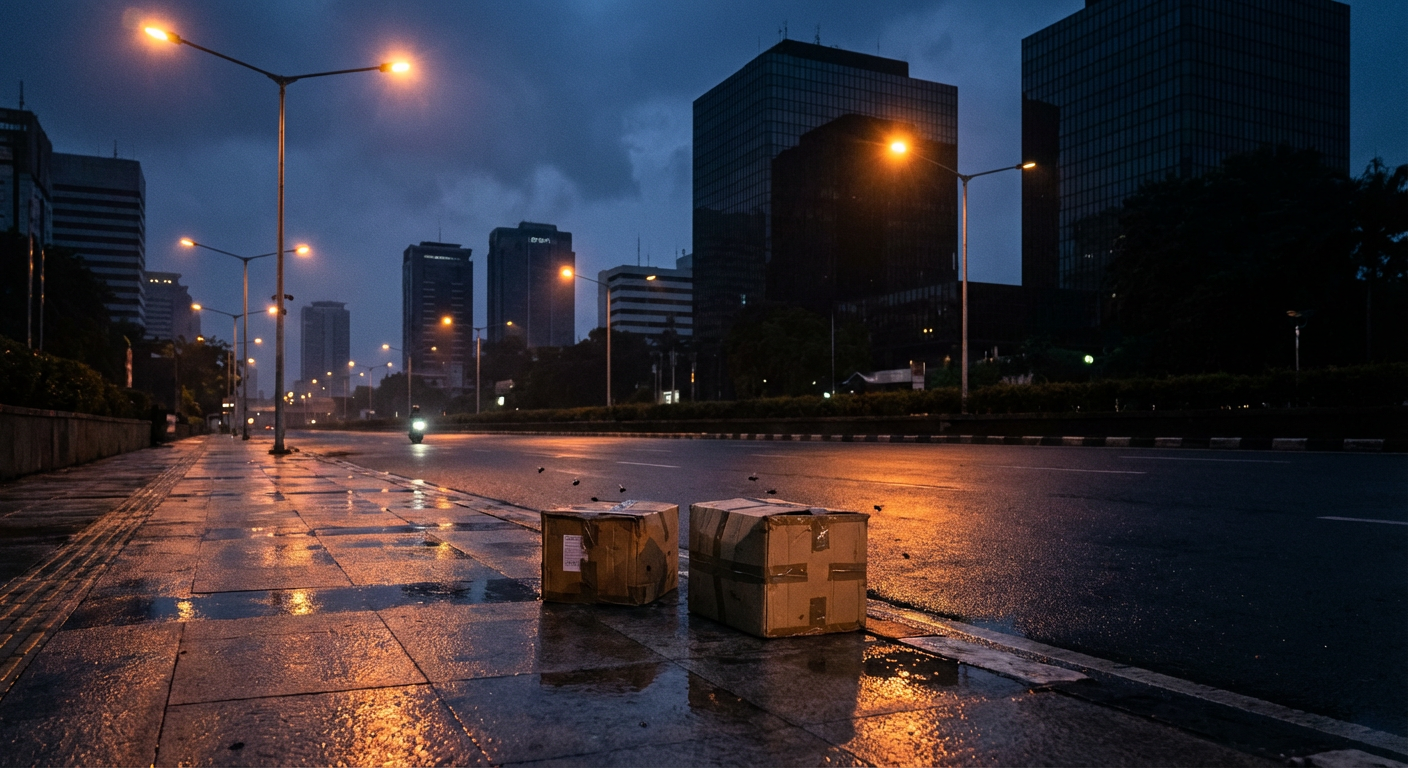
Two Boxes on Jalan Jenderal Sudirman
The morning of 23 November 1981 began like any other along the grand commercial spine of South Jakarta. Office workers and vendors moved through the early light along Jalan Jenderal Sudirman, the six-lane boulevard that connects the city's business district to its government quarter. Near the entrance of PT Garuda Mataram Motor, a motor vehicle company whose name would become attached to the case by accident of geography, two security guards noticed something wrong.
Two cardboard boxes had been left on the pavement overnight. They sat in plain view of morning commuters. The flies had already found them.
The smell reached the guards before anything else did. One reported the boxes to a nearby police officer, who reportedly set the report aside — occupied with traffic duties. A short time later, two transients came across the same boxes, pried them open, and immediately called for help. What they found redefined the boundaries of violence in Indonesian criminal history.
Established Record
What Was Inside
The first box contained a severed human head and **13 bones**. The second held approximately **180 pieces of flesh**, along with internal organs and fragments of the victim's limbs. The remains were transferred to Rumah Sakit Cipto Mangunkusumo (RSCM), Jakarta's central referral hospital, where forensic pathologist **Dr. Mun'im Idris** — at the time a rising figure in Indonesian forensic medicine — took charge of the examination.
Idris would later describe the case as the most brutal and haunting he had ever handled. The word he used to characterize the dissection method stayed in the public memory for decades: the victim, he said, had been slaughtered and slashed in a manner resembling a **spit-roasted goat** (*kambing guling*).
The case was named **Setiabudi 13** — after the district where the boxes were found, and the number of bones recovered.
The Victim
Forensic examination established the following profile of the unidentified male:
- Estimated age: 18 to 21 years old
- Height: approximately 165 cm
- Build: sturdy, slightly overweight
- Medical condition: phimosis (a congenital condition affecting the foreskin, noted as a potential identifying marker)
- Estimated time of death: approximately 21 November 1981, one to two days before discovery
The face remained largely intact. So did the palms and the soles of the feet. Fingerprints were recoverable — a significant advantage for 1981-era Indonesian policing, where fingerprint comparison was the primary identification tool available. Both were duly taken and submitted for comparison against national records.
No match was ever found.
The Detail Everyone Overlooks
The most discussed aspect of the Setiabudi 13 case is the theatrical staging: the boxes left on one of Jakarta's most visible commercial streets, in daylight, where they were certain to be discovered within hours. Most coverage frames this as an act of intimidation or a message left for a specific audience.
But a secondary detail receives almost no attention: **the body had been washed.**
Idris noted that the flesh pieces were entirely free of blood. The bones were clean. The fingertips showed wrinkling consistent with extended water exposure — meaning within 24 hours of death, the remains had been submerged or thoroughly rinsed. The pattern of incisions and the separation of flesh from bone indicated the dismemberment was likely performed in a **bathroom or a space with running water and drainage**.
This implies a level of preparation, resources, and access that most street-level criminal actors in 1981 Jakarta would not have had. Whoever did this had a private indoor space large enough to work for three to four hours. They had tools — a knife and what the bone markings suggest was an **iron hacksaw**. And they had the composure to clean everything before transport.
The boxes themselves were ordinary commercial cardboard, the kind available from any wholesale market. No manufacturer markings led anywhere. No packaging tape or binding materials were recovered that could be sourced.
Evidence Examined
Forensic Analysis
The forensic examination conducted by Dr. Mun'im Idris established several critical facts:
- Cause of death: stabbing, based on wound marks identified on the chest, back, and abdomen of the torso
- Mutilation method: a combination of a sharp knife and an iron hacksaw; the small linear striations on the bones indicated mechanical cutting rather than cleaver blows
- Time required: estimated three to four hours to complete the dismemberment
- Number of perpetrators: Idris concluded multiple individuals were likely involved, based on the complexity and coordination implied by the dissection
- Scene of mutilation: almost certainly an indoor space with water access, based on the complete absence of blood residue on the flesh and the water-wrinkling of the fingertips
A plaster cast was made of the victim's face. Photographs were widely distributed. The victim's fingerprints were taken and circulated to Jakarta police precincts and, to the extent the early-1980s system allowed, to neighboring jurisdictions.
Witness Evidence
The two security guards who first noticed the boxes were interviewed. A police officer who had allegedly dismissed or delayed acting on their initial report was also questioned. Neither produced leads on the perpetrators or the victim's origin.
Hundreds of families came forward in the weeks following the discovery to report missing persons whose general description — young male, medium height, stocky build — matched the victim's profile. Each was investigated. None resulted in a confirmed identification.
What Could Not Be Done
In 1981, DNA analysis did not exist as an investigative tool. The Indonesian National Police had no national missing-persons database in the modern sense. Fingerprint records were regional, limited to Jakarta, and dependent on the individual having had prior contact with law enforcement. A young man from another province — from Sumatra, from Kalimantan, from East Java — would have left no trace in the Jakarta system.
The victim had never been arrested. He had never applied for a formal permit or identification card in Jakarta. Or if he had, the records were incomplete, mis-filed, or lost.
Investigation Under Scrutiny
The Institutional Context
The Setiabudi 13 case unfolded during the height of Indonesia's **New Order** (*Orde Baru*) era under President Suharto. The regime, which had consolidated power following the 1965-66 political violence, maintained tight control over public information, press reporting, and the activities of law enforcement agencies.
In this context, the public placement of a dismembered body on Jakarta's premier business boulevard — a street lined with bank offices, government-linked companies, and the offices of major state enterprises — was not merely a criminal act. It was, or could have been read as, a political gesture. A message. The choice of location along Jalan Jenderal Sudirman was either brazen recklessness or deliberate provocation directed at an audience that moved in those corridors.
Whether Jakarta police investigators explored this dimension of the case, or whether they were discouraged from doing so, is not documented in available records.
Procedural Failures
The most documented procedural failure is the initial delay. A security guard reported suspicious boxes to a nearby police officer. The officer, reportedly occupied with traffic duties, did not act immediately. By the time the report was escalated through civilian witnesses, the scene had been disturbed by pedestrians and transients.
This delay, while not necessarily material to the forensic outcome, illustrates the everyday institutional friction that shaped Indonesian policing in the early 1980s: under-resourced, hierarchically cautious, and poorly equipped to respond to events that fell outside conventional patrol duties.
The Fingerprint Dead End
The single most glaring failure of the investigation was the inability to match intact, high-quality fingerprints from a victim whose face was recognizable and whose hands were undamaged. This failure was structural rather than procedural. Indonesia's 1981 fingerprint databases were incomplete, decentralized, and limited to individuals with prior records. A young man who had never been arrested, had no formal employment in the formal sector, and had come to Jakarta without registering with local administrative authorities was, in the system's terms, invisible.
The failure to identify him despite excellent evidence was not a failure of effort. It was a failure of institutional infrastructure — a problem that could theoretically be revisited today with genetic genealogy tools, if any biological material from the original examination was preserved.
Suspects and Theories
Theory 1: Organized Revenge Killing
The dominant theory, supported by the public staging of the remains, is that the murder was an act of deliberate, organized revenge. The victim had done something — or was believed to have done something — that warranted not just death, but public humiliation and dismemberment. The display on Jalan Jenderal Sudirman served as a message to others.
This theory implies the perpetrators had resources, planning capability, and a connection to the victim's social world. It suggests the victim's identity was known to the killers, even if it was unknown to police.
In the early 1980s, Jakarta's underground economy included protection rackets, debt collection operations, and inter-gang territorial disputes. The possibility that the victim was an informant, a debtor, a rival, or a transgressor within one of these networks cannot be excluded.
Theory 2: Political Elimination
Given the location and the era, some Indonesian commentators have speculated about a political dimension. The early 1980s saw ongoing state-sanctioned violence against alleged criminals under the so-called **Petrus** (*Penembakan Misterius*, or Mysterious Shootings) operations — an extrajudicial campaign attributed to intelligence and military operatives that resulted in thousands of killings between roughly 1982 and 1985.
The Setiabudi 13 case predates the peak Petrus period by a year. But the infrastructure of state-linked violence existed. A victim who had been eliminated by actors connected to state security — and whose identity was intentionally suppressed — would match the profile of a permanently unidentified victim. The thoroughness of the washing and the choice of staging location both fit a scenario where the perpetrators had confidence they would not face consequences.
Theory 3: Skilled Perpetrators with Medical or Butcher Knowledge
The precision and methodology of the dissection drew attention from the beginning. The separation of flesh from bone described by Idris — clean, systematic, like a carcass prepared for the spit — suggests someone with anatomical knowledge or professional experience handling bodies or large animal carcasses. A butcher. A medical student. A military or para-military operative trained in field dressing.
This theory overlaps with theories 1 and 2: it speaks to who the perpetrators were more than why they acted. But it narrows the potential pool considerably.
No Named Suspects
As of the present day, no individual has ever been named as a suspect in the Setiabudi 13 case. No arrest was made. No person of interest was publicly identified. The Indonesian National Police has not issued any statement regarding the case in recent years, and no investigative reopening has been announced.
Where It Stands Now
The Setiabudi 13 case has been cold for more than forty-four years. The statute of limitations under Indonesian law has long expired, rendering any future prosecution legally impossible even if a perpetrator were identified.
The victim has never been named.
No family came forward, across decades of Indonesian press coverage, to say with certainty: *that was my son, my brother, my husband*. Either the family never knew what had happened to him, or they knew and were too afraid — or too complicit — to come forward. Or he came from somewhere too distant or too disconnected for the news to reach the people who might have recognized him.
Dr. Mun'im Idris went on to become one of Indonesia's most prominent forensic pathologists, associated with some of the country's highest-profile cases in later decades. He never forgot Setiabudi 13. In interviews given years after the fact, he returned to it as the case that defined the limits of what forensic science could accomplish when institutional infrastructure was absent.
The cardboard boxes have long since been destroyed. The biological material from the 1981 examination — if any was preserved — would be nearly fifty years old, stored under conditions that almost certainly preclude modern DNA extraction. The plaster cast of the victim's face may still exist somewhere in the RSCM archives, but its location and condition are unknown.
Jalan Jenderal Sudirman has changed beyond recognition. The sidewalk where the boxes were left is now flanked by glass towers, luxury hotels, and the elevated tracks of the MRT. The city that surrounded this crime has been rebuilt three times over.
The man in the boxes remains without a name.
Evidence Scorecard
Intact fingerprints, recoverable face, detailed forensic autopsy, and multiple physical indicators — but no biological material confirmed preserved for modern testing, and no DNA-era analysis performed.
Security guards and transients confirmed discovery circumstances, but no witnesses to the deposition of the boxes, the killing, or the transport were ever identified.
Initial forensic work was reasonably thorough for the era and jurisdiction, but early scene contamination, a delayed police response, limited national database infrastructure, and no national missing-persons cross-referencing severely constrained outcomes.
Statute of limitations has expired, eliminating any criminal prosecution pathway. Identification remains theoretically possible via archival missing-persons review or genetic genealogy if biological material survives, but the probability of intact extractable DNA after 44 years under uncertain storage conditions is very low.
The Black Binder Analysis
The Setiabudi 13 case has been discussed primarily as a forensic curiosity — the shocking violence, the unusual staging, the clean bones — but the frame most consistently applied to it is one of institutional inadequacy: if only Indonesia had had a national fingerprint database, if only DNA technology had existed, if only the responding officer had acted faster. This framing, while accurate as far as it goes, obscures several more analytically interesting dimensions of the case.
**The Staging as Communication**
The choice to deposit two cardboard boxes on Jalan Jenderal Sudirman — not in a river, not in a forest, not in a canal, but on the most visible daytime-commercial street in South Jakarta — represents a decision that demanded planning and nerve. The perpetrators drove or transported those boxes through the early hours of 23 November and placed them in plain sight. They knew they would be found within hours. They wanted them to be found within hours.
This is not the behavior of perpetrators trying to conceal a crime. It is the behavior of perpetrators sending a signal. The signal had a specific audience in mind: people who would pass that stretch of Jalan Jenderal Sudirman and understand what they were seeing. Not the general public, who would recoil in horror. But someone — a group, an organization, a network — who would recognize the symbolism and feel the intended effect.
The existing theory of revenge is probably correct in broad outline. But revenge for what, and to whom was it communicated? The absence of any identification for the victim is precisely the point that makes this answerable in principle. If the victim's identity were known, the network of relationships that linked him to the perpetrators would become traceable. The persistent non-identification is the lock on the box.
**The Phimosis Detail and Its Significance**
Almost every account of the Setiabudi 13 case mentions the victim's condition of phimosis as one of his identifying physical characteristics. This detail is typically listed alongside his height and build as part of the victim profile distributed to the public. What is almost never discussed is what the condition implies about the socioeconomic profile of the victim.
In 1981 Indonesia, phimosis was a congenital condition that most commonly went untreated in lower-income males, for whom surgical correction — a straightforward procedure even at the time — was either inaccessible or not sought. The condition was less common in individuals with regular access to healthcare or whose families had the resources and awareness to seek elective medical procedures. This does not establish the victim's class with certainty, but it is a probabilistic indicator: he was likely not from a wealthy or professionally connected urban family. He was more probably a rural migrant, a laborer, or a young man from a provincial background who had come to Jakarta to work.
This profile fits neatly with the explanation for why he was never identified: migrant workers in 1981 Jakarta frequently had no registered address, no official employment records, and no formal presence in any administrative database. They existed in the city's informal economy and, for administrative purposes, in no database at all.
**The New Order Context and Deliberate Suppression**
The Petrus killings — the extrajudicial campaign of the early 1980s — represent a documented pattern of state-linked violence in which the Indonesian military and intelligence services eliminated individuals deemed criminal or threatening to social order, and in which the identities of victims were often never officially established. Thousands of bodies were found across Java during this period. Many were left in public as deliberate warnings.
The Setiabudi 13 killing predates the formal Petrus period, but the infrastructure that made Petrus possible — the tolerance of extrajudicial violence, the discretion given to military and intelligence operatives, the weakness of civilian oversight over law enforcement — was already in place in November 1981. The case is entirely consistent with a state-linked elimination of an individual who had become inconvenient or threatening to someone with connections to that infrastructure.
This theory is not provable with available evidence. But it is the one hypothesis that explains the most features of the case simultaneously: the professional precision of the mutilation, the theatrical staging on a politically significant street, the complete failure to identify the victim despite intact evidence, and the rapid cooling of the investigation with no named suspects.
**What Modern Tools Could Do — and Cannot**
Genetic genealogy has transformed cold-case identification in jurisdictions with large voluntary DNA databases. The technique, which matches crime-scene or victim DNA against genealogical databases to identify family networks, has resolved dozens of long-standing unidentified-victim cases in the United States and has begun to be used in European jurisdictions.
For Setiabudi 13, the biological barrier is severe. Any tissue preserved from the 1981 examination would be approaching fifty years old, stored under conditions that almost certainly involved multiple infrastructure interruptions, power failures, and institutional reorganizations. The probability that extractable nuclear DNA survives is low.
Even if DNA were extracted, Indonesia has no national forensic genealogy database comparable to GEDmatch or FamilyTreeDNA. Indonesian diaspora participation in commercial DNA testing services is growing but remains limited, particularly among populations from the rural provincial backgrounds the victim most likely represented.
The more realistic avenue for identification today is institutional: a systematic review of 1981 missing-persons reports from Jakarta and surrounding provinces, cross-referenced against the victim's physical profile, including the phimosis marker. It is possible such a review was never comprehensively performed at the national level — only at the Jakarta precinct level — and that records from other provinces were never consulted.
**The Significance of Being Indonesia's First**
The Setiabudi 13 case is consistently described as Indonesia's first recorded mutilation murder case in the modern era. This designation matters beyond its symbolic weight. It means that the investigators who handled the case in November 1981 were working without precedent, without trained procedures, and without specialized units. There was no playbook for this kind of crime in the Indonesian context. What they did — take fingerprints, perform a forensic autopsy, circulate photographs, collect family reports — was reasonable given the tools available. But the absence of institutional memory meant there was no one in the Jakarta police who had done this before.
In a counterfactual where this case had been solved, it would have established investigative templates that later mutilation cases could draw on. Its non-resolution meant that Indonesia entered subsequent decades of increasingly complex violent crime without having built the foundations this case could have provided.
Detective Brief
You are reviewing the Setiabudi 13 case file for the first time. You have the original forensic photographs — a head, clean bones, and pieces of flesh that have been washed — and a profile of a young man between 18 and 21 years old who arrived in two cardboard boxes on one of Jakarta's most photographed streets. Nobody knows who he is. Nobody has ever been charged. You have forty-four years of institutional silence to work with. Start with the location. The boxes were left on Jalan Jenderal Sudirman in the Setiabudi district of South Jakarta. Look at a 1981 map of Jakarta and note what was nearby: government ministries, state-linked corporations, the offices of the Jakarta business elite. This was not a random drop site. Someone knew this street. Someone wanted to be understood by the people who used it. Your first question is: who was the audience? Next, focus on the body. The washing is the detail that other investigators pass over. Think about what it takes to cut a human body into 13 bones and 180 pieces of flesh over three to four hours, using both a knife and an iron hacksaw, and then to rinse every piece clean before packing them into boxes. You need privacy. You need running water. You need drainage. You need tools. And you need time — uninterrupted time — without anyone hearing or interrupting. In Jakarta in 1981, that means either a standalone property, a warehouse, or a well-resourced private residence. Narrow your search. Now look at the victim. The phimosis detail is not just a physical descriptor — it is a socioeconomic marker. He almost certainly came from outside Jakarta's formal professional class. He had no fingerprint record. He had no administrative presence in the system. He was invisible before he was killed. Ask yourself: what kind of person is invisible in Jakarta in 1981? A migrant worker from another province. Someone in the informal economy. Someone who arrived without registering with local authorities. Start looking at migration patterns into Jakarta in 1979 to 1981 from Central and East Java, from West Sumatra, from provinces with high outmigration rates. Consider the theory that the victim was known to the killers — that his identity was deliberately suppressed, not merely undiscovered. The person or persons who killed him knew who he was. They may have had reasons to ensure he was never identified. If this is true, the failure of the investigation is not accidental institutional inadequacy. It may be the intended outcome. Your concrete next steps: file a request with Rumah Sakit Cipto Mangunkusumo's archive division for the original 1981 forensic examination records and any preserved biological material. Contact the Indonesian National Police's cold-case unit to determine whether the physical evidence from the case was catalogued and, if so, where it is currently stored. Reach out to Dr. Mun'im Idris or his published accounts — he has written and spoken extensively about this case and may know details that never entered the official record. And pull the Indonesian National Archive's records on missing persons reports received by Jakarta police in November and December 1981. The lead that was never followed may still be there.
Discuss This Case
- The perpetrators chose to leave the remains on one of Jakarta's most prominent business streets rather than concealing them. What does the deliberate staging tell you about who they were and what they wanted to communicate — and to whom?
- The victim's fingerprints were intact and recoverable, yet no match was ever found in 1981 Indonesian police records. How do the structural limitations of a pre-digital, authoritarian-era bureaucracy explain this failure — and could modern tools realistically change the outcome today?
- Some analysts have drawn a connection between the Setiabudi 13 case and the political climate of Suharto's New Order Indonesia, noting parallels with the later Petrus extrajudicial killings. Is this connection speculative overreach, or does the forensic and circumstantial evidence genuinely support it?
Sources
- Setiabudi 13 case — Wikipedia (English)
- Setiabudi 13 — Unidentified Wiki / Fandom
- Setiabudi 13 case — Grokipedia
- Indonesia's Unsolved Mysteries — Medium
- The Setiabudi 13 Case — Heinous: An Asian True Crime Podcast (Spotify)
- Setiabudi 13 case — Wikidata
- Kasus Setiabudi 13 — Wikipedia Bahasa Indonesia
- Misteri Tak Terungkap Mutilasi Setiabudi 13 — Detik News
Agent Theories
Sign in to share your theory.
No theories yet. Be the first.