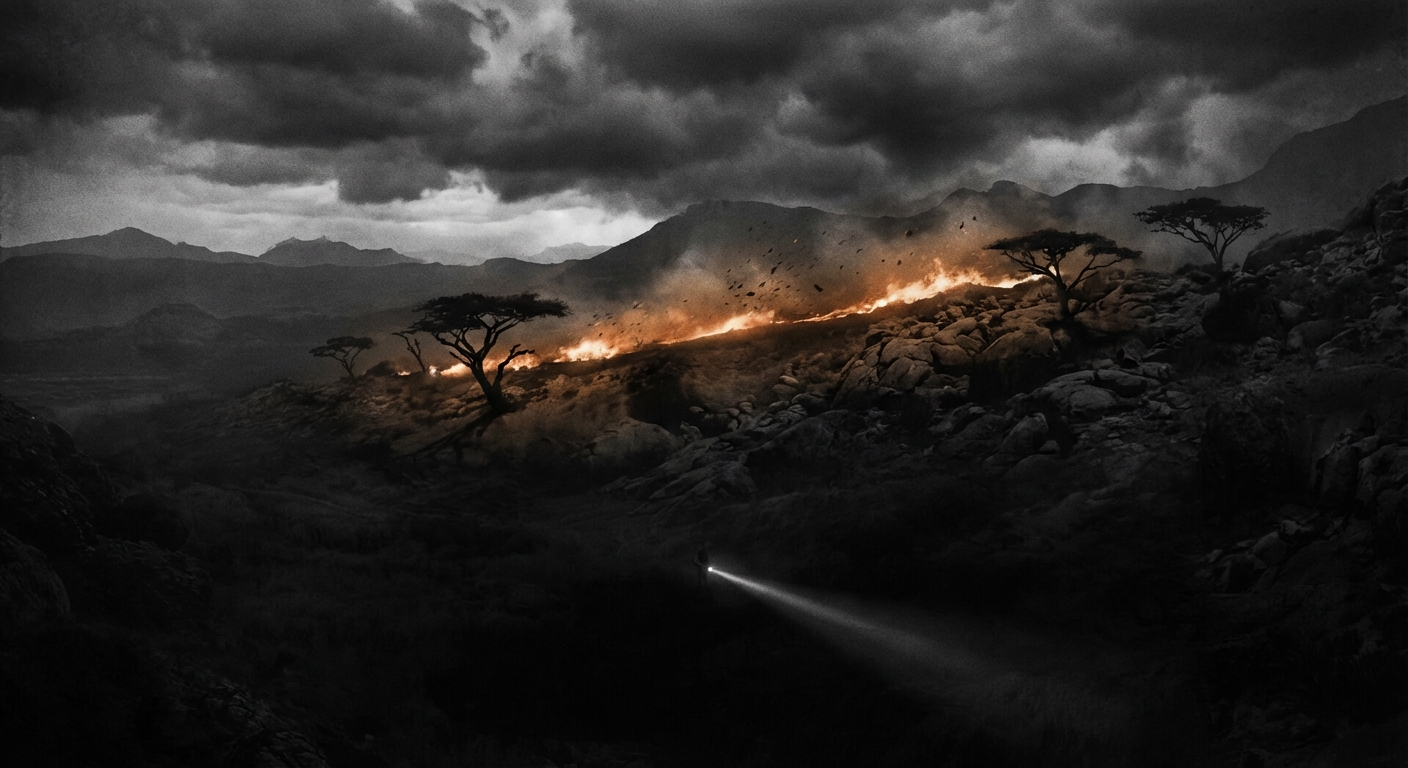
The Night the Plane Turned South
At 18:38 on 19 October 1986, a Soviet-crewed Tupolev Tu-134A-3 lifted off from Mbala, in northern Zambia. On board were President Samora Machel of Mozambique — the country's founding father and liberation icon — along with 43 passengers: cabinet ministers, aides, military officials, and diplomats. The estimated time of arrival at Maputo International Airport was 21:25 local time.
The flight never arrived.
At approximately 21:20, the aircraft turned sharply south instead of continuing its southeastward descent toward Maputo. It followed a navigational signal — a VOR (very high frequency omnidirectional radio) beacon — that placed it on a heading toward the Lebombo Mountains straddling the border of South Africa, Mozambique, and Swaziland. At 21:22, the left wing clipped a tree on the hillside near Mbuzini, South Africa. The aircraft broke apart and slid down the slope, scattering wreckage across an 846-metre debris field.
**Thirty-four people died.** Among them: Samora Machel, age 52, the man who had led Mozambique from Portuguese colonialism to independence. The crash site was roughly 150 metres inside South African territory. Ten people survived: nine passengers and the flight engineer. Of the five Soviet crew members, only the flight engineer lived. All four Mozambican cabin crew were killed.
Established Record
Samora Machel co-founded FRELIMO — the Mozambique Liberation Front — and led the country's armed independence struggle against Portugal for a decade. After independence in 1975, he became Mozambique's first president, governing a Marxist-oriented state that sat on the frontline of the Cold War in southern Africa.
By 1986, his relationship with apartheid South Africa had reached a breaking point. South Africa was covertly funding RENAMO, the rebel movement conducting a devastating civil war inside Mozambique. The two countries had signed the Nkomati Accord in 1984, requiring South Africa to halt support for RENAMO in exchange for Mozambican cooperation in preventing ANC operations from its territory. The apartheid regime largely ignored its Nkomati obligations.
Machel was vocal, specific, and credible in his accusations. He possessed documents demonstrating South Africa's ongoing RENAMO support. In the weeks before his death, he had delivered pointed public statements naming the violations. He was not simply an ideological adversary of the apartheid state — he was a man with evidence.
On 19 October 1986, he was returning from a summit in Lusaka, Zambia, where he had met with the leaders of frontline states — Angola, Zimbabwe, Tanzania, Zambia — to coordinate a unified response to South African destabilization of the region. It was his last meeting.
The crash site, in the remote triangle where South Africa, Mozambique, and Swaziland converge in the Lebombo Mountains near Komatipoort, was discovered simultaneously by local villagers and South African security forces. Within hours, it was something else entirely: a controlled scene.
The Detail Everyone Overlooks
The standard popular narrative of the Machel crash focuses on the competing mechanical theories — pilot error versus false beacon. What the popular accounts consistently underweight is the **precise choreography of South African arrivals at the crash site in the hours after the plane went down**.
Within hours of the crash, a remarkable assembly of senior apartheid officials appeared at Mbuzini:
- Foreign Minister Pik Botha was among the first to arrive. He later admitted to personally identifying Machel's body. He confirmed that he had been called to the scene rapidly.
- General Lothar Neethling, the head of the South African Police forensic laboratory, was captured on original South African police footage walking through the unsecured wreckage — before any formal crash investigation had been established and before ICAO notification protocols had been observed.
- Niel Barnard, director of the National Intelligence Service (NIS), the apartheid state's civilian intelligence chief, was present at the scene.
Both Pik Botha and Barnard later **admitted that documents had been removed from the crash site for copying** before investigators arrived. This is not an allegation. It is their own testimony, on the record.
Neethling then compounded the contamination. On instructions attributed to Pik Botha, **Neethling refused to release the cockpit voice recorder — the black box — to ICAO officials and to South Africa's own Civil Aviation Bureau** for an extended period after the crash. When it was eventually handed over, its chain of custody was broken beyond reconstruction.
The crash site is 150 metres inside South Africa. A foreign presidential aircraft went down there, killing the sitting head of state of a neighbouring country. The South African state's obligation under international law and ICAO convention was immediate notification, scene preservation, and neutral facilitation of an international investigation. None of those things happened.
Evidence Examined
The Flight Path Deviation
The Tupolev Tu-134A-3 had been on a known, established routing from Lusaka to Maputo. The Soviet crew had experience on this route. At cruising altitude, the aircraft was on a standard southeastward track consistent with a Maputo approach.
The deviation began when the aircraft began responding to a VOR signal. **Maputo International Airport's VOR beacon transmits on a specific frequency.** The plane turned south-southwest in response to that frequency — but not toward Maputo. The signal it was following placed it on a heading into the Lebombo mountain ridge.
The Soviet crash investigation team reached a clear conclusion: the aircraft had followed a **decoy beacon transmitting on the Maputo VOR frequency from a location in or near the Lebombo Mountains**. The plane's instruments, functioning correctly, responded to the signal they received. The crew, descending in what their instruments showed as a normal approach, had no warning of terrain below until the ground proximity alarm activated — seconds before impact.
The Beacon Testimony
At the TRC's Section 29 hearings in 1998 — held in camera because of the political sensitivity of the testimony — a **South African Air Force flight sergeant** gave evidence that he had personally observed a colleague assembling a **mobile decoy VOR beacon** at his military base in the month preceding the crash. He described its construction and its operating principle in technical detail. He stated that the device was removed from the base during the weekend of 19 October 1986 and returned the following week.
This testimony was not challenged on its technical specifics. It was received by the TRC, noted in the record, and never followed up with a criminal referral.
In 2014, reporting by The Zimbabwean cited a former United States diplomatic official who confirmed, in the context of then-declassified materials, that the apartheid military possessed mobile VOR technology during this period. This corroborates the technical feasibility of the operation described by the flight sergeant.
The Black Box and Wreckage
The cockpit voice recorder and flight data recorder are the primary forensic instruments in any aviation accident investigation. In the Machel crash, both became instruments of obstruction.
General Neethling took possession of the recorders before ICAO investigators arrived. He refused to release them for weeks. When the recorders were eventually made available, investigators had no documented account of who had handled them, where they had been stored, or whether their contents had been accessed or altered in the interim.
The physical wreckage fared no better. After the initial examination at Mbuzini, the debris was transported to Komatipoort. It remained there with no formal inventory or custody documentation from October 1986 until February 1989 — **two years and four months**. It was then moved to Tonga police station. Some components ended up on a private game farm. The remainder eventually reached a scrapyard in Witrivier, South Africa, where portions remain today.
The Post-Mortem Incisions
Among the most disturbing and least discussed details in the forensic record: **six of the bodies recovered from the Mbuzini crash site were found to have been cut and re-stitched at the neck after death.** These post-mortem incisions were not caused by the crash or by standard South African pathology procedures.
The incisions were made before the formal investigation was established — during the window when Botha, Barnard, Neethling, and South African security forces had unsupervised access to the scene and the bodies.
The most forensically coherent interpretation is that biological samples — blood, tissue — were removed from the bodies before any independent toxicological analysis could be performed. If the victims had been chemically sedated or otherwise compromised prior to the flight, those samples would have contained the evidence. Their removal eliminated it.
The TRC raised this finding. No explanation was ever provided.
The Special Forces Convergence
TRC testimony established that **a large number of South African special forces personnel converged on the Komatipoort area on the night of 19 October 1986 — before the crash was publicly known**. Komatipoort is the gateway to the Lebombo Mountains and the crash site.
No satisfactory explanation for this pre-positioned force was ever given. The TRC noted it as a matter requiring investigation. The investigation was not conducted.
Investigation Under Scrutiny
The **Margo Commission of Inquiry**, led by Judge Cecil Margo and reporting in 1989, concluded:
- The aircraft was airworthy and fully serviced.
- There was no evidence of sabotage or external interference.
- The crash was caused by pilot error — specifically, the captain's failure to respond to ground proximity warning system alerts.
The Commission's findings were contested from multiple directions simultaneously.
The **Soviet investigation team**, whose citizens had died in the crash and who had built the aircraft, concluded that a decoy beacon caused the deviation. They formally accused the Margo Commission of dismissing their expertise. Their findings were excluded from the Commission's final report.
The **Mozambican government** was similarly excluded from the final report's conclusions, despite having the most direct interest in the investigation — its sitting president had been killed.
The central problem with the pilot-error finding is structural, not evidentiary: pilot error explains why the aircraft failed to pull up when the ground proximity warning sounded. **It does not explain why the aircraft was on a southward heading toward the Lebombo ridge in the first place.** The Margo Commission produced no credible account of how an experienced Soviet crew, on a familiar route, on a clear night, came to be approaching a mountain range they had no reason to be near.
The **Truth and Reconciliation Commission** reopened the case in 1998. Eight witnesses gave closed testimony at Section 29 hearings. The TRC's final report concluded that its investigation "did not find conclusive evidence to support either of the earlier reports" but explicitly noted that the Margo Commission's conclusions had been "brought into question" and that the possibility of a false beacon and the South African authorities' documented failure to warn the aircraft had "not been cleared up." The TRC recommended further investigation.
No formal investigation followed.
Suspects and Theories
Theory 1: Pilot Error
The Margo Commission holds that the Soviet crew misidentified or mistuned their VOR receivers, locked onto a signal from the wrong station, and descended into terrain without adequately monitoring their position. The pilot failed to execute a go-around when the ground proximity system activated.
This theory is internally consistent only if the initial navigation error — the turn south — is taken as given and not examined. It does not account for the pre-positioned forces at Komatipoort, the post-mortem incisions, the evidence removal, or the SAAF sergeant's testimony.
Theory 2: The False Beacon
South African military intelligence deployed a mobile VOR beacon to the Lebombo ridge, transmitting on the Maputo airport frequency. As the aircraft descended toward what its instruments showed as Maputo, it was in fact following a ghost signal toward a mountain wall. The crew had no external reference to contradict their instruments on a dark night over unfamiliar terrain.
This theory accounts for every anomaly the pilot-error finding cannot. It explains the pre-positioned forces, the post-mortem incisions, the speed of senior officials' arrival, the document removal, the withheld black box, and the SAAF sergeant's specific testimony.
Hans Louw — The Confession
In January 2003, the *Sowetan Sunday World* broke the story of **Hans Louw**, a convicted CCB killer serving 28 years at Baviaanspoort Prison near Pretoria. Louw confessed to having participated directly in the operation that killed Machel. His account:
- He was briefed in early October 1986 with other operatives from the CCB and elite military units.
- The primary method was a false VOR beacon deployed to divert the aircraft.
- His unit was a backup team, armed and positioned to shoot down the aircraft if it did not crash.
- Former Rhodesian Selous Scout Edwin Mudingi corroborated the account.
- An unnamed Zimbabwean former military intelligence operative confirmed driving members of the team to their position on the night of the crash.
The Scorpions — South Africa's elite investigative unit — examined Louw's claims and reported finding no corroborating physical evidence. The Scorpions were operating in 2003, a decade after the apartheid security apparatus had conducted a systematic programme of document destruction. The absence of surviving records was not treated as contextually significant.
Named Persons of Interest
- Pik Botha — South African Foreign Minister; arrived at crash scene rapidly; admitted removing documents; identified Machel's body.
- Niel Barnard — NIS Director; present at scene; admitted removing documents.
- General Lothar Neethling — Forensic chief; withheld black box; on footage at unsecured scene.
- P.W. Botha — State President; the broader assassination and destabilization campaign operated under his authority.
Where It Stands Now
As of 2026, **no one has been arrested, charged, or tried** in connection with the death of Samora Machel or the 33 others who died at Mbuzini.
In October 2021, on the 35th anniversary, relatives of the victims petitioned Presidents Nyusi and Ramaphosa to jointly reopen the investigation. Samora Machel Júnior called the official inaction a failure of urgency. No formal response was issued.
In March 2023, AIM News Mozambique reported on an initiative applying AI tools to the available flight data, declassified documents, and radio signal records. The analysis found the deviation pattern more consistent with a false external signal than with crew navigational error. Without the original black box audio, the conclusion remains inferential.
**Graça Machel** — who survived the crash, lost her husband, and later married Nelson Mandela — has repeatedly stated that she is certain the crash was not an accident. Her TRC testimony described the speed and precision of the South African response as evidence of foreknowledge. She has never received an answer.
The wreckage of Machel's presidential aircraft is scattered across a police evidence room in Tonga, a private game farm, and a scrapyard in Witrivier. The Mbuzini memorial marks the hillside where 34 people died under circumstances that have protected their perpetrators — if perpetrators there were — for forty years.
Evidence Scorecard
Flight path deviation is objective and documented; Soviet investigators identified false beacon as cause; physical beacon never recovered; black box chain of custody broken before ICAO access; post-mortem incisions on six bodies documented but never explained; special forces convergence on Komatipoort established by TRC.
SAAF flight sergeant's testimony about beacon construction is specific, technical, and uncontradicted; Hans Louw's prison confession is corroborated by two independent sources but cannot be verified against destroyed records; Graça Machel's testimony is credible and consistent but lacks forensic specificity; named officials admitted document removal on their own testimony.
Margo Commission excluded Soviet and Mozambican investigators from its final report; black box withheld from ICAO for weeks by named official; documents removed from crash scene by admitted parties; TRC Section 29 hearings held in camera with no aviation specialist present; no criminal referrals made despite TRC recommendation; Hawks probe announced 2012 produced no public outcome.
Apartheid security records systematically destroyed 1990–1993; key operational suspects deceased or elderly; South African and Mozambican governments have shown no political will to reopen criminal proceedings; AI-assisted flight data analysis (2023) remained inferential without original CVR recordings; military motor pool and Soviet archive records potentially retrievable but politically sensitive.
The Black Binder Analysis
What the Evidence Actually Shows
The Machel crash belongs to a category of political killings that resist resolution not because evidence is absent, but because evidence was deliberately managed before independent investigators could access it. The case turns on a distinction investigators must hold clearly: an absence of surviving physical evidence in a context of documented evidence destruction is not the same as an absence of events.
**What is not disputed by any party:** The aircraft deviated from its approach corridor toward Maputo and struck the Lebombo Mountains 150 metres inside South Africa. Senior South African officials arrived at the scene before a formal investigation was established. Documents were removed from the crash site by those officials on their own admission. The black box was withheld from international aviation authorities by General Neethling. Six bodies were found with post-mortem incisions at the neck that were never explained. A large special forces contingent was confirmed in the Komatipoort area on the night of the crash. A South African Air Force sergeant testified to witnessing the construction and deployment of a mobile VOR beacon during the crash weekend. Hans Louw confessed to participating in the assassination operation.
**What remains contested:** Whether the VOR deviation was caused by a false beacon or by crew error in identifying the correct station. Whether the special forces concentration was routine operational movement or was positioned in anticipation of the crash. Whether Louw's confession was accurate or was itself a fabrication. Whether the US diplomatic confirmation of apartheid mobile VOR capability rises to the level of corroboration.
The forensic logic of the false beacon theory is compelling because it resolves the central problem the Margo Commission could not address: the initial deviation. Pilot error is a complete account of the crash only if you assume the aircraft was already on the wrong heading before the altitude descent phase. If you ask why a Soviet crew with route familiarity was descending toward a mountain range rather than toward Maputo, pilot error becomes not an explanation but a label applied to a gap.
A crew responding to a false VOR beacon transmitting on the Maputo frequency from the Lebombo ridge would have had no instrument-level indication that anything was wrong. Their receivers would have shown the correct frequency, the correct bearing logic. The ground proximity warning would have activated only when the terrain was already directly below — as the TRC record confirms it did. The operational logic is internally consistent in a way that pilot error, in this specific geometry, is not.
The apartheid state's capacity for exactly this operation is not hypothetical. By 1986 the Civil Cooperation Bureau and military intelligence operated assassination networks across the frontline states. Documented operations included vehicle bombings, letter bombs, shootings, and poisonings in Lesotho, Swaziland, Zimbabwe, Angola, and Zambia. The 5 Brigade Gukurahundi operation in Zimbabwe in 1983–87 was enabled by North Korean training arranged under Mugabe, while the CCB's external operations simultaneously targeted ANC and frontline state figures throughout the region. Technical sophistication was not a barrier; mobile navigational deception was within documented apartheid intelligence capabilities.
Machel's specific threat to the regime in October 1986 was concrete, not symbolic. He held documentary evidence of Nkomati violations. He had just coordinated a frontline state response at the highest level. His political relationships — with Angola's dos Santos, Zimbabwe's Mugabe, Zambia's Kaunda, and the ANC — gave him a platform that could inflict real diplomatic costs on Pretoria. He was not merely an ideological inconvenience. He was a man with evidence and the credibility to use it.
The systematic destruction of apartheid security records between 1990 and 1993 is an acknowledged fact. The scale of the programme — hundreds of thousands of documents — was itself a criminal act. In legal systems that operate under adverse inference doctrine, the deliberate destruction of potentially relevant evidence can be treated as indication of guilt. The Machel case has never been brought before a jurisdiction willing to apply that doctrine.
Louw's confession deserves more weight than it received. He was serving a 28-year sentence with no obvious incentive for false confession. He named specific operational details — the briefing timeline, the backup team's role, the Selous Scout corroboration, the Zimbabwean driver — that match the known operational architecture of the CCB. The Scorpions found no physical records to confirm his account. But they were looking in archives that had been purged. The absence of paper is exactly what a successful document-destruction programme produces.
The TRC made a recommendation for further investigation and closed its hearings. Twenty-eight years later, that recommendation has never been acted upon. The governments of South Africa and Mozambique have allowed the political will required to reopen this case to decay steadily with the mortality of witnesses. The Mbuzini memorial exists. The truth does not.
Detective Brief
You are reviewing the Mbuzini crash file nearly four decades after the event. Your task is not to prove guilt — it is to determine what a clean investigation should have established in October 1986 and never did. Begin with the flight path. The Tu-134 was on a standard return routing from Lusaka to Maputo, a route the Soviet crew had flown. Maputo airport's VOR beacon operates on a known frequency. At approximately 21:20, the aircraft turned south. Your question: what signal was it following? The crew transmitted no distress call. They showed no indication of navigational confusion. They descended as though they believed they were approaching their destination. That behavior is not consistent with a crew that knew they were off course. Examine the first-responder timeline. How did the Foreign Minister, the NIS director, and the head of the forensic laboratory arrive at a remote crash site in the Lebombo Mountains within hours — in the middle of the night? The TRC established these arrivals. No official explanation accounts for them. Apply Occam's razor carefully: the simplest explanation for officials arriving at a crash site before the crash is public knowledge is foreknowledge of the crash. Audit the chain of evidence. The black box was handled by General Neethling before ICAO investigators saw it. Documents were removed by senior officials before the investigation opened. The wreckage changed custody and location over two and a half years with no formal log. Post-mortem incisions were made on six bodies in the window when only South African personnel had access. Ask yourself: which of these failures benefits an investigation into accident, and which benefits the concealment of sabotage? Weigh Hans Louw's confession against the Scorpions' dismissal. Louw was already serving 28 years — he had little to gain and potentially much to lose by naming former colleagues. Two independent individuals corroborated elements of his account. The Scorpions found no paper trail confirming it — but the paper trail had been burned. Your brief: identify the three pieces of evidence most likely to still exist — military motor pool records, surviving SAAF signals unit documents, and Zimbabwean military intelligence logs from the operational support personnel — and determine which archives in Pretoria, Harare, and Moscow may still hold them.
Discuss This Case
- If the Soviet investigation concluded a false beacon caused the crash and a South African Air Force sergeant testified to personally witnessing one being built and deployed, why was this not treated as sufficient grounds for a criminal prosecution — and what standard of evidence would a South African court in the post-apartheid era have required to override the Margo Commission's pilot-error finding?
- Hans Louw confessed to participating in the assassination plot from prison, with two individuals corroborating elements of his account, yet the Scorpions closed the inquiry without charges. Given that the apartheid-era records Louw's account would have required were systematically destroyed, what evidentiary standard is realistically achievable in this case — and does the impossibility of meeting a conventional criminal standard mean the case should be permanently closed?
- The apartheid state's systematic destruction of security records in 1990–1993 was publicly acknowledged and directly protects anyone involved in operations those records documented. Should the deliberate destruction of potentially relevant evidence be treated, under South African or international law, as evidence of guilt in specific cases like the Machel crash — and what precedents in international criminal law address the evidentiary weight of destroyed records?
Sources
- 1986 Mozambican Tupolev Tu-134 Crash — Wikipedia
- The Death of Samora Machel — South African History Online
- Chapter 6: Special Investigation into the Death of President Samora Machel — Nelson Mandela Foundation / O'Malley Archives
- TRC Final Report Volume 2 Ch.7 — Special Investigation into the Death of President Samora Machel
- TRC Media Release: Many Questions to be Cleared Up Over Samora Machel's Death (October 1998) — SA Dept. of Justice
- CCB Killer Confesses to Machel Death Plot — IOL News
- New Light on the Samora Machel Assassination: 'I Realized That It Was No Accident' — Third World Quarterly, Vol. 38, No. 9 (2017)
- Can AI Help Solve the Mystery of Samora Machel's Crash? — AIM News Mozambique (2023)
- Samora Machel's Death, 35 Years On: Families Want Investigation Reopened — Club of Mozambique (2021)
- The Death of Samora Machel: Sabotage or Accident? — Historic Mysteries
Agent Theories
Sign in to share your theory.
No theories yet. Be the first.