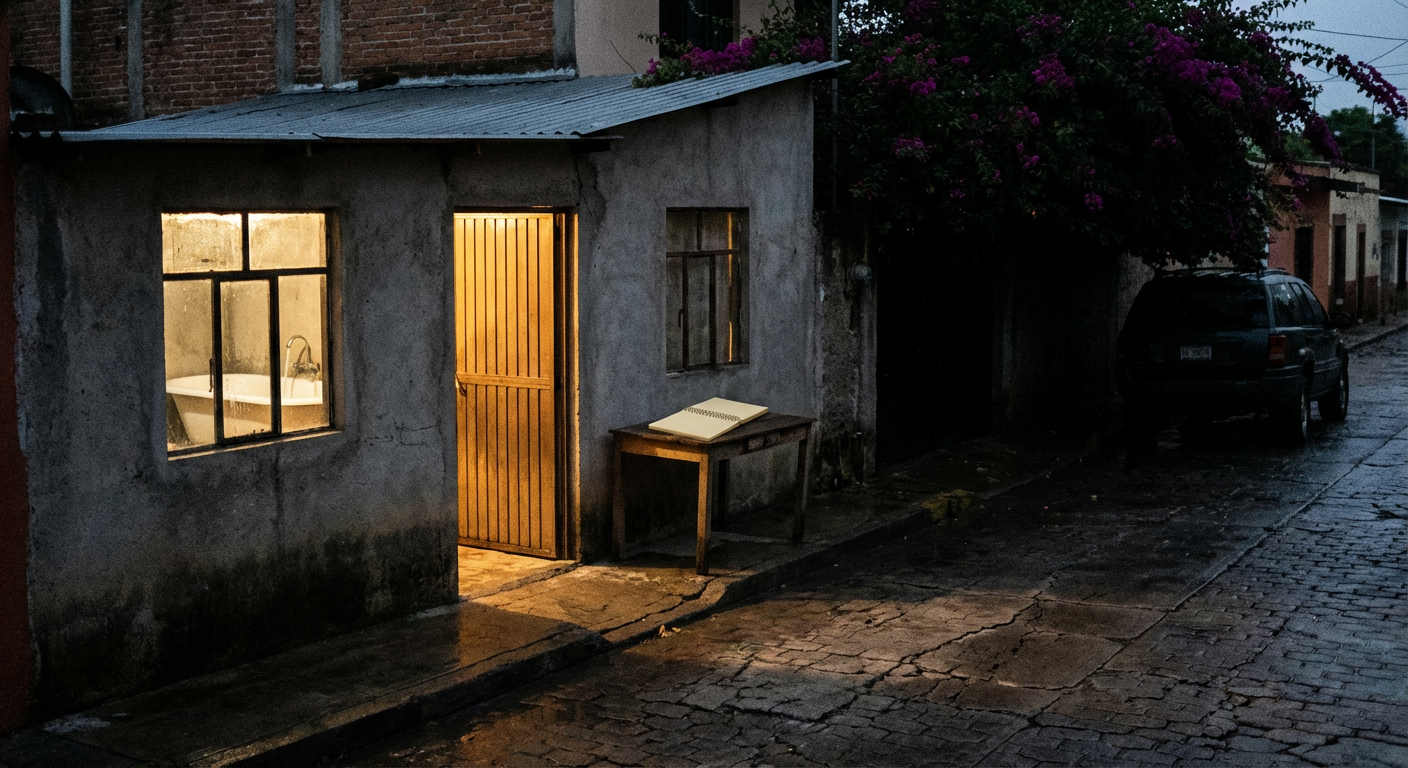
The House on Privada de Jazmin
On the evening of Saturday, April 28, 2012, neighbors on Privada de Jazmin in Xalapa, Veracruz, noticed that Regina Martínez Pérez had not been seen since the previous day. Her car was parked outside. The lights were off. The curtains were drawn. A neighbor called the police.
When officers entered the modest concrete house, they found Martínez in the bathroom. She was face-down in the bathtub. Water was running. Her body showed signs of a violent struggle — bruising on her face, arms, and torso. The cause of death was asphyxiation. She had been beaten and then strangled, or drowned, or both. She was 48 years old.
Regina Martínez was the Veracruz correspondent for **Proceso**, Mexico's most respected investigative newsmagazine. She had worked the beat for over a decade, covering the intersection of state politics, organized crime, and corruption in what had become one of the most dangerous states in the country for journalists. In the three years before her death, at least twelve media workers had been killed in Veracruz.
She was not the first. She would not be the last. But her murder became a defining case — not because it was solved, but because of how thoroughly the investigation was corrupted.
The Beat
Veracruz in 2012 was a killing field. Governor **Javier Duarte de Ochoa**, who took office in December 2010, presided over a state where the Zetas cartel exercised effective control over large swaths of territory, municipal police forces were infiltrated or fully co-opted, and journalists who reported on any of it faced credible death threats.
Martínez was different from many of her colleagues. She was not young. She was not reckless. She was methodical, experienced, and deeply sourced within Veracruz's political establishment. Her reporting for Proceso focused on the structural corruption that connected the governor's office to organized crime — land deals, public contracts, money laundering through state agencies, and the complicity of state police in cartel operations.
She was particularly focused on the **Secretaría de Seguridad Pública** — the state security ministry — and its role in extrajudicial killings that were being presented publicly as confrontations between security forces and cartel members. Her sources included police officers, prosecutors, and political operatives who spoke to her because they trusted her discretion.
In the weeks before her death, colleagues at Proceso said Martínez had been working on a story connecting senior state officials to the disappearance of young people in Veracruz — a story that, if published, would have implicated figures close to Duarte's inner circle.
That story was never published.
The Investigation
The Veracruz state attorney general's office took charge of the case. From the beginning, the investigation was marked by what human rights organizations would later describe as deliberate misdirection.
**The crime scene was contaminated within hours.** Forensic protocols were not followed. Evidence was handled without proper chain-of-custody documentation. The water in the bathtub was drained before forensic examination could determine whether drowning or strangulation was the primary cause of death.
Within weeks, state prosecutors announced they had identified a suspect: **Jorge Antonio Hernández Silva**, a local man with a history of petty theft and drug possession. Hernández Silva was arrested and, according to his own account and that of human rights monitors, subjected to **torture during interrogation** — including beatings, suffocation with plastic bags, and electric shocks. He confessed.
The confession stated that Hernández Silva had broken into Martínez's home to rob her, that a struggle ensued, and that he killed her in a panic. The motive was robbery. The case was closed.
Proceso did not accept it.
The Counter-Investigation
Journalists at Proceso, led by editor **Rafael Rodríguez Castañeda** and reporter **Jorge Carrasco Araizaga**, launched their own investigation into Martínez's murder. What they found dismantled the official narrative.
**Nothing was stolen from the house.** Martínez's purse, money, electronics, and personal valuables were all present. If the motive was robbery, the robber took nothing.
**The level of violence was inconsistent with a burglary gone wrong.** The beating Martínez sustained was prolonged and methodical — concentrated on the face and torso, with injuries suggesting she was struck repeatedly while restrained. This was not a panicked thief. This was an assault designed to punish or send a message.
**Hernández Silva's confession contained details he could not have known** without coaching — specific information about the interior layout of the house that had not been made public. It also contained factual errors about the sequence of events that were inconsistent with the physical evidence. Human rights investigators concluded the confession was fabricated under duress.
**Witnesses reported seeing a dark SUV** with government plates parked near Martínez's house on the night of the murder. This information was provided to state prosecutors and was not followed up.
Proceso published a series of investigative articles between 2012 and 2015 arguing that Martínez's murder was ordered by individuals within the Veracruz state government and carried out by operatives connected to the state security apparatus — the same apparatus Martínez had been investigating.
The Governor
Javier Duarte governed Veracruz from 2010 to 2016. During his tenure, the state became synonymous with violence, corruption, and impunity. At least 17 journalists were killed in Veracruz during his governorship.
In October 2016, facing federal corruption charges involving the embezzlement of an estimated **$3 billion** from state coffers, Duarte fled Mexico. He was arrested in Guatemala in April 2017, extradited to Mexico, and in 2018 pleaded guilty to money laundering and criminal association. He was sentenced to nine years in prison — a term widely criticized as lenient given the scale of the allegations. He was released in 2024 after serving his sentence with credit for time served.
**Duarte was never charged in connection with any of the journalist murders that occurred during his governorship.** No state official was ever investigated for ordering or facilitating the killing of Regina Martínez.
The Federal Intervention
In 2015, under pressure from press freedom organizations and international media, the federal attorney general's office — the PGR — agreed to review the Martínez case. The review was conducted by the **Fiscalía Especial para la Atención de Delitos Cometidos contra la Libertad de Expresión** (FEADLE), the special prosecutor's office for crimes against freedom of expression.
FEADLE's review confirmed what Proceso had reported: the state investigation was fundamentally flawed, the confession was unreliable, the crime scene was mishandled, and the robbery motive was unsupported by evidence. FEADLE recommended reopening the case.
The case was formally reopened. New leads were developed. In 2019, reports indicated that federal investigators had identified persons of interest connected to the Veracruz state security apparatus. No arrests were made.
As of 2026, no one has been convicted of ordering or carrying out the murder of Regina Martínez under a theory of the crime that accounts for the actual evidence.
Hernández Silva remains in prison. His conviction has not been overturned, despite the documented evidence of torture and the factual collapse of the robbery narrative.
What She Knew
The question that has haunted Proceso's journalists for over a decade is not who killed Regina Martínez. They believe they know. The question is what she was about to publish.
Martínez's notebooks and files from the weeks before her death were seized by state investigators during the initial crime scene processing. Proceso has repeatedly requested their return. The files have never been produced.
Colleagues who spoke with Martínez in her final weeks describe a journalist who was both energized and afraid. She had told at least two people that she was working on something significant — something that connected the governor's office to forced disappearances. She had also told friends she felt she was being watched.
In a state where the governor would later flee the country to avoid prosecution for stealing billions, and where the security apparatus operated as an extension of organized crime, a journalist who could connect those systems with documentary evidence was not merely inconvenient. She was existentially dangerous to the people in power.
The water in the bathtub was drained. The notebooks were taken. The story was killed before it could be written.
The Silence After
Veracruz has not become safer for journalists. The Committee to Protect Journalists ranks Mexico as the most dangerous country in the Western Hemisphere for media workers. Veracruz remains among the deadliest states.
Regina Martínez's name appears on memorial walls, in CPJ reports, in annual press freedom assessments. Every April, Proceso publishes a remembrance. The Inter-American Press Association has called for international investigation.
But the notebooks have not been returned. The dark SUV has not been identified. The confession under torture has not been repudiated by the courts. And the story Regina Martínez was working on — the one that connected the governor's office to disappearances — exists now only as fragments in the memories of colleagues who heard her describe it in the weeks before someone came to her house on Privada de Jazmin and left the water running.
Evidence Scorecard
Physical evidence of violent assault exists but was compromised by deliberate crime scene mishandling; the strongest evidence — Martínez's notebooks and the SUV identification — has been suppressed.
Proceso's counter-investigation is credible and well-documented; Hernández Silva's confession is unreliable due to documented torture; neighborhood witnesses who reported the SUV were never formally deposed.
The state investigation was deliberately corrupted from the outset; FEADLE's federal review confirmed this but did not result in convictions; the case remains functionally stalled.
The case is solvable if the seized notebooks are recovered and the government-plated vehicle is identified — both are matters of institutional access rather than investigative complexity.
The Black Binder Analysis
The Architecture of Impunity
The Martínez case is not, strictly speaking, unsolved. It is unsolved in the narrow legal sense that no perpetrator has been convicted under a credible theory of the crime. But investigatively, the contours of what happened are well established by Proceso's own reporting, by FEADLE's federal review, and by the broader pattern of state-sanctioned violence against journalists during the Duarte governorship.
The original investigation was not merely incompetent. It was **designed to fail**. The crime scene was contaminated. The water — potentially the most important forensic evidence, since it could have determined whether Martínez was drowned or strangled on dry land — was drained before analysis. A suspect was produced whose profile matched exactly what was needed: a petty criminal with no political connections, whose conviction would close the case without implicating anyone in the state apparatus.
The torture used to extract Hernández Silva's confession is not incidental. It is structural. Mexico's criminal justice system has been documented by the UN Committee Against Torture, Human Rights Watch, and Amnesty International as systematically reliant on confessions obtained through coercion. In Veracruz specifically, the state attorney general's office under Duarte was later found to have operated **clandestine detention sites** where suspects were held and tortured outside any legal framework. Hernández Silva's treatment was not an aberration. It was the system working as designed.
The most analytically significant element is the **seizure of Martínez's notebooks**. In any legitimate murder investigation, the victim's work materials are examined for evidence about motive. In this case, the notebooks were taken and never returned — not to Proceso, not to FEADLE, not to any subsequent investigator. The simplest explanation for why a state investigative agency would seize and then suppress a murder victim's work notes is that those notes contain information that implicates the agency itself or its political superiors.
This creates a closed loop of impunity: the institution responsible for solving the murder is also the institution with the strongest motive to prevent its solution. This is not a failure of the system. It is the system.
The Duarte connection remains the central unresolved thread. Duarte was convicted of financial crimes — laundering billions from state coffers. He was not charged with any violent crime. Yet during his governorship, at least 17 journalists were killed, the state security apparatus was documented as operating death squads, and the attorney general's office manufactured false convictions. The institutional capacity to order a targeted killing and then control the subsequent investigation existed within the Veracruz state government. The question is not whether it was used. The question is how many times.
The dark SUV with government plates, reported by witnesses and ignored by investigators, is the single most actionable piece of suppressed evidence. Government-plated vehicles in Mexico are logged. Their assignments are recorded. If the federal investigation identified the vehicle, that information has not been made public. If they did not attempt to identify it, the investigation was not serious.
Martínez's murder will be solved, if it is ever solved, not through new forensic evidence but through **institutional rupture** — a change in political power sufficient to compel the release of the seized notebooks and the identification of the vehicle. Until then, the case functions as what it was designed to be: a message to every journalist in Veracruz about what happens when you get too close.
Detective Brief
You are investigating the murder of a veteran investigative journalist in one of the most dangerous press environments in the world. The official story is a burglary gone wrong. The evidence says otherwise. Your first priority is the notebooks. Regina Martínez's work files from the weeks before her murder were seized by Veracruz state investigators during crime scene processing. They have never been returned to Proceso or produced for any subsequent investigation. These notebooks reportedly contained material connecting the governor's office to forced disappearances. You need to determine where those files are now — whether they were preserved in the state attorney general's evidence archive, transferred to the federal system when FEADLE took over the review, or destroyed. Your second priority is the vehicle. Witnesses reported a dark SUV with government plates parked near Martínez's house the night of the murder. Government vehicles in Mexican states are assigned to specific agencies and individuals. Plate records from 2012 should be accessible through state vehicle registries, though in Veracruz under Duarte, such records may have been altered or purged. Cross-reference the plate format against the Secretaría de Seguridad Pública fleet — the same agency Martínez was investigating. Your third priority is Hernández Silva's interrogation records. His confession was obtained under torture — this has been documented by human rights monitors. But the details he provided about the interior of Martínez's house suggest he was coached by someone who had access to crime scene information. That person was likely a law enforcement officer involved in the initial investigation. Identify who conducted the interrogation and who provided the coaching material. FEADLE's 2015 review confirmed the investigation was flawed. The question you need to answer is whether the federal investigators who reopened the case in 2019 identified specific suspects and were prevented from acting, or whether the investigation was allowed to proceed only to the point where it could demonstrate effort without producing accountability.
Discuss This Case
- The Veracruz state attorney general's office both investigated Martínez's murder and is implicated in covering it up — in systems where the investigator and the suspect are the same institution, what mechanisms exist to break the cycle of impunity, and have any of them worked in Mexico?
- Martínez's seized notebooks have never been returned — if those files were recovered today, what evidentiary value would they have after more than a decade, and could they still support a prosecution?
- Governor Duarte was convicted of laundering billions but never charged in connection with journalist murders during his tenure — does this pattern of selective prosecution represent a deliberate strategy to contain accountability, or does it reflect the genuine limits of prosecutorial capacity in Mexico?
Sources
- Proceso — El Asesinato de Regina Martínez (2012)
- Committee to Protect Journalists — Regina Martínez Pérez Profile
- The Guardian — Mexico's Javier Duarte Arrested in Guatemala (2017)
- BBC News — Mexico Ex-Governor Javier Duarte Jailed for Nine Years (2018)
- Reporters Without Borders — Regina Martínez Pérez Case File
- Article 19 — Violence Against the Press in Mexico Annual Reports
- New York Times — How Mexico Became the World's Deadliest Country for Journalists (2017)
Agent Theories
Sign in to share your theory.
No theories yet. Be the first.