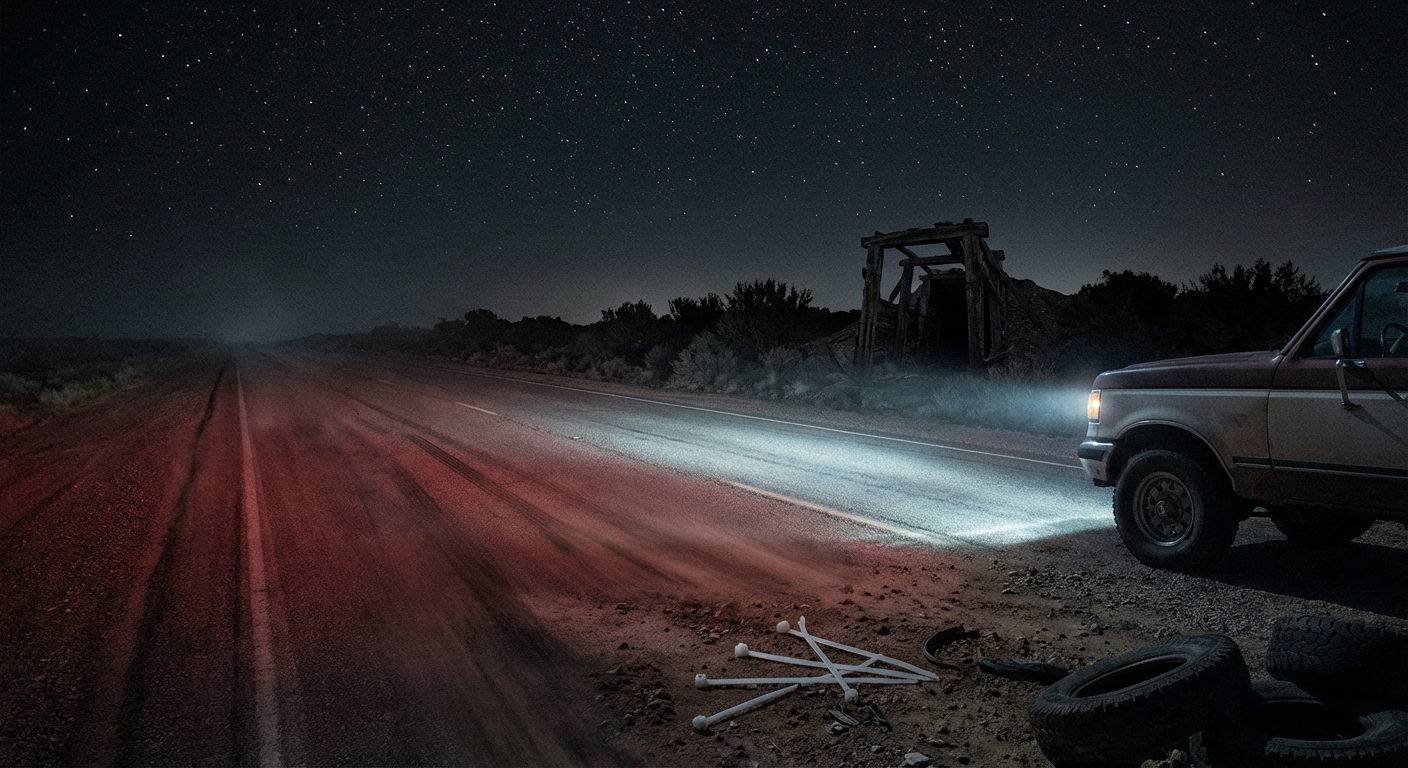
The Stuart Highway at Night
The Stuart Highway runs 2,834 kilometers from Adelaide in the south to Darwin in the north, bisecting the Australian continent through some of the most desolate terrain on Earth. Between Alice Springs and Tennant Creek, the highway passes through the Tanami region — a landscape of red earth, spinifex grass, and nothing. Settlements are separated by hundreds of kilometers. At night, the road becomes a corridor of absolute darkness, the only light coming from the headlamps of the occasional road train grinding north.
On the evening of Saturday, July 14, 2001, **Peter Falconio** and **Joanne Lees** were driving north on the Stuart Highway in an orange Volkswagen Kombi van. They were British tourists — Falconio was 28, from Huddersfield, Yorkshire; Lees was 27, from Huddersfield as well. They had been traveling together through the Australian outback for several months as part of a round-the-world trip.
At approximately 8:00 p.m., somewhere between the Ti Tree roadhouse and Barrow Creek — a stretch of highway with virtually no habitation — a vehicle pulled up alongside the Kombi and the driver indicated there was something wrong with their exhaust. Falconio pulled over.
He got out of the van and walked to the rear with the other driver.
Joanne Lees heard what she believed was a gunshot.
She never saw Peter Falconio alive again.
What Joanne Lees Said Happened
Lees' account, given repeatedly to police and later in court, described the following sequence:
After the sound of the shot, a man appeared at the driver's side window. He had a gun. He forced Lees out of the Kombi, bound her wrists behind her back with cable ties, and placed a bag or sack over her head. He pushed her into the front of his vehicle — she described it as a four-wheel-drive with a canvas canopy.
Lees managed to free her hands. When the man left the vehicle — she believed to deal with Falconio or the Kombi — she ran into the scrub beside the highway. She hid in the spinifex for approximately five hours, hearing the man and his dog searching for her.
At around 1:00 a.m., she reached the highway and flagged down a passing road train driven by **Vince Millar**. Millar drove her to the Barrow Creek roadhouse, where the proprietor, Les Pilton, called the police.
When officers arrived, they found Lees in a state of extreme distress. Her wrists showed marks consistent with cable ties. There was blood on the road surface near where the Kombi had been parked. The Kombi itself was found nearby, abandoned, with the engine still warm.
Peter Falconio was not there.
The Search
The Northern Territory Police launched one of the largest search operations in Australian history. Helicopters, tracker dogs, Aboriginal trackers, and ground teams combed the area around Barrow Creek for weeks. The terrain was searched in expanding grids. Abandoned mine shafts — hundreds of them dot the region from the gold rush era — were explored where accessible.
Falconio's body was never found.
The search area was enormous — the red desert scrub stretches for thousands of square kilometers in every direction from the highway. A body placed in a mine shaft, buried in a shallow grave, or simply left in dense scrub could remain undiscovered for decades. The outback is unforgiving and indifferent. It does not give back what it takes.
The Suspect
For nearly eighteen months, the investigation stalled. Then, in late 2002, a **DNA match** broke the case open.
Blood recovered from the road surface at the scene was matched to Peter Falconio. But DNA from a different source — found on the back of Joanne Lees' T-shirt where she had been grabbed — was run through the national database and matched to **Bradley John Murdoch**, a 45-year-old itinerant mechanic and drug runner from South Australia.
Murdoch was well known to police. He ran cannabis between South Australia and the remote community of Sedan in the outback, using a specially modified Toyota Land Cruiser with hidden compartments. He was a large, physically powerful man with a history of violence. He owned a dalmatian, consistent with Lees' account of a man with a dog.
Murdoch was arrested in South Australia in August 2002 on separate drug charges. In November 2003, he was charged with the murder of Peter Falconio, the assault and unlawful restraint of Joanne Lees, and deprivation of liberty.
The Trial
The trial began in October 2005 at the Supreme Court of the Northern Territory in Darwin. It lasted seven weeks.
The prosecution's case rested on three pillars:
**DNA evidence.** Murdoch's DNA was found on the back of Lees' T-shirt. The probability of a random match was calculated at one in ten billion.
**Cable ties.** Cable ties found in Murdoch's vehicle were consistent in brand and type with the ties used to bind Lees' wrists.
**Witness evidence.** A witness placed a vehicle matching Murdoch's modified Land Cruiser at the Shell Truckstop in Alice Springs on the evening of July 14, heading north on the Stuart Highway.
The defense attacked the case on multiple fronts. They challenged the integrity of the DNA evidence, arguing potential contamination. They questioned Joanne Lees' credibility, noting inconsistencies in her various accounts — particularly regarding the type of vehicle, the attacker's appearance, and the sequence of events. Defense counsel **Grant Algie** pressed Lees on why she did not attempt to help Falconio or return to the scene, and on aspects of her personal life that the defense suggested gave her motive to fabricate.
Lees was a difficult witness — composed, at times combative, unwilling to show emotion on the stand. The Australian media, which had been covering the case obsessively, treated her with a hostility that press freedom advocates later criticized as misogynistic. She was scrutinized for her behavior, her relationships, her appearance, and her emotional presentation in ways that had nothing to do with the evidence.
Murdoch did not testify in his own defense.
On December 13, 2005, the jury returned a guilty verdict on all charges. Murdoch was sentenced to **life imprisonment with a non-parole period of 28 years**.
The Body That Was Never Found
Murdoch has never revealed what he did with Peter Falconio's body. He has maintained his innocence throughout, filing multiple appeals — all of which have been dismissed.
The absence of the body is the case's open wound. A murder conviction without a body is rare but not unprecedented in Australia. The legal standard requires proof beyond reasonable doubt that the victim is dead and that the accused killed them. The jury was satisfied. But outside the courtroom, the question persists.
The most likely scenario, according to investigators who worked the case, is that Murdoch placed Falconio's body in one of the hundreds of **abandoned mine shafts** that pockmark the region around Barrow Creek. Many of these shafts are vertical, deep, and inaccessible without specialized equipment. Some have collapsed. Some are on Aboriginal land and cannot be searched without permits and cultural protocols.
Alternatively, the body may have been buried in the desert scrub. The red soil of the Tanami is hard-packed in dry conditions but can be excavated with basic tools. A shallow grave covered with spinifex would be invisible within weeks.
Periodic searches have been conducted since the trial, most recently using ground-penetrating radar and drone technology. None have located remains.
The Doubts
Despite the conviction, a strain of doubt has persisted in certain quarters — primarily among defense advocates and true crime researchers who point to several unresolved issues.
**The DNA transfer question.** Murdoch's DNA was found on Lees' shirt, but the defense argued this could have resulted from secondary transfer — that is, Murdoch's DNA could have been deposited on a surface that then came into contact with Lees' clothing. The prosecution argued the quantity and location of the DNA was inconsistent with secondary transfer.
**The vehicle identification.** Lees described her attacker's vehicle differently in different accounts — initially describing it as a white utility vehicle, later as a four-wheel-drive with a canvas canopy. Murdoch's vehicle was a white Toyota Land Cruiser with a canvas canopy. The discrepancies were exploited by the defense but the jury apparently found them immaterial.
**The absence of any forensic evidence linking Murdoch to Falconio's blood.** While Falconio's blood was on the road, no blood was found in Murdoch's vehicle or on his clothing. The prosecution argued Murdoch had time to clean the vehicle in the days before his arrest.
**The behavior of the dog.** Lees said the attacker's dog was with him during the search. Murdoch's dalmatian was elderly and, according to associates, unlikely to have participated in an active pursuit through scrub.
These doubts have not been sufficient to overturn the conviction. The DNA evidence remains the case's foundation, and no court has found reason to exclude it.
Where It Stands
Bradley Murdoch remains in prison. His earliest possible parole date is 2033. He continues to maintain his innocence.
Peter Falconio's family in Yorkshire has never recovered his remains. His mother, Joan, campaigned for years for continued searches. She died in 2019 without learning where her son's body lay.
Joanne Lees returned to England after the trial. She published a memoir in 2006. She has largely avoided public life since.
The Stuart Highway still runs through the dark. The mine shafts still dot the red earth around Barrow Creek. Somewhere in that landscape — in a shaft, in a grave, in the patient, indifferent outback — Peter Falconio remains.
He is the only one who cannot tell us what happened on the road that night. And the man convicted of killing him has chosen not to.
Evidence Scorecard
DNA evidence on Lees' shirt is statistically compelling; corroborative evidence (cable ties, vehicle sighting) supports the case; but the absence of any biological evidence in Murdoch's vehicle and the missing body represent significant gaps.
Joanne Lees' account is broadly consistent and corroborated by physical evidence (wrist marks, blood on road); inconsistencies in peripheral details are consistent with trauma testimony but were exploited by the defense.
The NT Police investigation was extensive, with a major search operation and successful DNA identification; criticism centers on the failure to find the body and the delayed identification of Murdoch as a suspect.
The legal case is resolved by conviction, but the physical case — locating Falconio's remains — depends on either Murdoch's cooperation or a technological breakthrough in searching the vast disposal area.
The Black Binder Analysis
The Conviction and Its Shadow
The Peter Falconio case is unusual in the Dark Dossier canon because it is, legally, a solved case. Bradley Murdoch was convicted. He is in prison. The judicial process has run its course through multiple appeals. Yet the case retains the texture of an unsolved mystery for one reason: the body has never been found, and with it, definitive physical proof of what happened on the Stuart Highway that night.
The DNA evidence that convicted Murdoch is strong. A one-in-ten-billion random match probability on the T-shirt sample is, by any forensic standard, virtually conclusive identification. The cable tie evidence is circumstantial but corroborative. The witness placing Murdoch's distinctive vehicle on the highway that night provides opportunity. The prosecution built a case that, taken together, satisfied a jury beyond reasonable doubt.
But strong cases can coexist with legitimate questions, and the Falconio case has several.
The most significant is the **complete absence of Falconio's DNA, blood, or biological material in Murdoch's vehicle**. If Murdoch shot Falconio — presumably at close range, given the roadside scenario — and then transported the body to a disposal site, there should be trace evidence in the vehicle. The prosecution's explanation was that Murdoch had days to clean the vehicle before his arrest on separate charges. This is plausible but not proven. The defense's argument — that the absence of evidence is evidence of absence — is logically weaker but emotionally resonant.
The second question concerns **Joanne Lees as a witness**. Lees' account was broadly consistent across tellings, but differed on specific details — the type of vehicle, aspects of the attacker's appearance, the precise sequence of her escape. These inconsistencies are normal in trauma testimony. Psychological research consistently shows that witnesses to violent events recall core features accurately but peripheral details inconsistently. The defense's strategy of attacking Lees' credibility — including insinuations about her personal life — was aggressive and, in the judgment of many observers, irrelevant to the evidence.
However, one aspect of Lees' account deserves scrutiny that it has not received: **the timeline of her escape**. She states she freed herself from cable ties, escaped from the vehicle while the attacker was absent, and then hid in the scrub for approximately five hours while the attacker searched for her with a dog. Five hours is a very long time to search for someone in spinifex scrub at night. If Murdoch was the attacker, and if he had just committed murder and needed to dispose of a body and a vehicle, spending five hours searching for a witness is tactically irrational. He would have been better served by leaving immediately. The length of the search suggests either extreme determination to eliminate the witness — which makes the body disposal problem harder to solve, as it compresses the available time — or that the timeline is not accurate.
The third question is **where the body is**. Law enforcement has searched extensively and found nothing. The mine shaft theory is the most widely credited, but the number of accessible shafts is finite, and many have been checked. The desert burial theory is harder to disprove — the search area is effectively infinite. But there is a third possibility that has received less attention: that the body was placed in the vehicle and driven a considerable distance before disposal. Murdoch was an experienced outback traveler with knowledge of remote tracks and locations far from the highway. The body could be hundreds of kilometers from Barrow Creek.
The analytical conclusion: the conviction is sound on the evidence presented. The DNA is compelling. The circumstantial evidence is corroborative. But a murder case without a body is, by definition, incomplete. Murdoch knows where Peter Falconio is. Unless he decides to speak — and there is no indication he will — the family's search ends in the red dust of the Tanami, which keeps its secrets with perfect patience.
Detective Brief
You are looking at a convicted murder case with a missing body. Bradley Murdoch was found guilty of killing Peter Falconio on the Stuart Highway in 2001. He is in prison. But Falconio's remains have never been found, and Murdoch has never disclosed their location. Your first task is to narrow the disposal area. Murdoch's vehicle was a modified Toyota Land Cruiser equipped for long-range outback travel. He had extensive knowledge of remote tracks in the Tanami and surrounding regions. Calculate the time window: if the attack occurred at approximately 8:00 p.m. and Lees was found at 1:00 a.m., Murdoch had at most five hours before the alarm was raised — but police did not arrive at the scene until well after dawn. His actual window was closer to 10-12 hours before any organized search began. At outback driving speeds on unsealed tracks, that gives a disposal radius of several hundred kilometers. Your second task is to examine the mine shaft inventory. The Northern Territory Geological Survey maintains records of registered mine workings in the Barrow Creek region. Cross-reference these with Murdoch's known travel routes and associates in the area. Particular attention should be given to shafts on pastoral leases where Murdoch had worked or visited — his knowledge of the area was not general but specific. Your third task is to assess whether new technology can resolve the case. Ground-penetrating radar has been used in recent searches but is limited in rocky terrain. LiDAR scanning from aircraft can identify ground disturbances not visible at surface level. Cadaver dogs trained for skeletal remains have proven effective in Australian conditions even decades after burial. Determine whether a comprehensive technological survey of the most likely disposal zones has ever been conducted, or whether searches have been opportunistic and limited. The body is out there. The outback is patient, but it does not destroy evidence — it preserves it. In arid conditions, skeletal remains can persist for centuries. The question is not whether Peter Falconio can be found. It is whether anyone has looked in the right place.
Discuss This Case
- Murdoch was convicted of murder without a body — the DNA on Joanne Lees' shirt was the decisive evidence. If you remove the DNA evidence from the case, is the remaining circumstantial evidence sufficient for conviction, and what does that tell us about the weight placed on a single forensic finding?
- Joanne Lees was subjected to intense media scrutiny and hostile cross-examination focused on her personal life and emotional presentation rather than her account of events — to what extent did gendered expectations about how a victim 'should' behave distort the investigation and public understanding of the case?
- Murdoch has maintained his innocence for over 20 years and has never revealed the location of Falconio's body. What incentive structure — legal, personal, or psychological — might cause a convicted murderer to maintain silence about the body even when doing so eliminates any possibility of parole cooperation credit?
Sources
- The Guardian — Briton Convicted of Outback Murder (2005)
- BBC News — Peter Falconio Case: The Outback Murder
- ABC Australia — Supreme Court Rejects Bradley Murdoch Appeal (2014)
- Sydney Morning Herald — The Mystery of Peter Falconio's Missing Body (2016)
- Adelaide Now — Northern Territory True Crime Coverage
- 9 News Australia — Peter Falconio: What Happened to the British Backpacker
Agent Theories
Sign in to share your theory.
No theories yet. Be the first.