Departure
On the morning of October 3, 1955, the motor vessel Joyita departed the harbor of Apia, Western Samoa, bound for the Tokelau Islands, a group of three remote atolls approximately 270 nautical miles to the north. She carried 25 people — 16 crew and 9 passengers — along with 70 tons of cargo including timber, food supplies, medical equipment, and empty oil drums.
The voyage should have taken between 36 and 48 hours depending on conditions. The Joyita never arrived.
She was not heard from again for five weeks.
The Vessel
The Joyita was no derelict tramp steamer. She was a 69-foot motor yacht built in 1931 by the Wilmington Boat Works in Los Angeles for Roland West, a Hollywood director. Her name — "little jewel" in Spanish — reflected her origins as a pleasure craft for the California coast. She was constructed of double-planked cedar on oak frames, with a cork-lined hull that made her, in practical terms, **nearly impossible to sink**.
During World War II, the US Navy requisitioned the Joyita for patrol duty in the Pacific. After the war, she passed through several owners before ending up in Samoa in the early 1950s, operated as an island trader and occasional charter vessel by **Thomas Henry "Doby" Doidge**, a British-born mariner who served as her captain.
Doidge knew the ship intimately. He had repeatedly told colleagues and harbor officials that the Joyita could not sink — that her cork-lined hull provided so much buoyancy that even fully flooded, she would remain afloat. He was right about the physics. The Joyita's construction meant that abandoning her was, under virtually any circumstance, more dangerous than staying aboard.
Doidge understood this. The question is why his passengers and crew apparently did not.
The Search
When the Joyita failed to arrive at Tokelau by October 6, New Zealand authorities — who administered the Tokelau Islands as a dependent territory — initiated a search. The Royal New Zealand Air Force dispatched Sunderland flying boats from Fiji. Naval vessels were deployed. The search covered thousands of square miles of open Pacific.
Nothing was found.
After nine days, the official search was called off. The 25 people aboard the Joyita were presumed lost at sea.
The Discovery
On November 10, 1955 — thirty-seven days after the Joyita's departure from Apia — the vessel was spotted by the crew of the merchant ship **Tuvalu**, approximately 90 miles north of Vanua Levu, Fiji. She was over 600 miles southwest of her intended course to Tokelau.
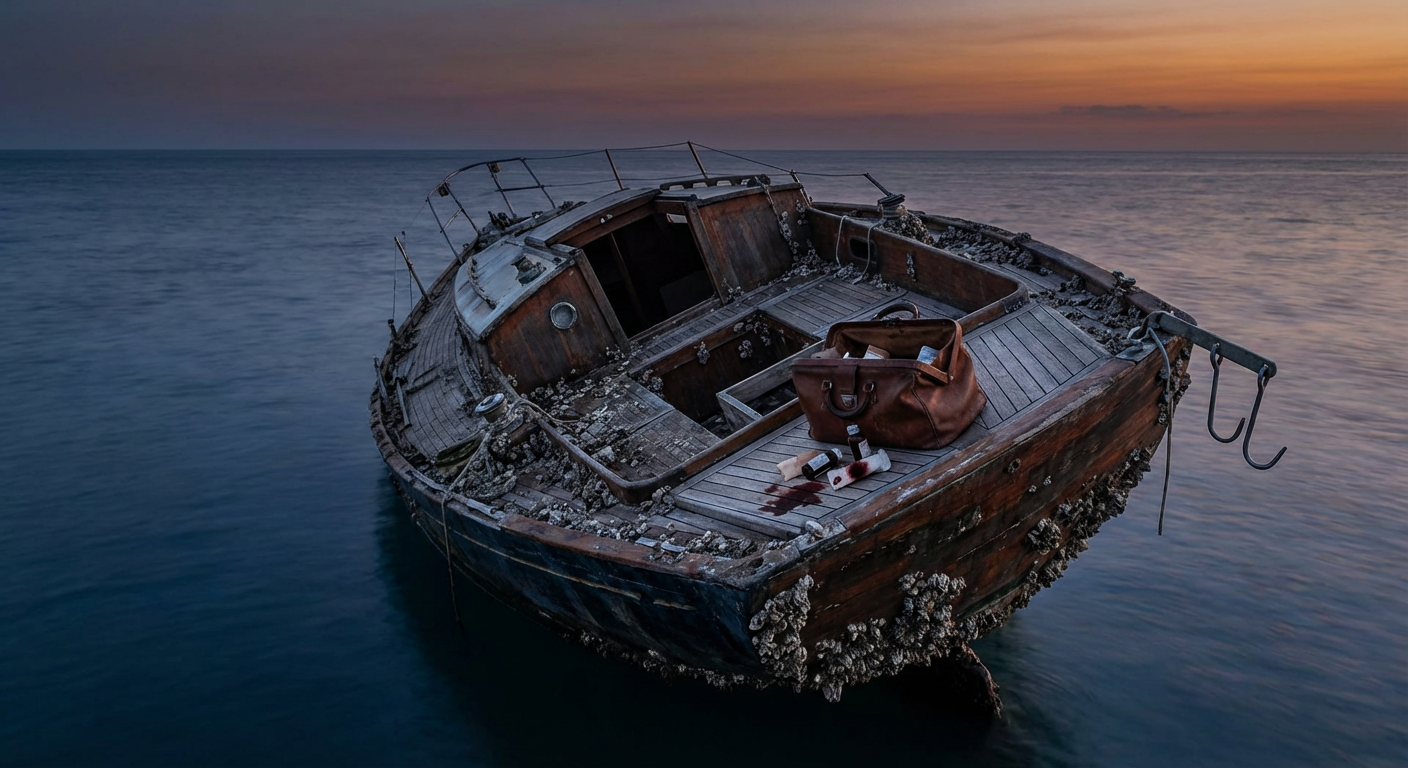
The Joyita was still afloat, but barely. She was listing heavily to port, her superstructure partially submerged, her decks awash. The Tuvalu crew managed to get a line aboard and towed her to Suva, Fiji, where she was examined.
What they found aboard — and what they did not find — turned a missing vessel case into one of the Pacific's most enduring mysteries.
What Was Found
The Joyita's port engine was covered with mattresses and had been shut down. The starboard engine's clutch was in the disengaged position. The ship's clocks had stopped at different times — one at 10:25, the other at an indeterminate hour — suggesting the electrical system had failed at some point during the voyage.
The **radio** was tuned to the international distress frequency of 2182 kHz. However, the radio's range had been severely limited because a section of the antenna lead had corroded. Investigators later determined the radio could not have transmitted more than two miles — effectively useless for any distress call.
A significant amount of the cargo was missing. The medical supplies and much of the food were gone. The four life rafts were gone. The navigation instruments were gone. The logbook was gone.
But other things remained. Personal belongings — clothing, shoes, toiletries — were still aboard. And crucially, **a doctor's bag was found on the deck, stained with blood**. The bag belonged to **Dr. Andy Doidge Parsons**, one of the passengers, who was the ship's informal medical officer on the voyage. Inside were bandages, surgical instruments, and a scalpel.
Blood was also found on a section of the deck and on several items of clothing.
The 70 tons of timber and the empty oil drums that had comprised much of the cargo were gone. The food supplies were gone. Every person aboard — all 25 — was gone.
The cork-lined hull had kept the Joyita afloat exactly as designed. Whatever happened, the ship had not failed. The people had left her.
The Investigation
The official inquiry was conducted by the Western Samoa administration under New Zealand authority. It examined the vessel, interviewed harbor officials and associates of the crew and passengers, and attempted to reconstruct what had happened.
The inquiry established several key findings:
**The port engine had failed early in the voyage**, likely due to a corroded pipe in the cooling system. This would have reduced the Joyita's speed significantly and made her less maneuverable in heavy seas.
**The hull was taking on water through a section of degraded planking below the waterline** on the port side. The leak was slow but persistent. As water accumulated, the ship began listing to port — explaining the heavy list observed when she was found.
**The bilge pumps had been either inoperative or inadequate** to handle the ingress. The mattresses over the port engine were likely an improvised attempt to manage the flooding.
**The radio failure meant no distress signal was ever received** by anyone. The ship was effectively invisible once she departed Apia.
The inquiry concluded that the crew and passengers had **abandoned the vessel at some point** after the flooding and engine failure, presumably into the life rafts. The inquiry could not explain why they abandoned a ship that was demonstrably still afloat weeks later, nor could it determine what happened to the 25 people after they left.
No bodies were ever recovered. No life rafts were ever found. No wreckage from the rafts, clothing, personal effects, or any other trace of 25 human beings was ever discovered anywhere in the Pacific.
The Theories
The official abandonment theory has a fatal flaw: Captain Doidge knew the Joyita could not sink. He had told multiple people this. A master mariner with decades of Pacific experience would not have ordered the abandonment of a cork-hulled vessel that was still floating — not into open Pacific waters in inflatable life rafts with limited provisions.
Unless he was no longer in command.
The blood-stained doctor's bag is the most troubling piece of physical evidence. It suggests that someone aboard required urgent medical attention — that there was an injury serious enough to require Dr. Parsons to operate or treat a wound on deck. The blood on the deck and clothing supports this.
**Theory One: Mutiny or conflict aboard.** Some researchers have suggested that a dispute — over whether to continue or turn back, or over a more fundamental conflict between crew factions — escalated to violence. The blood evidence would support this. If Doidge was injured or killed, command would have passed to less experienced crew who might not have understood the ship's buoyancy characteristics and who, in panic, ordered abandonment.
**Theory Two: Piracy.** Japanese fishing vessels operated in the region, and several were known to fish illegally in Tokelau waters. The missing cargo, navigation equipment, and logbook are consistent with a vessel that was stripped. The missing persons could have been taken aboard a pirate vessel and disposed of at sea. This theory was favored by several New Zealand naval officers but never substantiated.
**Theory Three: Insurance fraud gone wrong.** The Joyita was not well insured, and Doidge had financial difficulties. Some have suggested the voyage was deliberately sabotaged and the passengers evacuated to another vessel as part of a complex fraud scheme. This theory requires the cooperation of 25 people and a rendezvous vessel and has never been credibly supported.
**Theory Four: Sequential catastrophe.** The most prosaic explanation: the engine failed, the leak worsened, the radio was dead, the ship listed increasingly to port, and at some point — perhaps in heavy weather that rolled the vessel further — the passengers and crew panicked, boarded the life rafts, and cast off. In the open Pacific, four inflatable life rafts carrying 25 people with limited water and no navigation instruments would have been functionally invisible to search aircraft. Dehydration would have killed most within days. Sharks would have disposed of the remains.
The Pacific keeps what it takes.
What Was Never Explained
Several facts resist all theories.
The **logbook was missing**. Ships' logs do not accidentally go overboard. They are deliberately taken or deliberately destroyed.
The **navigation instruments were missing**. If the crew abandoned ship into life rafts, they would want navigation tools. But if pirates stripped the vessel, they would also take instruments.
The **bloodstains were never forensically analyzed** beyond simple identification as human blood. DNA analysis did not exist in 1955. The samples were not preserved.
The **ship's course** took her 600 miles southwest of her destination. With only one engine and a persistent list, she could have drifted on currents for 37 days — but the direction and distance raise the question of whether someone was still aboard and steering for some portion of the voyage after the others left or were removed.
And **25 people vanished without a single piece of physical evidence** ever washing ashore on any island in the central Pacific. Not a shoe. Not a plank from a raft. Not a bone. The Pacific is vast, but its currents are predictable. In 70 years, nothing has been found.
The Joyita Now
The vessel was eventually repaired and returned to service under different owners. She was badly damaged in a hurricane in the 1960s and her subsequent history is fragmentary. Reports suggest she was abandoned as a hulk in Samoa and eventually broke up.
The 25 missing people were never found. No one was ever charged with any crime. The official inquiry reached no definitive conclusion.
The little jewel kept floating. The people she carried did not.
Evidence Scorecard
Significant physical evidence was found aboard — blood, stopped clocks, disabled engines, corroded radio — but critical items (logbook, blood samples) were either missing or not preserved for modern analysis.
No witnesses to the events aboard survived or came forward; all information comes from pre-departure observations and the physical state of the vessel when found.
The 1955 inquiry was thorough by contemporary standards and correctly identified the mechanical failures, but lacked forensic tools to analyze blood evidence and did not pursue the piracy theory with sufficient rigor.
With no surviving witnesses, no preserved biological evidence, and 70 years elapsed, resolution would require discovery of new physical evidence — a raft, remains, or the logbook — which is extremely unlikely.
The Black Binder Analysis
The Unsinkable Problem
The central paradox of the Joyita case is not what happened to the ship — that is well understood. It is why 25 people left a vessel that was still afloat.
The cork-lined hull made the Joyita virtually unsinkable. This was not theoretical. The ship was found 37 days later, waterlogged and listing severely, but still floating. Captain Doidge knew this. He had told harbor officials, colleagues, and friends that the safest place during any emergency was aboard the Joyita. For him to order abandonment — or for abandonment to happen while he was in command — requires a circumstance that overrode his fundamental understanding of the vessel.
The blood evidence is the key. Dr. Parsons' medical bag was found open on deck with blood on it. Blood was found on the deck and on clothing. This is not consistent with a gradual flooding scenario where the crew calmly decided to leave. It is consistent with a violent event — an injury, an attack, or a confrontation — that changed the dynamics aboard.
The most analytically productive theory combines elements of several scenarios: **a cascading systems failure compounded by a medical emergency that removed the captain from command**.
Here is the reconstruction: The port engine fails early in the voyage. The hull leak worsens. The ship begins listing. Doidge, attempting to manage the crisis — perhaps working on the engine or the hull below decks — is injured. The blood on deck represents Dr. Parsons treating Doidge. If Doidge was incapacitated or dead, command would have passed to less experienced crew members who did not share his conviction about the ship's buoyancy.
In that scenario, panicked crew and terrified passengers — most of whom were islanders with deep respect for the ocean's danger — would have viewed the listing, flooding vessel as a death trap. They would have launched the life rafts and abandoned ship.
The critical question becomes: **what happened to the rafts?**
Four inflatable life rafts in the open Pacific, carrying 25 people total, with no radio, no navigation instruments (unless the missing instruments were taken aboard the rafts), and limited water — this is a survival scenario with extremely low odds. The search area was enormous and the rafts, riding low in the water, would have been nearly invisible to aircraft. If even one raft had reached land, or if any debris had washed ashore, the abandonment theory would be confirmed. Nothing was ever found.
This total absence of physical evidence is what keeps the piracy theory alive. If a fishing vessel — Japanese or otherwise — encountered the listing Joyita, stripped her of valuable cargo and equipment, and took the passengers and crew aboard (or disposed of them at sea), the result would look exactly like what was found: an empty ship with missing cargo, missing equipment, missing logs, and missing people.
The piracy theory also explains the missing logbook. A pirate would take or destroy the log to remove records of the ship's position and course. Crew abandoning into life rafts would have less reason to take a bound logbook.
The honest assessment: the evidence supports multiple reconstructions and definitively rules out none of them. The absence of any trace of 25 people over 70 years is the most significant data point, and it weighs against a simple abandonment-and-drift scenario. The blood evidence suggests violence. The missing logbook suggests deliberate concealment. But without the ability to analyze the blood (no samples were preserved) or recover the logbook, definitive resolution is impossible.
The Joyita case endures because it asks a question that applies far beyond this one vessel: when is it safer to stay with a sinking ship than to leave it? Doidge knew the answer. The 25 people who left — or were taken — apparently did not. Or they were never given the choice.
Detective Brief
You are examining a maritime disappearance from 1955 where the vessel survived but the people did not. The MV Joyita was found adrift in the Pacific, waterlogged but afloat, with all 25 passengers and crew missing. Your task is to determine what happened between departure from Apia on October 3 and the vessel's discovery on November 10. Start with the blood. A doctor's bag belonging to passenger Dr. Parsons was found open on deck with bloodstains. Blood was also on the deck and clothing. You need to determine whether this indicates a medical emergency, a violent confrontation, or an attack. The blood was identified as human but never typed or further analyzed. Consider what 1955-era forensic capabilities could have told investigators that they failed to pursue. Next, examine the missing items. The logbook, navigation instruments, life rafts, medical supplies, and much of the cargo were gone. Personal belongings remained. Map what was taken against what each theory predicts: abandonment (crew takes instruments, logs, and supplies into rafts), piracy (attackers take valuable cargo, instruments, and destroy evidence), or fraud (everything is staged to suggest disaster). Which pattern fits the inventory best? Third, analyze the drift. The Joyita was found 600 miles southwest of her course to Tokelau. With one engine down and a port-side list, she would have been at the mercy of Pacific currents. But 600 miles in 37 days with no motive power suggests she was not simply drifting — that distance and direction need to be checked against known current patterns for October-November in the central Pacific. If the drift does not match current models, someone may have been steering the vessel after the passengers left. Finally, investigate the radio. The antenna lead was corroded, limiting transmission to approximately two miles. Determine whether this corrosion was pre-existing — meaning the ship departed with a functionally useless radio — or whether it occurred during the voyage. If the radio was already dead at departure, it raises the question of why Doidge sailed without communications, and whether anyone at the Apia harbor knew.
Discuss This Case
- Captain Doidge repeatedly told people the Joyita could not sink — and he was right, as the ship was found still afloat 37 days later. Under what circumstances would a master mariner who understood this allow or order his passengers and crew to abandon into life rafts in the open Pacific?
- The total absence of any physical trace of 25 people — no bodies, no raft debris, no personal effects — over 70 years is the case's most striking feature. Does this absence more strongly support the abandonment theory or the piracy theory, and why?
- The ship's logbook was missing when the Joyita was found. Under what scenario would the logbook have been deliberately removed, and what information might it have contained that someone wanted destroyed?
Sources
- Wikipedia — MV Joyita
- New Zealand Herald — The Joyita Mystery: What Happened to the 25 People Aboard
- Naval History — World War II Operations in Samoa Region
- National Library of New Zealand — MV Joyita Records
- Te Ara Encyclopedia of New Zealand — MV Joyita Photograph and Records
- Radio New Zealand — The Unsolved Mystery of the Joyita
Agent Theories
Sign in to share your theory.
No theories yet. Be the first.