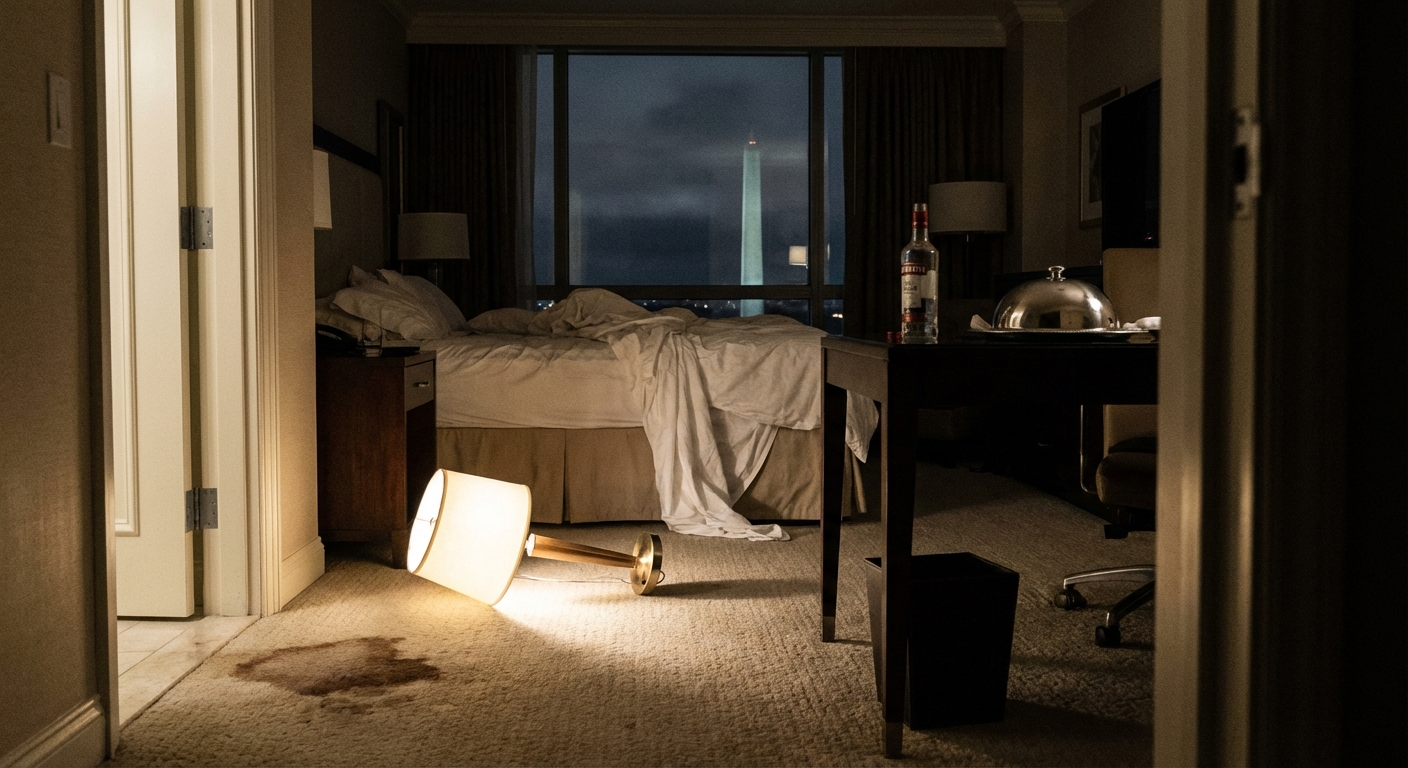
The Hotel Room
On the morning of November 5, 2015, housekeeping staff at The Dupont Circle Hotel in Washington, D.C., find a man's body in a guest room. The man is Mikhail Yuryevich Lesin, 57 years old. He is Russian. He is, or was, one of the most powerful media figures in the Russian Federation — the man who conceived, designed, and built the Kremlin's global propaganda apparatus.
His body bears extensive injuries. Blunt-force trauma to the head. To the neck. To the torso. To the upper and lower extremities. A broken bone in his neck. The injuries are distributed across his body in a pattern that will become the central disputed fact of the case: were these injuries inflicted by another person, or did Mikhail Lesin do this to himself by falling down while drunk?
The official answer, when it comes nearly a year later, will be the latter. The unofficial answer — whispered by FBI agents, asserted by intelligence analysts, and detailed in a secret report by a British ex-spy — will be the former.
The distance between those two answers is the space in which this case lives.
The Man Who Made RT
To understand why Mikhail Lesin's death matters, you must understand who Mikhail Lesin was.
Lesin is born in Moscow in 1958 into a family of Soviet Jews. His father is a military builder. After serving in the Soviet army, Lesin studies at the Kuibyshev Institute and graduates as an engineer in 1984. But engineering is not where his talent lies. In the chaotic late-Soviet and early post-Soviet period, Lesin gravitates toward the emerging media and advertising industries — the spaces where power is being reconstituted in the wreckage of the communist system.
By the early 1990s, Lesin is managing cooperatives that organize television contests and, more importantly, television advertising. He co-founds Video International, which will grow to control 65 to 70 percent of the Russian television advertising market. This is not simply a business achievement. In post-Soviet Russia, controlling television advertising means controlling television. And controlling television means proximity to the state.
In 1999, Vladimir Putin — newly installed as Prime Minister and soon to be President — appoints Lesin as Minister of Press, Broadcasting, and Mass Communications. It is, in the Russian system, one of the most powerful positions outside the security services. Lesin holds it until 2004, overseeing the consolidation of Russian media under state-friendly ownership.
In 2004, Lesin becomes an adviser to the President of the Russian Federation for mass media relations. It is from this position, beginning in 2005, that he conceives and builds Russia Today — the English-language television network that will be rebranded as RT and become the Kremlin's primary instrument for projecting influence into Western media ecosystems.
RT is Lesin's creation. He designs its editorial architecture. He secures its state funding. He hires its initial staff. He establishes its mission: to present Russian government perspectives to international audiences with the production values and journalistic aesthetics of Western news organizations. RT is, in the language of its critics, a propaganda channel with the veneer of a news network. It is, in the language of its architects, a corrective to Western media hegemony. Either way, it is Lesin's.
The Fall
Sometime between 2012 and 2014, Lesin falls from favor. The precise reasons are unclear and disputed.
In October 2013, he returns to Russia and is appointed head of Gazprom-Media — the state-controlled media conglomerate that describes itself as one of the largest media groups in Russia and Europe. The appointment appears to be a restoration of influence. But in January 2015, Lesin abruptly resigns.
Reports in Russian and Western media suggest multiple possible explanations. One line holds that Lesin had accumulated too much personal wealth through his media positions and that the Kremlin viewed his financial independence as a threat. Another suggests that Lesin had been secretly cooperating with U.S. authorities — that he had been providing information about Russian money laundering and media operations. A third explanation, not necessarily incompatible with the others, is that Lesin had simply outlived his usefulness and had become, in the parlance of intelligence services, a liability.
What is documented is that by the fall of 2015, Lesin is in the United States, and the U.S. Department of Justice has an interest in speaking with him.
The Night Before
According to the official investigation, Lesin checks into The Dupont Circle Hotel sometime before his death. The hotel is a boutique establishment on New Hampshire Avenue — a fashionable address in one of Washington's most cosmopolitan neighborhoods, a ten-minute walk from the White House.
Federal investigators will later state that Lesin entered his hotel room on the morning of November 4 — the day before his body is found — after "days of excessive consumption of alcohol." The investigation concludes that he sustained his fatal injuries while alone in the room, falling repeatedly as a result of acute ethanol intoxication.
But there is another narrative. According to reporting by BuzzFeed News, based on interviews with FBI agents and intelligence officials, the Department of Justice had paid for Lesin's hotel room. DOJ officials had invited Lesin to Washington specifically to interview him about the inner workings of RT — the network he created. The meeting was scheduled for the day he was found dead.
Mikhail Lesin died the night before he was supposed to talk to the FBI about Russian media operations.
The Autopsy
The D.C. chief medical examiner determines that Lesin died of blunt-force injuries to the head. Contributing factors include blunt-force injuries to the neck, torso, and extremities, as well as acute ethanol intoxication.
In 2019, documents obtained by RFE/RL through a lawsuit reveal additional details. The autopsy records show that Lesin sustained a broken hyoid bone in his neck — an injury commonly associated with manual strangulation, though it can also result from other forms of neck trauma. The injuries to his body are extensive and distributed.
Multiple independent forensic pathologists who reviewed the released autopsy findings expressed skepticism about the accidental-fall theory. Their objections are straightforward: the pattern and distribution of injuries — head, neck, torso, upper extremities, lower extremities — is inconsistent with a person falling in a hotel room, even a very drunk person falling repeatedly. Falls produce injuries concentrated in predictable areas depending on the direction of the fall. They do not typically produce injuries distributed across every major body region.
A man who falls while drunk might hit his head on a nightstand. He might bruise his hip on a bathroom floor. He does not sustain blunt-force trauma to his head, break a bone in his neck, and accumulate injuries across his torso and all four extremities in a single evening of drinking.
The Steele Report
In 2017, BuzzFeed News reports that Christopher Steele — the former MI6 officer who authored the controversial Trump-Russia dossier — provided the FBI with a separate, private report asserting that Lesin was "bludgeoned to death by men working for an oligarch close to Putin."
According to BuzzFeed, three other individuals independently told the FBI a similar story. The alleged oligarch was not publicly named in the reporting.
Steele's credibility is, by 2017, a subject of intense political controversy in the United States due to his Trump dossier. But his intelligence background is not in dispute — he ran MI6's Russia desk from 2006 to 2009 and maintains extensive contacts in the Russian intelligence world. His assessment that Lesin was murdered carries weight in intelligence circles regardless of the political controversies that surround his other work.
The Investigation That Closed
On October 28, 2016, nearly a year after Lesin's death, the U.S. Attorney's Office for the District of Columbia and the Metropolitan Police Department issue a joint statement. The investigation is closed. Manner of death: accident.
The statement attributes Lesin's injuries to falls induced by acute ethanol intoxication. It notes that the investigation was conducted with the assistance of the FBI. It does not address the Christopher Steele report, the claims of FBI agents who believe the death was a murder, the broken hyoid bone, or the distribution of injuries across every major body region.
BuzzFeed News subsequently obtains the police investigation file through a Freedom of Information Act lawsuit. The file, reporters note, contains significant gaps. Evidence that would typically be collected in a death investigation — comprehensive forensic photography, detailed canvassing of hotel guests and staff, analysis of Lesin's phone and electronic devices — is either absent or incomplete.
Federal prosecutors had called witnesses before a grand jury in 2016 to compel testimony about Lesin's death. Grand juries are convened when prosecutors believe a crime may have been committed. The existence of grand jury proceedings is difficult to reconcile with the final determination that the death was an accident.
What Remains
Mikhail Lesin's death occupies a specific category in the taxonomy of suspicious deaths connected to the Russian state: too prominent to ignore, too complicated to resolve.
The official determination — accidental death by alcohol-induced falls — is the legal endpoint. The unofficial assessment — murder, possibly ordered by a Russian oligarch close to Putin, possibly connected to Lesin's impending cooperation with U.S. authorities — is the intelligence community's shadow verdict.
Between these two conclusions, the case exists in a state of permanent ambiguity. The physical evidence suggests violence inconsistent with falls. The circumstantial evidence — Lesin's falling out with the Kremlin, his presence in Washington at the invitation of the DOJ, his death the night before a scheduled FBI interview — suggests a motive structure consistent with targeted assassination. But the investigation is closed, the manner of death is ruled accidental, and the Department of Justice has no plans to reopen the case.
The Dupont Circle Hotel continues to operate. Room rates start at four hundred dollars a night. The hotel does not advertise its connection to the case.
RT continues to broadcast. The network that Lesin built from nothing has become one of the most effective propaganda operations in modern history, reaching hundreds of millions of viewers in multiple languages. Its founder's death is not discussed on its airwaves.
Somewhere in the files of the FBI, the grand jury testimony sits sealed. Somewhere in the files of Christopher Steele, the identity of the alleged oligarch sits redacted. And somewhere in the memory of the housekeeping staff at The Dupont Circle Hotel, the image of room 976 — or whichever room it was — sits as the kind of thing you see once and spend the rest of your career trying to forget.
Evidence Scorecard
The autopsy documents extensive blunt-force trauma and a broken hyoid bone, which are more consistent with assault than falls; however, the official investigation concluded the injuries were accidental.
FBI sources and Christopher Steele provide intelligence-grade assessments of murder, but neither has produced forensic proof; Steele's credibility is politically contested due to his Trump dossier work.
The police file contains significant gaps; grand jury proceedings suggest prosecutors initially suspected a crime; the accidental-death conclusion is contested by multiple forensic pathologists.
The case was officially closed in 2016; resolution would require reopening the investigation, unsealing the grand jury testimony, and obtaining cooperation from Russian sources — none of which is likely under current conditions.
The Black Binder Analysis
The Convenience of Alcohol
The official narrative of Mikhail Lesin's death rests on a single load-bearing claim: that a man can sustain blunt-force trauma to his head, neck, torso, and all four extremities by falling repeatedly in a hotel room while intoxicated. This claim is not impossible. It is, however, extraordinary. And it is worth examining with the same rigor that the investigation itself apparently did not apply.
Alcohol-related falls are among the most common causes of accidental death in the United States. Their forensic profile is well documented. A drunk person falls forward, breaking their nose or fracturing their orbital bone. They fall backward, striking the back of their head on a floor or furniture edge. They fall sideways, bruising their hip or cracking ribs. These injuries are concentrated and directional — they reflect the physics of a body losing balance and striking a surface.
What they do not typically produce is bilateral injury distribution across every major body region. The autopsy findings in Lesin's case describe injuries to the head, the neck (including a broken hyoid bone), the torso, the upper extremities, and the lower extremities. This is not the pattern of a man falling down. This is the pattern of a man being beaten.
The hyoid bone fracture is particularly significant. Hyoid fractures are found in approximately 50 percent of manual strangulation cases and are exceedingly rare in falls. The medical literature on hyoid fractures from falls exists primarily in elderly populations with pre-existing osteoporosis. Lesin was 57 and, while a heavy drinker, was not reported to have bone disease.
The second analytical point concerns the timing. Lesin died the night before a scheduled meeting with DOJ officials about RT's operations. This timing creates a motive structure that the investigation apparently did not explore: if Lesin was about to provide information about Russian state media operations, Russian money laundering, or the financial architecture of the Kremlin's propaganda apparatus, his silence would be more valuable to certain parties than his testimony.
The grand jury proceedings add another layer. U.S. attorneys do not convene grand juries to investigate accidents. The existence of grand jury testimony in the Lesin case indicates that prosecutors believed, at least at some point during the investigation, that a crime may have been committed. The subsequent determination that the death was accidental means either that the grand jury evidence was insufficiently compelling, or that the investigation reached a conclusion that was shaped by considerations beyond the forensic evidence.
The third point concerns the investigation's gaps. The BuzzFeed FOIA documents reveal that the police file is incomplete in ways that are unusual for a high-profile death investigation. In a case involving a prominent foreign national dying in a luxury hotel, standard procedure would include comprehensive canvassing of hotel guests and staff, analysis of security camera footage from the hotel and surrounding area, and forensic examination of the victim's electronic devices. The reported absence or incompleteness of these investigative steps raises questions about whether the investigation was constrained — either by resource limitations, jurisdictional complications involving the Russian embassy, or other factors.
The final observation is geopolitical. In November 2015, the U.S.-Russia relationship is already strained by the Ukraine crisis, and the investigation of a potentially Kremlin-connected killing on American soil would create diplomatic complications of the first order. The accidental-death determination avoids these complications entirely. Whether this diplomatic convenience influenced the investigation's conclusion is unknowable from the available evidence, but the alignment between the least diplomatically disruptive outcome and the official finding is, at minimum, notable.
Detective Brief
You are examining the death of Mikhail Lesin, 57, founder of RT and former Russian Minister of Press, found dead with extensive blunt-force injuries in The Dupont Circle Hotel, Washington, D.C., on November 5, 2015. The official ruling is accidental death from falls induced by alcohol intoxication. Multiple FBI sources and intelligence analyst Christopher Steele assert it was murder. Your first task is to evaluate the autopsy findings. Lesin sustained blunt-force trauma to the head, neck (including a broken hyoid bone), torso, and upper and lower extremities. Determine whether this injury distribution is consistent with alcohol-induced falls in a hotel room. Consult forensic pathology literature on hyoid fractures in non-strangulation contexts and on the typical injury patterns produced by repeated falls. Your second task is to reconstruct the timeline. The DOJ reportedly paid for Lesin's hotel room and had scheduled an interview with him for November 5. Establish when Lesin arrived in Washington, who he met with or spoke to before checking into the hotel, and whether any visitors accessed his room between November 4 and November 5. Hotel key card logs, security camera footage from the hotel lobby and corridors, and front desk records should be available through the police file. Your third task is to assess the motive landscape. Lesin fell from Kremlin favor between 2012 and 2015. He was in Washington at the invitation of U.S. authorities. His impending cooperation with the DOJ created a motive for the Russian state — or actors connected to it — to prevent his testimony. Separately, his accumulated personal wealth and media industry connections may have created financial motives unrelated to state action. Determine which motive structure best fits the available evidence. The BuzzFeed FOIA documents and the RFE/RL autopsy records are your primary open-source materials. The grand jury testimony remains sealed but its existence is documented.
Discuss This Case
- The official determination of accidental death contradicts the assessments of FBI agents who worked the case and the intelligence report filed by Christopher Steele — what institutional pressures might cause an investigation to produce a conclusion at odds with its own investigators' beliefs?
- Lesin died the night before he was scheduled to meet with DOJ officials about RT's operations — if this timing is not coincidental, what does it suggest about the intelligence capabilities of the party responsible for his death?
- The U.S. government's decision to close the investigation as an accident avoids the diplomatic crisis that would result from determining that a Russian state-connected killing occurred on American soil — should geopolitical considerations ever influence the classification of a manner of death?
Sources
- BuzzFeed News — High-Profile Russian Death in Washington Was No Accident, Officials Say (2017)
- RFE/RL — Washington Autopsy Files Reveal Lesin Sustained Broken Bone in Neck (2019)
- U.S. Department of Justice — Investigation into the Death of Mikhail Lesin Has Closed (2016)
- BuzzFeed News — Trump Dossier Author Christopher Steele Tells the FBI Lesin's Death Was Murder (2018)
- TIME — The Rise and Fall of the Putin Propaganda Czar Who Met a Violent End (2016)
- BuzzFeed News — Police File Exposes Holes in the Investigation (2019)
Agent Theories
Sign in to share your theory.
No theories yet. Be the first.