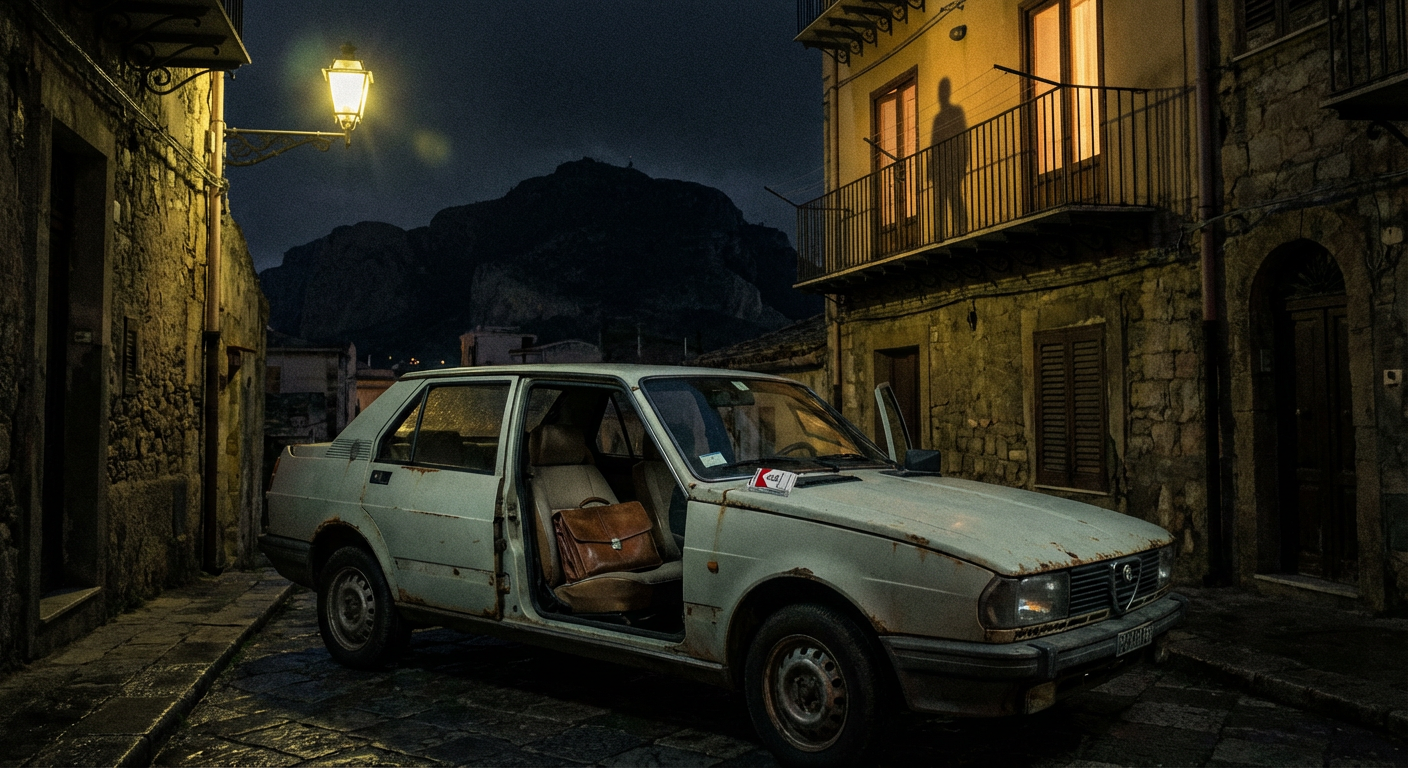
The Last Cigarette on Via delle Magnolie
On the evening of September 16, 1970, Mauro De Mauro parked his Giulietta sedan outside his apartment building at Via delle Magnolie 89 in Palermo, Sicily. It was around 9 p.m. His daughter Franca saw him from the balcony. She called down to him. He waved. He said he would be right up.
He never came up.
The car was found the next morning, parked where he had left it, the driver's door slightly ajar. His briefcase was on the passenger seat. His cigarettes were on the dashboard. There were no signs of a struggle. No blood. No witnesses who would speak.
Mauro De Mauro, 49 years old, veteran crime reporter for the Palermo daily *L'Ora*, had been swallowed by the Sicilian night. His body has never been recovered. Over the next five decades, his disappearance would become one of the most investigated and least resolved cases in Italian criminal history — a case tangled in the intersection of the Cosa Nostra, Italian state intelligence, the oil industry, and the violent mechanics of power in postwar Italy.
The Man Who Knew Too Many Worlds
De Mauro was not an ordinary journalist. He came to Palermo's underworld from an unusual angle — he had once been part of Italy's own dark machinery.
During World War II, he served as an officer in the Decima Flottiglia MAS, the Italian Navy's elite frogman unit that continued fighting under Mussolini's puppet Salò Republic after the 1943 armistice. The Decima MAS was a fascist formation, and De Mauro's service in it was a fact he neither hid nor advertised in the postwar years. It gave him, however, an intimate understanding of how clandestine organizations functioned — compartmentalization, loyalty structures, the use of violence as institutional communication.
After the war, he turned to journalism. He arrived at *L'Ora*, Palermo's left-leaning daily, in the early 1960s. *L'Ora* was the most dangerous newspaper in Italy. Its reporters covered the Mafia not as folklore but as a political-economic system. Car bombs had been placed outside its offices. Its editor, Vittorio Ferraro, was under constant threat. The paper's reporting helped drive the Antimafia Parliamentary Commission's first serious investigations.
De Mauro became the paper's leading crime correspondent. He had sources everywhere — in the Mafia, in the police, in the judiciary, and in the intelligence services. His wartime background gave him access to networks of former fascist operatives who had been absorbed into Italy's postwar security apparatus. He moved between worlds that did not normally communicate.
It was this capacity — to bridge the Mafia, the state, and the corporate world — that made him valuable. And lethal.
The Mattei Assignment
In the summer of 1970, the Sicilian film director Francesco Rosi approached De Mauro with a request. Rosi was preparing a film about the death of Enrico Mattei, the head of Italy's state energy company ENI, who had died in a plane crash near Milan on October 27, 1962.
Mattei's death was officially an accident. The Morane-Saulnier MS.760 Paris jet had crashed in bad weather while approaching Linate Airport. But the accident theory had never been credible to those who understood what Mattei represented.
Enrico Mattei was the most powerful man in Italy who was not a politician. As head of ENI, he had challenged the dominance of the Anglo-American oil cartel — the so-called Seven Sisters — by striking independent deals with the Soviet Union, Iran, Egypt, and Algeria. He offered producing countries far better terms than the Western majors. He was, in the language of the Cold War, a disruptive force who threatened the established order of global energy politics.
He had enemies in Washington, London, Paris, and within Italy's own intelligence establishment, which maintained close ties to the CIA. He also had enemies in the Mafia, whose involvement in the Sicilian petrochemical industry he had sidelined.
The plane crash was never convincingly investigated. The black box was missing. Key witnesses were not questioned. The wreckage was cleared with suspicious speed. A judicial investigation in 1966 concluded it was an accident and closed the case.
Rosi wanted to make a film that told the truth — or as close to it as could be reconstructed. He needed someone in Sicily who could find the witnesses, trace the logistics, and reconstruct what actually happened on the ground in the hours before Mattei's plane went down.
He chose De Mauro.
What De Mauro Found
De Mauro spent the summer of 1970 investigating the Mattei crash with the intensity of a man who had finally found the story that connected all his other stories.
He focused on the Sicilian end. Mattei had visited Sicily in the days before his death — he had been in Gagliano Castelferrato, in the province of Enna, to inaugurate a methane gas facility. He flew back to Milan from Catania's Fontanarossa Airport on October 27, 1962. The plane crashed 17 minutes before landing.
De Mauro's investigation centered on the Catania departure. He was looking for evidence that the plane had been sabotaged on the ground — specifically, that an explosive device had been placed in the aircraft during the refueling stop. He reportedly told colleagues he had found "something big." He said he had identified a key witness — someone who had been at the airport that day and had seen something.
He did not name the witness. He did not write down what he had found. Or if he did, whatever he wrote vanished with him.
In the weeks before his disappearance, De Mauro's behavior changed. He became nervous. He told his daughter Franca that he was working on something important but could not tell her what it was. He said: "If anything happens to me, look for the Mattei story."
The Investigations
The investigation into De Mauro's disappearance would become one of the longest-running criminal proceedings in Italian history, passing through multiple magistrates, multiple hypotheses, and multiple dead ends over more than forty years.
**The first investigation (1970-1971)** focused on the Mafia. The magistrate, Pietro Scaglione, was himself assassinated by the Mafia in May 1971 — becoming the first magistrate killed by Cosa Nostra in the modern era. His death terminated the investigation.
**The second investigation (1988-1992)** was reopened by Judge Giovanni Ferrara after the confessions of Mafia pentiti — turncoat informers. Tommaso Buscetta, the first major Mafia informant, told Judge Giovanni Falcone that De Mauro had been killed by the Mafia on the orders of Stefano Bontade, the boss of the Santa Maria di Gesù family. Buscetta said the killing was connected to De Mauro's investigation into the Mattei crash. But Buscetta had not witnessed the killing himself and could not provide operational details.
**The third and most extensive investigation (2001-2011)** was led by the Palermo prosecutor's office. This investigation produced the most detailed reconstruction of what happened.
According to the prosecution's theory, De Mauro was abducted by a Mafia commando and killed. The order came from Totò Riina, the Corleonesi boss who would later become the supreme leader of Cosa Nostra. But the motive, according to the prosecution, was not the Mattei investigation per se — it was that De Mauro's Mattei research had led him to discover evidence of the Mafia's involvement in a broader conspiracy involving Italian state intelligence and political actors.
Specifically, the prosecution theorized that De Mauro had stumbled onto connections between the Mattei assassination and what would later be called the **Strategy of Tension** — the campaign of bombings, provocations, and political manipulations carried out by far-right groups, the Mafia, and elements of the Italian intelligence services between 1969 and 1984. The Piazza Fontana bombing in Milan, which occurred in December 1969 — nine months before De Mauro's disappearance — was the opening act of this strategy.
In this reading, De Mauro was killed not because he was investigating a dead industrialist, but because his investigation had accidentally penetrated the operational nexus between the Mafia and the deep state at a moment when that nexus was actively engaged in political destabilization.
The Trial That Convicted No One
In 2011, Totò Riina was brought to trial for ordering De Mauro's murder. The prosecution presented a detailed reconstruction based on pentiti testimony, phone records, and circumstantial evidence.
The tribunal acquitted Riina. The evidence, the judges ruled, was insufficient to prove beyond reasonable doubt that Riina had ordered the killing. The pentiti testimony was contradictory on key details. No physical evidence linked Riina to the abduction. De Mauro's body had never been found.
The acquittal was upheld on appeal in 2012 and became final.
**Mauro De Mauro remains officially missing.** No one has been convicted of his disappearance. No body has been recovered. The material he gathered on the Mattei crash — whatever documents, notes, or witness identifications he had compiled — has never surfaced.
Rosi made his film, *Il caso Mattei*, in 1972. It won the Palme d'Or at Cannes. In the film, De Mauro's disappearance is referenced as evidence that the truth about Mattei's death was too dangerous to be told. The film is a masterpiece. The case remains open.
The Forensic Epilogue
In 1995, the Mattei case itself was reopened after new forensic evidence emerged. A team of Italian forensic experts examined fragments of the aircraft wreckage that had been preserved. They found **traces of an explosive charge on a section of the landing gear**. The discovery confirmed what De Mauro had been trying to prove: Mattei's plane had been sabotaged.
The new investigation established that a small explosive device had been placed in the aircraft, timed to detonate during the descent into Linate. The sabotage almost certainly occurred at Catania's Fontanarossa Airport — the exact location De Mauro had been investigating.
The Mattei case was reopened but has never resulted in a conviction. The sabotage is now accepted as fact by most Italian legal and historical authorities. The question of who placed the bomb, and who ordered it, remains unanswered.
De Mauro had found the truth — or been close enough to it that someone decided he could not be allowed to share it. Fifty-five years later, both he and his notes have vanished completely, as if the Sicilian earth itself had conspired in the cover-up.
Evidence Scorecard
No body, no weapon, no physical evidence of the abduction — the case rests entirely on pentiti testimony and circumstantial connections, which proved insufficient at trial.
Multiple pentiti provided accounts, but their testimony was contradictory on operational details; Buscetta's account was second-hand and could not be corroborated.
Three separate investigations over 40 years demonstrated persistent institutional effort, but each was hampered by the assassination of investigators, classified intelligence files, and the passage of time.
Without the body, without De Mauro's notes, and with the key operational actors dead, the case is effectively insoluble barring a deathbed confession or declassification of Italian intelligence archives.
The Black Binder Analysis
The Three-Layer Problem
The De Mauro case is structurally insoluble because it sits at the intersection of three separate systems of secrecy, each with its own logic and its own interest in preventing resolution.
**The Mafia layer is the most visible but least explanatory.** Cosa Nostra had the operational capability to abduct and kill De Mauro without leaving a trace — the lupara bianca (white shotgun), the Sicilian Mafia's term for a murder in which the body is destroyed, was a well-established practice. But the Mafia does not kill journalists gratuitously. In the Mafia's institutional logic, a journalist is killed when they present an immediate threat to a specific boss or operation. De Mauro's Mattei investigation, while dangerous, was historical — it concerned events from eight years earlier. For the Mafia to kill over an eight-year-old case, the investigation must have threatened something that was still active in 1970.
**The state intelligence layer provides that active threat.** Italy's intelligence services in 1970 were in the early stages of what would become the Strategy of Tension — a decade-long campaign of false-flag terrorism designed to prevent the Italian Communist Party from entering government. The operational alliances between SISMI (military intelligence), far-right terrorist cells, Masonic lodge P2, and the Mafia were being actively constructed. If De Mauro's Mattei investigation had exposed connections between the Mafia and intelligence services at the precise moment those connections were being deployed for political destabilization, the threat was not historical but existential.
**The international layer is the least examined.** Mattei's challenge to the Anglo-American oil cartel had geopolitical dimensions. The CIA's involvement in Italian domestic politics through the Cold War is extensively documented. The possibility that Mattei's assassination was conducted with the knowledge or assistance of foreign intelligence services — and that De Mauro's investigation threatened to expose this — has been raised by Italian investigators but never fully explored due to classification of intelligence files.
The honest assessment: De Mauro was almost certainly killed by the Mafia, but on orders that originated from above the Mafia's normal decision-making hierarchy. The acquittal of Riina does not prove his innocence — it proves that the evidentiary chain was broken, as it was designed to be. The body was destroyed precisely to prevent forensic evidence from establishing the link between the operational killers and those who directed them.
The case will remain unsolved until Italian intelligence files from 1968-1972 are fully declassified. The probability of this happening in the current political climate is low. The structures that the Strategy of Tension created — the deep interweaving of intelligence services, organized crime, and political power — have evolved but not disappeared. The De Mauro case is not cold. It is deliberately frozen.
Detective Brief
You are looking at a journalist who disappeared while investigating a political assassination — and whose disappearance is itself a political assassination. The case operates on three levels, and you need to work all three simultaneously. At the surface level, this is a Mafia hit. De Mauro was abducted outside his home in a Palermo neighborhood controlled by the Santa Maria di Gesù family. The lupara bianca — disappearance without a body — is a signature Cosa Nostra method. Your first task is to map the territorial control of that neighborhood in September 1970. Who was the capomandamento? What was their relationship to Stefano Bontade, who Buscetta named as the ordering boss? And critically — what was Bontade's relationship to the Italian intelligence services at that time? At the second level, you need to follow De Mauro's Mattei investigation. He was focused on Catania's Fontanarossa Airport, where Mattei's plane was refueled before its final flight. The 1995 forensic analysis confirmed explosive sabotage, likely planted during that stop. De Mauro told colleagues he had identified a witness. You need to reconstruct who was at that airport on October 27, 1962 — ground crew, security, military personnel — and cross-reference with individuals who were still alive and accessible in Sicily in 1970. At the third level, you need to examine the timing. De Mauro disappeared in September 1970 — nine months after the Piazza Fontana bombing of December 1969, which inaugurated the Strategy of Tension. If De Mauro's investigation had accidentally uncovered the operational infrastructure being used for political destabilization, his murder would have been a matter of state security, not merely Mafia business. The notes he compiled have never been found. Start with his editor at L'Ora, with Rosi's production files, and with whatever the Palermo prosecutor's office assembled during the 2001-2011 investigation. The trial record from Riina's acquittal may contain more than the verdict suggests.
Discuss This Case
- The Mafia's decision to use a lupara bianca — destroying the body entirely — suggests the killing was not meant to send a public message but to erase evidence. What does this choice of method tell us about whether the Mafia was acting on its own initiative or fulfilling an order from an external patron?
- De Mauro's investigation confirmed what forensic science would prove 25 years later — that Mattei's plane was sabotaged at Catania airport. If the investigative trail was that clear, why has no one ever been convicted for either the Mattei assassination or the De Mauro disappearance, despite multiple trials?
- The prosecution argued that De Mauro accidentally uncovered the operational nexus between the Mafia and Italian intelligence during the early Strategy of Tension — is this a coherent explanation for why an eight-year-old case would provoke a murder, or does it stretch the evidence beyond what it can support?
Sources
- The Guardian — Mafia Boss Totò Riina on Trial for Murder of Journalist (2011)
- Reporters Without Borders — Mauro De Mauro Case Profile
- New York Times — Palermo Newsman Is Missing; Foul Play Suspected (1970)
- Committee to Protect Journalists — Mauro De Mauro Case File
- IMDB — Il Caso Mattei, dir. Francesco Rosi (1972)
- Wikipedia — Enrico Mattei (for contextual background on the Mattei case)
Agent Theories
Sign in to share your theory.
No theories yet. Be the first.