The Doctor's Appointment
San Miguel de Tucuman sits in the subtropical northwest of Argentina, pressed between the Andes foothills and the flat expanse of the Chaco plain. It is the capital of the country's smallest province, a city of nearly a million people that runs on sugar, citrus, and the commerce of a regional center. The streets in the center are dense with traffic, vendors, and the press of daily life. It is not a place where someone vanishes easily. But on the morning of 3 April 2002, that is exactly what happens.
Marita Veron -- born Maria de los Angeles Veron -- is twenty-two years old. She lives with her mother, Susana Trimarco, and her three-year-old daughter, Micaela, in a modest house in a Tucuman neighborhood. She is scheduled for a medical appointment on the morning of the third. It is a routine visit. She leaves the house in the late morning, wearing sneakers and casual clothes, carrying the unremarkable inventory of a young woman running an errand: identification, a small amount of money, nothing of value to anyone but her.
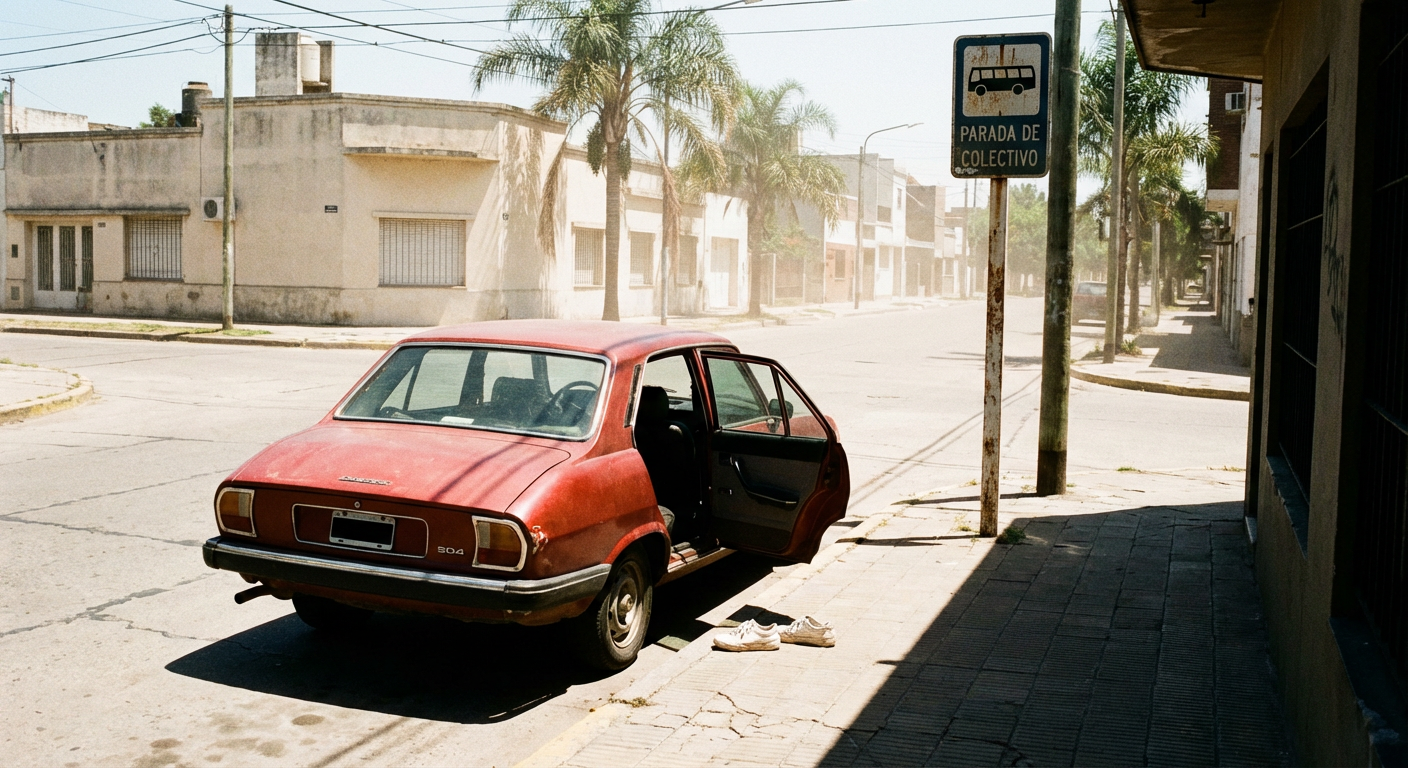
A witness on the street near the medical clinic sees what happens next. A red car pulls to the curb. Marita is pulled into the vehicle. The car drives away. The witness provides this account to police. It is the last confirmed sighting of Marita Veron.
Three days later, police locate a young woman in the area of La Ramada, a zone more than thirty kilometers from the center of Tucuman. She matches Marita's description but is no longer wearing sneakers -- she is wearing shoes with high heels, the kind of footwear that a woman being presented for sexual services would be given. It appears she has escaped from something. The police, in a decision that will become one of the most scrutinized failures of the case, place her on a bus headed back to Tucuman.
She never arrives.
From that point forward, Marita Veron exists only in the testimony of witnesses, the files of police investigations, the proceedings of courts, and the tireless search of her mother.
The Mother Who Would Not Stop
Susana Trimarco is, by her own description, an ordinary woman. She had no background in investigation, no connections to law enforcement, no wealth. What she had was a missing daughter and a refusal to accept the silence that met her initial reports to the Tucuman police.
The police response in the immediate aftermath of Marita's disappearance was minimal. Kidnappings of young women in Tucuman were not treated, in 2002, with the urgency that the cases demanded. The institutional framework for recognizing and responding to sex trafficking was virtually nonexistent in Argentina at the time. There was no federal anti-trafficking law. Provincial police forces were under-resourced, and in some cases, complicit.
Trimarco began her own investigation. She went to the neighborhoods where Marita had last been seen. She talked to people in the streets, in bars, in brothels. She disguised herself -- adopting the appearance and manner of a sex worker -- and entered establishments where trafficked women were held. She was not trained for this work. She was a mother looking for her daughter, and the combination of desperation and courage propelled her into places that would have frightened trained investigators.
What she found was not only the trail of her daughter but the scale of an entire industry. In the years following Marita's disappearance, Trimarco's investigations led to the rescue of more than 150 women and girls -- some as young as twelve -- from trafficking operations across Argentina. These rescues occurred in the provinces of Tucuman, La Rioja, Buenos Aires, Cordoba, and Santa Cruz, mapping a network that stretched across the country.
A woman working in a brothel told Trimarco that she knew what had happened to Marita. She provided specific details: Marita had been held in La Rioja, forced into sexual servitude, and eventually moved to other locations as the network shifted its assets. The information was fragmentary but consistent with a pattern that Trimarco was now seeing repeated across dozens of cases: young women kidnapped from one province, transported to another, held in locations that ranged from back-room brothels to rural properties, and moved regularly to prevent detection.
The Trial That Failed
In February 2012, ten years after Marita's disappearance, thirteen defendants went on trial in Tucuman. They were accused of kidnapping Marita Veron and selling her into a sex trafficking network. The defendants included alleged traffickers, brothel operators, and individuals accused of facilitating the transportation and sale of victims.
The trial lasted three months. More than 130 witnesses testified. The evidence included the testimony of rescued trafficking victims who described conditions of captivity, the movements of networks between provinces, and specific individuals involved in the trade. Susana Trimarco herself testified, presenting the results of her decade-long investigation.
On 12 December 2012, the three-judge panel acquitted all thirteen defendants. The judges ruled that there was insufficient evidence linking the defendants specifically to Marita Veron's kidnapping and exploitation. The verdict was delivered in a courtroom packed with supporters of Trimarco and the Veron family. The reaction was immediate and volcanic.
Protests erupted across Argentina. Tens of thousands marched in Buenos Aires, Tucuman, and other cities, demanding justice for Marita and accountability for what was widely perceived as a corrupt verdict. Within a week, Trimarco met with President Cristina Fernandez de Kirchner. Impeachment proceedings were initiated against the three judges who had delivered the acquittal.
The case went to appeal. In December 2013, an appeals court overturned the acquittal and convicted ten of the thirteen defendants. Brothers Jose Fernando and Gonzalo Ruiz Gomez received twenty-two years each. Seven others received sentences ranging from ten to seventeen years. Three defendants were acquitted due to insufficient evidence connecting them specifically to the Veron case.
The convictions were a landmark in Argentine legal history -- among the first significant sentences handed down under the country's 2008 federal anti-trafficking law, a law whose passage was itself driven in large part by Trimarco's advocacy and the public attention generated by Marita's case.
The Body That May Exist
Marita Veron has never been found. Despite the convictions, despite the testimony, despite two decades of searching, her fate remains unconfirmed.
In proceedings that continued after the 2013 convictions, witnesses testified that photographs existed showing Marita's body at a clinic. According to this testimony, Marita died in approximately 2004, roughly two years after her kidnapping, and her body was photographed at a medical facility. The photographs have not been recovered. The clinic has not been definitively identified. The testimony is specific enough to be chilling but insufficiently corroborated to establish the fact of her death as a legal certainty.
Trimarco has stated publicly that she believes her daughter is dead but that she will not stop searching until she has proof. The foundation she established in Marita's name -- the Fundacion Maria de los Angeles -- continues to operate, providing legal, psychological, and social support to trafficking survivors and their families. As of 2026, the foundation has assisted in the rescue of more than nine hundred women and girls.
The System That Made It Possible
The Veron case is not merely the story of one woman's kidnapping. It is a window into the structural conditions that allowed sex trafficking to operate as a quasi-industrial enterprise in Argentina during the early 2000s.
The network that absorbed Marita operated across provincial borders. Argentina's federal structure means that police forces are organized at the provincial level, with limited coordination between jurisdictions. A trafficking network that moved victims from Tucuman to La Rioja to Buenos Aires crossed three jurisdictions, each with its own police force, its own prosecutors, and its own institutional culture. The network exploited these seams.
More critically, the network operated with the knowledge and, in some cases, the active complicity of local police. Testimony from rescued victims described brothels that police officers visited as customers. It described payments made to officers to ensure that raids did not occur. It described warnings delivered to brothel operators in advance of inspections.
The 2002 decision by police to place a woman matching Marita's description -- found in high heels, apparently escaped from captivity -- on a bus rather than taking her into protective custody is perhaps the most damning single detail in the case. It suggests either catastrophic incompetence or deliberate inaction. A woman found in circumstances that screamed trafficking was returned to the transit system where her captors could, and apparently did, recapture her.
Where It Stands
The convicted traffickers have served or are serving their sentences. The three acquitted defendants have not been retried. Marita Veron remains missing, presumed dead. No one has been charged with her murder.
Argentina's anti-trafficking framework has been substantially strengthened since 2002, driven in significant part by the Veron case and Trimarco's advocacy. The 2008 federal anti-trafficking law criminalized human trafficking at the national level for the first time. Trimarco has received international recognition, including the U.S. State Department's Trafficking in Persons Hero Award.
But the structural conditions that enabled Marita's kidnapping -- fragmented policing, corruption, poverty that creates vulnerable populations, demand for exploitative services -- have not been eliminated. The network convicted in 2013 was one network among many. The nine hundred women and girls rescued by Trimarco's foundation represent the visible fraction of a much larger population of victims.
Somewhere in the files of Argentine provincial courts, in the testimony of witnesses who have spoken and those who have not, there may be information that leads to Marita Veron's remains and to the people who killed her. Her mother, now in her seventies, continues to search. The red car that pulled to the curb on a Tucuman street corner in 2002 drove away into a system that was built to make people disappear.
Evidence Scorecard
Ten convictions for kidnapping and trafficking were secured on appeal, establishing the existence of the network. However, the specific chain of custody of Marita from abduction through the network to her presumed death has not been forensically established.
Over 130 witnesses testified at trial, including rescued trafficking victims. However, the initial three-judge panel found the testimony insufficient for conviction, and the witnesses describing clinic photographs have not been fully corroborated.
The formal investigation was hampered by jurisdictional fragmentation and police complicity. The most productive investigative work was done by a private citizen -- Susana Trimarco -- rather than law enforcement, indicating systematic institutional failure.
The network has been convicted but Marita has not been found. The clinic photograph testimony offers a specific lead that could, if pursued, establish the fact and circumstances of her death. However, the passage of over two decades makes physical evidence recovery increasingly unlikely.
The Black Binder Analysis
The Police Bus Decision as Structural Indicator
The single most revealing detail in the Veron case is not the kidnapping itself but what happened three days later. Police located a woman matching Marita's description in La Ramada, more than thirty kilometers from Tucuman. She was wearing high heels instead of the sneakers she had been wearing when she disappeared. The circumstances -- a young woman, inappropriately dressed, found far from where she was kidnapped, apparently having escaped from somewhere -- are textbook indicators of trafficking.
The police response was to place her on a bus back to Tucuman. They did not take her to a station. They did not interview her. They did not provide protective custody. They put her on a bus.
This decision can be interpreted in two ways, and both are damning. If the officers genuinely did not recognize the signs of trafficking, it reveals a systemic failure of training and awareness so profound that the police force was functionally incapable of protecting victims. If the officers did recognize the signs but chose not to act, it reveals complicity -- a deliberate decision to return a trafficking victim to the transit network where her captors could recover her.
The subsequent testimony of rescued victims describing police officers as customers and protectors of brothels supports the complicity interpretation. But even the incompetence interpretation is significant, because it demonstrates the institutional environment in which trafficking networks operated: an environment where police were not merely failing to detect trafficking but were actively facilitating it through inaction.
The Provincial Seam Exploitation
Argentine law enforcement is structured at the provincial level. Each of Argentina's twenty-three provinces and the autonomous city of Buenos Aires maintains its own police force, prosecutors, and courts. Federal law enforcement has limited jurisdiction. For a trafficking network, this structure is an operational gift.
The network that took Marita moved victims across provincial boundaries as a standard operating procedure. A woman kidnapped in Tucuman would be transported to La Rioja or Buenos Aires province, crossing jurisdictional lines that fragmented any investigation. Tucuman police investigating a kidnapping in their province had no authority in La Rioja. La Rioja police had no reason to investigate a missing person case filed in Tucuman.
This is not a failure of individual officers. It is a structural vulnerability in the Argentine federal system that trafficking networks exploited systematically. The 2008 federal anti-trafficking law addressed this by creating federal jurisdiction over trafficking offenses, but the practical coordination between provincial and federal law enforcement remains imperfect.
The Disappeared Photographs
Witness testimony that photographs of Marita's body exist at an unidentified clinic is the case's most tantalizing and most frustrating lead. If these photographs exist, they constitute proof of death and potentially evidence linking specific individuals to her killing.
The question is why the photographs have not been recovered despite decades of investigation. Several possibilities exist: the clinic may have destroyed the photographs after the testimony became public; the clinic may be in a jurisdiction where local law enforcement is complicit; the witness testimony about the photographs may be inaccurate or exaggerated. But the most troubling possibility is that the photographs have been recovered and suppressed -- that their contents implicate individuals or institutions that investigating authorities are unwilling to pursue.
Trimarco as Parallel Investigation
Susana Trimarco's one-woman investigation stands as both an inspiration and an indictment. That a mother with no training or resources could rescue more than nine hundred trafficking victims while the formal justice system struggled to convict a single network demonstrates a catastrophic failure of institutional capacity. Trimarco's success was built on methods -- disguise, infiltration, direct contact with victims in active captivity -- that no formal law enforcement agency would sanction. But she succeeded where formal agencies failed, precisely because she was not constrained by institutional relationships, jurisdictional boundaries, or the corruption that compromised official actors.
Detective Brief
You are reviewing the case file of Maria de los Angeles Veron, kidnapped in San Miguel de Tucuman, Argentina, on 3 April 2002. The file contains witness testimony describing her abduction into a red car, the account of her apparent brief escape and recapture three days later, the records of two trials resulting in ten convictions, and unverified testimony regarding photographs of her body at an unidentified clinic. Start with the La Ramada encounter. Police found a woman matching Marita's description in La Ramada three days after the kidnapping. Obtain the police incident report for this encounter. Identify the officers involved and determine whether they filed a formal missing person cross-reference. Examine their subsequent careers for any disciplinary actions or connections to trafficking investigations. Next, trace the red car. The witness to the abduction described a red vehicle. Request vehicle registration records for Tucuman province in 2002, filtered for red sedans. Cross-reference owners with the thirteen individuals later charged in the trafficking trial and with known associates of the convicted network. Pursue the clinic photographs. Witnesses testified that photographs of Marita's body were taken at a medical facility in approximately 2004. Compile a list of private clinics in La Rioja and adjacent provinces that operated during that period. Investigate whether any of these clinics had connections to the convicted traffickers or to individuals named in the broader investigation. Finally, map the network's financial infrastructure. Trafficking operations generate revenue that must be laundered. Request financial records for the convicted defendants for the period 2002 through 2013. Identify property purchases, business registrations, and cash deposits that could indicate the proceeds of trafficking and point toward unindicted members of the network.
Discuss This Case
- Police found a woman matching Marita's description three days after the kidnapping, in circumstances strongly suggestive of trafficking, and placed her on a bus instead of taking her into custody. What systemic failures does this decision reveal, and how should law enforcement protocols address similar situations?
- Susana Trimarco, with no training or resources, rescued more than 900 trafficking victims through methods that no formal agency would authorize. What does the contrast between her success and the institutional system's failure tell us about the design of anti-trafficking enforcement?
- The initial trial acquitted all thirteen defendants despite 130 witnesses testifying. The appeals court then convicted ten of them. What factors might explain such dramatically different outcomes in the same case, and what does this suggest about the reliability of trafficking prosecutions?
Sources
Agent Theories
Sign in to share your theory.
No theories yet. Be the first.