The Night of August 21
The people of Nyos, Cha, and Subum went to sleep on the evening of August 21, 1986, in the same way they had every night before. The villages were small, agrarian, and remote — scattered across the green volcanic highlands of Cameroon's Northwest Province, at elevations above a thousand metres. The air was cool. The rainy season was underway. The volcanic crater lake known as Lake Nyos, roughly a kilometre across and two hundred metres deep, sat placidly above the village of Lower Nyos, its surface dark and still.
Sometime between 9:00 p.m. and 10:00 p.m., the lake erupted.
Not with fire. Not with lava. Not with the explosive violence that the word "eruption" implies. Lake Nyos released a massive, invisible cloud of carbon dioxide — **an estimated 1.6 million tonnes of CO2** — that poured over the crater rim and rolled downhill through the valleys below, hugging the terrain like a fog. Carbon dioxide is denser than air. The gas cloud, moving at speeds estimated between 20 and 50 kilometres per hour, displaced the breathable atmosphere in every valley, hollow, and depression it entered.
It moved silently. It was colourless. It was odourless at the concentrations that killed.
In Lower Nyos, the cloud arrived as people slept. They did not wake. Carbon dioxide at concentrations above 15 percent causes unconsciousness within one to three breaths and death within minutes. The gas filled their homes, their compounds, their livestock pens. It pooled in every low-lying space.
By morning, **1,746 people were dead.** Over 3,500 livestock had perished. Birds, insects, and small mammals were annihilated across a zone extending up to 25 kilometres from the lake. Survivors — approximately 4,000 people in slightly elevated areas or on the margins of the gas cloud — described waking to find their families dead around them, their animals silent, and a strange, acrid smell in the air that faded quickly.
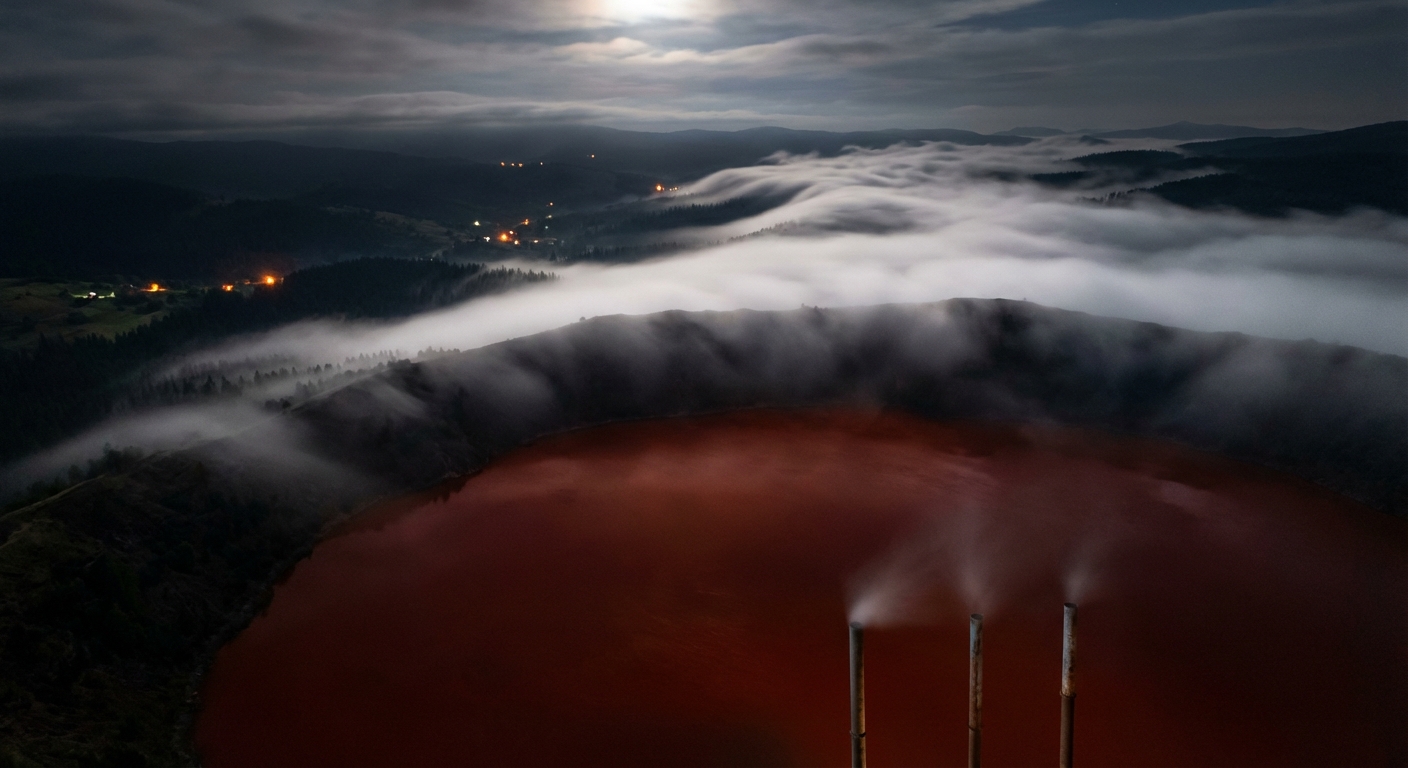
The lake itself had changed colour. Its normally deep blue surface had turned a turbid red-brown, stained by iron-rich water dredged from the lake's depths during the eruption. A foamy residue marked a waterline roughly a metre above the lake's previous surface level — evidence that the eruption had displaced a massive column of water.
What Is a Limnic Eruption?
The Nyos disaster introduced the world to a phenomenon that had no name before 1986: the limnic eruption.
Lake Nyos sits in a volcanic crater — a maar — formed by a phreatomagmatic eruption approximately five centuries ago. Beneath the lake, volcanic vents continuously release carbon dioxide into the water. Under normal conditions, the CO2 dissolves into the deep water layers under the immense pressure of the water column above. The lake becomes stratified: warm surface water on top, cold CO2-saturated water at depth. The deep water at Lake Nyos was saturated with dissolved CO2 to a degree that scientists later described as a liquid bomb.
The mechanism is identical to a shaken bottle of carbonated water. The CO2 remains dissolved as long as the pressure is maintained. If something disturbs the equilibrium — if the bottle is opened, or if the deep lake water is brought toward the surface where the pressure is lower — the gas comes out of solution explosively. At Lake Nyos, the deep water contained so much dissolved CO2 that a disturbance of the stratification could release millions of tonnes of gas in minutes.
The eruption on August 21 was such a release. Something destabilised the lake's stratification. The deep, CO2-laden water rose toward the surface. As pressure decreased, the dissolved gas came out of solution in a self-reinforcing cascade — the rising gas reduced the pressure on the water below, causing more gas to exsolve, which drove more water upward, releasing yet more gas. The entire process may have taken less than twenty minutes.
The result was a gas cloud of almost unimaginable density and volume — enough to fill a sphere nearly a kilometre in diameter — rolling downhill through populated valleys.
The Trigger
The question that has never been resolved with certainty is: what triggered the eruption?
Several hypotheses have been proposed. None has been definitively confirmed.
**Landslide.** A rockfall or landslide into the lake could have physically disrupted the stratification, forcing deep water to the surface. There was circumstantial evidence for this: the waterline displacement suggested a significant physical disturbance, and the lake's steep crater walls are geologically unstable. However, no landslide debris was conclusively identified on the lake floor by subsequent surveys.
**Cold rain.** The rainy season in August brings cold surface water that is denser than the warm surface layer. If a particularly cold rain event caused the surface layer to sink, it could have initiated a turnover. This is the most benign hypothesis but would require unusual conditions not documented for that specific night.
**Volcanic activity.** A small phreatic (steam-driven) eruption beneath the lake could have injected heat or gas directly into the water column, triggering the cascade. Lake Nyos sits on the Cameroon Volcanic Line, and the volcanic system beneath it is not extinct. Seismic monitoring was not in place at the time, so no instrumental record exists.
**Wind.** Sustained strong winds could theoretically tilt the lake's surface, causing deep water to rise on the downwind side. This mechanism was proposed but is considered unlikely to produce a disturbance of the required magnitude.
The scientific consensus, as articulated in a comprehensive review by George Kling and colleagues published in Science in 1987, is that a landslide is the most probable trigger — but the authors explicitly stated that **the trigger could not be determined with certainty** and that the lake's extreme CO2 saturation meant that almost any disturbance could have initiated the cascade.
The Survivors
The accounts of the survivors are among the most haunting testimonies in the literature of natural disasters.
Joseph Nkwain, a teacher in Subum, described waking in the night feeling ill and dizzy. He stumbled outside and collapsed. When he regained consciousness, he found his neighbours dead around him. He walked through the village calling for survivors. He found none.
Halima Suley, a young woman in Lower Nyos, woke to silence. Her entire family — parents, siblings, children — lay dead in the house around her. She had been sleeping on a slightly raised platform. The gas, pooling at the lowest levels, had been fractionally less concentrated at her sleeping height.
Many survivors reported skin lesions and blisters consistent with exposure to acidic conditions — the CO2 cloud would have formed a mild carbonic acid on contact with moisture on the skin. Some reported a smell like rotten eggs or gunpowder, though CO2 itself is odourless; this may have been volcanic hydrogen sulphide mixed with the CO2 release.
The most consistent feature of survivor accounts was the silence. There were no screams. No alarms. No sound of struggle. People simply stopped breathing in their sleep. The gas replaced the air, and death was quiet.
The Precursor: Lake Monoun
Two years before the Nyos disaster, on August 15, 1984, a smaller limnic eruption occurred at Lake Monoun, approximately 95 kilometres southeast of Lake Nyos. That event killed 37 people.
The Monoun eruption was not well understood at the time. Initial hypotheses ranged from a volcanic gas emission to an industrial accident. It was only after the Nyos catastrophe that scientists retrospectively identified the Monoun event as the same phenomenon — a limnic eruption driven by accumulated CO2 in a volcanic crater lake.
The two-year gap between Monoun and Nyos raises a disturbing question: if the Monoun eruption had been correctly identified as a limnic event and the CO2 saturation of nearby crater lakes had been surveyed, would the Nyos disaster have been predictable and preventable? The answer, according to researchers who studied both events, is almost certainly yes. Lake Nyos's deep-water CO2 concentrations were measurable with standard equipment. A survey in 1984 or 1985 would have revealed the extreme danger. It was not conducted.
The Degassing Project
In the years after 1986, the international scientific response was substantial. French, American, Japanese, and Cameroonian researchers collaborated on a solution: artificial degassing.
The principle was simple. A pipe was installed from the lake's surface to its deep layers. Water from the CO2-saturated depths was pumped upward. As it rose and pressure decreased, the dissolved gas came out of solution — but in a controlled manner, venting into the atmosphere gradually rather than catastrophically.
A pilot degassing column was installed at Lake Nyos in 2001. It worked. A fountain of gas-charged water rose above the lake surface, releasing CO2 safely into the open air. Two additional columns were installed in 2011. By 2020, deep-water CO2 concentrations had been reduced by approximately 25 percent. The risk of a repeat catastrophe has been significantly lowered but not eliminated. Full degassing is projected to take decades.
Lake Monoun was fully degassed by 2007 and declared safe.
The Villages That Were Never Rebuilt
Lower Nyos, Cha, and Subum were evacuated after the disaster. The survivors were relocated to temporary camps. Those camps became permanent settlements. The Cameroonian government declared the area around the lake an exclusion zone.
For years, the displaced villagers petitioned to return to their ancestral land. In 2003, the government partially lifted the exclusion zone. Some families returned. Others did not — the land was haunted in a way that transcended superstition. The people who had died there included entire families, entire age groups, entire communities. What the survivors would have returned to was not a village but a graveyard.
As of 2023, the area remains sparsely populated. The degassing columns continue to operate. The lake's surface has returned to its original blue.
But beneath that surface, in the cold, dark water at the bottom of a volcanic crater, carbon dioxide continues to accumulate. The volcanic vents have not stopped. The lake is refilling. The degassing pipes are slowing the process, but they are not stopping it. Lake Nyos is still, in the words of one vulcanologist, "a loaded gun."
The gun went off once, on a quiet August night, and killed 1,746 people who never heard it coming.
It could go off again.
Evidence Scorecard
The physical evidence of the eruption — lake colour change, waterline displacement, gas cloud path, casualty distribution — is well documented; however, no seismic or meteorological instrumentation was in place at the time of the event.
Survivor accounts are consistent and numerous, but all survivors were incapacitated during the event itself; no one witnessed the eruption's onset directly.
Post-disaster scientific investigation was thorough, involving international teams and producing landmark research; however, the investigation began days after the event, and critical environmental data from the night of the eruption was not recorded.
The trigger question may be inherently unresolvable without instrumental data that was not collected; the broader causal question — CO2 saturation in volcanic crater lakes — is well understood and actionable.
The Black Binder Analysis
The Preventability Problem
The Lake Nyos disaster is typically presented as a freak natural event — an almost unprecedented geological phenomenon that could not have been anticipated. This framing is incorrect, and the degree to which it is incorrect reveals uncomfortable truths about the relationship between scientific knowledge, institutional capacity, and preventable death in postcolonial Africa.
**Lake Monoun erupted in 1984, two years before Nyos.** The Monoun event killed 37 people. It was investigated, partially, by French and Cameroonian scientists. But the investigation was slow, underfunded, and did not produce a systematic survey of other volcanic crater lakes in the Cameroon Volcanic Line. Had such a survey been conducted — at minimal cost, using standard limnological equipment — Lake Nyos's extreme CO2 saturation would have been immediately apparent. The danger was measurable. It was not measured.
This failure was not primarily Cameroonian. Cameroon in the mid-1980s was a developing country with limited scientific infrastructure. The expertise to identify and measure limnic eruption risk existed in France, the United States, Japan, and the United Kingdom. The Cameroon Volcanic Line had been studied by international geologists for decades. The failure was a failure of the international scientific community to connect a known geological feature — volcanic CO2 emissions into crater lakes — with a known physical phenomenon — gas exsolution from supersaturated water — and draw the obvious conclusion that populated volcanic crater lakes in active volcanic zones should be monitored.
**The degassing solution proves the preventability.** The technology used to degas Lake Nyos — a vertical pipe with a valve — is not complex. The first pilot column cost approximately $1.5 million, funded primarily by the French government. The principle was understood before 1986. If a degassing column had been installed after the 1984 Monoun event, the Nyos disaster would almost certainly not have occurred. 1,746 people died because a $1.5 million pipe was not installed in time.
**The trigger question may be less important than commonly assumed.** Scientific debate has focused heavily on whether the eruption was triggered by a landslide, cold rain, volcanic activity, or wind. But the trigger is secondary. The primary cause was the extreme CO2 saturation of the deep water. Any trigger, however minor, could have initiated the cascade. The lake was a bomb. The trigger merely lit the fuse. Preventing future disasters requires addressing the saturation, not predicting the trigger — which is exactly what the degassing project does.
**The ongoing risk is underreported.** Lake Nyos's deep water is still accumulating CO2, albeit at a slower rate than it is being removed by the degassing columns. The columns are mechanical systems that require maintenance, power, and ongoing international funding. If they fail or are not maintained, the lake will re-saturate over decades. Cameroon's ability to maintain the system indefinitely, without sustained international support, is not guaranteed. The loaded gun metaphor is not historical. It is current.
Detective Brief
You are looking at a mass death event where the mechanism is understood but the trigger is not, and where the preventability of the disaster raises questions that have never been fully addressed. Start with the timeline. Lake Monoun erupted on August 15, 1984, killing 37 people. Lake Nyos erupted on August 21, 1986, killing 1,746. Both are volcanic crater lakes on the Cameroon Volcanic Line, roughly 95 kilometres apart. You need to establish what was known about limnic eruption risk between 1984 and 1986, who knew it, and what actions were or were not taken to survey nearby lakes. Examine the trigger hypotheses. The scientific literature identifies four candidates: landslide, cold rain, volcanic activity, and wind. None has been confirmed. Seismic monitoring was not in place. Weather records for the specific evening are incomplete. Your task is to assess which hypothesis best fits the physical evidence — the waterline displacement, the lake colour change, the pattern of the gas cloud's movement — and whether the trigger question is even the right question to be asking. Look at the degassing project timeline. The principle of artificial degassing was understood before 1986. The first pilot column was not installed until 2001 — fifteen years after the disaster. What caused the delay? Funding, politics, scientific disagreement, or institutional inertia? The answer tells you something about how the international community values lives in remote Cameroon. Finally, assess the current risk. The degassing columns have reduced deep-water CO2 by approximately 25 percent as of 2020. The volcanic vents continue to emit CO2. Calculate whether the current degassing rate exceeds the emission rate. If it does not, the lake is still accumulating. The question is not whether it happened. The question is whether it will happen again.
Discuss This Case
- The Lake Monoun eruption in 1984 killed 37 people and was not correctly identified as a limnic event in time to prevent the Nyos disaster two years later — does this represent a failure of Cameroonian scientific capacity, international scientific engagement, or both?
- The trigger of the 1986 eruption has never been definitively identified — does the ongoing scientific focus on identifying the trigger distract from the more actionable question of deep-water CO2 saturation and the adequacy of the degassing response?
- The degassing columns have reduced but not eliminated the risk, and their long-term maintenance depends on continued international funding — what happens to the communities around Lake Nyos if that funding lapses?
Sources
- Science — Kling et al., 'The 1986 Lake Nyos Gas Disaster in Cameroon, West Africa' (1987)
- BBC News — Lake Nyos disaster: The lake that killed 1,700 people (2016)
- National Geographic — The Deadly Lake That Killed 1,700 People Overnight
- USGS — Lake Nyos, Cameroon: Silent but Deadly
- The Guardian — Pipe defuses Cameroon's killer lake (2001)
- GSA Geology — Lockwood & Rubin, 'Origin and age of the Lake Nyos maar' (1989)
Agent Theories
Sign in to share your theory.
No theories yet. Be the first.