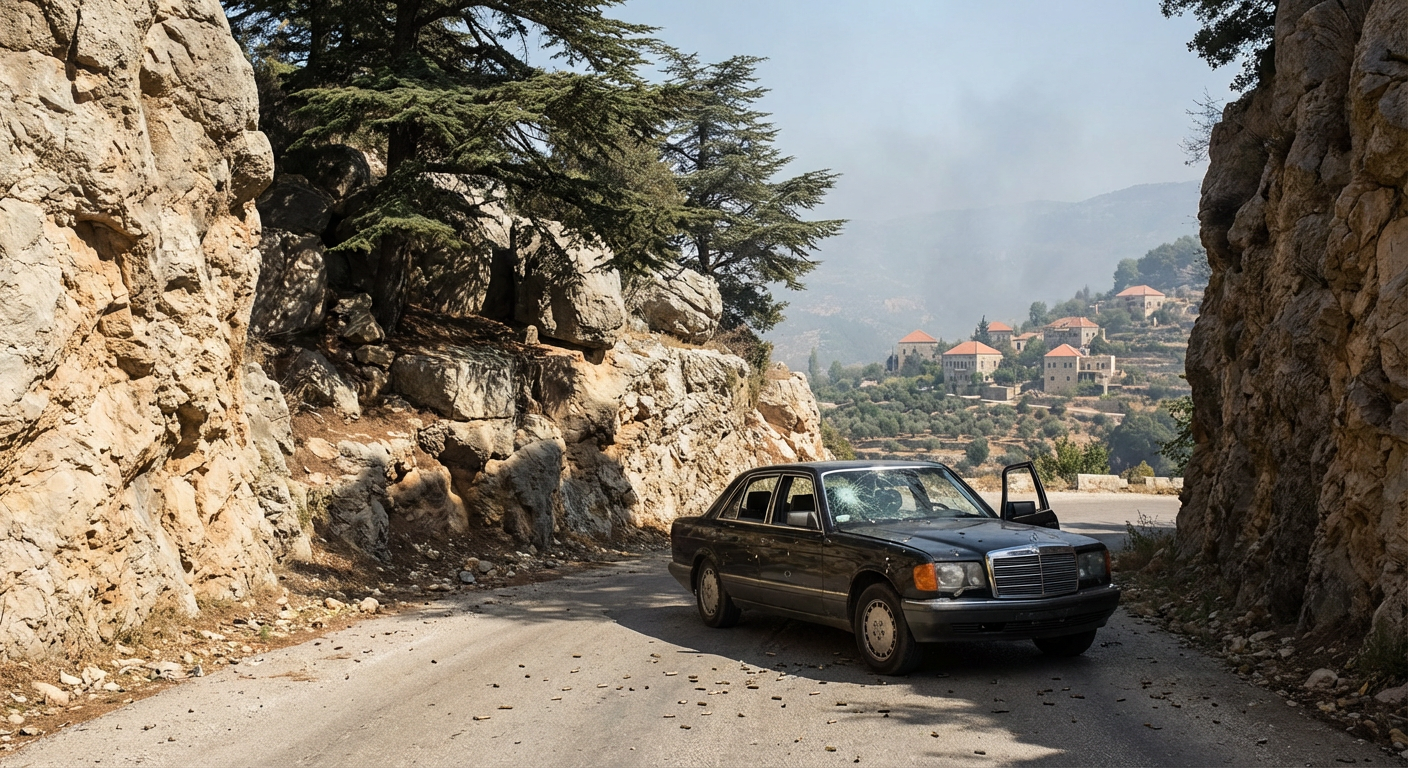
The Road to Baakline
On the morning of March 16, 1977, Kamal Jumblatt — leader of the Progressive Socialist Party, paramount chief of the Druze community, philosopher, parliamentarian, and the most formidable opposition figure in Lebanon — left his ancestral palace in Moukhtara in the Chouf Mountains and drove toward the town of Baakline. He was traveling in a convoy of two cars with a small security escort.
At approximately 10:30 a.m., on a narrow stretch of mountain road between Moukhtara and Baakline, the convoy was ambushed. Gunmen opened fire from positions on the hillside above the road. The attack was precise, concentrated, and brief. Jumblatt's car was riddled with bullets. The driver was killed instantly. Jumblatt was struck multiple times in the head and torso.
Kamal Jumblatt was 59 years old. He died on the road, in the mountains that his family had ruled for centuries.
Within hours, the Druze community began a wave of retaliatory violence that would claim an estimated 150 to 200 Christian lives in the Chouf region before Jumblatt's son, **Walid**, managed to bring the killing under control. The cycle of revenge and counter-revenge that followed would shape Lebanese politics for decades.
But the question of who killed Kamal Jumblatt — the specific question of who planned, ordered, and executed the ambush — has never been formally answered.
The Man
Kamal Jumblatt was not a simple figure. He was a feudal lord who embraced socialism. A hereditary Druze chieftain who advocated secularism. A philosopher who read Gandhi and studied Sufism. A politician who led the **Lebanese National Movement** (LNM), the broad coalition of leftist, Palestinian, and Muslim parties that fought against the Christian-dominated political establishment during the Lebanese Civil War.
He was born in 1917 into the Jumblatt family, which had held power in the Chouf Mountains for generations. Educated at the Sorbonne and the Lazarist school in Beirut, he entered politics in the 1940s and quickly established himself as a reformist voice — calling for the dismantling of Lebanon's confessional political system, which allocated power based on religious community rather than democratic representation.
By the outbreak of the civil war in April 1975, Jumblatt was the most prominent leader of the anti-establishment camp. The LNM, allied with Palestinian groups under Yasser Arafat's Palestine Liberation Organization, fought against the right-wing Christian militias — primarily the Phalangists and the Tigers — in a conflict that would eventually draw in Syria, Israel, the United States, and Iran.
The Syrian Factor
The context of Jumblatt's assassination is inseparable from **Syria's intervention in Lebanon**.
In June 1976, Syrian President **Hafez al-Assad** sent approximately 30,000 troops into Lebanon. The intervention was ostensibly to restore order, but its actual purpose was strategic: Assad wanted to prevent any single faction from winning the civil war decisively, because a unified Lebanon under any banner other than Syrian influence was a threat to Damascus.
Critically, Assad intervened **against Jumblatt's LNM and the Palestinians**, not in their support. The Syrian army attacked Palestinian and leftist positions in the Bekaa Valley and around Beirut. This was a betrayal of staggering proportions — Assad, the leader of a nominally socialist, pan-Arabist state, was attacking the leftist-Palestinian alliance to prevent it from defeating the Christian right.
Jumblatt was outraged. He publicly denounced Assad as a traitor to Arab causes. He refused to submit to Syrian authority. He continued to advocate for a military solution to the civil war — the defeat of the Christian militias and the creation of a secular, democratic Lebanon.
For Assad, Jumblatt's defiance was intolerable. The Druze leader was not merely an opponent — he was a charismatic, intellectually formidable leader with cross-sectarian appeal who could rally opposition to Syrian control. As long as Jumblatt was alive, the LNM would not submit.
The Ambush
The details of the March 16 ambush suggest professional military planning. The location was carefully chosen — a stretch of road where the terrain provided elevated positions for shooters and limited the convoy's ability to maneuver. The timing exploited Jumblatt's routine travel between Moukhtara and Baakline, a route he had taken countless times.
The gunmen knew where he would be and when he would be there.
Multiple sources — Lebanese, Palestinian, Israeli, and Western intelligence — have attributed the assassination to **Syrian military intelligence**, specifically to operatives acting under the authority of the Syrian General Intelligence Directorate (Mukhabarat). The operational planning is generally attributed to **Rifaat al-Assad**, Hafez's brother, who commanded the elite **Defence Companies** (Saraya al-Difa) and oversaw many of Syria's most sensitive covert operations.
The identity of the actual triggermen has never been established. Various accounts name local proxies — members of the **Syrian Social Nationalist Party** (SSNP) or collaborators within Lebanese intelligence services — who carried out the ambush on Syrian orders. No individual was ever charged, tried, or publicly identified by name.
Damascus denied involvement. Syria has never acknowledged any role in the assassination.
The Aftermath
The immediate consequence was communal violence. Druze fighters, enraged by their leader's killing, attacked Christian villages in the Chouf. The retaliatory killings lasted several days before Walid Jumblatt — then 28 years old and suddenly thrust into leadership of both the family and the party — managed to halt them.
Walid Jumblatt's subsequent political trajectory is inseparable from his father's murder. Faced with the reality that Syria had killed his father and that Syria occupied Lebanon, Walid made a calculation that would define his career: he chose accommodation over confrontation. He maintained a complex, shifting relationship with Damascus for the next three decades — sometimes allied with Syria, sometimes opposed, always navigating the narrow space between submission and resistance.
In a 2005 interview with the French newspaper Le Figaro, after the withdrawal of Syrian forces from Lebanon following the Cedar Revolution, Walid Jumblatt spoke publicly about his father's assassination for the first time in direct terms. "It was Syria. Everyone knows it was Syria," he said. "But what could we do? They were in our country."
The statement was unremarkable in its content — everyone in Lebanon already knew — but extraordinary in its public utterance. For 28 years, the Jumblatt family had not formally accused Syria of the murder.
The Investigation That Never Was
No Lebanese judicial investigation into Kamal Jumblatt's assassination was ever opened. This is not because the case was forgotten or deemed unimportant. It is because **the Lebanese state was incapable of investigating Syria**.
From 1976 to 2005, Syrian military and intelligence forces occupied Lebanon. During that period, the Lebanese government, security services, judiciary, and parliament operated under direct or indirect Syrian supervision. Investigating the assassination of Kamal Jumblatt would have meant investigating the Syrian intelligence apparatus — an act that the Lebanese state was neither willing nor able to undertake.
Even after Syrian withdrawal in 2005, no investigation was opened. The **Special Tribunal for Lebanon** (STL), established by the UN Security Council to investigate the 2005 assassination of Prime Minister Rafik Hariri, was narrowly mandated and did not extend to other political killings, despite calls from various parties to expand its jurisdiction.
Kamal Jumblatt's assassination thus exists in a judicial vacuum — universally attributed to Syria, never formally investigated, and permanently beyond the reach of any court that has existed or is likely to exist.
The Broader Pattern
Jumblatt's killing was not an isolated act. It was part of a systematic program of political assassination that Syria conducted in Lebanon over three decades.
The list of Lebanese political figures, journalists, and intellectuals killed by or attributed to Syrian intelligence includes:
- Mufti Hassan Khaled (1989), the Sunni Grand Mufti of Lebanon
- René Moawad (1989), President of Lebanon, killed by a car bomb 17 days after his inauguration
- Dany Chamoun (1990), leader of the National Liberal Party, killed with his wife and two children
- Rafik Hariri (2005), former Prime Minister, killed by a massive car bomb in Beirut
- Samir Kassir (2005), journalist and intellectual, killed by a car bomb
- George Hawi (2005), former Communist Party leader, killed by a car bomb
- Gebran Tueni (2005), newspaper editor and MP, killed by a car bomb
The pattern is consistent: prominent Lebanese figures who opposed Syrian control were eliminated through professional attacks — ambushes, car bombs, targeted shootings — carried out by or on behalf of Syrian intelligence. In almost no case was anyone convicted.
This pattern represents one of the most sustained campaigns of political assassination in the modern Middle East. It was not secret. It was conducted in plain sight, with the understanding that Syrian military dominance in Lebanon rendered accountability impossible.
What Remains
Kamal Jumblatt's body lies in the family cemetery in Moukhtara. His palace is maintained as a monument. His philosophical writings — on Sufism, on socialism, on the nature of political community — are studied in Lebanese universities.
But his murder remains officially unsolved. No investigation. No prosecution. No verdict.
The Assad dynasty that ordered his death ruled Syria until 2024, when the regime of **Bashar al-Assad** — Hafez's son — collapsed during the Syrian Civil War. Rifaat al-Assad, who is widely credited with operational authority over the assassination, was convicted in France in 2020 of real estate fraud and money laundering, but has never faced charges related to any of his activities in Lebanon.
The mountain road between Moukhtara and Baakline has been repaired, repaved, and driven by thousands of cars since March 16, 1977. There is no memorial at the site of the ambush. The bullets were removed from the rock face decades ago.
In Lebanon, the killed stay dead, and the killers inherit the state. Kamal Jumblatt knew this. He said once, in an interview years before his death, that he expected to be killed. He said he did not fear it. He said the mountains would remember.
The mountains remember. The courts do not.
Evidence Scorecard
Physical evidence from the 1977 ambush was never forensically processed; attribution to Syria rests on intelligence assessments, journalistic sources, and political consensus rather than documentary or physical proof.
Multiple independent intelligence sources — Lebanese, Palestinian, Israeli, and Western — converge on Syrian responsibility, but none have produced publicly verifiable documentation.
No investigation was ever opened by any judicial body; the Lebanese state was structurally incapable of investigating Syria during 29 years of occupation, and no international body has jurisdiction.
The fall of the Assad regime creates a theoretical window for accessing Syrian intelligence archives, but document survival, political will, and the passage of nearly 50 years make formal resolution unlikely.
The Black Binder Analysis
The Architecture of Untouchable Violence
The Jumblatt assassination is analytically significant not for what it reveals about the specific event — the facts are broadly known and uncontested — but for what it reveals about a specific type of political murder: one that is **universally attributed, permanently uninvestigated, and structurally irresolvable**.
This is not a whodunit. Every serious actor in Lebanese politics — Druze, Christian, Sunni, Shia, and secular — acknowledges that Syrian intelligence ordered and executed the killing. The question was never who did it. The question is why accountability was impossible, and what that impossibility tells us about the relationship between military occupation, judicial sovereignty, and political violence.
The first key insight is that **the occupation was the cover-up**. Syria did not need to destroy evidence, silence witnesses, or corrupt investigators. It simply occupied the country whose judicial system would have been responsible for investigating the crime. For 29 years, the Lebanese state operated under Syrian supervision. The murder weapon was, in a sense, the same apparatus that prevented investigation. This is a mode of impunity that is qualitatively different from cases where evidence is hidden or investigations are deliberately sabotaged. Here, the entire institutional framework for accountability was disabled by the presence of the perpetrator.
The second insight concerns **the victim's own analysis**. Jumblatt was a political philosopher who understood power structures with unusual clarity. He publicly predicted his own assassination. He continued his political activity despite this expectation. This is not the behavior of a man who failed to understand the risks — it is the behavior of a man who calculated that the cause was worth the cost. Jumblatt's defiance of Assad was not impulsive. It was a strategic choice to maintain principled opposition even at the cost of his life, in the belief that his death would expose the nature of Syrian control more effectively than his continued accommodation.
In this sense, the assassination was a **mutual recognition of stakes**. Both Jumblatt and Assad understood that the Druze leader's continued opposition was incompatible with Syrian dominance. Assad resolved the incompatibility through violence. Jumblatt accepted the possibility of that resolution as the price of his position.
The third insight is about **the son's calculation**. Walid Jumblatt's decision to accommodate Syria after his father's murder has been criticized as cowardice by some and praised as pragmatism by others. Analytically, it represents the rational response of a political leader who correctly assessed the power differential: Syria had 30,000 troops in Lebanon, controlled the security services, and had just demonstrated its willingness to assassinate the most prominent opposition leader in the country. Walid's accommodation was not submission — he repeatedly maneuvered against Syrian interests when opportunities arose — but it was calibrated to a reality that his father's death had made unmistakable.
The final observation concerns the **post-Assad era**. With the fall of Bashar al-Assad's regime in 2024, the Syrian state that ordered Kamal Jumblatt's killing no longer exists in its previous form. In theory, this creates an opening for accountability — Syrian intelligence archives may become accessible, former operatives may speak, and the Lebanese judicial system is no longer under Syrian supervision. In practice, the chaos of post-conflict Syria, the fragmentation of Lebanese politics, and the passage of nearly 50 years make a formal investigation virtually impossible.
The Jumblatt case thus stands as a monument to a specific truth about political violence: that some murders are committed not in spite of their visibility but because of the perpetrator's certainty that visibility without consequence is the most effective message of all. Everyone knew who killed Kamal Jumblatt. That was the point.
Detective Brief
You are examining a political assassination that everyone knows the answer to but no one has ever proven in court. Kamal Jumblatt was killed on a mountain road in Lebanon on March 16, 1977. Syrian intelligence is universally blamed. No investigation has ever been opened. Your first task is to identify the operational chain. The ambush required advance knowledge of Jumblatt's movements, placement of shooters in elevated positions along the road, and coordination to ensure the attack was decisive. This level of planning implicates an intelligence service with local assets. Determine whether the Syrian General Intelligence Directorate (Mukhabarat) had established networks in the Chouf Mountains by 1977, and who their local contacts were. The Syrian Social Nationalist Party had a presence in the region and has been named in several accounts as providing local operatives. Your second task is to examine Rifaat al-Assad's role. Hafez al-Assad's brother commanded the Defence Companies and is consistently named as the operational authority behind the assassination. Rifaat is alive and was living in France and London. He was convicted in France in 2020 of financial crimes. Determine whether French or international investigators ever examined his involvement in Lebanese political assassinations during the course of their financial investigations. Your third task is to assess whether the fall of the Assad regime in 2024 has opened new avenues. Syrian intelligence archives — if they survived the civil war — may contain documentation of the 1977 operation. Former Mukhabarat officers who have defected or been captured may have testimony. The Caesar files — photographs of detainees smuggled out of Syria — demonstrated that Syrian intelligence documented its operations meticulously. Determine whether any organization — the UN, the STL's successor bodies, or Lebanese civil society groups — has begun to catalog post-regime Syrian intelligence materials for evidence related to Lebanese political assassinations. The truth of this case has been known for nearly 50 years. What has been missing is proof. The collapse of the Syrian regime may have created a window — narrow and closing — to obtain it.
Discuss This Case
- Walid Jumblatt chose to accommodate Syria after his father's assassination, maintaining a complex and shifting relationship with Damascus for three decades — was this pragmatism or capitulation, and what alternative course of action was realistically available to him?
- The Special Tribunal for Lebanon was established to investigate the Hariri assassination but was not given jurisdiction over other political killings — should its mandate have been expanded to cover the pattern of Syrian-attributed assassinations, and what political dynamics prevented this?
- With the fall of the Assad regime in 2024, Syrian intelligence archives may become accessible for the first time — what would it take to mount a credible posthumous investigation into the Jumblatt assassination, and is there any institutional body with both the authority and the will to pursue it?
Sources
- Al Jazeera — Remembering Kamal Jumblatt (2012)
- New York Times — Kamal Jumblatt, Lebanese Leftist Leader, Is Slain in Ambush (1977)
- Middle East Eye — The Forgotten History of Kamal Jumblatt's Assassination
- L'Orient-Le Jour — Kamal Joumblatt: Le Prophète Assassiné
- Special Tribunal for Lebanon — Official Website and Case Archives
- Carnegie Middle East Center — Analysis of Lebanese Political History
- BBC News — Lebanon Profile: A Country of Many Divisions
Agent Theories
Sign in to share your theory.
No theories yet. Be the first.