The Reserve
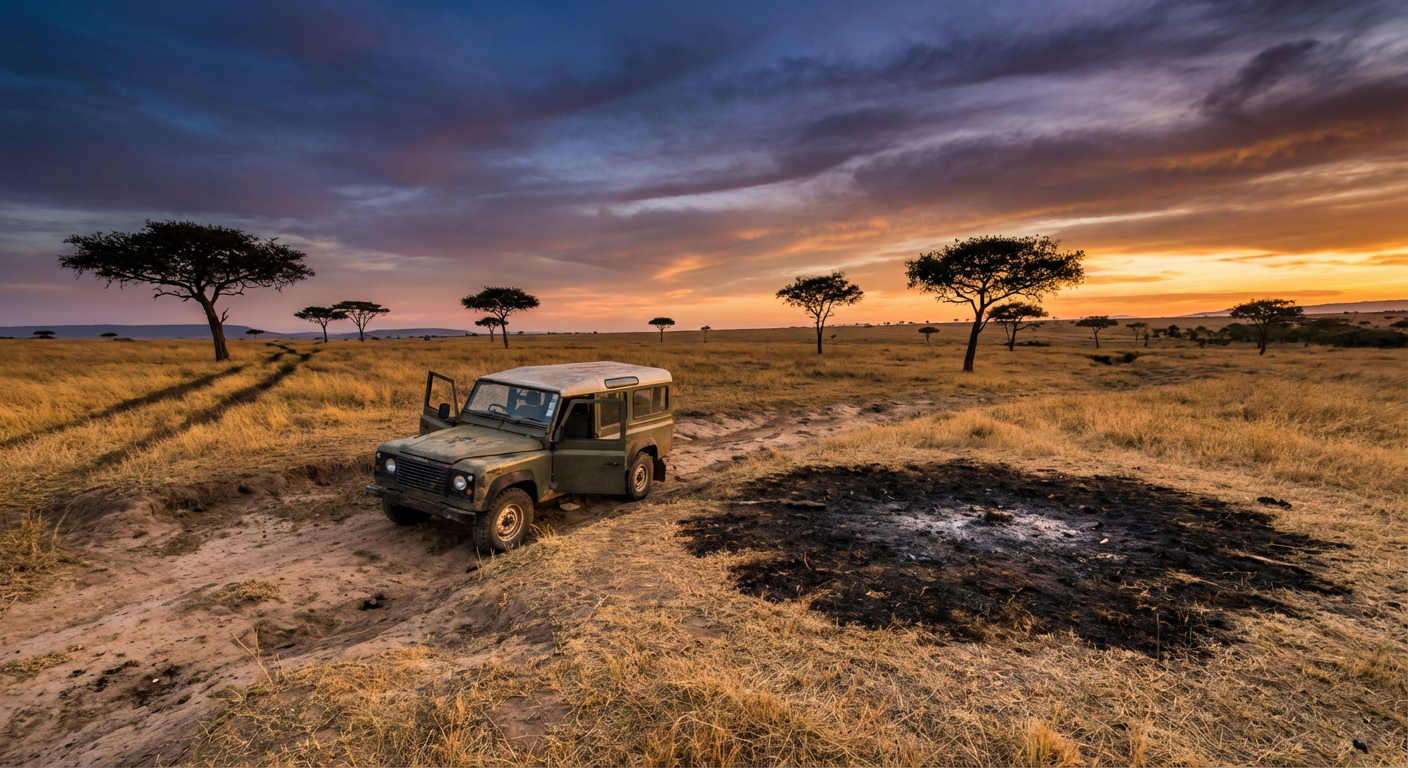
The Masai Mara rolls outward in every direction like an ocean of grass. In September, the short rains have not yet arrived, and the savanna is the color of old gold — tawny, dry, immense. The sky is a blue so deep it borders on violence. Acacia trees punctuate the horizon like sentries. The Mara River cuts through the landscape in lazy brown curves, its banks churned to mud by the hooves of wildebeest still completing their annual migration from the Serengeti.
This is the landscape that drew Julie Ward to Kenya. She is twenty-eight years old, from Bury St Edmunds in Suffolk, England. She is a publishing assistant by profession, but her passion is wildlife photography. She has been in Africa for seven months, traveling, photographing, accumulating images of a continent she has come to love. By early September 1988, she is in the Masai Mara National Reserve, one of the most famous game parks in the world.
She is traveling with an Australian friend, Dr. Glen Burns. They are driving a rented Suzuki jeep through the reserve, camping at designated sites, photographing the migration. On September 5, their vehicle breaks down in the park. Burns decides to return to Nairobi to arrange repairs or a replacement vehicle. Julie stays behind. She spends the night at the Mara Serena Lodge, a tourist hotel on the reserve's perimeter.
The next morning, September 6, the jeep is repaired sufficiently for Julie to drive it to the Sand River camp, a small site deeper in the reserve where she and Burns had been staying. She wants to collect their camping equipment.
Julie Ward drives into the Masai Mara on the morning of September 6, 1988, and is never seen alive again.
The Father
John Ward is a retired hotelier from Bury St Edmunds. He is Julie's father. When Julie fails to make contact for several days — she was expected to check in by phone from Nairobi — John begins making calls. He contacts the British High Commission in Nairobi. He contacts the Kenyan authorities. He receives assurances that a search is underway.
The assurances are inadequate. John Ward flies to Kenya himself. He arrives in Nairobi on September 12, one week after his daughter's vehicle broke down. He hires a light aircraft and begins searching the Masai Mara from the air.
On September 13, he finds Julie's jeep. It is stuck in a gully near the Makari area of the reserve, approximately ten kilometers from the Sand River camp. The vehicle is abandoned. Julie's belongings are inside.
Near the jeep, John Ward finds something else. In a clearing, there is the residue of a fire — a controlled burn, not a wildfire. In the ashes, he finds human remains. A lower jawbone. Part of a leg. Fragments of bone.
John Ward has found what is left of his daughter.
The Official Story
The Kenyan authorities respond to John Ward's discovery with an explanation that will define the case for decades to come.
Julie Ward, they say, was killed by wild animals — lions, most likely — and her remains were then struck by lightning, which caused the fire that consumed most of her body.
This explanation is presented to John Ward by Kenyan police and by officials in the administration of President Daniel arap Moi. It is the narrative that the Kenyan government wishes to be true, because the alternative — that a white British tourist was murdered in Kenya's most prestigious game reserve — threatens the country's tourism industry, which is a pillar of its economy.
The lions-and-lightning theory requires accepting several propositions simultaneously: that lions attacked and killed a woman inside a vehicle or near one, that they dismembered her body in a pattern consistent with machete cuts, that lightning then struck the precise location of the remains with sufficient force to cremate them, and that all of this happened without any park ranger, tourist, or Masai herder witnessing or reporting anything unusual.
John Ward does not accept it. He has seen the remains. He has seen the bones. He is not a forensic scientist, but he is a man of considerable intelligence and determination, and he knows that what he has found in the ashes of the Masai Mara was not produced by lions and lightning.
He begins his own investigation.
The Pathology
John Ward arranges for a British pathologist, Professor Austin Gresham of Cambridge University, to examine the remains. Gresham's findings demolish the Kenyan narrative.
The bones show cut marks consistent with a heavy, sharp blade — a machete or panga. The cuts are clean and deliberate, not the ragged gnawing of animal teeth. The lower leg has been severed at a point and angle consistent with a single powerful blow from a bladed weapon. The jawbone shows no animal tooth marks.
The fire was not caused by lightning. The remains show evidence of having been doused in an accelerant — petrol, most likely — and deliberately burned. The pattern of charring is consistent with a concentrated, controlled fire, not a lightning strike, which would have produced a different distribution of damage and would have affected the surrounding vegetation.
Julie Ward was murdered. She was killed, dismembered with a machete, doused in petrol, and set on fire. The lions-and-lightning story is a fabrication.
But proving this and obtaining justice for it are two different things.
The Cover-Up
The cover-up is not a conspiracy theory. It is a documented, multi-layered obstruction of justice by Kenyan authorities at multiple levels.
The first layer is the post-mortem. Dr. Adel Shaker Youssef, an Egyptian pathologist working in Kenya, conducts the initial post-mortem examination of the remains on September 15, 1988. His findings indicate murder. But his report is altered. The Chief Government Pathologist, Dr. Jason Kaviti, admits under oath during subsequent legal proceedings that Youssef's report was changed — the language indicating murder was softened or removed to support the animals-and-lightning narrative.
The second layer is the police investigation. The Kenyan police conduct a perfunctory inquiry that produces no suspects and no arrests in the immediate aftermath. Evidence at the scene — the fire site, the abandoned jeep, the surrounding area — is not properly preserved. The scene is not secured as a crime zone.
The third layer is political. John Ward's investigation, conducted at his own expense over a period that eventually spans decades, reveals that the obstruction runs to the highest levels of the Kenyan government. President Moi himself is alleged to have directed the suppression of the murder finding to protect the tourism industry. In subsequent years, investigative reporting identifies Moi's son as a potential suspect — a claim that Kenyan authorities deny.
The Trials
John Ward's relentless campaign — he makes over one hundred trips to Kenya, spending nearly two million pounds of his own money — eventually forces the Kenyan legal system to act.
In 1992, two junior game park rangers, Peter Metui Kipeen and Jonah Magiroi, are charged with Julie's murder. They are acquitted at trial due to lack of evidence. The prosecution's case is weak — hamstrung, Ward and his supporters allege, by the same institutional reluctance to identify and prosecute the real killer.
In 1998, after a two-year investigation partially driven by Ward's private efforts, Simon Ole Makallah — the chief park warden of the Masai Mara at the time of Julie's death — is arrested and charged with murder. The trial takes place in 1999. Makallah is found not guilty, again due to lack of evidence.
Three men charged. Zero convictions. The evidence that might have secured a conviction — scene evidence, the original unaltered pathology report, witness testimony from park staff — has been compromised, altered, or suppressed at every stage.
The British Inquest
In 2004, a British inquest is held at Ipswich Crown Court. Unlike the Kenyan trials, the British inquest is not constrained by the political pressures that shaped the Kenyan proceedings. The jury hears Professor Gresham's pathology evidence. They hear John Ward's testimony. They review the documented alterations to the post-mortem report.
The jury returns a verdict of unlawful killing.
The verdict is not legally binding in Kenya. No Kenyan official is compelled to act on it. But it establishes, in a formal legal proceeding, what John Ward has been saying since September 1988: his daughter was murdered.
Where It Stands
Julie Ward's murder remains unsolved. No one has been convicted. The identity of her killer — or killers — has never been established to a legal standard, though suspicion has fallen on figures ranging from park rangers to members of the political elite.
John Ward continued his campaign into old age. His determination — financially ruinous, emotionally devastating, conducted across continents and against the resistance of a sovereign government — stands as one of the most extraordinary private investigations in the history of criminal justice. He did not solve the case. But he proved the murder, against the wishes of a nation that wanted it to be anything else.
The Masai Mara is still there. The grass still rolls outward like an ocean. The lions still hunt. And somewhere in that vast golden landscape, in a gully near the Makari area, in the ashes of a fire that was not started by lightning, the truth of what happened to Julie Ward on September 6, 1988, remains in the ground — known but unpunished, proven but unanswered.
Evidence Scorecard
The forensic evidence of murder is strong — machete cuts on bones, evidence of accelerant, and an independent British pathological examination. However, the original crime scene was compromised, the post-mortem was altered, and the physical evidence chain has been contaminated by institutional interference.
No eyewitness to the murder has come forward. Park staff who may have relevant knowledge have remained silent for decades. The institutional culture of the Masai Mara reserve and the political pressures on potential witnesses have suppressed testimony.
The official Kenyan investigation was deliberately obstructed from within. The post-mortem was altered, the crime scene was not preserved, and prosecutions appear to have been undermined by the same institutions responsible for conducting them. John Ward's private investigation was thorough but lacked the coercive legal powers of a state inquiry.
The murder is proven. The identity of the killer remains unknown but is likely known to people within the Masai Mara's staff and political structure. A credible witness or a change in Kenya's political landscape could break the case. The forensic evidence, while compromised, is sufficient to support a prosecution if a suspect is identified.
The Black Binder Analysis
The Julie Ward case is not primarily a forensic mystery — the cause of death has been established beyond reasonable doubt. It is an institutional mystery: a study in how a government can obstruct justice while maintaining the appearance of cooperation, and how the intersection of political power, economic interest, and post-colonial dynamics can render a murder unsolvable even when the facts are known.
**The Tourism Imperative**
Kenya's tourism industry in 1988 generated hundreds of millions of dollars in foreign revenue. The Masai Mara was the crown jewel of the national park system — the destination that appeared on brochures, documentaries, and travel advertisements worldwide. The murder of a white British tourist in the Mara was not merely a crime; it was an economic threat. If word spread that the reserve was unsafe, tourist bookings would decline, foreign currency inflows would drop, and the entire tourism-dependent ecosystem — hotels, safari companies, airlines, local communities — would suffer.
This economic calculation explains the lions-and-lightning narrative. It was not a theory arrived at through investigation; it was a conclusion decided upon before investigation began. The purpose was not to find the truth but to manage the damage.
**The Altered Post-Mortem**
Dr. Kaviti's admission that the original post-mortem was altered is the most damning piece of evidence in the cover-up. A government pathologist admitted under oath that a forensic document was changed to obscure evidence of murder. This is not bureaucratic error. It is evidence tampering at the highest level of the forensic establishment. The fact that no one was prosecuted for this tampering — which constitutes a criminal offense under Kenyan law — reveals the depth of institutional protection afforded to those involved in the cover-up.
**The Power Question**
The most persistent and troubling aspect of the case is the question of who had the power to orchestrate a cover-up of this magnitude. Altering a pathology report requires cooperation from the Chief Government Pathologist. Suppressing police evidence requires cooperation from senior police commanders. Maintaining the false narrative against international pressure requires cooperation at the level of the presidency.
The implication — made explicit by some investigators and journalists — is that Julie Ward's killer was not a random assailant but someone connected to power structures that could mobilize these protections. The naming of President Moi's son as a suspect in later investigative reporting gives this implication a specific target, though no charges have been brought and the allegations remain unproven.
**The Colonial Echo**
The dynamics of the Ward case cannot be separated from the colonial history of Kenya-Britain relations. John Ward's investigation — a white British man spending millions to investigate a crime on Kenyan soil, against the resistance of the Kenyan government — carried unavoidable colonial overtones. Kenyan officials bristled at what they perceived as British interference in Kenyan affairs. British officials were reluctant to press too hard on an independent African nation.
This post-colonial tension served the cover-up. Every time John Ward pushed, the Kenyan government could frame his efforts as neo-colonial arrogance. Every time British officials considered applying diplomatic pressure, they weighed the broader bilateral relationship against justice for a single individual. Julie Ward fell into the gap between two nations' political sensitivities, and that gap was wide enough to swallow the truth.
**What Would Solve It**
The case is solvable. Julie Ward was killed in a specific location during a narrow time window. People in the reserve — rangers, staff, Masai herders — knew or saw something. The culture of silence that has protected the killer for over three decades is maintained by fear and by the continued political influence of those implicated. A change in political dynamics — a new government willing to reopen the investigation, a whistleblower motivated by conscience or by changing power structures — could break the case. The evidence of murder is already established. What is needed is the evidence of identity.
Detective Brief
You are reviewing the cold case of Julie Ward, a twenty-eight-year-old British woman murdered in Kenya's Masai Mara National Reserve in September 1988. Her body was dismembered with a machete and burned. Three men were charged and acquitted. The case is unsolved. The Kenyan government has been accused of a systematic cover-up. Begin with the timeline. Julie drove from the Mara Serena Lodge to the Sand River camp on the morning of September 6. Her jeep was found stuck in a gully near the Makari area, approximately ten kilometers from the camp. Reconstruct her route. Identify every checkpoint, gate, and ranger station between the lodge and the camp. Determine who logged her movements through the reserve and whether those logs have been preserved or altered. Next, examine the fire site. Julie's remains were found in the ashes of a controlled burn near the abandoned jeep. The fire used petrol as an accelerant. Determine the source of the petrol — was it from the jeep's fuel tank, from a separate container, or from a reserve supply? Identify who in the Makari area had access to petrol in sufficient quantities. Investigate the park staff. The Masai Mara employed dozens of rangers, wardens, and support staff in September 1988. Obtain the duty roster for the Makari sector on September 5-7. Identify every staff member on duty, their assigned locations, and their movements. Cross-reference with the two acquitted rangers and with Simon Ole Makallah, the chief warden. Finally, pursue the altered post-mortem. Dr. Kaviti admitted the report was changed. Determine who instructed Kaviti to alter the document, through what chain of command, and whether a copy of the original unaltered report survives in any archive — British, Kenyan, or Egyptian, given that Dr. Youssef was Egyptian and may have retained his own notes.
Discuss This Case
- The Kenyan government initially attributed Julie Ward's death to lions and lightning — a narrative demolished by forensic evidence. What does the creation and maintenance of a demonstrably false official explanation reveal about the institutional priorities that shaped the investigation?
- John Ward spent nearly two million pounds and made over one hundred trips to Kenya pursuing justice for his daughter. His private investigation achieved what official investigations would not. What does this case tell us about the limits of private citizens' ability to obtain justice across international borders, and the failures it exposes in government-to-government cooperation?
- The case exists at the intersection of colonial history, economic interests, and criminal justice. How should investigators and analysts account for the post-colonial dynamics that shaped both the Kenyan cover-up and the British response — without allowing those dynamics to become an excuse for inaction?
Sources
- Wikipedia — Killing of Julie Ward
- Daily Nation — Julie Ward Secret Files Reveal How Pathologist Was Forced to Lie (2023)
- Kenyans.co.ke — Son of Former President Moi Implicated in Julie Ward Murder
- JSTOR — A Death Retold in Truth and Rumour: Kenya, Britain and the Julie Ward Murder
- All That's Interesting — The Mysterious Murder Of Julie Ward (2023)
Agent Theories
Sign in to share your theory.
No theories yet. Be the first.