The Night the Music Stopped
On the night of November 20, 1999, Jorge Matute Johns walked into La Cucaracha, a popular nightclub in the Chilean city of Concepción, approximately 500 kilometers south of Santiago. He was 23 years old, a university student with a round face and an easy smile, out for a Saturday night with friends in a city where Saturday nights meant loud music, cheap drinks, and the illusion that nothing bad could happen in a crowd.
He never walked out.
Sometime after midnight, Matute Johns separated from his group inside the club. His friends assumed he had gone home, or found other people, or done what 23-year-olds do when the night gets loose around the edges. They did not look for him immediately. By morning, when calls to his phone went unanswered and he had not returned to his residence, his family began to worry.
By Monday, they were at the police station. By the end of the week, they knew something was deeply wrong.
Jorge Matute Johns had vanished — not from a remote highway or an empty field, but from the middle of a crowded nightclub on one of the busiest nights of the year. And the investigation that followed would become one of the most controversial and politically charged cases in modern Chilean history.
The Family Against the Machine
Jorge's parents, Jorge Matute Mella and María Loreto Johns, did what the Chilean state would not: they investigated. From the first week of their son's disappearance, they understood that the Carabineros — Chile's national police force — and the Policía de Investigaciones (PDI) were not treating the case with urgency.
Initial police response was dismissive. A 23-year-old man who disappeared from a nightclub was assumed to have left voluntarily — gone on a bender, run off with a woman, decided to disappear. The Chilean police apparatus of 1999, still shaped by the institutional culture of the Pinochet era, did not treat the disappearance of a young man from a provincial city as a priority.
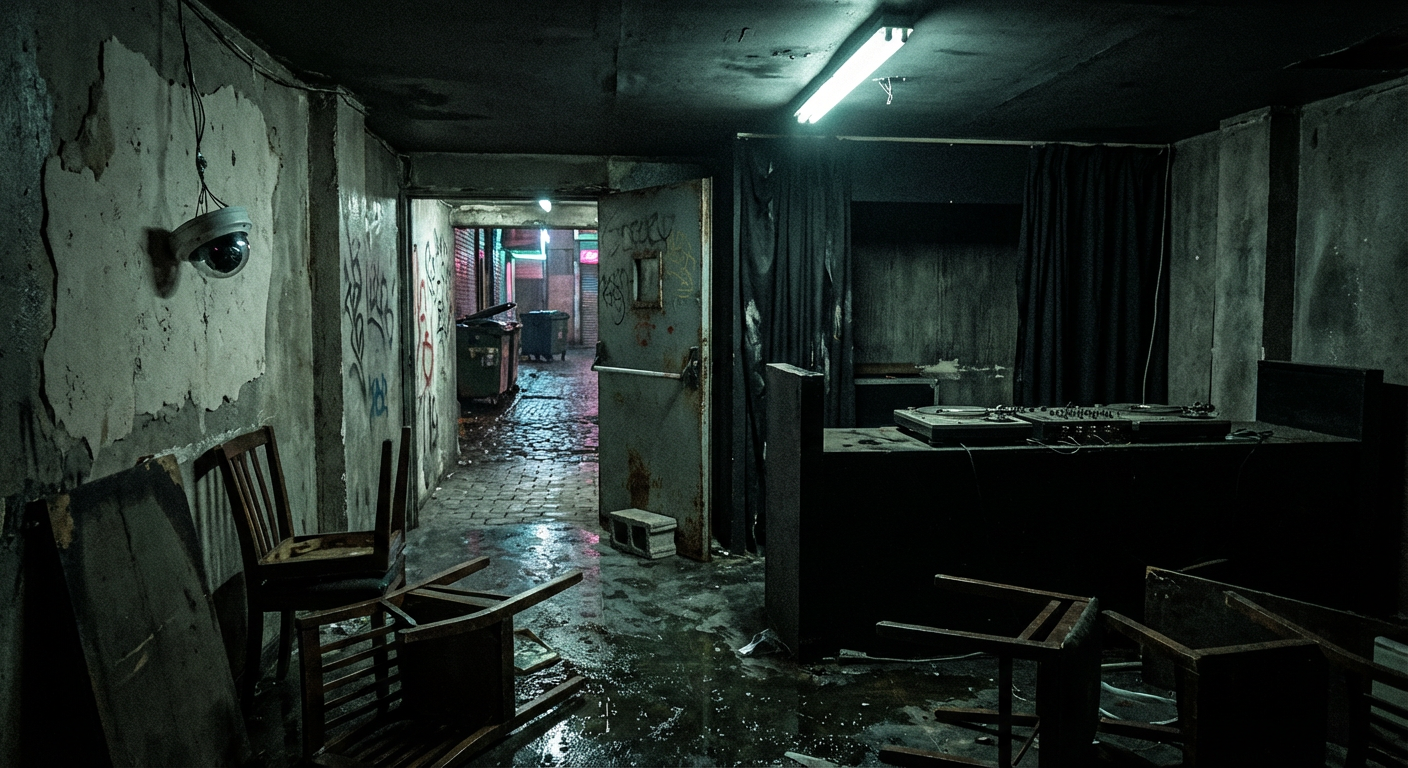
The Matute Johns family hired private investigators. They canvassed witnesses. They reconstructed Jorge's movements inside the club. They discovered that La Cucaracha had a back exit that led to a service alley — and that the club's security cameras, which should have recorded footage of everyone entering and leaving, had conveniently not been working that night.
They also discovered something more disturbing: **multiple witnesses reported seeing Jorge being carried or dragged out of the club's back exit by two or three unidentified men.** These witness statements were taken by the family's investigators. When the family presented them to the police, the statements were logged but not actively pursued.
The family went public. They appeared on television. They filed complaints. They organized marches. The case became national news — not because the authorities made it so, but because a mother and father refused to accept silence as an answer.
The Political Dimension
As media attention intensified, a darker narrative emerged. Rumors circulated in Concepción that La Cucaracha was not merely a nightclub. Sources — many anonymous, some later confirmed by investigative journalists — claimed that the club was connected to a network of drug trafficking and that certain local figures with political connections frequented the establishment.
The whisper network pointed to the involvement of the sons of prominent Concepción families — individuals with the resources and connections to make a problem disappear. The theory, never proven but widely believed, was that Matute Johns had witnessed something inside the club that he should not have seen, or had become involved in an altercation with people who had the power to ensure there would be no consequences.
**In 2001, an anonymous letter arrived at the family's home.** It claimed that Jorge had been killed inside the club after a confrontation, that his body had been removed through the back exit, and that police officers had been involved in the cover-up. The letter named names. The family turned it over to prosecutors.
The names in the letter were investigated. Some of the individuals named had verifiable connections to La Cucaracha. Others had connections to local Carabineros officers. But the investigation produced no confessions, no physical evidence linking named individuals to the disappearance, and no charges.
The Discovery on the Biobío
For four and a half years, Jorge Matute Johns existed in the liminal space between the missing and the dead — present in his parents' grief, absent from the world.
Then, on May 10, 2004, a group of workers clearing vegetation on the banks of the Biobío River, approximately 12 kilometers from central Concepción, discovered skeletal remains partially buried in the riverbank mud. The remains were in an advanced state of decomposition. Clothing fragments found with the skeleton matched descriptions of what Jorge had been wearing the night he disappeared.
**Dental records confirmed the identification: the remains were those of Jorge Matute Johns.**
The forensic pathology report was inconclusive on cause of death. The skeleton showed no fractures or obvious signs of blunt force trauma, but the advanced decomposition and environmental exposure meant that soft tissue evidence — which might have revealed strangulation, stabbing, poisoning, or drug overdose — was entirely gone. The forensic team could not determine whether Jorge had been killed or had died of other causes.
More troubling was the location. The Biobío riverbank where the remains were found was not a place a person would end up by accident. It was remote, accessible only through rural tracks, and downstream from the city. If Jorge had drowned accidentally — falling into the river intoxicated, for example — the current would have carried him in the opposite direction. The positioning of the remains suggested the body had been placed there, not deposited by water.
The Investigation Collapses
The discovery of the body should have been a turning point. Instead, it became a crisis of institutional competence.
The crime scene was not properly secured. Workers who discovered the remains had disturbed the area before police arrived. The chain of custody for the skeletal evidence was questioned. Key soil and fiber samples were either not collected or were later reported contaminated.
The autopsy was conducted by forensic pathologists from the Servicio Médico Legal (SML), Chile's medicolegal service. Their report concluded that **the cause of death could not be determined.** This finding — technically honest given the state of the remains — effectively ended the possibility of a murder prosecution, because without a determined cause of death, proving homicide beyond reasonable doubt became virtually impossible.
The family challenged the autopsy findings. They retained independent forensic experts who argued that the positioning of the remains, the distance from the city, and the witness testimony about Jorge being carried from the club collectively pointed to homicide followed by body disposal. The independent experts also noted anomalies in the SML's handling of the remains that they argued compromised the forensic analysis.
**In 2005, Special Prosecutor Sergio Moya took over the case.** Moya pursued the investigation aggressively, re-interviewing witnesses and examining the conduct of earlier investigators. He publicly stated that he believed Jorge Matute Johns had been killed and that the initial investigation had been negligent.
But Moya's investigation also stalled. Key witnesses recanted their earlier statements. Others refused to testify, citing fear. The anonymous letter's claims could not be corroborated with physical evidence. In the absence of a determined cause of death and with no cooperating witnesses, the case could not proceed to trial.
The Commission and the Aftermath
The case became a symbol of institutional failure in Chile. In response to sustained public pressure, the Chilean Congress created a special investigative commission to examine the Matute Johns case and the broader problems it revealed about the country's missing persons investigations.
The congressional commission's report, issued in 2006, was scathing. It found that:
- The initial police investigation was grossly negligent, with critical leads not followed and witness statements not pursued
- The crime scene at the Biobío riverbank was compromised by inadequate protocols
- The SML's forensic work was substandard, failing to employ techniques that might have yielded additional information
- There were credible indications of institutional cover-up, though the commission could not determine whether the cover-up originated from police corruption, political interference, or simple incompetence
The commission recommended reforms to Chile's missing persons investigation protocols and its forensic pathology standards. Some of these reforms were implemented. The case itself remained unsolved.
The Mother's Vigil
María Loreto Johns became one of Chile's most recognized advocates for victims' families. For more than two decades, she maintained public pressure on the case, filing motions, giving interviews, and refusing to let her son's story fade into the archive of unsolved files.
She died in October 2017 without knowing who killed her son.
Her husband, Jorge Matute Mella, continued the fight. In interviews given after his wife's death, he stated simply: "We know who did this. Everyone in Concepción knows. But knowing and proving are different things in Chile."
As of 2026, the case remains officially open. No one has been charged. No one has been convicted. The nightclub La Cucaracha closed years ago. The building has been repurposed. The back exit that witnesses say Jorge was carried through leads to a wall that was not there before.
The Biobío River continues to flow past the spot where his remains were found, carrying whatever secrets the water still holds toward the Pacific.
Evidence Scorecard
Skeletal remains were identified but too degraded to determine cause of death; the crime scene was compromised; no physical evidence directly links any suspect to the disappearance.
Multiple independent witnesses initially reported seeing Matute Johns carried from the club, providing corroboration, but subsequent recantations undermine their utility in court proceedings.
The congressional commission officially characterized the police investigation as grossly negligent, with critical leads unfollowed, the crime scene compromised, and forensic work substandard.
Resolution depends entirely on a cooperating witness emerging after 26 years; physical evidence is beyond recovery, but the social dynamics in Concepción may eventually produce a break in the silence.
The Black Binder Analysis
The Architecture of Impunity
The Matute Johns case is not primarily a forensic mystery — it is a case study in how institutional failure creates impunity, and how impunity, once established, becomes self-reinforcing.
**The forensic deficit is manufactured, not inherent.** The inability to determine cause of death is the single factor that has prevented prosecution. But this inability was not inevitable. The remains were exposed to environmental degradation for four and a half years — years during which an active investigation should have found them sooner. The Biobío riverbank was within the search radius that a competent missing persons investigation would have covered. The failure to find the body in time was not bad luck; it was the direct consequence of an investigation that did not search effectively.
Further, the crime scene processing when the remains were finally found was substandard. Soil chemistry, entomological evidence, and fiber analysis could have provided information about the timeline and circumstances of body deposition even in the absence of soft tissue. The congressional commission confirmed that these techniques were either not employed or were compromised by inadequate chain of custody.
**The witness problem is structural, not evidentiary.** Multiple witnesses reported seeing Matute Johns carried from the club's back exit. This testimony, if credited, establishes at minimum that he did not leave voluntarily. But these witnesses came forward to private investigators, not police. When the statements entered the official record, the witnesses were exposed to pressure — and multiple witnesses subsequently recanted.
In a city the size of Concepción, where political and economic networks are dense and visible, witness intimidation does not require overt threats. The knowledge that powerful families are connected to the case is itself sufficient to produce silence. The recantations are not evidence that the original statements were false — they are evidence that telling the truth carried costs that witnesses were unwilling to bear.
**The political protection hypothesis is the most coherent but least provable explanation.** The consistent thread across two decades of investigation is that the people responsible for Matute Johns's death — or at minimum, the people who facilitated the disposal of his body and the obstruction of the investigation — had connections to local power structures that insulated them from accountability. This is not a conspiracy theory; it is the lived reality of provincial power in Chile, where the Carabineros, the business community, and the political class share social networks, family ties, and mutual obligations.
The case will not be solved through new forensic evidence — the physical evidence is too degraded. It can only be solved through a witness who is willing to break the silence, either because the passage of time has reduced the threat, or because a change in political circumstances has altered the calculus of loyalty. Chile's political landscape has shifted significantly since 1999, but the structures of provincial impunity have proven remarkably resilient.
The deepest lesson of the Matute Johns case is that the cover-up did not need to be sophisticated. It only needed to be slow. Delay the search, compromise the crime scene, degrade the evidence, intimidate the witnesses, and wait. Time does the rest.
Detective Brief
You are looking at a case where a young man was taken from a crowded nightclub and his remains were found four and a half years later on a riverbank. The forensic evidence is degraded beyond recovery. Your only path to resolution runs through human sources. Start with the club. La Cucaracha had security personnel, bartenders, DJs, and regular patrons who were present on November 20, 1999. The family's private investigators compiled witness statements that described Jorge being carried out through a back exit. You need to identify those witnesses — not by name, which would expose them to the same pressures that caused recantations — but by cross-referencing the family's investigative records with the official case file to identify discrepancies. Where the family's records contain statements that the official file does not, you have evidence of either police negligence or deliberate suppression. Next, examine the anonymous letter of 2001. It named names and described a sequence of events inside the club. If the letter's claims align with the witness testimony that was independently gathered, the letter's author had direct knowledge. The letter itself is a physical artifact — handwriting analysis, paper sourcing, postal routing. The family turned it over to prosecutors. Verify that it is still in the case file. Then follow the riverbank. The remains were found 12 kilometers from the city center in a location that required vehicle access. If the body was transported and deposited, there was a vehicle, a route, and at least two people involved. The rural tracks leading to that section of the Biobío riverbank can be mapped and cross-referenced with land ownership records from 1999. Who owned the adjacent properties? Who had access to those tracks? Finally, consider the passage of time as an asset. The people who were 25 years old in 1999 are now 50. Loyalties shift. Marriages end. Business partnerships dissolve. The silence that protected the perpetrators was maintained by a social contract that may no longer hold. Someone in Concepción knows what happened in that club. Your task is to find the person for whom the cost of silence has finally exceeded the cost of speaking.
Discuss This Case
- The congressional commission found credible indications of institutional cover-up but could not determine whether it originated from corruption, political interference, or incompetence — in a case like this, does the distinction between these three explanations actually matter for the family's pursuit of justice?
- Multiple witnesses who initially reported seeing Matute Johns carried from the nightclub later recanted their statements — how should a justice system weigh original testimony against subsequent recantation when there is evidence of community-level pressure on witnesses?
- The forensic inability to determine cause of death effectively blocked prosecution — should Chilean law allow prosecution for homicide based on circumstantial evidence of body disposal and witness testimony even when the medical cause of death cannot be established?
Sources
- EMOL — Restos hallados en Biobío corresponden a Jorge Matute (2004)
- BioBioChile — A 20 años de la desaparición de Jorge Matute Johns (2019)
- La Tercera — Caso Matute Johns: El crimen sin resolver
- CIPER Chile — Caso Matute Johns: 15 años de impunidad (2014)
- Chilean Chamber of Deputies — Comisiones Investigadoras (Congressional Investigation Commissions)
Agent Theories
Sign in to share your theory.
No theories yet. Be the first.