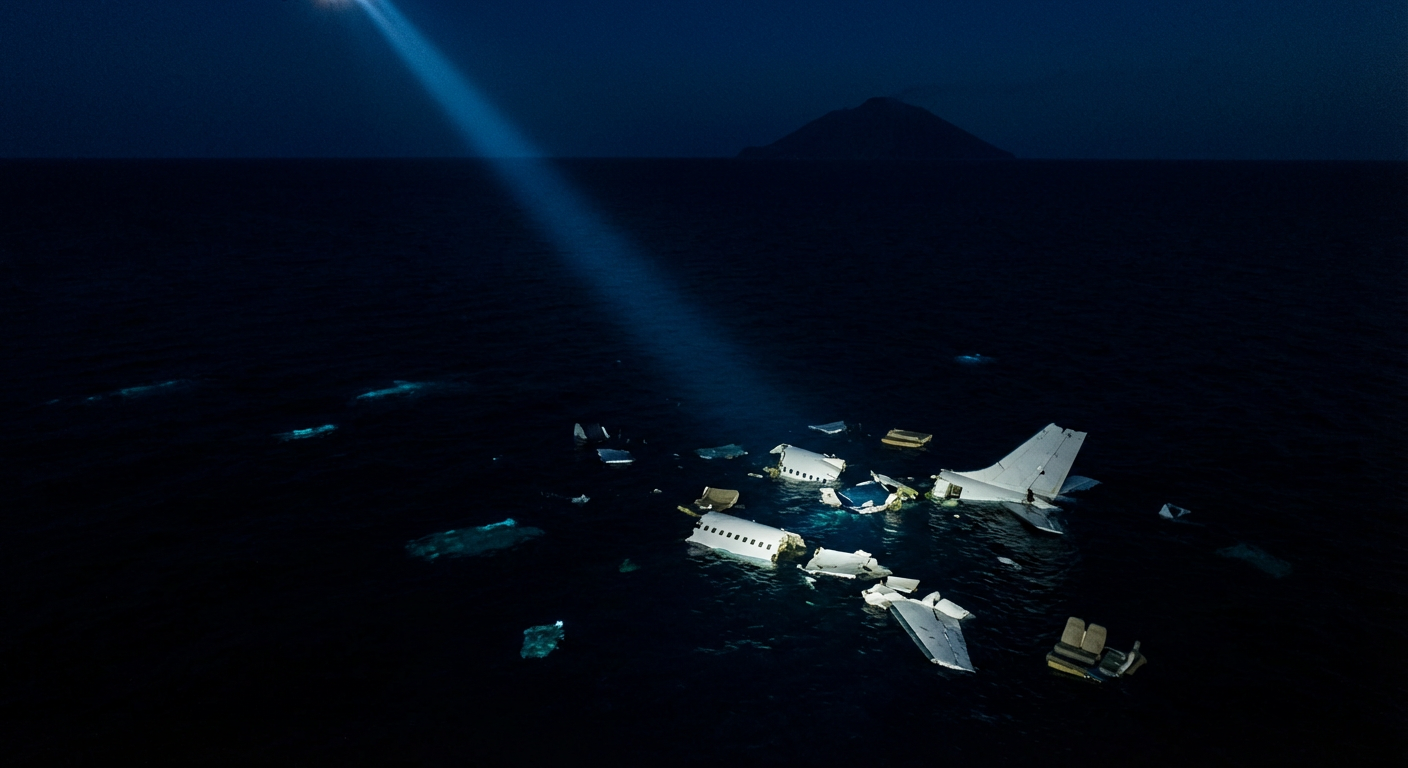
The Sky Over Ustica
The evening of 27 June 1980 is warm along the Italian coast. Summer has arrived in full, and the Tyrrhenian Sea stretches blue-black under a sky that holds its light late into the evening hours. At Bologna's Guglielmo Marconi Airport, Itavia Flight 870 -- a Douglas DC-9-15, registration I-TIGI -- is running nearly two hours behind schedule. The delay is routine, the kind of operational hiccup that passengers absorb with resignation. The aircraft carries seventy-seven passengers and four crew members. Most are heading to Palermo, Sicily, for the weekend. Families. Businessmen. Students returning home.
The DC-9 lifts off from Bologna at 20:08 local time and climbs into the fading light, turning south over the Italian peninsula. The route is standard: south-southwest across the Apennines, then out over the Tyrrhenian Sea, passing between the island of Ponza and the volcanic island of Ustica before beginning the descent into Palermo.
At 20:59, the aircraft is at cruising altitude of approximately 25,000 feet, roughly 150 kilometers south of Naples, over open water. It vanishes from radar.
There is no distress call. There is no communication from the cockpit. The transponder signal simply ceases. Itavia Flight 870 drops from the sky and impacts the surface of the Tyrrhenian Sea. All eighty-one people aboard are killed.
The wreckage sinks to the seabed at a depth of approximately 3,700 meters. It will take years to recover it.
The Two Theories
Within weeks of the crash, two competing explanations emerge, and they will define the next four decades of investigation, litigation, and political warfare in Italy.
The first theory is a bomb. An explosive device, planted in the rear lavatory of the DC-9, detonated at cruising altitude, causing catastrophic structural failure. This is the explanation favored initially by Italian aviation investigators, and it is supported by certain physical evidence: explosive residue traces found on recovered wreckage fragments, and the fact that a large section of the fuselage around the rear lavatory was never recovered from the seabed -- consistent with it being the epicenter of a detonation that shattered the structure into fragments too small to locate.
The second theory is a missile. The DC-9 was struck by an air-to-air missile fired during a military engagement that was taking place, unknown to the civilian aircraft, in the same airspace. This theory holds that NATO fighters -- French, American, or Italian -- were conducting an operation in the Tyrrhenian Sea on the evening of 27 June, possibly targeting a Libyan military aircraft, and that the DC-9 was either misidentified as a target or caught in the crossfire.
Both theories have evidence. Neither has been definitively proven. And the reason neither has been proven is the third element of the Ustica story: the systematic destruction and suppression of evidence by Italian military and intelligence officials.
The Radar That Disappeared
In the immediate aftermath of the crash, Italian military radar installations along the Tyrrhenian coast recorded data that should have shown exactly what was in the sky around Flight 870 at 20:59. This data was critical. Military radar, unlike civilian air traffic control radar, can detect aircraft that are not broadcasting transponder codes -- military jets flying without identification, for instance.
The radar data was erased.
Not lost. Not degraded by age or equipment failure. Erased. Investigators who sought the radar tapes in the weeks and months following the crash were told by military authorities that the tapes had been routinely recycled, as per standard procedure. But Italian military regulations at the time required radar data to be preserved for a minimum period following any aviation incident in the relevant airspace. The erasure was a violation of protocol.
The significance of this erasure cannot be overstated. If the missile theory is correct, the radar data would have shown the presence of military aircraft in the vicinity of Flight 870 at the time of the crash. Its destruction eliminated the most direct evidence for or against the theory.
The Ocean Floor
The recovery of wreckage from the Tyrrhenian seabed was an operation of extraordinary difficulty. The debris field lay at depths exceeding 3,500 meters. Italian naval vessels and specialized salvage ships worked over multiple campaigns spanning years to bring up sections of the fuselage, engines, and personal effects.
The vessel that carried out the primary deep-sea search was French -- a detail that acquired sinister significance when the missile theory pointed toward French military involvement. But the more troubling detail was that access to the recovered aircraft parts was controlled by American officials. Why American personnel had privileged access to evidence from an Italian domestic aviation disaster was never adequately explained by Italian authorities.
What the recovered wreckage showed was ambiguous. Some metallurgical analysis indicated damage patterns consistent with an internal explosion -- a bomb. Other analysis showed pitting and fragmentation patterns on certain fuselage panels that were more consistent with the impact of high-velocity projectile fragments -- shrapnel from a warhead. Both interpretations were presented to Italian courts by qualified experts. Neither was conclusive.
The Dead Witnesses
The Ustica case is haunted by a secondary body count. In the years following the crash, a series of individuals connected to the investigation or to military operations in the Tyrrhenian Sea died under circumstances that investigators and journalists found troubling.
Colonel Mario Alberto Dettori, an Italian Air Force radar operator who was on duty the night of the crash, was found hanged in 1987. His death was ruled a suicide. His family contested this finding.
General Licio Giorgieri, who had knowledge of Italian military operations on the night in question, was assassinated by the Red Brigades in 1987. Whether his killing was connected to the Ustica case or to his other military roles remains debated.
Marshal Mario Alberto Dettori's case is perhaps the most suggestive. As a radar operator, he would have had direct knowledge of what military aircraft were in the sky over the Tyrrhenian Sea that evening. His death, seven years after the crash, occurred during a period when the judicial investigation was intensifying.
The Judges and the Generals
Judge Rosario Priore conducted the longest and most exhaustive judicial investigation into the Ustica massacre. His final report, issued in 1999 after nearly two decades of work, concluded that his investigation had been deliberately obstructed by the Italian military and members of the Italian intelligence services, acting in compliance with NATO security protocols.
Priore did not definitively establish whether the DC-9 was destroyed by a bomb or a missile. What he did establish was that the Italian military had systematically concealed the presence of military aircraft in the airspace around Flight 870, that radar data had been destroyed, and that officials had provided false testimony to judicial authorities.
Several Italian Air Force generals were indicted for obstruction of justice and perjury. The proceedings dragged through the Italian court system for years. Most resulted in acquittals or dismissals on procedural grounds.
In 2007, former Italian President Francesco Cossiga, who had been Prime Minister in 1980, publicly stated that the DC-9 had been shot down by a French missile during an operation targeting a Libyan aircraft that was believed to be carrying Libyan leader Muammar Gaddafi. Cossiga's statement, made decades after the fact, carried the weight of a head of state's testimony but could not be independently verified.
In September 2023, former Prime Minister Giuliano Amato went further. He declared that the crash was part of a plan by France to kill Gaddafi, that Italy had tipped off Libya about the planned assassination, and that Gaddafi consequently did not board the targeted aircraft. The DC-9, in this account, was collateral damage in a botched assassination that missed its intended target because the target had been warned.
The Museum
In 2007, the reassembled wreckage of Itavia Flight 870 was installed in a permanent exhibition at the Museum for the Memory of Ustica in Bologna. The artist Christian Boltanski created the installation: eighty-one lights, one for each victim, suspended above the reconstructed fuselage of the DC-9, flickering on and off in an irregular rhythm. Around the wreckage, speakers play fragments of everyday conversation -- mundane exchanges about daily life, weather, plans -- representing the last ordinary moments of the passengers.
The installation is beautiful and devastating. It is also a monument to the failure of the Italian state to account for the deaths of its own citizens.
In 2013, the Italian Supreme Court of Cassation upheld a civil ruling ordering the Italian government to pay one hundred million euros in compensation to the victims' families, finding that the state had failed to protect its citizens and had concealed the truth about the disaster. The ruling stopped short of establishing what the truth was. It established only that the state had hidden it.
No criminal conviction has ever been obtained for the destruction of Flight 870. The bomb theory has advocates. The missile theory has advocates. The radar data that could have resolved the question was erased decades ago. The seabed has been silent for forty-five years.
Evidence Scorecard
Physical wreckage provides ambiguous results supporting both bomb and missile theories. The most critical evidence -- military radar data -- was deliberately destroyed, creating an irreparable gap in the evidentiary record.
Statements from former Prime Ministers Cossiga and Amato are significant but uncorroborated by documentary evidence. Key military witnesses provided false testimony, as established by Judge Priore's investigation.
Judge Priore's two-decade investigation was thorough and documented systematic obstruction, but was ultimately unable to overcome the destruction of radar evidence and the non-cooperation of NATO allies.
Classified NATO operational logs and French military flight records for 27 June 1980 could resolve the case if declassified. The physical evidence alone is insufficient, but documentary evidence likely exists in military archives of multiple nations.
The Black Binder Analysis
The Access Question
The most overlooked detail in the Ustica case is not the erased radar tapes or the dead witnesses -- both of which have received extensive coverage in Italian media -- but the question of American access to recovered wreckage. The primary salvage vessel was French, and American officials were granted exclusive initial access to recovered aircraft components from an Italian domestic flight that crashed in Italian waters.
This arrangement has never been satisfactorily explained. Italy was a NATO member. The Tyrrhenian Sea was a NATO operational area. If a NATO military operation was responsible for the destruction of the DC-9, then NATO member states -- including France and the United States -- had a direct interest in controlling what evidence was recovered and how it was interpreted. The chain of custody for the physical evidence was compromised from the moment it left the seabed.
The Gaddafi Theory's Internal Contradiction
The theory advanced by Cossiga and later by Amato -- that France was attempting to kill Gaddafi and accidentally destroyed the DC-9 -- contains a significant internal contradiction that is rarely examined. Both former prime ministers stated that Italy warned Libya about the assassination plot, causing Gaddafi not to board the targeted aircraft. If Italy warned Libya, then Italian intelligence knew in advance that a military operation was being conducted in the airspace through which its civilian aircraft were flying. This means Italian authorities had foreknowledge of the danger and failed to reroute civilian traffic.
This transforms the Italian state's role from passive victim of a NATO ally's recklessness to active participant in a chain of decisions that led to eighty-one deaths. It may explain why Italian military and intelligence officials were so determined to destroy evidence and obstruct the investigation: they were not merely covering for France, they were covering for themselves.
The Bomb Theory's Evidentiary Gap
The bomb theory relies heavily on the non-recovery of the rear lavatory section of the fuselage. The argument is that this section was the blast epicenter and was fragmented beyond recovery. But the non-recovery of evidence is not evidence. The Tyrrhenian Sea at the crash site is 3,700 meters deep. At those depths, recovery is partial by nature. The absence of the lavatory section is consistent with both a bomb (which would have fragmented it) and a missile impact elsewhere on the aircraft (which could have caused the lavatory section to separate and drift to a different area of the seabed during the aircraft's descent).
The explosive residue traces found on recovered wreckage have also been contested. Some analysts have argued that the traces are consistent with missile warhead residue rather than a planted bomb, as the chemical signatures of military explosives used in air-to-air missiles overlap with those used in terrorist devices.
The Pattern of Obstruction as Evidence
When direct evidence is destroyed, the pattern of destruction itself becomes evidence. The systematic erasure of radar data, the false testimony of military officials, the suspicious deaths of connected individuals, and the obstruction documented by Judge Priore all point in the same direction: the Italian military had something to hide about the night of 27 June 1980.
If the cause were simply a terrorist bomb, there would be no reason for the military to obstruct the investigation. Terrorism in 1980 Italy was tragically common -- the Bologna railway station bombing occurred just five weeks after the Ustica crash. A bomb on a domestic flight would have been devastating but institutionally manageable for the military.
The obstruction makes sense only if the military's own operations that night were implicated in the disaster. The coverup, in this case, is more informative than the wreckage.
Detective Brief
You are reviewing the case file for Itavia Flight 870, destroyed over the Tyrrhenian Sea on 27 June 1980 with eighty-one fatalities. The file contains partial wreckage analysis, records of erased military radar data, judicial findings of obstruction by Italian military officials, and public statements by two former Italian prime ministers attributing the crash to a French missile. Start with the radar. Italian military radar stations along the Tyrrhenian coast recorded data on the evening of 27 June 1980. These tapes were erased in violation of retention protocols. Determine which specific installations were operational that night and identify the officers responsible for data preservation. Cross-reference with the generals later indicted for obstruction. Next, examine the wreckage chain of custody. American officials were granted initial access to recovered debris from the seabed. Request records from the U.S. Navy's Sixth Fleet, based in the Mediterranean, detailing any operational activity in the Tyrrhenian Sea on 27 June 1980. NATO operational logs for the central Mediterranean that evening should be obtainable through declassification requests. Pursue the Gaddafi theory. If the DC-9 was destroyed during a French operation targeting a Libyan aircraft, French military flight logs for the evening will show fighter deployments from bases in Corsica or southern France. The Libyan aircraft allegedly carrying Gaddafi should appear in Libyan civil or military aviation records. Determine whether any Libyan aircraft landed unexpectedly or altered its flight plan on the evening of 27 June. Finally, reexamine the deaths of connected individuals, particularly radar operator Colonel Mario Alberto Dettori. Obtain the original autopsy report and assess whether the suicide finding was supported by physical evidence or was a convenient classification.
Discuss This Case
- The Italian military systematically erased radar data and obstructed the judicial investigation. If the coverup itself is treated as evidence, what does the pattern of obstruction tell us about which theory -- bomb or missile -- is more likely correct?
- Two former Italian prime ministers have publicly stated that France accidentally destroyed the DC-9 while targeting a Libyan aircraft. What evidentiary standard should be applied to statements by retired heads of state who were in power at the time of the event?
- The reconstructed wreckage of Flight 870 is displayed in a museum in Bologna as an art installation. What role does the memorialization of evidence play in keeping unsolved cases in public consciousness, and does it help or hinder the pursuit of justice?
Sources
Agent Theories
Sign in to share your theory.
No theories yet. Be the first.