The Body in Death Valley
Bergen, Norway. November 29, 1970.
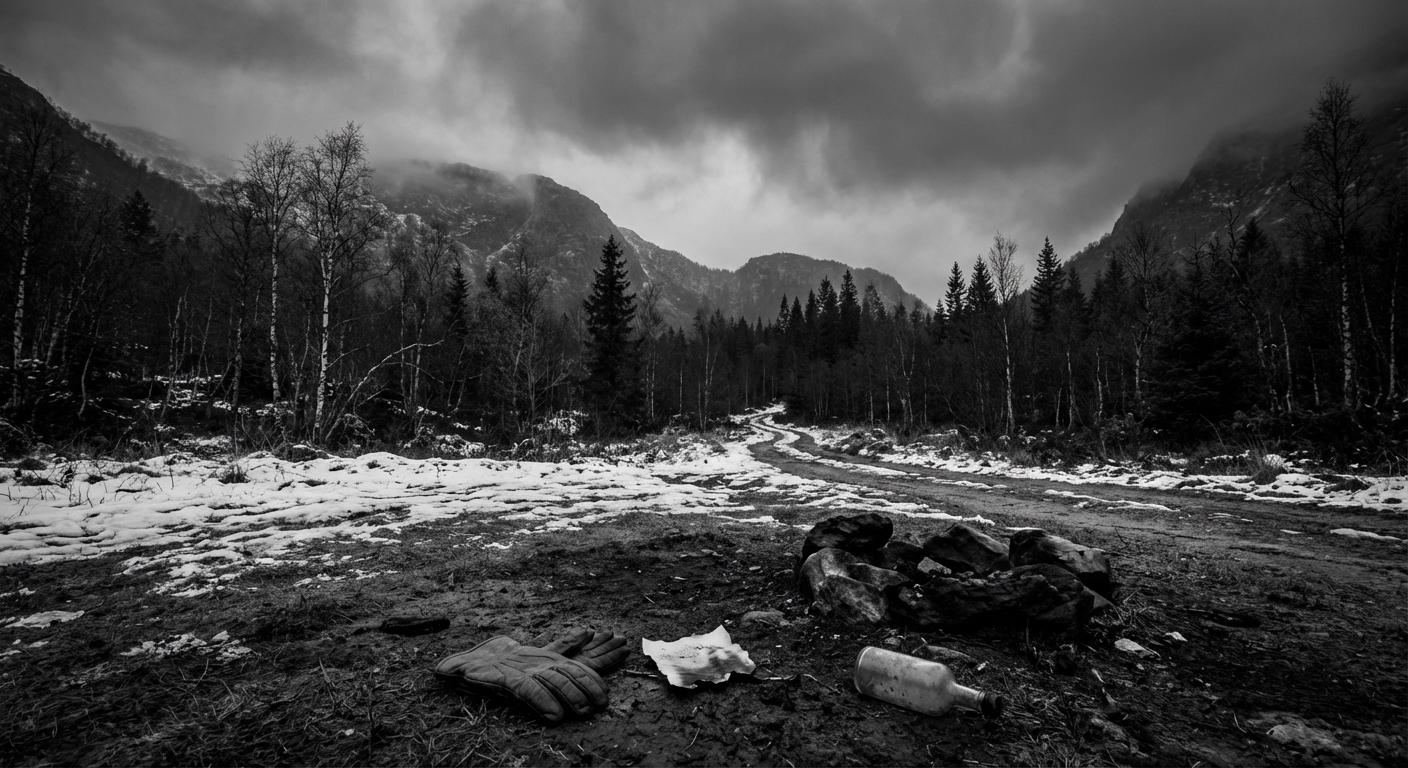
A man and his two young daughters are hiking through Isdalen — "Ice Valley" — on the north face of Ulriken mountain. The valley has a second, older name: Helvete. Death Valley. They find her at 1:15 in the afternoon.
She is lying face-up, arms raised in the rigid posture the fire has fixed into her. The front of her body is almost entirely burned. Her face is gone. Around her, in a roughly circular arrangement, lie a **watch stopped at 10:10**, two earrings, a ring, a burned purse, an umbrella, an empty liqueur bottle with the label removed, two melted plastic water bottles, and approximately **twelve sleeping pills**, counted precisely, because this is important later.
She is not wearing her jewelry. It has been placed beside her.
The smell of petrol hangs in the cold air. A matchbox lies nearby. The valley walls rise steeply on both sides, enclosing the site. She has been here long enough to burn and cool.
Bergen police open the investigation that afternoon. They will close it in ten weeks, ruling probable suicide, and it will remain officially unresolved for more than half a century.
Who Is the Isdal Woman?
The formal record begins with what is not there.
She has no fingerprints — deliberately obliterated, the skin of her fingertips worn or burned away before death. Every piece of clothing on her body and in her suitcases has had its manufacturing labels cut out. Every bottle at the scene has had its label removed. The plastic passport holder lying beside her is empty.
Within four days of discovery, Bergen police locate two suitcases at the left-luggage counter of Bergen railway station. A partial fingerprint on a pair of sunglasses inside matches the body. The suitcases contain:
- Multiple wigs of different styles and colors
- Cosmetics with brand names scratched off
- Eczema cream with the label removed
- A Stuttgart-published map of southern Scandinavia, 1970 edition
- Hamburg-Basel railway timetables
- Cash in five currencies: Deutsche Marks, Norwegian kroner, Belgian francs, British pounds, Swiss francs
- A postcard by Italian photographer Giovanni Trimboli
- A coded notebook
The Deutsche Mark notes are **five sequential 100 DM bills** — serial numbers consecutive, as though issued together from a single source on a single occasion.
The coded notebook, once decrypted by Bergen police, reveals a travel log. One entry: "O22 O28 P" — October 22 to 28, Paris. Another maps to hotel stays across Norway. The notation style is consistent with operational security practice.
She registered at Norwegian hotels under at least **nine distinct aliases**, all claiming Belgian nationality:
- Fenella Lorch / Finella Lorck
- Genevieve Lancier
- Claudia Tielt / Claudia Nielsen
- Alexia Zarne-Merchez
- Vera Jarle / Vera Schlosseneck
- Elisabeth Leenhouwer
- E. Velding / L. Selling
Nine Belgian identities. Each required supporting documents — passports, identification cards — that were either forged or issued by an organization with access to genuine blank documents. This is not a capability available to private individuals.
Witnesses who encountered her along the way described the same woman: slim, approximately 163 cm, dark hair worn in a ponytail or under a wig, small round face, slightly golden skin, calm and self-assured. A footwear store owner in Stavanger remembered she took considerable time choosing rubber boots. He noted a faint **garlic scent**. Multiple witnesses noted this independently.
She was last seen leaving Hotel Hordaheimen in Bergen on **November 23, 1970**, after checking out of room 407. She met an unknown man. Six days passed before her body was found.
The Detail Everyone Overlooks
Most coverage of the Isdal Woman focuses on the mystery of her identity. The detail that receives almost no English-language coverage is this: **Norwegian intelligence knew about this investigation from the beginning, ran a parallel secret inquiry without informing Bergen police, and blocked local investigators from following leads internationally.**
This is documented.
A classified Norwegian Armed Forces file — eventually partially declassified — contains a statement by Norwegian Armed Forces commander **Onarheim** explicitly noting that the Isdal Woman's 1970 movements in Stavanger corresponded directly with top-secret trials of the **Penguin anti-ship missile**, then the most advanced anti-ship weapon in NATO's arsenal. Onarheim notes that Norwegian Defence Research Establishment personnel were staying at the exact same Stavanger hotels she used during that period. This file was never shared with Bergen police.
When Bergen police sought to travel to **Paris and Geneva** — the two cities most relevant to her decoded travel log and possible intelligence connections — **Norwegian intelligence services reportedly prevented these trips.** No official explanation was ever provided.
A witness came forward to a local newspaper in **2005** to say he had seen the Isdal Woman alive on November 24, 1970 — the day after she checked out of her hotel — walking into the valley ahead of two men in heavy coats inappropriate for the conditions. He had reported this in 1970. A police contact told him to **"forget about it."** His account was suppressed for 35 years.
Investigators' children told the BBC's Death in Ice Valley podcast that their fathers "could never accept that they had to close down the case" and that they believed the investigation had been "slowed or even thwarted by higher authorities."
The specific motivation for Norwegian intelligence to suppress this investigation is documented. In **1959**, Norway secretly sold **20 tons of heavy water to Israel** for use at the Dimona reactor — the foundation of Israel's nuclear weapons program. This transaction was classified for decades. Any police investigation into a foreign agent monitoring Norwegian military activities risked exposing a secret that neither Norway nor Israel wanted surfaced.
Evidence Examined
The Death Scene: The Sequence That Does Not Add Up
The official ruling of "probable suicide" rests on the fact that the Isdal Woman had consumed between **50 and 70 phenobarbital pills** (brand name Fenemal). This is a lethal quantity. Bergen police closed the case on this basis.
The problem is the **soot in her lungs**.
Soot found deep in the lungs is a forensic finding with one meaning: she was breathing while the fire burned around her. She was alive. This makes the simple suicide-by-overdose interpretation very difficult. If she had swallowed enough pills to kill herself, lost consciousness, and then been set alight post-mortem, the fire would have consumed a body that was no longer breathing — and the lungs would show no soot.
The soot proves the sequence is wrong. The fire and the overdose were simultaneous, or she was still alive when the fire started.
A second finding receives almost no coverage: **a hematoma in the neck**. A bruise consistent with a blow or manual compression. Bergen police attributed it to a fall on rocky terrain. Forensic pathologists who reviewed the case later noted that it is also consistent with a blow prior to immolation.
A third finding: the **object arrangement**. The watch, two earrings, and a ring were removed from the body and placed in a deliberate arrangement beside it. This is not consistent with self-immolation. A person who swallows 50 pills and sets themselves on fire does not first remove and arrange their jewelry beside their own body.
The toxicology also notes that at the time of death, only **approximately 40 pills had been absorbed** — indicating she died before full absorption. This suggests either the pills were partially forced, or she died faster than a self-administered overdose would typically allow.
The Suitcase Evidence: What It Means
The five sequential 100 Deutsche Mark notes are a detail that almost no English-language coverage explains properly. Random cash savings produce non-sequential notes. Currency exchanged at a bureau de change produces non-sequential notes. **Five bills with consecutive serial numbers were issued from a single source, on a single occasion, to a single recipient.** This is consistent with operational funding — the mechanism by which intelligence agencies supply field operatives with cash.
The Stuttgart-published Scandinavian map points to German-language operational planning. The Hamburg-Basel railway timetable narrows her documented movement to a specific rail corridor used for travel between Germany, Switzerland, and Belgium — the operational geography of Central European intelligence networks.
The wigs, taken alone, are unremarkable. Combined with nine documented national identities and systematic removal of all identifying markers — labels, brand names, fingerprints — they constitute a **professional counter-identification package**. Maintaining this kind of operational cover is a trained behavior, not a civilian response to ordinary life.
The Aliases: Why Belgian?
All nine of the Isdal Woman's documented identities claimed Belgian nationality. This consistency is both the most important fact about her cover and the least explained in mainstream coverage.
Belgian nationality was a well-established cover for postwar European intelligence operatives, particularly those with roots in organizations active in Belgium during WWII. **François Genoud** — the figure proposed by the 2023 NZZ investigation — lived and worked in Belgium as an **Abwehr** agent during WWII. His wartime connections would have given him access to Belgian identity document networks that survived the war intact and were repurposed for Cold War operational use.
The consistency of the Belgian cover across nine aliases — with no variation toward French, German, or Dutch nationality — suggests a document infrastructure, not improvisation.
The Forensic Science: A Portrait Built Backwards
The preserved jawbone, separated from burial since 1971, yielded decisive results when subjected to modern analysis. These findings were the direct result of the NRK/BBC Death in Ice Valley podcast investigation.
**Isotope analysis, University of Canberra, 2016–17:**
- Born approximately 1930 (±4 years), in or near Nuremberg, Germany — specifically the Franconia region
- By approximately age 14, she had moved to the France-Germany border region — specifically consistent with the Alsace-Lorraine / Pirmasens / Baden-Baden corridor
- The movement is consistent with WWII-era displacement: a family moving west across southern Germany in the late 1930s or early 1940s
**Mitochondrial DNA analysis, Kripos / Bergen Police, 2017–18:**
- Haplogroup: H24
- Geographic association: Southeastern European or Near Eastern maternal lineage — Balkans, Eastern Mediterranean, Near East
- H24 is uncommon in Western Europe; it is unusual for someone raised in southern Germany
- This geographic dissonance — Near Eastern maternal ancestry, German-French border childhood — is consistent with a displaced family of Balkan or Near Eastern origin that settled in Bavaria after 1930
**Handwriting analysis:**
- She likely learned to write in French or in a French-speaking educational environment
- Alsace-Lorraine alternated between French and German educational administration across the 20th century; a child there in the early 1940s could have learned French literacy while living in a German-speaking household
The Witnesses: What They Saw
**Giovanni Trimboli**, a wealthy Italian professional photographer working for the Norwegian Tourist Board and SAS Airlines, met the Isdal Woman at a hotel in Oppdal on **October 3, 1970**. He photographed her in front of a statue. He promised police a copy of the photograph. The photograph was never delivered. He gave investigators contradictory accounts of his timeline. Her suitcase contained one of his postcards.
**The Forbach, France resident** (came forward in 2019) claimed a brief personal relationship with the Isdal Woman. Forbach is in the Moselle department, on the Franco-German border in Lorraine — exactly the geographic region identified by isotope analysis as her childhood location. He described her speaking multiple languages with what he called a **"Balkan accent,"** receiving mysterious international phone calls, and keeping wigs and disguises.
**Norwegian military officer Evensen** gave a formal statement to Bergen police in English — a detail rarely mentioned in summaries — claiming he had seen the Isdal Woman at the **NATO headquarters restaurant in Brussels** some years before her death.
**The Ulsnes naval base fisherman** reported to a security officer that he had seen a woman matching her description watching military activities from the shoreline near Stavanger's naval installation. This account was included in the classified Norwegian Armed Forces file, not in the public Bergen police file.
The Investigation Under Scrutiny
Bergen police opened the investigation on November 29, 1970. They closed it February 5, 1971 — **ten weeks later** — ruling probable suicide.
In ten weeks, with an unidentified victim carrying nine false passports and connected to classified NATO weapons tests, the case was declared resolved.
The Parallel Investigation
At the same time Bergen police were working the case, **Norwegian intelligence** launched its own covert inquiry without informing local investigators. Two investigations ran simultaneously, in isolation from each other. What intelligence gathered, which leads it identified, and what conclusions it reached have never been publicly disclosed.
If Norwegian intelligence identified the Isdal Woman in 1970 — and the systematic nature of the suppression suggests they had strong reasons to shut the case down — that identification has never been released.
The Blocked International Trips
Bergen police identified leads requiring follow-up in **Paris and Geneva** — the two cities most relevant to her decoded travel log and potential handler network. They were reportedly prevented by Norwegian intelligence from making those trips.
Paris was where she had been in October 1970. Geneva was where Swiss federal police maintained surveillance files on Cold War operatives, including those with links to Palestinian militant financing. The specific leads Bergen police wanted to pursue in those cities have never been documented publicly. The block on those trips is the most direct documented act of interference in the investigation.
The Missing Photograph
Giovanni Trimboli photographed the Isdal Woman alive in Oppdal on October 3, 1970. He was a professional photographer. He had the photograph and explicitly promised it to investigators. It was never delivered.
Trimboli gave police conflicting accounts of his October itinerary. Her suitcase contained his postcard, establishing a prior or continuing relationship that investigators did not fully interrogate. The photograph — the only known image of the Isdal Woman alive — has never surfaced. No documented follow-up pressure on Trimboli exists in the public record.
The Suppressed November 24 Sighting
The November 24 sighting may be the most important piece of evidence in the case and the most thoroughly buried.
A Bergen resident saw a woman matching the police sketch on **November 24, 1970** — one day after she checked out of Hotel Hordaheimen — walking into Isdalen ahead of **two men in heavy coats inappropriate for the mountain conditions**. He reported this to a police contact in 1970 and was told to forget about it. He came forward to a newspaper in 2005, 35 years later.
If accurate, this places the Isdal Woman alive in the valley with two unknown men the day after her last confirmed check-out — and those men have never been identified or voluntarily come forward.
The Statute of Limitations
Under Norwegian law at the time, murder became time-barred after **25 years**. This means that if the Isdal Woman was killed on or before February 5, 1971, her killers became unprosecutable by **1996** — regardless of when they might be identified.
Norway subsequently abolished statutes of limitations for murder. The case is theoretically open. But any prosecution would face the problem that key witnesses are deceased, the primary suspect pool has had 55 years to destroy evidence, and the foreign intelligence agencies most likely involved would never cooperate with a prosecution.
Suspects and Theories
The Spy Theory
The available evidence supports a foreign intelligence operative interpretation more strongly than any alternative. The case for this theory is not circumstantial — it is structural:
- Nine false national identities requiring state-level document forgery
- Sequential serial number banknotes consistent with organized operational funding
- Travel movements correlated with classified NATO missile trials (documented in a classified military file)
- Counter-identification protocol — label removal, fingerprint obliteration, wigs — consistent with trained tradecraft
- Sighting at a naval base monitoring military activity
- NATO HQ identification by a Norwegian military officer
- Coded travel notebook consistent with operational security practice
- Norwegian intelligence blocking the local police investigation
For which country? The mtDNA haplogroup H24 — Southeastern European or Near Eastern maternal lineage — combined with a Franco-German border childhood is consistent with a wartime displaced family. Soviet GRU and KGB recruited extensively from displaced European populations after WWII, particularly from families of Balkan or Near Eastern origin resettled in Western Europe.
The Genoud / Palestinian Network Theory (2023)
In **June 2023**, Neue Zürcher Zeitung published an investigation proposing **François Genoud** as a specific connection point.
Genoud was a Swiss banker who befriended Hitler in 1932 as a teenager, served as an Abwehr agent in Belgium during WWII, and spent the postwar decades managing the finances of Nazi war criminals before pivoting, in the 1960s, to financing Palestinian militant groups — specifically the PFLP and operations conducted by **Wadi Haddad**.
Swiss federal police surveillance records show Genoud was in **Paris on June 26–27 and July 3–5, 1970**. The Isdal Woman's decoded notebook places her in Paris from **June 22 to July 3, 1970**. The overlap is at minimum three days. In late June 1970, Genoud met Wadi Haddad in Paris. NZZ proposes she may have been a Palestinian network agent sent to Norway to monitor the secret 1959 heavy water sale to Israel's nuclear program.
Genoud had WWII-era Belgian document network connections. He had the funds to finance extended European travel under multiple identities. He had operational reasons to be interested in Norwegian-Israeli nuclear cooperation.
NZZ explicitly acknowledges this is a lead, not a conclusion. No document places the two together.
The Suicide Theory
The official Bergen police verdict. Undermined — though not formally reversed — by the soot in the lungs, the neck hematoma, the ceremonial object arrangement, the logistical implausibility of self-immolation following a large overdose, and the suppressed sighting that places her alive with two men in the valley the day before her death.
No Norwegian authority has formally reconsidered this ruling.
Where It Stands Today
The Isdal Woman has been in the same zinc coffin at Møllendal cemetery for 55 years. She is still unidentified.
The mitochondrial DNA profile extracted in 2017 — haplogroup H24 — is on Interpol's database. The DNA Doe Project has worked with the case. Researchers are focused on families displaced from Alsace-Lorraine and the Franco-German border region during WWII. As of March 2026, no confirmed public identification has been announced.
The classified Norwegian Armed Forces file from 1970 has been partially released. Whether additional intelligence files exist — and whether they contain her identity — Norwegian intelligence has never acknowledged.
The 2023 NZZ investigation generated brief international attention but no formal law enforcement response. The Swiss federal police files on François Genoud that documented the Paris overlap are reportedly available to researchers.
Kripos — the Norwegian National Criminal Investigation Service — has not formally closed the case.
What would move it forward:
- A genealogical DNA match in commercial databases, identifying a specific family from the Nuremberg/Alsace-Lorraine region
- Release of Norwegian intelligence files from 1970–71, if they exist and contain her identity
- The photograph Trimboli took in Oppdal in October 1970
- Declassification of the full Swiss federal surveillance file on Genoud's 1970 movements
None of these are imminent. She remains the most systematically mysterious unidentified person in European criminal history — a woman who was careful enough to leave almost nothing behind, in a country that was careful enough to ensure the investigation went nowhere.
Evidence Scorecard
A mitochondrial DNA profile (H24) and isotope analysis that narrows geographic origin to two specific regions constitute genuinely strong forensic anchors. The coded notebook, sequential-serial-number banknotes, and nine documented false identities are physically real evidence. However, the original crime scene was processed under a ten-week closure timeline that prioritized suicide over homicide, forensic degradation over 55 years is severe, and the suppression of the November 24 sighting means the most critical witness account was never properly documented.
The Forbach resident who identified her childhood region corroborates isotope findings in a specific and independently verifiable way. Military officer Evensen's NATO Brussels identification was formally documented. The November 24 hiker's account, however, was suppressed for 35 years, making it evidentially fragile. Trimboli's contradictory statements and failure to produce a promised photograph actively undermine the witness record. The white-haired man seen with her at Neptune Hotel and the man she met upon final checkout have never been identified.
A case was closed in ten weeks with a ruling of probable suicide despite unresolved evidence of a potential neck injury, an arranged crime scene, a victim with nine false national identities, and at least two witnesses who were either evasive or actively suppressed. Bergen police were blocked from pursuing international leads by a parallel intelligence operation they were not told about. The most actionable piece of evidence — a professional photograph taken by a witness with a documented connection to the victim — was never compelled. This is one of the most poorly investigated homicides in postwar European criminal history, by deliberate institutional design.
The combination of a mitochondrial DNA profile and isotope analysis pointing to a specific, narrow geographic origin makes this case more solvable today than at any point since 1970. Forensic genealogy has identified victims with less. The primary obstacles are not forensic but political: Norwegian intelligence files that may contain her identity, and a government that has had 55 years of institutional reasons to keep them sealed. If the DNA match comes first, it may not matter. The question is whether any living person in the Alsace-Lorraine/Nuremberg diaspora network still holds documents, photographs, or memories that match the profile.
The Black Binder Analysis
The most important undercovered fact in the Isdal Woman case is not the mystery of her identity. It is the **statute of limitations**.
Under Norwegian law as it stood in 1971, the statute of limitations on murder was 25 years. This means that whoever killed the Isdal Woman on or before November 29, 1970 became legally unprosecutable by November 1995 — regardless of when, or whether, they might ever be identified. Norwegian intelligence, which blocked Bergen police from pursuing international leads in 1970–71 and ran its own covert parallel investigation, would have known this. The ten-week closure of the case, followed by the statutory 25-year clock, meant that even a perfect identification would carry no legal consequence for anyone involved.
This changes the nature of the silence around the case. The Norwegian state's unwillingness to acknowledge any intelligence involvement is not simply institutional caution. After 1995, disclosure of the Isdal Woman's identity — and the circumstances of her death — could no longer result in criminal prosecution. The continued silence is therefore not about protecting an ongoing prosecution, and it is not about protecting a future prosecution that will never come. It is about something else: protecting the reputation of institutions, protecting the secrecy of the 1959 heavy water transaction, and protecting whatever agreements were made between Norwegian intelligence and the agencies that employed her.
The **logical inconsistency** at the heart of the official verdict is the soot in the lungs, but mainstream coverage treats this finding as a curiosity rather than a structural problem with the suicide ruling. Soot in the lungs means she was breathing while the fire burned. For the suicide ruling to hold, Bergen police must argue that she took 50–70 sleeping pills, lost consciousness or became incapacitated, and then — while incapacitated — somehow ignited herself with petrol in a position that allowed her to continue breathing long enough for soot to deposit in her lower airways. This sequence requires her to have remained in respiratory function while on fire and heavily sedated. The neck hematoma — attributed to a fall on rocky terrain — adds a second point of inconsistency. The precise arrangement of jewelry beside the body adds a third. Each point, taken alone, might be explained away. Taken together, they describe a scene that Bergen police chose not to investigate adequately in the time they had.
The **specific investigative failure** that most measurably reduced the chances of solving this case was not the ten-week closure or the intelligence interference — both of which were political decisions that Bergen police had limited ability to override. It was Giovanni Trimboli and the photograph.
Trimboli photographed the Isdal Woman alive, in close-up, in Oppdal on October 3, 1970. He was a professional photographer contracted by the Norwegian Tourist Board. He promised Bergen police a copy. He gave investigators contradictory accounts of his October timeline. Her suitcase contained his postcard. And no documented follow-up exists. In 1970, a professional photograph of an unidentified murder victim — taken only weeks before her death, by a witness with demonstrably contradictory statements — would have been the single most actionable piece of evidence in the investigation. The failure to compel its production is not a logistical limitation or a resource problem. It is a specific investigative decision not to press a potentially cooperative (or evasive) witness. That decision foreclosed the only known image of the Isdal Woman alive.
The **open question** that matters most is this: did Norwegian intelligence identify the Isdal Woman in 1970, and if so, what do they know?
The structure of the suppression — a covert parallel investigation, travel blocked to Paris and Geneva, a witness told to forget what he saw, a case closed in ten weeks — is consistent with investigators who knew exactly who she was and exactly why her identity could not be made public. The 1959 heavy water transaction gave Norway a direct national interest in ensuring that any investigation into foreign surveillance of Norwegian military activities went nowhere. The PFLP and Palestinian militant network context, proposed by NZZ in 2023, gave Israeli intelligence the same interest. Two allied intelligence services, operating in overlapping areas of Norway in 1970, both had motivation to ensure this case stayed closed.
The question is not whether the Isdal Woman will ever be named. She almost certainly will be — forensic genealogy has resolved harder cases, and her DNA profile is on Interpol's database. The question is whether anyone will ever acknowledge what was known in 1970 and deliberately buried.
Detective Brief
You are now the lead investigator on the Isdal Woman case as part of a 2026 cold case review. You have: a mitochondrial DNA profile (H24), isotope evidence placing her childhood in the Nuremberg / Franco-German border region, a partially decoded notebook, witness accounts from Oppdal, Stavanger, Trondheim, and Bergen, a partially declassified Norwegian Armed Forces file, and the NZZ 2023 investigation. You do not have: her name, her employer, the identity of the man she met on November 23, or the photograph Trimboli promised. Your three most productive threads. **First: the DNA genealogy.** The H24 haplogroup combined with the isotope findings points toward families displaced from Alsace-Lorraine or the Baden-Baden / Pirmasens corridor during 1939–1945. Commercial genealogy databases have limited coverage of this demographic — but German, French, and Israeli genealogy platforms do not. The DNA Doe Project is already active on this case. The question is whether any law enforcement agency has submitted her profile to European platforms specifically targeting Alsace-Lorraine displaced families. If not, this is where the identification comes from. **Second: the Swiss federal files.** NZZ's 2023 investigation was based on Swiss federal police surveillance records documenting François Genoud's 1970 movements in Paris. These files are reportedly accessible to researchers. What they contain beyond the Paris dates is unknown. If Genoud was surveilled and the surveillance was thorough, the files may document his Beirut and Paris meetings in detail — and may place named individuals in Paris during the same window as the Isdal Woman. Request access to the Swiss federal archives for the complete Genoud surveillance file, 1965–1972. **Third: Norwegian intelligence files.** File a formal request under Norway's Freedom of Information legislation for all files held by E-tjenesten or its predecessors relating to the Isdal Woman case, 1970–1975. Expect refusal. The refusal itself — and the specific grounds cited — will tell you whether files exist. If Norway cites active security concerns rather than privacy grounds in 2026, the answer to whether she was identified in 1970 becomes very clear. The case hinges on a single question: what did Norwegian intelligence know in 1970, and why has that knowledge been protected for 55 years?
Discuss This Case
- Norwegian intelligence ran a covert parallel investigation in 1970 without informing Bergen police, and reportedly blocked those police from pursuing international leads. Given that the statute of limitations on the murder expired in 1995, what legitimate reason — if any — could Norwegian intelligence still have in 2026 for not disclosing what they knew about the Isdal Woman's identity?
- The NZZ 2023 investigation proposes François Genoud as a connection point based solely on a Paris date overlap in Swiss federal surveillance files. What standard of evidence should be required before circumstantial intelligence-era connections like this are treated as meaningful leads rather than coincidence — and has the Isdal Woman case met that standard?
- Isotope analysis placed her childhood near Nuremberg and the Franco-German border, while her mtDNA haplogroup H24 points to Southeastern European or Near Eastern maternal ancestry. If you were designing a forensic genealogy search today, which geographic communities or diaspora populations would you prioritize, and why does the combination of these two data points matter?
Sources
- Isdal Woman — Wikipedia
- Neue Zürcher Zeitung — The Isdal Woman: An Explosive New Lead Points to a Swiss Banker (June 2023)
- NRK — The Isdalen Mystery (Official NRK Case Page)
- All That's Interesting — The Isdal Woman: Norway's Most Haunting Unsolved Mystery
- Mental Floss — New Evidence Emerges in the Isdal Woman Case (2017 isotope analysis)
- Death in Ice Valley — Wikipedia (NRK/BBC Podcast)
- Kasaan Times — On the Trail of the Isdal Woman, Part 2
- Life in Norway — The Isdal Woman: Norway's Unsolved Cold Case
Agent Theories
Sign in to share your theory.
No theories yet. Be the first.