The Evening Route
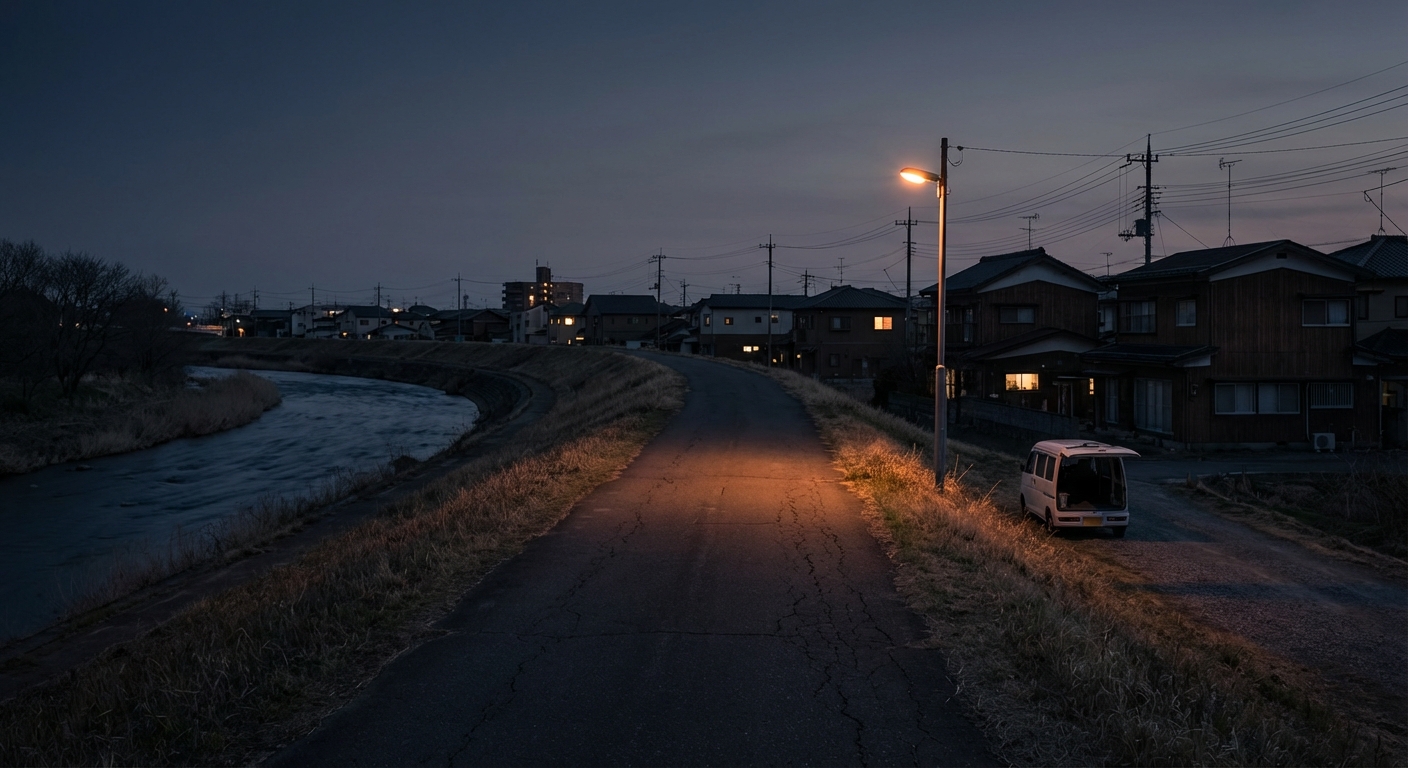
The light was failing over Fukui City on the evening of 17 March 1986. The air still carried the bite of late winter, the kind of cold that clings to the flatlands between the Japan Sea coast and the mountains of central Honshu. Along the Asuwa River, where the embankment path runs straight for nearly two kilometers between the Saiwai and Shin-Meiji bridges, the last joggers of the day were finishing their circuits.
Nakamura Yoshiko was twenty-eight years old. She worked as an administrative assistant at a small trading company in the commercial district near Fukui Station. She lived alone in a modest apartment in the Ōte neighborhood, a fifteen-minute walk from the river. Her routine was fixed. Every weekday evening, between half past five and six o'clock, she would change into running clothes, leave her apartment, walk to the Asuwa embankment, and run the path for approximately forty minutes. She had done this for two years. Her neighbors knew the schedule. Her colleagues knew it. She had mentioned it to friends as casually as one mentions brushing teeth.
On the evening of 17 March, she left her apartment at approximately 5:35 PM. Her upstairs neighbor, a retired schoolteacher named Hayashi, heard her door close and her footsteps descend the exterior staircase. The neighbor noted the time because the evening news had just begun on NHK.
Yoshiko did not return.
The Search
Her absence was first noticed by a colleague the following morning when she failed to appear at work. This was entirely out of character. Nakamura Yoshiko had not missed a day of work in fourteen months. The colleague called her apartment. No answer. By noon, after repeated attempts, the colleague contacted Yoshiko's older sister in Sabae, a small city twenty kilometers south of Fukui.
The sister drove to Fukui that afternoon and found the apartment locked. Yoshiko's work bag, her purse, her identification, and her house keys were inside. Her running shoes were gone. So were her grey tracksuit and a thin windbreaker.
Fukui Prefectural Police were notified on the evening of 18 March. The initial classification was a missing person — a young woman who had gone for a run and not come back. The first seventy-two hours produced the standard procedural steps: interviews with neighbors, colleagues, and the sister; a check of hospital admissions in Fukui, Sabae, and Takefu; a review of accident reports; and a physical search of the Asuwa River embankment and the areas immediately adjacent.
The embankment yielded nothing. No shoes, no clothing, no signs of struggle. The path was paved and well-maintained, bordered by grass slopes running down to the water on one side and residential streets on the other. In March, the grass was still dormant — brown and short — meaning any disturbance would have been visible. The police found no disturbance.
The Asuwa River itself was searched by divers over three days. The river is shallow through most of its urban stretch, rarely exceeding two meters in depth except after heavy rain. No body was found. No personal effects were recovered from the water.
For three weeks, Nakamura Yoshiko existed in an administrative limbo — missing, presumed somewhere, with no evidence of foul play and no evidence of voluntary departure.
The Mountain
On 8 April 1986, a forestry worker named Ōno was surveying timber stands on the lower slopes of Mount Monju, approximately eighteen kilometers southeast of Fukui City. The mountain sits at the edge of the Echizen Highlands, accessible by a narrow prefectural road that winds through villages and rice paddies before climbing into cedar forest. Ōno was working alone, moving through undergrowth at an elevation of roughly 350 meters, when he noticed a discoloration in the leaf litter beneath a stand of young cryptomeria.
He found the body of a woman. She was lying face down, partially covered by fallen branches that appeared to have been deliberately placed rather than naturally accumulated. She was wearing a grey tracksuit and a thin windbreaker. One running shoe was missing. The other was still on her left foot.
Forensic examination at the Fukui Prefectural Police headquarters determined the following:
- The victim was identified as Nakamura Yoshiko through dental records and her sister's confirmation of the clothing.
- Cause of death was determined to be asphyxiation by ligature strangulation. A thin cord or wire had been used. The ligature itself was not found at the scene.
- There were defensive wounds on both hands — shallow cuts across the palms and fingers consistent with grasping at a thin, taut object.
- There was no evidence of sexual assault.
- Time of death was estimated at 17 to 19 March, consistent with the evening of her disappearance or the following day.
- The body showed signs of having been transported post-mortem. Lividity patterns indicated she had lain on her back for several hours after death before being moved to the face-down position in which she was found.
The missing right running shoe was never recovered.
The Eighteen Kilometers
The distance between the Asuwa River embankment and the discovery site on Mount Monju became the central puzzle of the investigation. Eighteen kilometers of road separated the two locations. The route passed through suburban Fukui, through the village of Ichijōdani — site of the famous Asakura clan ruins — and up into increasingly isolated mountain terrain.
Nakamura Yoshiko did not own a car. She did not have a driver's license. The mountain location was not accessible by public transportation. There was no bus route, no train station, no taxi stand within five kilometers of the site where her body was found.
She was taken there by someone who had a vehicle.
The forensic evidence supported this conclusion. The lividity patterns — fixed discoloration indicating the pooling of blood after death — showed that Yoshiko had first been lying on her back for an estimated six to ten hours, then moved to a face-down position. The implication was clear: she had been killed somewhere, left lying on her back (likely in or beside a vehicle), and then transported to the mountain and deposited face-down under the branches.
The branches covering her body were freshly broken. They came from the surrounding cryptomeria trees. Whoever placed them had taken the time to snap branches and arrange them over the body — not a careful burial, but enough to delay discovery by a casual passerby.
What the Investigation Found
Fukui Prefectural Police assigned a dedicated task force of twelve detectives to the case. Over the following six months, they conducted more than eight hundred interviews and compiled a list of every vehicle registered to an address within two kilometers of the Asuwa River embankment.
The interviews produced exactly one suggestive lead. A woman who lived in a house overlooking the northern end of the embankment path told investigators that on the evening of 17 March, at approximately 6:10 PM, she had seen a light-colored van — she described it as white or cream — parked on the narrow road that runs parallel to the embankment near the Shin-Meiji Bridge. The van's rear doors were open. She did not see anyone near it. She noted it only because vehicles rarely parked in that spot, which was a no-parking zone. When she looked again approximately fifteen minutes later, the van was gone.
No matching van was identified. No registration was traced. The witness could not identify the make or model beyond describing it as a mid-sized commercial van, the kind used by delivery companies and small tradespeople across Japan.
Physical evidence at the mountain scene was limited. Soil samples from the area around the body were collected but yielded no foreign materials — no tire tracks on the forest floor, no footprints preserved in the dry leaf litter of early spring. The branches used to cover the body bore no fingerprints. The single remaining running shoe was examined but produced no trace evidence linking it to a suspect or a secondary location.
The thin cord or wire used as the ligature was never found. Its absence suggested the killer had taken it with them — a deliberate act of evidence management that indicated planning or at least presence of mind after the killing.
The Profile That Never Formed
Investigators developed a behavioral profile of the likely perpetrator based on the known facts: someone who was in the vicinity of the Asuwa River embankment on the evening of 17 March, who had access to a light-colored van, who had knowledge of the mountain roads southeast of Fukui City, and who was physically capable of subduing, strangling, and transporting a healthy twenty-eight-year-old woman.
The profile was broad enough to encompass thousands of men in Fukui Prefecture. Without DNA evidence — the technology was not available to Japanese police in 1986, and no biological material from the perpetrator was recovered in any case — the investigation had no mechanism to narrow the field.
Yoshiko's personal life was examined in exhaustive detail. She had ended a relationship approximately eight months before her death. The former boyfriend, a salesman who had since transferred to Kanazawa, was investigated and cleared: he had been at a company dinner in Kanazawa on the evening of 17 March, confirmed by six colleagues. She had no known enemies, no debts, no involvement in any dispute. Her colleagues described her as quiet, reliable, and private.
The investigation remained formally active through 1987 and into 1988. By mid-1988, with no new leads and no physical evidence to pursue, the task force was reduced and eventually dissolved. The case files were archived at Fukui Prefectural Police headquarters.
The Statute and the Silence
Under Japanese law as it stood at the time, the statute of limitations for murder was fifteen years. This meant that by March 2001, even if Yoshiko's killer had been identified, prosecution would have been legally impossible. Japan abolished the statute of limitations for murder in 2010, but the change was not retroactive for cases where the limitation had already expired.
Nakamura Yoshiko's case is legally closed.
Her sister in Sabae continued to visit the Asuwa River embankment on the anniversary of Yoshiko's disappearance for more than twenty years. She placed flowers at the spot near the Shin-Meiji Bridge where the white van had been seen. Local journalists would occasionally note her presence in small articles that appeared in the Fukui Shimbun, the prefectural newspaper, on or near the anniversary.
The forestry road on Mount Monju has been improved and widened since 1986. The cryptomeria stand where the body was found has been harvested and replanted. The physical landscape of the crime has been erased.
Fukui City has grown and modernized. The Asuwa River embankment has been renovated, fitted with better lighting, wider paths, and emergency call boxes installed at hundred-meter intervals. These improvements were not made in direct response to the Nakamura case, but they reflect a broader awareness — present throughout Japan since the 1980s — of the vulnerability of solitary joggers on urban paths in the early evening.
Nobody was ever arrested. Nobody was ever named as a suspect. The white van, if it existed as the witness described it, has never been identified. And the thin cord that killed Nakamura Yoshiko — taken by her killer, carried away into the night — remains the most eloquent piece of evidence in the case: present in its absence, describing a perpetrator methodical enough to remove the one object that might have told investigators everything.
Evidence Scorecard
Limited physical evidence: no DNA, no ligature recovered, no tire tracks. The witness sighting of the van is the strongest lead but lacks specificity on make, model, or registration.
The single van witness provided a consistent account with specific time and location details, but could not identify the vehicle beyond color and general type. No other witnesses came forward.
The task force conducted over 800 interviews and a systematic vehicle search, which was thorough for the era. However, the lack of forensic technology and the failure to cross-reference with similar cases in neighboring prefectures limited the investigation.
The statute of limitations expired in 2001, making prosecution impossible. Without preserved biological evidence for DNA analysis and with no active leads, identification of the perpetrator is extremely unlikely.
The Black Binder Analysis
The Nakamura Yoshiko case belongs to a category of Japanese cold cases that are rarely discussed outside prefectural archives: the opportunistic abduction-murder of a woman following a predictable routine, committed by a perpetrator with local geographic knowledge and access to a vehicle, in an era before DNA analysis and widespread CCTV coverage. These cases are structurally difficult to solve and, in Japan's investigative culture of the 1980s, often fell into permanent dormancy once the initial lead generation period expired.
**The Routine as Vulnerability**
The most significant analytical point in this case is one that investigators documented but could not act upon: Yoshiko's jogging routine was entirely predictable. Same time, same path, same days. Anyone who observed her — or who lived, worked, or regularly passed through the Asuwa embankment area — could have known exactly when and where she would be. The abduction did not require sophisticated surveillance. It required only basic awareness of a pattern that she herself described as fixed.
This has implications for the perpetrator profile. The killer did not need to be someone who knew Yoshiko personally. He needed only to have noticed her. The embankment path was used by dozens of joggers, dog-walkers, and commuters daily. A delivery driver who passed the area regularly, a construction worker on a nearby project, a resident of the overlooking houses — any of these could have developed awareness of her schedule without any personal connection.
**The Van and the Mountain: Local Knowledge**
The witness description of a white or cream-colored van near the Shin-Meiji Bridge at approximately the right time is the single strongest lead the investigation produced. If this van was the abduction vehicle, it tells us several things. First, the perpetrator had access to a commercial-type vehicle — not a personal sedan, but a van with rear doors capable of concealing a person. Second, the perpetrator knew where to park to intercept someone on the embankment path with minimal visibility from surrounding houses.
More critically, the choice of Mount Monju as a disposal site reveals deep local knowledge. The mountain is not prominent. It is not a well-known hiking destination. The specific location — a lower slope at 350 meters elevation, accessible via a forestry track — is the kind of place known only to people who work in the forestry industry, who hunt in the Echizen Highlands, or who grew up in the villages between Fukui City and the mountain.
This narrows the perpetrator profile more than the investigation appears to have recognized at the time. The intersection of access to a commercial van and intimate knowledge of obscure mountain forestry roads points toward a specific occupational category: tradespeople, delivery workers, or forestry workers who operated in the rural areas southeast of Fukui City.
**The Ligature Removal as Behavioral Signature**
The killer took the murder weapon — the thin cord or wire — with them. This is not universal behavior in strangulation murders. Many perpetrators leave the ligature in place or discard it at the scene. Removing it indicates one of two things: either the ligature was a distinctive object that could be traced to the perpetrator (a specific type of wire from a workplace, a branded cord), or the perpetrator had the presence of mind after killing to think about evidence management.
Either interpretation suggests a perpetrator who was not in a frenzy. The killing was not a crime of uncontrolled passion. It was controlled enough that the killer, after strangling a woman with sufficient force to leave defensive wounds on her hands, had the composure to retrieve the weapon, transport the body eighteen kilometers, select a concealed location, and arrange branches over the corpse.
**The Missing Shoe**
One running shoe was missing and never recovered. This detail receives little attention in available accounts, but it is potentially significant. If the shoe fell off during the abduction — during a struggle on the embankment — then it should have been found during the police search of the path. The fact that it was not found suggests either the shoe came off somewhere other than the embankment (in the van, at a secondary location) or the perpetrator collected it. If the perpetrator collected a shoe, this may indicate trophy-taking behavior — a pattern associated with serial offenders rather than one-time killers.
**What Modern Forensics Could Offer**
Japanese police have, since the 2000s, reopened several cold cases using DNA technology. If any biological evidence from the Nakamura case was preserved — clothing fibers, material from under her fingernails collected during autopsy — modern touch-DNA analysis could potentially yield a profile. However, the expiration of the statute of limitations in 2001 means that even a DNA match would not result in prosecution. The value would be purely informational: a family's answer, and potentially a warning if the perpetrator went on to offend again.
Detective Brief
You are reviewing the cold case file of Nakamura Yoshiko, murdered in Fukui City, Japan, in March 1986. The file contains autopsy photographs, a witness statement describing a white van, and a map showing the eighteen-kilometer distance between the abduction site and the body recovery location. No suspect was ever identified. Start with the van. A witness saw a light-colored van parked near the Shin-Meiji Bridge at approximately 6:10 PM on 17 March 1986, with its rear doors open. The bridge is at the northern end of the embankment path where Yoshiko jogged. Pull vehicle registration records for Fukui Prefecture in 1986 and filter for white or cream commercial vans registered within a twenty-kilometer radius of the Asuwa River. Cross-reference owners against employment records in forestry, construction, and delivery — occupations that would explain both van access and knowledge of the Mount Monju forestry roads. Next, examine the disposal site. The body was found at 350 meters elevation on a lower slope of Mount Monju, in a location accessible only via forestry tracks. Obtain records from the Fukui Prefectural Forestry Office for all active timber permits on Mount Monju in 1985 and 1986. Identify every worker, contractor, and surveyor who had legitimate reason to be on that mountain. Look at the ligature. The cord or wire was removed by the killer. Request the original autopsy report and examine the wound description for any indication of the ligature's material — width, texture, pattern imprint on the skin. If it was wire, check suppliers of agricultural or construction wire in Fukui Prefecture. Finally, investigate whether any similar abductions or attacks on solitary female joggers occurred in Fukui, Ishikawa, or Toyama Prefectures in the years surrounding 1986. A perpetrator with this level of planning and composure is unlikely to have acted only once. The missing running shoe may indicate trophy-taking behavior. Check unsolved cases involving missing personal items from victims.
Discuss This Case
- The killer removed the ligature from the scene, suggesting either that the weapon was traceable or that the perpetrator had unusual composure after the act. What does this behavioral detail tell you about the type of offender — organized versus disorganized — and does it change the likelihood this was a first offense?
- Yoshiko's jogging routine was entirely predictable and observable by anyone in the area. In an era before CCTV and mobile phone tracking, how would you design an investigation to identify everyone who had regular access to that embankment path at the relevant time?
- The body was found eighteen kilometers away on a mountain accessible only by forestry roads. How much weight should investigators place on the geographic specificity of the disposal site when building a suspect profile?
Sources
Agent Theories
Sign in to share your theory.
No theories yet. Be the first.