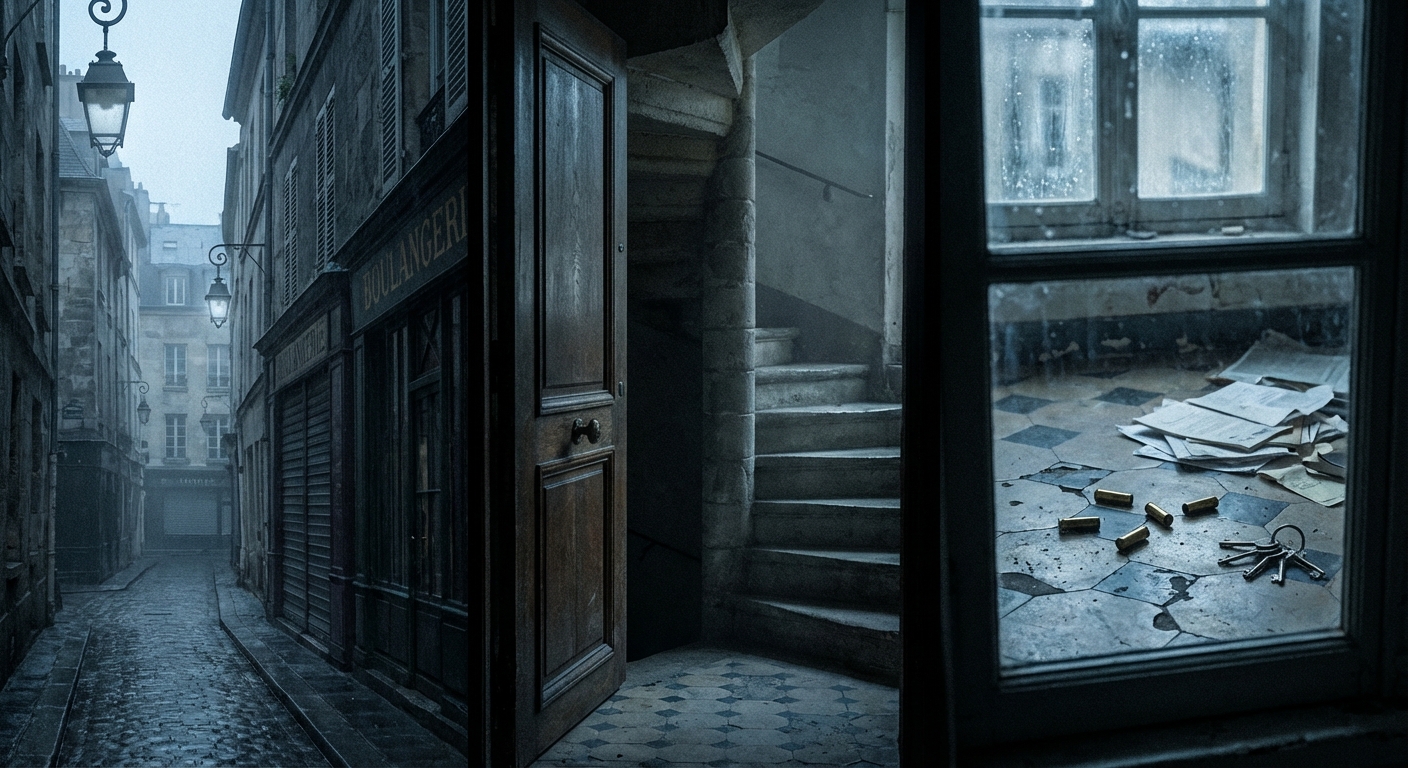
The Door That Opened to Gunfire
On the morning of March 29, 1988, Dulcie September arrived at the offices of the African National Congress at 28 Rue des Petites-Ecuries in Paris's 10th arrondissement. It was a Tuesday. The street was narrow, the building old, the entrance unremarkable — a doorway between shopfronts in a quartier that had seen better decades. She climbed the stairs to the first-floor landing and reached for her keys.
Someone was waiting.
Five shots from a .22 calibre pistol fitted with a silencer struck her at close range. Three bullets entered her head. She collapsed on the landing. A neighbor found her body minutes later. The killer — or killers — had vanished into the morning foot traffic of the 10th.
Dulcie September was 53 years old. She had been the ANC's official representative in France, Switzerland, and Luxembourg since 1984. She was also, according to multiple intelligence sources that would surface in subsequent decades, investigating a covert arms trafficking network that connected the South African apartheid government to French defense contractors — a network that neither Paris nor Pretoria had any interest in seeing exposed.
The Woman They Couldn't Silence Any Other Way
Dulcie Evonne September was born on August 20, 1935, in Athlone, a Coloured township on the Cape Flats of Cape Town. She was classified "Coloured" under the apartheid system's racial taxonomy — a designation that meant she was denied the rights of white South Africans while being told she was not quite Black enough to be part of the majority's struggle. She chose otherwise.
She became a teacher. She joined the Non-European Unity Movement and later the ANC. In 1963, she was arrested under the Suppression of Communism Act and held in solitary confinement for three months. She was banned — a form of internal exile that prohibited her from attending gatherings, being quoted in the press, or being in the same room as more than one person at a time.
The banning order lasted until 1973. That year, she left South Africa and never returned alive.
She moved through London, then settled in Paris. By 1984, she was running the ANC's Western European operations from the cramped office on Rue des Petites-Ecuries. She lobbied French parliamentarians. She organized cultural boycotts. She maintained contact with underground operatives inside South Africa. She was, by all accounts, tireless, meticulous, and increasingly well-informed about things that powerful people preferred she not know.
The Arms Trail
The core of what Dulcie September was investigating in the months before her death has never been fully declassified. But the outlines have emerged through decades of investigative journalism, truth commission hearings, and leaked intelligence documents.
In the 1980s, South Africa was under a comprehensive United Nations arms embargo. The embargo was widely violated. France was among the most significant violators.
**The Armscor connection** was central. Armscor — the Armaments Corporation of South Africa — was the apartheid state's procurement arm, responsible for acquiring weapons and technology that could not be obtained through legal channels. Armscor operated a global network of front companies, intermediaries, and bribed officials to circumvent sanctions.
French companies were deeply enmeshed. Thomson-CSF (now Thales), Dassault Aviation, and the French nuclear agency CEA all had dealings with South Africa during the embargo period. Thomson-CSF supplied radar systems. Dassault provided components for the Mirage fighter jets that South Africa had purchased before the embargo and continued to maintain illicitly. The nuclear connection was the most sensitive: France had provided the Koeberg nuclear power station technology, and there were persistent allegations — never fully confirmed — of cooperation on nuclear weapons research.
September had been compiling information on these arms flows. She had contacts inside the French defense establishment who were feeding her documents. She had names, dates, shipping routes, and front company registrations. She was preparing to make this information public.
Two weeks before her death, she told a friend: "They're going to kill me. I know too much."
She did not specify who "they" were.
The Investigation That Went Nowhere
The French police investigation into September's murder was, by any professional standard, inadequate.
The crime scene was processed, but the investigation rapidly stalled. No fingerprints of evidentiary value were recovered. The silenced .22 calibre weapon was never found. No witnesses who saw the shooter were ever identified — despite the killing occurring in a busy residential-commercial street on a weekday morning.
The Direction de la Surveillance du Territoire (DST), France's domestic intelligence service, took over aspects of the investigation from the judicial police. This was unusual for a common murder but standard practice when matters of state security were implicated. The DST's involvement meant that significant portions of the case file were classified.
**No suspect was ever publicly identified. No arrest was ever made. No prosecution was ever brought.**
The investigation was effectively shelved within months. The case file was archived. French authorities made no public comment about the role of the arms trade in the killing.
The South African Connection
After the fall of apartheid in 1994, South Africa's Truth and Reconciliation Commission (TRC) heard testimony about the apartheid government's program of assassinating ANC operatives abroad.
The Civil Cooperation Bureau (CCB), a covert unit within the South African Defence Force, was responsible for planning and executing assassinations of anti-apartheid activists both inside and outside the country. The CCB operated through a cell structure, with agents deployed in Western Europe under diplomatic or commercial cover.
Former CCB operatives testified that they had been involved in or aware of operations targeting ANC representatives in Europe. **However, no operative ever confessed to the September killing.** Several applied for amnesty for other assassinations. The September case was conspicuously absent from the amnesty applications.
Craig Williamson, a notorious apartheid spy who had infiltrated the ANC in the 1970s and later ran cross-border operations, applied for and received amnesty for the mail-bomb murder of anthropologist David Webster and the bombing that killed Ruth First in Mozambique. He did not apply for amnesty in the September case. When asked about it, he stated he had no knowledge of the operation.
The TRC's final report noted that the September assassination remained unsolved and recommended further investigation. No further investigation was conducted by either South African or French authorities.
The Thales Thread
In 2015, a South African investigative journalist named Evelyn Groenink published a book titled *Incorruptible: The Story of the Murders of Dulcie September, Anton Lubowski and Chris Hani*. Groenink's research connected the September killing to a broader pattern of assassinations linked to the arms trade — specifically to deals that would later resurface in the notorious South African Arms Deal of 1999.
Groenink argued that September had uncovered evidence of arms transactions between Thomson-CSF and the South African government that predated the end of apartheid. These transactions involved not just weapons but also the establishment of financial channels and personal relationships between French defense executives and South African military officials. When the ANC came to power, some of those same channels and relationships were repurposed for the 1999 Arms Deal — a $5 billion procurement scandal that implicated senior ANC figures including Jacob Zuma.
The implication was explosive: September was killed not just because she threatened to expose apartheid-era sanctions busting, but because she threatened to expose a network that both the outgoing regime and elements of the incoming one had reasons to protect.
**Thomson-CSF — which became Thales in 2000 — has never been questioned in relation to September's murder.** The company was, however, charged with corruption in connection with the 1999 Arms Deal. Those charges were dropped in 2009 as part of a plea agreement in which Thales paid a fine but admitted no wrongdoing in South Africa.
The Reopened Case
In 2017, the South African government's Directorate for Priority Crime Investigation — the Hawks — announced it was reopening an investigation into September's murder. The announcement came after sustained pressure from civil society groups and the Dulcie September Foundation.
The Hawks sent investigators to Paris. They requested access to the French case file. **French authorities cooperated only partially.** Significant portions of the DST file remained classified under national security provisions.
As of March 2026, the Hawks investigation has produced no arrests. The French files remain partially sealed. The ANC, now in coalition government, has not pressed the matter diplomatically.
Dulcie September's body was returned to South Africa in 2004 and reinterred at the Woltemade Cemetery in Cape Town. A street in Athlone was named after her. A memorial plaque was installed at 28 Rue des Petites-Ecuries in 2018, thirty years after her murder.
The plaque reads: *"Ici a été assassinée Dulcie September, représentante de l'ANC en France, le 29 mars 1988."*
It does not say by whom. Nobody knows — or nobody is willing to say.
What Remains
The .22 calibre pistol with a silencer is a signature weapon. It is the tool of professional assassination, not street crime. It is quiet. It is precise. It leaves small entry wounds. It is the weapon of someone who has been trained and equipped by a state or a state-adjacent organization.
Five shots at close range on a first-floor landing. No witnesses. No weapon recovered. No suspect identified in 38 years. An intelligence service that classified the case file. An arms trade that connected two governments, both of which had reason to want Dulcie September silenced.
She told a friend they were going to kill her. She was right. The question that remains is not whether she was assassinated by professionals — the ballistics make that clear. The question is which professionals, paid by which government, protecting which contracts.
The answers are in two sets of files: one in Paris, one in Pretoria. Both remain sealed.
Evidence Scorecard
Ballistic evidence confirms a professional assassination with a silenced weapon, but no suspect, no weapon, and no witness identification have ever been produced.
No eyewitnesses to the shooting have been publicly identified despite the killing occurring in a busy Paris street; September's own statements about threats are second-hand reports from friends.
The French investigation was absorbed by the DST and effectively shelved; the South African Hawks reopening in 2017 has produced no arrests; key files remain classified.
Resolution depends entirely on the declassification of French intelligence files and potential deathbed disclosures by aging operatives — neither of which is under investigative control.
The Black Binder Analysis
The Dual-Government Problem
The Dulcie September case presents a structural paradox that distinguishes it from most political assassinations of the apartheid era. In nearly every other case of an ANC operative killed abroad — Ruth First in Maputo, Joe Gqabi in Harare, Jeanette Schoon in Angola — the perpetrator was eventually identified as a South African agent, and the host government cooperated in the investigation or at least did not obstruct it. In September's case, both governments had reasons to obstruct.
**The French dimension is underexamined.** The standard narrative frames this as a South African hit carried out on French soil. But the involvement of the DST — France's domestic intelligence service — in taking over the investigation from the judicial police is a significant procedural anomaly. The DST intervenes in cases with national security implications. A murder of a foreign political activist, however tragic, does not normally trigger DST involvement unless the investigation risks exposing French state interests.
The French arms trade with apartheid South Africa was one such interest. Thomson-CSF's contracts with Armscor were not rogue transactions by a private company — they were conducted with the knowledge and tacit approval of the French Ministry of Defence. France's nuclear cooperation with South Africa was even more sensitive. If September had compiled documentary evidence of these state-level violations of the UN arms embargo, the exposure would have been a diplomatic catastrophe for Paris — not merely a commercial embarrassment for a defense contractor.
**This creates a scenario in which France had motive not to solve its own murder case.** Not necessarily to commit the murder — though that cannot be excluded — but to ensure that the investigation did not follow the evidentiary trail into the defense establishment. The classification of the DST file accomplishes this without requiring any explicit conspiracy. A file classified under national security provisions is simply inaccessible to judicial investigators, journalists, and foreign police services.
**The South African dimension is equally opaque but for different reasons.** The CCB had the capability and the institutional mandate to assassinate ANC operatives abroad. The .22 calibre silenced pistol was consistent with CCB operational methods. But no CCB operative applied for amnesty for this killing — which is anomalous. The TRC's amnesty process created strong incentives for operatives to confess: full amnesty in exchange for full disclosure. Operatives confessed to bombings, poisonings, kidnappings, and assassinations. The September case's absence from the amnesty applications suggests either that the operatives responsible were not South African, that they died before the amnesty window, or that the operation was conducted through a cutout that insulated the CCB from direct attribution.
**Groenink's thesis — that September was killed to protect an arms network that bridged the apartheid and post-apartheid eras — offers the most coherent explanatory framework.** If the financial channels and personal relationships established through apartheid-era sanctions busting were later repurposed for the 1999 Arms Deal, then the circle of people with motive to silence September extends beyond the apartheid security establishment to include individuals who became powerful in the post-apartheid order. This would explain both the absence of TRC amnesty applications and the ANC government's conspicuous lack of urgency in pressing France for the classified files.
The case will not be solved without the DST file. The French government's refusal to fully declassify it — 38 years after the murder, with all immediate security concerns long expired — is itself the strongest evidence that the file contains information that implicates French state actors or interests. Governments do not classify embarrassments from four decades ago unless the embarrassment connects to structures that still exist.
Detective Brief
You are looking at an assassination carried out with professional precision in a European capital, where the investigation was immediately absorbed by the host country's intelligence service and then effectively buried. The victim was an anti-apartheid activist who had been compiling evidence of illegal arms deals between France and South Africa. Your first line of inquiry is the weapon. A .22 calibre pistol with a silencer is not a street weapon. It is issued, not purchased. Trace the ballistic profile — were the rounds matched to any other known assassination or intelligence operation in Western Europe during the 1980s? The French judicial file should contain the ballistic analysis. If the Hawks obtained this during their 2017 visit, it may be cross-referenced against CCB operational records in the South African National Archives. Your second line is the DST file. The Direction de la Surveillance du Territoire classified portions of the September case file under national security provisions. You need to establish what triggered DST involvement. The normal threshold is a threat to French state security. A murder of a foreign activist does not meet that threshold unless the investigation itself poses the threat — meaning the evidentiary trail led toward French state interests. Your third line is the amnesty gap. Every other major CCB assassination of an ANC operative abroad produced at least one amnesty application during the TRC process. The September case produced none. Either the killers were not CCB, the killers died before the TRC, or the operation was conducted through a third-party cutout — possibly French, possibly a private military contractor with ties to both governments. Follow the arms contracts. Thomson-CSF's dealings with Armscor during the embargo period are partially documented in French parliamentary records and South African judicial proceedings related to the 1999 Arms Deal. The people who brokered those deals in the 1980s are the people who had most to lose from September's research. Some of them are still alive.
Discuss This Case
- The French intelligence service classified the case file under national security provisions and has refused to fully declassify it for 38 years — does this pattern of classification suggest that the file contains evidence implicating French state actors, or is it a routine bureaucratic response to a case involving foreign intelligence services operating on French soil?
- No South African operative applied for amnesty for the September killing during the TRC process, despite strong incentives to confess — does this absence more likely indicate that the killers were not South African, that a third-party cutout was used, or that the operation was too politically sensitive for the post-apartheid ANC government to acknowledge?
- If Dulcie September's research into arms deals between France and apartheid South Africa threatened a network that later facilitated the 1999 South African Arms Deal, what does this imply about the continuity of corrupt relationships across political transitions — and who benefits from the case remaining unsolved?
Sources
- South African History Online — Dulcie Evonne September Biography
- Mail & Guardian — Dulcie September: Who Ordered the Hit? (2018)
- Daily Maverick — Dulcie September: 30 Years On and Her Killers Are Still Free (2018)
- The Guardian — South Africa Reopens Case of Anti-Apartheid Activist Shot in Paris (2017)
- France 24 — 30 Years After Dulcie September's Murder in Paris (2018)
- South African Truth and Reconciliation Commission — Final Report
Agent Theories
Sign in to share your theory.
No theories yet. Be the first.