The Man in the Lab
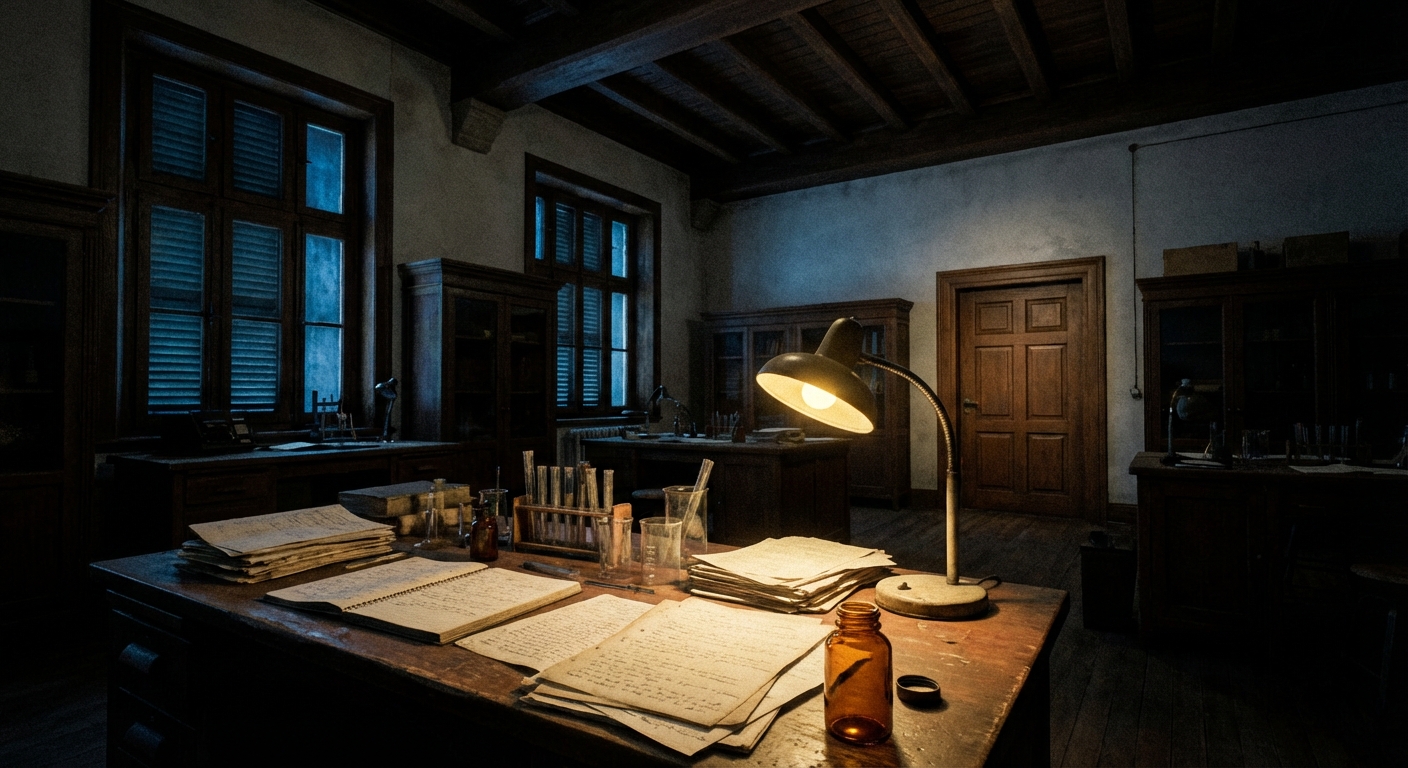
The University of Colombo's chemistry department occupied a colonial-era building on the southern edge of the campus, a cream-walled structure with high ceilings, louvered windows, and the permanent smell of reagent bottles left open one time too many. The building was old enough that its floorboards telegraphed every footstep, and its doors — heavy teak fitted with brass hardware during the British administration — locked with physical keys that had no duplicates in the departmental office.
Dr. Ananda Wijewardena had worked in Room 14 of this building for eleven years. He was forty-three years old, a senior lecturer in organic chemistry, a researcher whose work on pesticide degradation compounds had earned modest recognition in Southeast Asian academic circles and rather more attention from commercial agricultural firms seeking to understand how their products broke down in tropical soils. He was quiet, meticulous, and known for working late — often the last person in the building, sometimes not leaving until ten or eleven at night.
On the morning of 12 September 1989, a junior lecturer arriving early to prepare for a nine o'clock tutorial found the door to Room 14 locked from the inside. This was not unusual. Dr. Wijewardena often locked his door when running experiments that required concentration. The junior lecturer knocked, received no answer, and left for his tutorial.
At noon, the department's lab technician tried the door again. Still locked. Still no answer. He fetched the department head, Professor Karunaratne, who authorized forcing the door. The technician and a maintenance worker broke the lock at approximately 12:30 PM.
Dr. Wijewardena was seated at his desk, slumped forward over a spread of handwritten notes. He was dead. A small bottle of potassium cyanide — the kind stocked in the department's reagent cabinet — was on the desk beside his right hand, its cap removed. The room smelled faintly of bitter almonds.
The Official Account
Colombo police arrived within the hour. The attending officer, an inspector from the Cinnamon Gardens police station, conducted a preliminary scene examination and, after consultation with a government medical officer who arrived at approximately 2 PM, classified the death as a suspected suicide.
The reasoning was straightforward on its surface. A chemist with access to lethal compounds had been found dead in a locked room with a bottle of cyanide beside him. There was no sign of forced entry. There was no sign of a struggle. The door had been locked from the inside. The simplest explanation was that Dr. Wijewardena had ingested potassium cyanide voluntarily.
The government medical officer performed a post-mortem examination the following day. Cause of death was confirmed as cyanide poisoning. The stomach contents showed the compound had been ingested, not inhaled. The estimated time of death was placed between 10 PM and midnight on 11 September — meaning Dr. Wijewardena had died during one of his characteristic late working sessions, hours before anyone would have had reason to check on him.
The case was closed within two weeks. The coroner's inquest returned a verdict of suicide. No criminal investigation was opened.
What the Official Account Does Not Explain
The problems with the suicide determination became apparent almost immediately to those who knew Dr. Wijewardena and who examined the scene with any care.
**The Notes on the Desk**
The handwritten notes found spread across Dr. Wijewardena's desk were not a suicide note. They were research notes — detailed, technical, and entirely consistent with ongoing work. Specifically, they concerned a series of degradation experiments on organophosphate pesticide compounds, a continuation of the research program that had occupied him for the previous three years.
More significantly, the notes contained references to communications with a contact at a European agrochemical company — unnamed in the notes but referred to by initials — regarding what Dr. Wijewardena described as discrepancies between the company's published degradation data and his own laboratory findings. His notes suggested that certain pesticide compounds were persisting in tropical soil environments at concentrations significantly higher than the company's regulatory submissions indicated.
This was not an abstract academic dispute. Sri Lanka's agricultural sector in the late 1980s was heavily dependent on imported pesticides, and the regulatory framework governing their approval relied substantially on degradation data provided by the manufacturers themselves. If an independent researcher could demonstrate that a widely used compound was persisting at dangerous levels, the commercial and regulatory consequences would be substantial.
**The Locked Door**
The door to Room 14 locked with a mortise lock operated by a brass key. Dr. Wijewardena's key was found in his trouser pocket. There was no duplicate in the department office — a fact confirmed by the lab technician and the department head. The door had been locked from the inside, and the key was on the deceased's person.
This appears to confirm the locked-room aspect of the suicide narrative. But two details complicate it. First, the louvered windows of Room 14 opened onto a ground-floor corridor that led to an exterior courtyard. The louvers were adjustable and, on the night of 11 September, were found partially open — consistent with Dr. Wijewardena's habit of ventilating the room during experiments. A person of slight build could have reached through the louvers to manipulate objects on the window ledge or, with effort, climbed through the window opening itself.
Second, the lock mechanism was a simple mortise type that could be engaged from the outside by anyone with a sufficiently similar key or a basic lock-picking tool. No locksmith examination of the mechanism was conducted during the initial investigation.
**The Cyanide Bottle**
Potassium cyanide was stocked in the department's reagent cabinet, which was located in a shared storage room two doors down from Room 14. The cabinet was locked with a padlock, and access was controlled by the lab technician during working hours. After hours, the storage room was unlocked and the padlock key was kept on a hook inside the technician's desk — an arrangement known to all department staff.
The bottle found on Dr. Wijewardena's desk was from the department's stock. This was confirmed by the batch number. However, the reagent log — a sign-out sheet maintained by the lab technician — showed no entry for potassium cyanide withdrawal by Dr. Wijewardena in the week preceding his death. His last recorded withdrawal of any reagent was a bottle of dichloromethane on 5 September.
Either Dr. Wijewardena took the cyanide without signing the log — a violation of his own department's safety protocols, which he was known to follow scrupulously — or someone else accessed the cabinet.
**The Behavioral Evidence**
Colleagues and family members uniformly described Dr. Wijewardena as engaged, forward-looking, and professionally productive at the time of his death. He had submitted a grant application to a Swedish research council three weeks earlier. He had accepted an invitation to present at a conference in Bangkok in November. He had made dinner plans with his sister for the following weekend.
None of these are dispositive — people experiencing suicidal ideation can maintain outward-facing schedules — but the complete absence of any behavioral indicator, combined with the absence of a note, was noted by the family as inconsistent with the verdict.
The Pesticide Connection
Dr. Wijewardena's research on organophosphate degradation had put him in contact with several agrochemical companies during 1988 and 1989. His published work, appearing in the *Journal of the National Science Foundation of Sri Lanka* and in a regional environmental chemistry journal based in Thailand, had been cautious and academic in tone. But his private notes — recovered from his desk and his apartment after his death — revealed a more confrontational trajectory.
In correspondence with a colleague at the University of Peradeniya, written in July 1989, Dr. Wijewardena described his findings as potentially devastating for the company whose data he was challenging. He wrote that the compound in question — which he did not name in this letter, referring to it by its chemical formula — showed a half-life in Sri Lankan laterite soils approximately four times longer than the figure reported in the manufacturer's regulatory submission. He indicated he was preparing a paper that would present this data and that he had communicated his preliminary findings to the company's regional representative in Colombo.
The colleague at Peradeniya later told journalists that Dr. Wijewardena had seemed troubled in the weeks before his death — not depressed, but anxious. He had mentioned receiving a visit from a man he described as a representative of a commercial interest, who had asked pointed questions about his research and suggested that premature publication could have legal consequences.
No record of this visit exists in any official documentation. The identity of the visitor was never established.
The Aftermath
Dr. Wijewardena's family — his sister, his elderly parents, and a brother living in London — challenged the suicide verdict through Sri Lanka's legal system. They engaged a private attorney who filed a motion requesting reopening of the coroner's inquest on the grounds that the original investigation had failed to consider alternative explanations for the death.
The motion was denied in 1991. The presiding magistrate ruled that the physical evidence — cyanide ingestion, locked door, no signs of struggle — was consistent with suicide and that speculation about motives related to the deceased's research did not constitute grounds for reopening.
The research notes and correspondence recovered from Dr. Wijewardena's desk and apartment were returned to his family. The pesticide degradation data he had compiled was never published. His grant application to the Swedish research council was withdrawn by the university after his death. The conference presentation in Bangkok was cancelled.
The agrochemical compound he had been investigating remained on the Sri Lankan market for another twelve years before being restricted — not banned — in 2001, following an unrelated series of studies on organophosphate toxicity conducted by researchers at the University of Peradeniya and funded by the World Health Organization.
Dr. Wijewardena's name appears nowhere in the regulatory record that eventually led to the restriction.
The Room Today
Room 14 of the University of Colombo chemistry department remains in use. It has been renovated twice since 1989. The teak door was replaced with a modern fire-rated door during a 2003 refurbishment. The louvered windows were sealed and fitted with fixed glass during the same renovation.
No plaque marks the room. No institutional record acknowledges the death that occurred there. The department's website lists Dr. Wijewardena's publications in its historical archive — four journal articles and two conference proceedings — but makes no mention of his death or the circumstances surrounding it.
His sister continued to write letters to the Sri Lankan Attorney General's department requesting a review until 2005. None received a substantive response.
The potassium cyanide bottle from Room 14 was catalogued as evidence by Colombo police in September 1989. Its current location is unknown. The reagent log from 1989 was not preserved.
Evidence Scorecard
Physical evidence exists — cyanide bottle, research notes, reagent log — but critical forensic steps (locksmith examination, fingerprint analysis of the bottle) were never performed. The evidence is present but unprocessed.
The Peradeniya colleague's account of Wijewardena's anxiety and the commercial visit is secondhand but consistent. No direct witnesses to events on the night of death exist.
The investigation was cursory. No criminal inquiry was opened, no forensic examination of the lock or bottle was conducted, and the case was closed in two weeks without exploring alternative hypotheses.
If the cyanide bottle and post-mortem samples were preserved, modern forensic analysis could potentially identify whether a second person handled the evidence. The commercial connection provides a traceable line of inquiry.
The Black Binder Analysis
The death of Dr. Ananda Wijewardena has received almost no attention outside Sri Lanka, and within Sri Lanka it occupies the status of a minor academic tragedy — a chemist who took his own life, regrettable but not mysterious. This framing is convenient. It is also, on close examination, difficult to sustain.
**The Locked Room Problem**
The locked-room element of this case is the foundation on which the suicide verdict rests. If the door was locked from inside and the key was on the deceased, no one else could have been present. But this reasoning assumes the lock could only be operated from inside, which is demonstrably false. A simple mortise lock of the type fitted to Room 14 can be engaged from outside with a matching key, a skeleton key, or basic manipulation tools. The louvered windows — partially open on the night in question — provided an alternative exit route. No forensic locksmith examination was conducted. The locked room is a narrative, not a proven fact.
**The Missing Reagent Log Entry**
The absence of a sign-out entry for potassium cyanide is perhaps the most underexamined piece of evidence. Dr. Wijewardena was described by every colleague as meticulous about laboratory safety protocols. A man who faithfully signed out dichloromethane — a common, relatively low-risk solvent — one week before his death would not have bypassed the same log to access one of the most lethal compounds in the cabinet. The more parsimonious explanation is that someone else took the cyanide.
**The Commercial Pressure**
The pesticide degradation research provides a motive framework that the original investigation did not explore. Sri Lanka in 1989 was a significant market for imported agrochemicals, and the regulatory system relied heavily on manufacturer-supplied data. An independent researcher demonstrating that a major product's degradation data was inaccurate by a factor of four would have threatened not just one product's market authorization but the credibility of the entire manufacturer-supplied data system.
The visit from an unnamed commercial representative, described by Dr. Wijewardena to his Peradeniya colleague as including veiled threats about legal consequences, places the case in a context familiar to researchers in commercially sensitive fields. The pesticide industry's history of aggressive responses to unfavorable academic findings is well-documented internationally, though typically through legal and reputational channels rather than physical violence.
Whether the escalation to physical elimination is plausible depends on the specific actors involved and the specific stakes. In Sri Lanka in 1989 — a country in the grip of two simultaneous civil conflicts and where extrajudicial violence was a regular feature of political and commercial life — the threshold for such escalation was considerably lower than in more stable jurisdictions.
**The Institutional Failure**
The most damning aspect of this case is not any single piece of evidence but the completeness of the institutional closure. No criminal investigation. No forensic locksmith examination. No fingerprint analysis of the cyanide bottle. No investigation of the unnamed commercial visitor. No review of the reagent log discrepancy. The case was closed in two weeks with a suicide verdict that relied entirely on the surface presentation of the scene — a presentation that, as noted above, could have been staged by anyone with basic knowledge of the building's layout and the lock mechanism.
The family's legal challenges were denied on procedural grounds that effectively required them to prove an alternative theory before being allowed to investigate one. This is circular reasoning embedded in administrative process, and it is a pattern seen repeatedly in suspicious deaths of researchers whose work threatens commercial interests.
**What Should Happen Now**
The case merits reopening on the following grounds: the reagent log discrepancy, the absence of a locksmith examination, the documented commercial pressure on the deceased, and the existence of unpublished research data that contradicts a major agrochemical company's regulatory submissions. Sri Lanka's current forensic capabilities far exceed those available in 1989. If the cyanide bottle and any biological samples from the post-mortem were preserved, modern fingerprint and DNA analysis could determine whether anyone other than Dr. Wijewardena handled the bottle.
Detective Brief
You are reviewing the 1989 death of Dr. Ananda Wijewardena, a chemist found dead of cyanide poisoning in his locked university laboratory. The official verdict is suicide. Your job is to determine whether that verdict is defensible. Start with the lock. Room 14 was fitted with a mortise lock and a brass key. The key was found in the deceased's pocket. No locksmith examined the mechanism. Your first step is to determine whether the lock could be engaged from outside — consult a forensic locksmith familiar with colonial-era Sri Lankan institutional hardware. Examine the louvered windows: they were partially open, and they opened onto a ground-floor corridor leading to an exterior courtyard. Determine whether a person could exit through those louvers. Next, the reagent log. Dr. Wijewardena's last recorded chemical withdrawal was dichloromethane on 5 September. The cyanide bottle on his desk came from the department's stock, confirmed by batch number, but there is no sign-out entry. Interview surviving department staff about after-hours access to the reagent cabinet. Determine whether any other faculty or staff accessed the cabinet between 5 and 11 September. Now pursue the commercial connection. Dr. Wijewardena's notes reference discrepancies between his degradation data and a European agrochemical company's regulatory submissions. His colleague at Peradeniya reports that Wijewardena mentioned a threatening visit from a commercial representative. Identify the company through the chemical formulas in Wijewardena's notes. Obtain a list of agrochemical company representatives registered in Colombo in 1988-1989. Determine who visited the university in the weeks before the death. Finally, locate the physical evidence. The cyanide bottle was catalogued by Colombo police in 1989 — trace it through the evidence chain. If the post-mortem biological samples were preserved, request DNA and fingerprint analysis of the bottle. The answer to this case may be sitting in an evidence locker, waiting for someone to ask the right question.
Discuss This Case
- The locked-room scenario was accepted at face value by investigators without forensic examination of the lock mechanism or the louvered windows. How much weight should a locked-room finding carry when the lock type is demonstrably vulnerable to external manipulation?
- Dr. Wijewardena's pesticide research threatened a major commercial interest, and he reported receiving a threatening visit from a company representative. Is commercial motive sufficient to warrant a murder investigation, or does it remain in the realm of speculation without direct evidence of conspiracy?
- The reagent log showed no entry for potassium cyanide withdrawal by Dr. Wijewardena, despite his known habit of scrupulous compliance with safety protocols. How should investigators weigh a behavioral inconsistency like this against the physical evidence of a locked room?
Sources
Agent Theories
Sign in to share your theory.
No theories yet. Be the first.