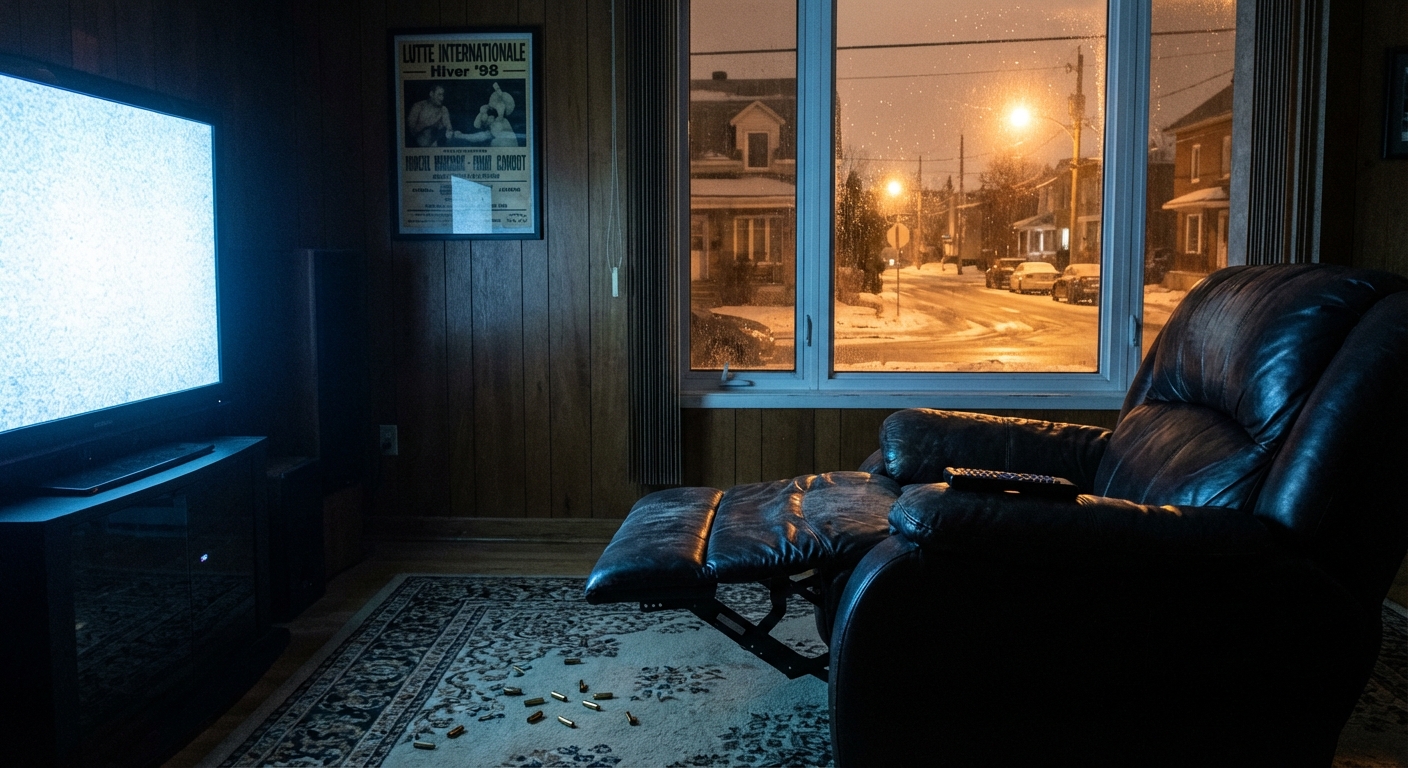
The Remote Control
The television is tuned to the Montreal Canadiens game. The remote control is still in his right hand. This detail is important. It tells you something about the last seconds of Adolfo Bresciano's life — that he was sitting in his favourite chair, watching his team, in the house in Laval, Quebec, that he had earned through a career built on equal parts athletic spectacle and criminal enterprise. He was relaxed. He trusted whoever came through the door.
Seventeen bullets. Seven to the head. Ten to the torso. No sign of forced entry. No defensive wounds. No struggle. The forensic evidence is unambiguous: Dino Bravo, the man who had once lifted the heaviest bench press in professional wrestling history in front of fifteen thousand people at the Royal Rumble, never got out of his chair.
It is March 10, 1993. The Canadiens are playing. The remote is in his hand. And the man who knew where the cigarettes went, where the cocaine was stored, and who in Montreal's underworld owed what to whom is dead on his living room floor.
The Strongman From Verdun
Adolfo Bresciano was born on August 6, 1948, in Verdun, a working-class borough of Montreal with a large Italian-Canadian population. He grew up in the gravitational field of two institutions that defined Italian-Montreal life in the mid-twentieth century: the Catholic Church and the families. The Cotronicrime family controlled much of Montreal's organized crime, and in Verdun, their influence was woven into the fabric of daily life — not as a visible threat but as an ambient reality, like humidity.
Bresciano was a natural athlete, massive and quick. He began training as a wrestler in Montreal's thriving local circuit and adopted the ring name Dino Bravo, cultivating a persona as the quintessential Canadian strongman. By the mid-1970s, he was wrestling professionally across North America. By the 1980s, he had reached the World Wrestling Federation — the WWF, now WWE — where he became a mid-card fixture, a heel with a French-Canadian accent and an inflated bench press record that would become one of wrestling's most debated moments.
At the 1988 Royal Rumble, Bravo attempted to bench press 715 pounds, which would have been a world record. The lift was assisted — visibly, on camera — by Jesse "The Body" Ventura. Wrestling is a performance. The bench press was a performance. But Bravo's strength was real enough, and the character it built was profitable. He was a reliable draw, a competent in-ring worker, and a man who understood that professional wrestling was a business where the line between character and person was deliberately blurred.
He retired from active wrestling in 1992. He was forty-four years old. He had a family. He had a house in Laval. And he had a second career that had been running in parallel with his wrestling career for years — one that did not involve turnbuckles.
The Family Connection
Dino Bravo was a nephew by marriage of Vincenzo Cotroni, the patriarch of the Cotroni crime family, one of the most powerful Mafia organizations in Canada. The Cotroni family controlled or influenced gambling, loan-sharking, drug trafficking, and labor racketeering across Quebec. Bresciano's connection to the family was not secret — it was known within the wrestling industry and within Montreal's law enforcement community.
The nature of Bravo's role in the organization evolved over time. Initially, his celebrity status served as cover. A professional wrestler traveling across North America attracts attention, but not the kind of attention that triggers customs inspections. He crossed borders frequently, carried luggage, visited cities where the Cotroni family had contacts. Fellow wrestlers have described him as a courier and an enforcer — a man who collected debts and delivered messages for people who preferred not to use telephones.
By the early 1990s, after his retirement from the ring, Bravo had moved into the cigarette smuggling trade. This was not small-time crime. Cigarette smuggling across the US-Canada border, particularly through the Akwesasne Mohawk Territory that straddles the border between Ontario, Quebec, and New York State, was a multi-million-dollar enterprise. Bravo's celebrity status gave him access and reduced scrutiny. Fellow wrestler Rick Martel later stated that Bravo had confided in him about using his fame to monopolize smuggling routes through the reserves.
The Cocaine Problem
The cigarette smuggling was lucrative but it was not enough. According to multiple accounts from within the wrestling industry and from law enforcement sources, Bravo was attempting to expand into cocaine trafficking in the months before his death. This expansion brought him into a different stratum of organized crime — one with different rules and different consequences for failure.
The specific incident that appears to have sealed Bravo's fate involved a warehouse. According to accounts relayed through wrestling industry sources, Bravo was responsible for a cocaine shipment valued at approximately $400,000. The shipment was stored in a warehouse. It sat there for three days — far longer than planned. On the third day, when the buyer arrived to collect, the police were waiting.
The seizure was catastrophic. Four hundred thousand dollars in product, gone. And someone had to be held responsible.
In the calculus of organized crime, the person responsible for a seized shipment is the person who had custody of it. Bravo had custody. The money was owed. And in the Cotroni family's operational environment, debts of this magnitude were not written off or negotiated. They were collected, or the debtor was eliminated to send a message to anyone else who might be tempted to be careless.
The Execution
The forensic evidence at the crime scene in Laval constructs a clear narrative. Bravo was seated. He was watching television. He was shot at close range, beginning with the torso and finishing with the head. The pattern is consistent with a professional execution — a controlled, deliberate killing by someone who entered the house without force, approached the victim from behind or beside, and fired until the weapon was empty or the job was certain.
There was no sign of forced entry. The door was either unlocked or opened by Bravo himself. This means he either expected his killer or was surprised by someone he trusted enough to admit without suspicion. In the world of organized crime, the latter is more common. Hits are frequently carried out by associates — men the victim has worked with, dined with, done business with.
Seventeen bullets is excessive for a single target. It suggests either a weapon with a high-capacity magazine fired in rapid succession, or multiple weapons. Some accounts have suggested that more than one shooter was involved, but the forensic evidence on this point has never been publicly clarified by the Laval Police Service.
The killer or killers left no physical evidence that has been made public. No weapon was recovered. No fingerprints were reported. The execution was professional, clean, and complete.
The Investigation
The Laval Police Service investigated the murder as an organized crime hit. The connection to the Cotroni family was immediately obvious to investigators, and the cocaine warehouse incident provided a clear motive. But organized crime investigations in Quebec in the early 1990s operated under severe constraints.
The Cotroni family's code of silence — the omerta — meant that potential witnesses within the organization would not cooperate with police. The hitman, if identified, would be protected by the family. And the family itself was in flux: Vincenzo Cotroni had died in 1984, and the organization was undergoing internal power struggles that made it simultaneously more violent and more difficult to penetrate.
No arrest was ever made. No suspect was ever publicly identified. The case remains officially open in the files of the Laval Police Service, but it has been cold for over three decades.
The Wrestling Industry's Silence
Dino Bravo's murder received minimal coverage in the mainstream wrestling media at the time. The WWF issued no statement. Fellow wrestlers who knew about his criminal activities maintained their silence, in part out of fear and in part out of the wrestling industry's deeply ingrained culture of protecting kayfabe — the maintenance of the illusion that what happens in the ring is real and what happens outside the ring is private.
It was not until 2020, when the documentary series Dark Side of the Ring devoted an episode to Bravo's life and death, that the full scope of his criminal activities became widely known outside Quebec. The episode featured interviews with fellow wrestlers, family members, and investigators who had worked the case. The portrait that emerged was of a man trapped between two worlds — the performative violence of professional wrestling and the real violence of organized crime — who discovered too late that only one of those worlds has a script.
Where It Stands
As of 2026, the murder of Dino Bravo remains unsolved. The Laval Police Service has not publicly announced any new leads or developments. The Cotroni crime family has largely dissolved as an independent entity, absorbed into or replaced by other criminal organizations in Quebec. The individuals most likely to have ordered or carried out the hit are now elderly, dead, or imprisoned on other charges.
The house in Laval has changed hands. The wrestling business has moved on. The Canadiens are still playing.
But the image persists: the remote control in the dead man's hand, the television flickering blue light across the body, seventeen bullet holes in a man who made his living pretending to be indestructible and died proving that nobody is.
Evidence Scorecard
Clear forensic evidence of a professional execution — close-range shooting, no forced entry, no struggle — but no weapon was recovered and no physical evidence linking a specific suspect has been made public.
Fellow wrestlers have provided context about Bravo's criminal activities decades after the fact, but no eyewitness to the murder has come forward and the omerta prevents testimony from organized crime insiders.
The Laval Police correctly identified the organized crime context and probable motive, but the code of silence within the Cotroni organization and the wrestling industry prevented the investigation from progressing to an arrest.
The dissolution of the Cotroni family and the passage of time may eventually produce a deathbed confession or cooperating witness, but the primary suspects are aging or deceased and physical evidence is limited.
The Black Binder Analysis
The Two Silences
The Dino Bravo case is bracketed by two distinct cultures of silence, and the interaction between them is what has kept the case cold for over thirty years.
The first silence is the omerta — the Mafia code that prohibits members and associates of organized crime families from cooperating with law enforcement. This silence is well understood and widely documented. It is the reason no insider has ever testified about who ordered the hit on Bravo or who carried it out. In Quebec's organized crime landscape in the early 1990s, the omerta was enforced with lethal consistency. Breaking it meant death — not eventually, but immediately.
The second silence is less obvious but equally consequential: the wrestling industry's culture of kayfabe and mutual protection. Professional wrestlers in the 1980s and early 1990s operated in a closed world with its own codes. Wrestlers who knew about Bravo's criminal activities — and many did — maintained their silence because the wrestling business punished disclosure. Talking about a colleague's real-life problems violated the unwritten contract of the locker room. This was not omerta; it was a professional norm that functioned identically.
The convergence of these two silences created a double seal around the Bravo case. Neither the criminal underworld nor the wrestling world was willing to talk. Investigators were locked out from both directions.
The cocaine warehouse incident deserves more granular analysis than it has received. The standard narrative is that Bravo was careless — that he left the shipment in the warehouse too long and the police found it. But this raises questions. How did the police know to look? Drug warehouses are, by definition, not advertised. A seizure of this specificity — at a particular warehouse, at a particular time — suggests either surveillance or a tip. If it was surveillance, then law enforcement had Bravo under observation before the seizure, and their intelligence files on his activities may contain information relevant to his murder. If it was a tip, the question becomes: who tipped the police? Because in the world of the Cotroni family, a tip that leads to a $400,000 seizure and the subsequent execution of the person responsible looks very much like a setup.
The possibility that Bravo was set up — that the cocaine warehouse seizure was engineered by someone within the organization who wanted Bravo eliminated — has not been publicly explored by investigators. But it fits a pattern. The Cotroni family was in internal turmoil following Vincenzo Cotroni's death. Power struggles within the organization frequently produced exactly this kind of manufactured pretext for elimination: arrange for an associate to fail, then execute them for the failure.
If the warehouse seizure was a setup, then the person who ordered the tip to police and the person who ordered the hit may be the same individual. This narrows the suspect pool considerably — to someone within the Cotroni organization who had the authority to arrange both a police tip and an execution, and who had a motive to remove Bravo from the organization. The Laval Police files, if they contain intelligence on internal Cotroni power dynamics in 1992-1993, may point to this individual.
Detective Brief
You are investigating a professional execution in the context of Montreal organized crime. The victim is a former professional wrestler with documented ties to the Cotroni crime family who was killed in his home with seventeen bullets while watching television. Your first priority is the cocaine warehouse seizure. Determine the source of the intelligence that led police to the warehouse. If it was a wiretap or surveillance operation, the RCMP or Surete du Quebec may have recordings or case files that document Bravo's activities in the months before his death. If it was an informant tip, determine whether the informant was connected to the Cotroni organization — because a tip that leads to a seizure that leads to an execution looks like a manufactured pretext. Your second priority is the internal dynamics of the Cotroni family in 1992-1993. Vincenzo Cotroni died in 1984. The organization was undergoing succession struggles. Identify who controlled the cocaine distribution network that Bravo was attempting to enter, and whether Bravo's expansion into cocaine trafficking was authorized or freelance. An unauthorized expansion into cocaine by a cigarette smuggler would have been seen as both a threat and an insult to whoever controlled that territory. Examine the crime scene mechanics. Seventeen bullets at close range with no forced entry suggests a killer known to the victim. In organized crime hits, the hitter is typically someone from outside the victim's immediate circle — brought in from another city or another family — but admitted to the home by an associate who accompanies them as a trusted face. Identify who in Bravo's circle had access to his home and who was seen in his vicinity in the days before March 10, 1993. Finally, pursue the wrestling industry witnesses. The 2020 Dark Side of the Ring documentary opened doors that had been closed for decades. Wrestlers who spoke on camera may know more than they said. Rick Martel's account of Bravo's cigarette smuggling confessions suggests a level of candor between wrestlers that may extend to other details about Bravo's criminal associates.
Discuss This Case
- The cocaine warehouse that led to a $400,000 seizure was discovered by police at a suspiciously convenient moment — does the evidence more likely suggest routine law enforcement surveillance, or a deliberate tip from within the Cotroni organization designed to create a pretext for Bravo's elimination?
- The wrestling industry maintained silence about Bravo's criminal activities for decades, paralleling the Mafia's own code of omerta — to what extent did the professional wrestling culture of kayfabe and locker room loyalty actively obstruct the murder investigation?
- Bravo was killed with seventeen bullets while watching television with no sign of forced entry, indicating he trusted his killer enough to open the door — does this execution pattern suggest a professional hitman accompanied by a trusted associate, or someone from Bravo's inner circle acting on orders from higher up?
Sources
- Wikipedia — Dino Bravo
- Wrestling News — Cigarettes and Silencers: The Dark Post-Wrestling Reality of Dino Bravo
- Pro Wrestling Stories — Dino Bravo: His Tragic Unsolved Murder by the Mob
- The Sportster — The Mysterious Death of WWE Star Dino Bravo, Explained
- Slam Wrestling — True Crime Creates Interest in Dark Side of the Ring's Assassination of Dino Bravo (2020)
Agent Theories
Sign in to share your theory.
No theories yet. Be the first.