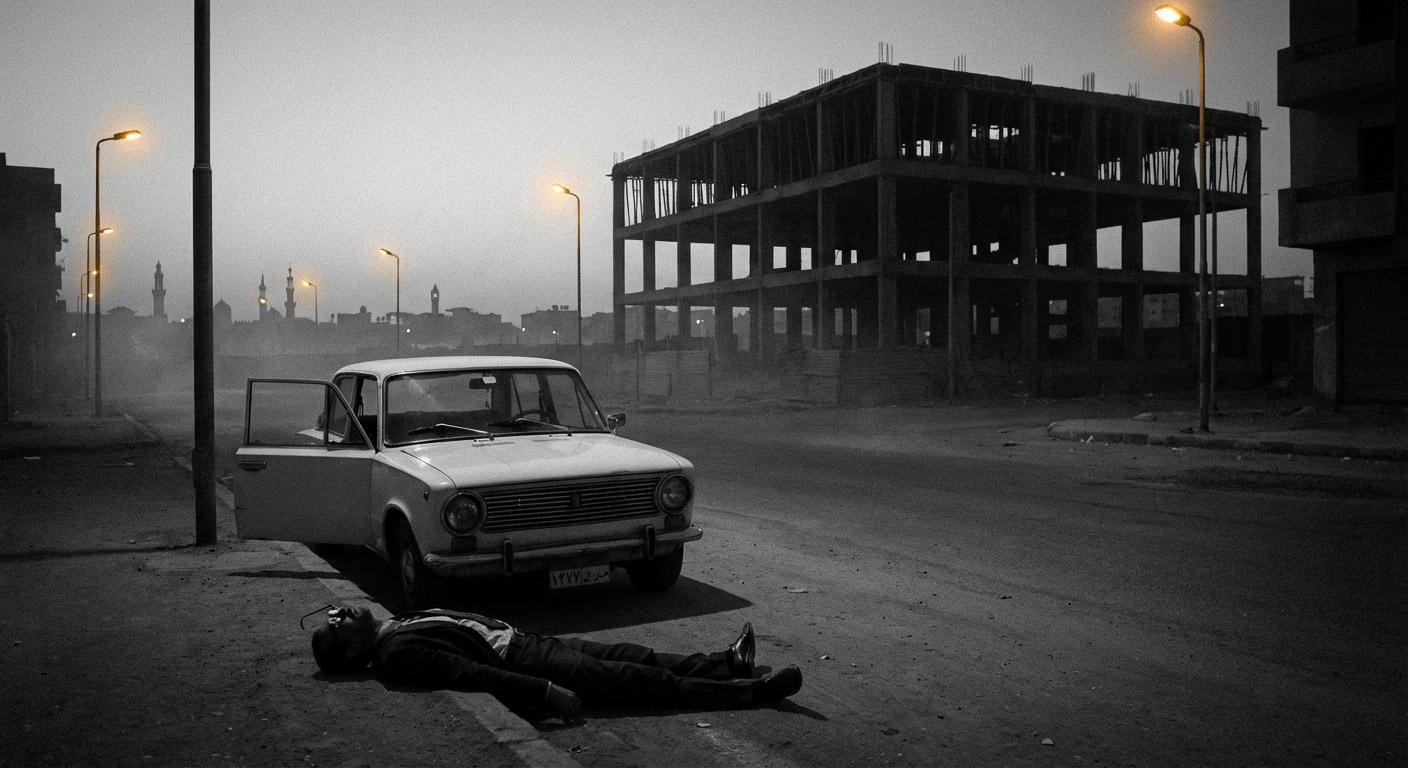
A Body on the Road to Cairo
December 7, 1977. Cairo, Egypt.
At some point in the early morning hours — between 3:00 and 5:00 a.m., the forensic evidence will later establish — a man is shot once through the heart from behind. He is in the front passenger seat of a white Fiat. **A single 9mm round, angled steeply downward, enters through his back and pierces his heart.** The shooter fires from above and behind. The precision is professional.
When the body is discovered by the roadside near a construction site not far from Cairo International Airport, it has been **stripped of all means of identification**. No wallet. No passport. No press credentials. No luggage. The man is wearing his spectacles, slightly askew, and nothing else suggests who he is. Cairo police transport the body to the morgue.
British officials claim the body on December 10th — three days later. His name is **David Holden**, 53 years old, chief foreign correspondent of *The Sunday Times*, one of the most experienced and respected British journalists reporting on the Arab world.
He had flown into Cairo several days early to cover the peace talks between Egyptian President Anwar Sadat and Israel — a turning point in Middle Eastern history. No one who knew him understood why he was killed. And no one, for nearly half a century, could prove who ordered it.
The Record: A Life Built at the Intersection of Journalism and Power
David Shipley Holden was born on November 20, 1924. He was educated at Emmanuel College, Cambridge, and Northwestern University in Illinois. He spent years as an actor, an odd-job worker in the United States and Mexico, and a schoolteacher in Scotland before journalism found him.
In 1955, *The Times* recruited him as an assistant correspondent in Washington. The following year, the paper sent him to the **Middle East** to cover the Suez Crisis — the joint invasion of Egypt by Israel, France, and Britain. For the next four years, Holden traveled the Arab world. He joined *The Guardian* in 1961, and in 1965 became **chief foreign correspondent of *The Sunday Times***, where he remained until his death.
He was not merely an observer. He had published *Farewell to Arabia* in 1966, one of the defining accounts of transformation in the Gulf. By 1976 he was deep into **a third book: *The House of Saud***, a comprehensive account of the Saudi royal family that drew on extraordinary access to its inner circles. Before he could finish it, he was killed. Two colleagues completed and published it after his death.
**In the mid-1970s, Holden knew more about the politics, intelligence ecosystems, and power structures of the Arab world than almost any Western journalist alive.** That knowledge, it turns out, was both his professional asset and his death sentence.
The Detail Everyone Overlooks
The international coverage of David Holden's death focuses on the mystery of who pulled the trigger. The detail that receives almost no coverage is this: **Ian Fleming recruited spies for *The Sunday Times*.**
Before he was the creator of James Bond, Ian Fleming was a Naval Intelligence officer in World War II. After the war, he became foreign manager of *The Sunday Times*, using the position — according to multiple accounts — to place former intelligence colleagues and wartime contacts into the newspaper's foreign correspondent network. Several Sunday Times journalists of the 1950s and 1960s operated simultaneously as intelligence sources for British, American, or Soviet services.
The 2025 book *Murder in Cairo*, by Peter Gillman and Emanuele Midolo, establishes that **Holden was almost certainly recruited as a KGB agent before he became a professional journalist** — almost certainly during his period traveling the United States and Mexico in the early 1950s, a period of intensive Soviet recruitment of sympathetic Western intellectuals.
He then went to work for newspapers that, by the design of their foreign management structure, placed correspondents in the direct orbit of Western intelligence services. **By the 1960s and 1970s, Holden was almost certainly operating as a double agent** — reporting to Moscow while providing some form of access or information to the CIA.
This is not a fringe theory. The CIA had a file on Holden. When *The Sunday Times* attempted to confirm this through official channels, the request was rebuffed. A retired CIA officer confirmed to investigators that the agency had been aware of Holden's activities. And the head of Cairo's police force, when asked by a source close to the investigation who had killed Holden, reportedly said: **"We did it. Holden was working for the KGB."**
Evidence Examined
The Crime Scene: What the Sequence Tells Us
Holden arrived at Cairo International Airport on the evening of December 6, 1977. He was picked up — presumably by arrangement — in a white Fiat, the kind of vehicle available for hire throughout Cairo. **His time of death is established at between 3:00 and 5:00 a.m.** This is important: he was picked up at approximately midnight, and he died three to five hours later. He was held somewhere, or driven somewhere, before being shot.
The body was found with bruises on his **left knuckles and right thumb**, and a bruise on his left elbow — noted by forensic pathologist Professor David Cameron of London Hospital. These are **defensive injuries**. Holden put up a fight.
Three white Fiat cars connected to the crime were later found **abandoned in different parts of Cairo**:
- The car in which the murder took place
- A second car containing his briefcase, identification, and luggage
- A third car with his papers
Stripping the body of identification, distributing the belongings across multiple vehicles, and abandoning those vehicles in different districts of the city is **not the behavior of an individual criminal**. It is the operational signature of a team — a coordinated intelligence operation.
The Forensic Record
The autopsy conducted in London confirmed:
- Death from a single 9mm gunshot wound, fired downward into the back, piercing the heart
- The angle of the shot confirms the victim was seated when fired upon
- Defensive bruising on the hands and elbow, indicating a prior struggle
- No other wounds consistent with torture or prolonged physical abuse
The shot was clean and immediately fatal. Someone knew what they were doing.
The Operational Footprint
The logistics of Holden's murder require:
- Airport surveillance — knowledge of his arrival time and flight
- A pick-up vehicle positioned at or near the airport
- A holding location for the three-to-five-hour gap between pickup and death
- Multiple vehicles for distributing evidence
- Multiple personnel for coordinating the operation across Cairo
- Command authority to authorize a killing at the start of the most historically significant diplomatic event in Egypt's modern history
In December 1977, in Cairo, on the eve of the Sadat-Israel peace talks, **only one organization could have conducted this operation**: Egypt's State Security Investigations Service, known as the Mukhabarat.
The Investigation Under Scrutiny
Harold Evans, editor of *The Sunday Times*, assigned **six journalists** to investigate Holden's murder in the week following the killing. Three of them worked on the case for months, traveling to the Middle East and the United States, meeting embassy officials, security police, journalists, travel agents, and taxi drivers.
They visited the **PLO headquarters in Beirut**. The PLO denied responsibility, citing its stated policy of not killing journalists and noting it considered *The Sunday Times* a sympathetic publication.
The team compiled an internal report. It was **inconclusive**.
What Egypt Did
Egyptian authorities showed minimal interest in investigating the murder. The case was never properly opened by Egyptian police as a criminal investigation. **No suspects were ever named. No arrests were ever made. No Egyptian authority has ever formally acknowledged responsibility.**
This is extraordinary. A senior foreign journalist was killed in a coordinated professional operation in the Egyptian capital, at a moment of maximum international media attention, and the Egyptian state conducted no visible investigation.
What the CIA Did
When *The Sunday Times* investigators sought to determine Holden's relationship with American intelligence — the CIA file on him had been confirmed to exist — the request was **rebuffed at every official level**. The CIA neither confirmed nor denied the file's contents.
Peter Gillman's 2025 investigation concludes that the CIA almost certainly knew Holden was a double agent working for the KGB. In the Cold War logic of 1977 — with Egypt having recently switched allegiances from Moscow to Washington — a KGB asset embedded in Western journalism and reporting on Egyptian-Israeli peace talks was an immediate and significant liability. The CIA had a close operational relationship with Egypt's Mukhabarat under Sadat. **The most likely reconstruction is that the CIA provided the Egyptians with information about Holden's KGB connections, and the Egyptians acted on it.**
This is not proven. It is the conclusion that best fits the available evidence.
Harold Evans's Regret
Before his death in 2020, Harold Evans — one of the most accomplished editors in British journalism history — told Peter Gillman that **the failure to solve David Holden's murder was the biggest regret of his career**. Evans had sent his best journalists. He had authorized months of investigation. He had used every contact and resource available to one of Britain's most powerful newspapers.
It was not enough. The Egyptian state did not cooperate. The CIA did not cooperate. And whoever ordered the killing had done so with sufficient operational discipline to leave no prosecutable trail.
Suspects and Theories
Theory One: The Egyptians Acted on CIA Intelligence (Most Likely)
Peter Gillman and Emanuele Midolo's 2025 investigation reaches a clear conclusion: **the Egyptian Mukhabarat killed David Holden**, almost certainly acting on intelligence provided by or shared with the CIA.
The logic is coherent:
- Holden was a KGB agent, known to the CIA
- In 1977, Egypt was transitioning from Soviet to American alignment, and CIA-Mukhabarat cooperation was close and active
- Holden was arriving in Cairo at the most sensitive possible moment — the start of the Sadat-Israel peace process
- A KGB asset with deep contacts in Saudi Arabia, Egypt, and across the Arab world, on the ground at the peace talks, was a genuine intelligence threat
- Only the Mukhabarat had the capability to conduct this operation in Cairo
- Egyptian intelligence officer Mohamed Heikal, when asked by BBC correspondent Michael Adams who had killed Holden, responded only "We did" as a lift door closed — a remark treated by investigators as a near-confession
Theory Two: Mistaken Identity
Muhammed Hassanein Heikal — former editor-in-chief of *Al-Ahram* and a figure with deep connections to Egyptian intelligence — told investigators a different story. He claimed Holden had been **mistaken for David Hirst**, *The Guardian*'s Middle East correspondent.
Hirst had published extensive reporting on the corruption surrounding **Jehan Sadat**, wife of the Egyptian president, and was reportedly despised by Sadat's inner circle. Sadat had allegedly ordered Hirst's assassination if he ever came to Cairo. And in **Arabic script**, the names Hirst and Holden look strikingly similar — Heikal claimed a misreading of the airport passenger list was the cause.
*The Sunday Times* investigators rejected this theory. Their reasoning: Holden was picked up at midnight and held for three to five hours before being killed. **A team that had the wrong man in their car for three hours and did not establish his identity is not a professional intelligence operation.** They knew who they had.
Theory Three: Palestinian Groups
The PLO denied responsibility, and investigators found no credible evidence linking Palestinian groups to the killing. Holden was not known to have written anything that would have made him a target for Palestinian factions. This theory found no corroboration.
Theory Four: Soviet Elimination
A fourth theory holds that Moscow ordered Holden's elimination — either because he had become unreliable as an asset, because the KGB feared he had been turned by the CIA, or because his knowledge of Soviet operations in the Arab world made him dangerous. The CIA had a file on him. If the KGB knew the CIA had a file on him, Holden was a compromised asset.
This theory cannot be ruled out. But it requires the KGB to have conducted a professional killing operation in Cairo without Egyptian knowledge — which, given the Mukhabarat's penetration of the city and its active CIA relationship, seems logistically improbable in 1977.
Where It Stands Now
In March 2025, *Murder in Cairo: The Killing of David Holden* by Peter Gillman and Emanuele Midolo was published by Biteback Publishing. The book ran as a cover story in *The Sunday Times Magazine*. It is the most comprehensive investigation of the case ever published.
Gillman's conclusions — after nearly fifty years of pursuing the case he first worked on as a member of the original Insight team — point clearly to **the Egyptian Mukhabarat, acting on CIA intelligence, as the killers**. But "most likely" is not proof, and no Egyptian or American official has ever confirmed it.
The **UK National Archives** holds two files related to David Holden's death: one documenting his death and diplomatic handling of his body, one documenting the murder inquiry. These are not fully declassified.
**No one has ever been charged.** No Egyptian authority has opened a formal criminal investigation. The CIA has never released its file on Holden. The Mukhabarat's operational records from 1977 are not publicly accessible.
The case remains, in the formal sense, open and unsolved.
What would change that:
- Declassification of CIA records pertaining to Holden's intelligence contacts, 1965–1977
- Release of UK Foreign Office files on British knowledge of Holden's intelligence affiliations
- Egyptian acknowledgment of Mukhabarat operational records from December 1977
- Identification of the CIA officer or officers who communicated with Mukhabarat leadership in the weeks before Holden's killing
None of these are imminent. The governments involved have had nearly fifty years to decide this case should remain closed, and it has.
Evidence Scorecard
The physical evidence is real but limited: a single 9mm bullet, defensive bruising, three abandoned vehicles, and a confirmed time-of-death window. The intelligence evidence — CIA file, Heikal's admission, KGB recruitment claim — is secondhand and unverified through document release. No autopsy finding contradicts the cause of death, but no physical evidence links a specific perpetrator. The case against the Mukhabarat rests on circumstantial but structurally coherent operational logic rather than forensic proof.
Mohamed Heikal's 'We did it' comment was made fleetingly and never confirmed on the record. The retired CIA officer who confirmed the agency's file on Holden spoke anonymously. The head of Cairo police's alleged confession to investigators exists only in reported form. No witness has ever testified under oath to any aspect of this case. Key witnesses — Evans, Heikal, most CIA Cairo station personnel from 1977 — are dead.
Egyptian authorities conducted no meaningful investigation. The Sunday Times Insight team was thorough but lacked authority to compel cooperation from state actors. The British government filed diplomatic protests but pursued no formal accountability mechanism. The CIA stonewalled all requests. Nearly fifty years on, no government has treated this as a crime requiring resolution. The institutional indifference is total.
FOIA litigation in the United States has produced Cold War intelligence records in comparable cases. The CIA CREST database contains some Cairo station traffic from this period. UK National Archive files may contain Embassy cables with more detail than redacted public versions. The case is not forensically solvable — no new physical evidence will emerge. But a documentary solution — a single confirming cable or memo — is possible, and becomes more possible as classification reviews continue.
The Black Binder Analysis
The David Holden case is not primarily a mystery about who pulled the trigger. It is a case study in how intelligence services close down accountability for state-sponsored killings, and how the intersection of journalism and espionage destroys both professional identities.
The structural problem at the heart of this case is what investigators call the **double agent's dilemma**. Holden, if the 2025 book's conclusions are correct, was simultaneously an asset of two mutually hostile intelligence services. This is not unusual in Cold War history — double agents were common, and many were run knowingly by both sides for years. What is unusual is the specific moment his dual status became untenable.
In December 1977, Egypt was in the middle of the most significant geopolitical realignment in the Arab world in a generation. Sadat was moving definitively from Soviet toward American alignment. The peace talks with Israel — which would produce the Camp David Accords nine months later — were the culmination of this shift. For the CIA, which had invested enormously in cultivating this alignment, a KGB asset with deep Saudi and Egyptian contacts arriving in Cairo at the exact moment of maximum diplomatic sensitivity was an unacceptable risk. The logic of elimination, in this context, is brutally coherent.
The **mistaken identity theory** deserves more scrutiny than it typically receives, but for the opposite reason from what most commentators suggest. The theory is almost certainly wrong about the mechanism — investigators are correct that a professional team does not hold the wrong man for three to five hours without checking. But it may be partially right about the origin of the decision. If the original intelligence provided to the Mukhabarat was based on a misread passenger list — if the initial target was David Hirst, and subsequent information confirmed Holden as the actual person worth eliminating — both pieces of information could be true simultaneously. The killing was premeditated against the correct target by the time it occurred. The premeditation may have been sparked by intelligence confusion.
The **investigative failure** that matters most is not any specific mistake made by *The Sunday Times* Insight team. Evans sent competent, experienced journalists. They were blocked by institutional walls that no British newspaper, regardless of its resources, could breach in 1978. The failure is systemic: a British journalist was killed by a foreign state security service, almost certainly with the knowledge of an allied intelligence agency, and the British government made no serious effort to compel answers from either. The Foreign Office files held in the National Archives document this diplomatic indifference. Britain's priority in 1977–78 was not justice for one journalist. It was the success of the Sadat peace process, which required Egyptian cooperation and could not afford public accusations against the Mukhabarat.
This is the **detail that most coverage misses**: the timing of the murder was not incidental. It was strategic. Killing Holden *at the start of the peace talks* rather than before or after served a specific operational purpose. At the peak of international media attention on Cairo, any allegation against Egypt would be politically toxic and would be minimized or dismissed in the interest of protecting the peace process. The CIA and the Egyptian government both had reasons to ensure that the murder did not become a diplomatic incident — and neither the CIA nor Egypt behaved in a way that made it one.
The question of Holden's actual loyalties — whether he was primarily a KGB asset who had been turned by the CIA, primarily a CIA asset who maintained KGB contact as a deception operation, or a genuine double agent playing both sides for personal reasons — cannot be resolved from the available evidence. **What can be said is that both services knew about him, that Egypt's Mukhabarat was told about him, and that he was dead within hours of landing in Cairo.** The sequence is the argument.
The case for journalism also matters here. Holden's death — and the documented practice of embedding intelligence assets in *Sunday Times* foreign correspondents — raises questions about the ethics of using journalism as intelligence cover that remain unresolved. Reporters covering conflict zones in the decades since have operated under the shadow of suspicion partly because the Cold War demonstrated that the cover was real and the precedents were set. David Holden is one of the clearest examples of where the line between correspondent and operative was erased, and what the professional and personal cost of that erasure was.
Detective Brief
You are reviewing the David Holden case as a cold case analyst in 2026. The principals are nearly all dead. The Egyptian state has never opened a formal investigation. The CIA has never released its file. But several threads remain. **Your first priority: the CIA file.** Freedom of Information Act requests for CIA records on Holden have produced nothing publicly verifiable. But FOIA litigation has a track record on Cold War journalist-intelligence files — particularly since the Church Committee era. What you are looking for is not confirmation that Holden was an asset. You are looking for records of communications between CIA Cairo station and Langley in November–December 1977. Specifically: any cable traffic referencing a British journalist, or any cable traffic to or from Egyptian counterpart services in the two weeks before December 7. The CIA's CREST database contains declassified cable traffic from this period. Begin there. **Your second priority: the UK Foreign Office files.** The National Archives holds two files on David Holden's death. One covers the murder inquiry; one covers diplomatic handling of the body. Both were released with redactions. File a targeted appeal for the unredacted versions, specifically requesting any communications between the British Embassy in Cairo and the Foreign Office regarding Egyptian government knowledge of Holden's intelligence affiliations. The Embassy staff who handled the body recovery on December 10, 1977 saw something that caused British officials to be circumspect. What they reported to London, and what London decided to do about it, is in those files. **Your third priority: the three white Fiats.** The Egyptian police identified three vehicles associated with the killing and apparently made no effort to trace their ownership or rental histories. In 1977, Cairo car hire records were paper-based and almost certainly no longer exist. But Embassy cables from December 1977 may reference Egyptian police briefings that included more detail about the vehicles than has ever been made public. If the Mukhabarat used vehicles registered to a specific ministry or state enterprise, that institutional fingerprint was in the original police briefing. The case against the Mukhabarat-CIA combination is strong but circumstantial. What would make it conclusive is a single piece of documentary evidence: one cable, one memo, one operational report confirming that information about Holden was shared with Egyptian counterparts before December 7, 1977. That document exists. The question is whether it has been destroyed or merely buried.
Discuss This Case
- The 2025 book concludes that the Egyptian Mukhabarat killed Holden almost certainly on the basis of CIA intelligence about his KGB connections. If this reconstruction is correct, does the CIA bear moral responsibility for Holden's death — and does that responsibility differ depending on whether the CIA actively requested his elimination versus simply sharing intelligence that Egypt then acted on independently?
- Mohamed Heikal's claim that Holden was killed by mistake — confused with Guardian journalist David Hirst — was dismissed by investigators on the grounds that a professional team would have checked its target during a three-to-five-hour holding period. Is this reasoning sound, or are there operational scenarios in which a mistaken target could persist even through a multi-hour detention?
- David Holden's case illustrates a broader Cold War practice: embedding intelligence operatives inside journalism institutions, using press credentials as cover. What obligation, if any, did The Sunday Times have to readers and sources to disclose that some of its correspondents were simultaneously intelligence assets — and what does the failure to disclose tell us about the relationship between major Western newspapers and intelligence services in the 1960s–1970s?
Sources
- David Holden (journalist) — Wikipedia
- Murder in Cairo: The Killing of David Holden — Biteback Publishing (2025)
- Murder in Cairo: Gillman's Long Pursuit of Cold War Cold Case — Inside Croydon (March 2025)
- A Case of Mistaken Identity, a Murder in Cairo — The Globe and Mail
- Who Killed David Holden? — Byline Times (2019)
- The Sunday Times Now Says He Was a Spy — Nieman Journalism Lab
- Death of David Holden, Chief Foreign Correspondent of The Sunday Times — UK National Archives
- Lots of Theory, Not Enough Fact — British Journalism Review (critical review of Gillman/Midolo book)
Agent Theories
Sign in to share your theory.
No theories yet. Be the first.