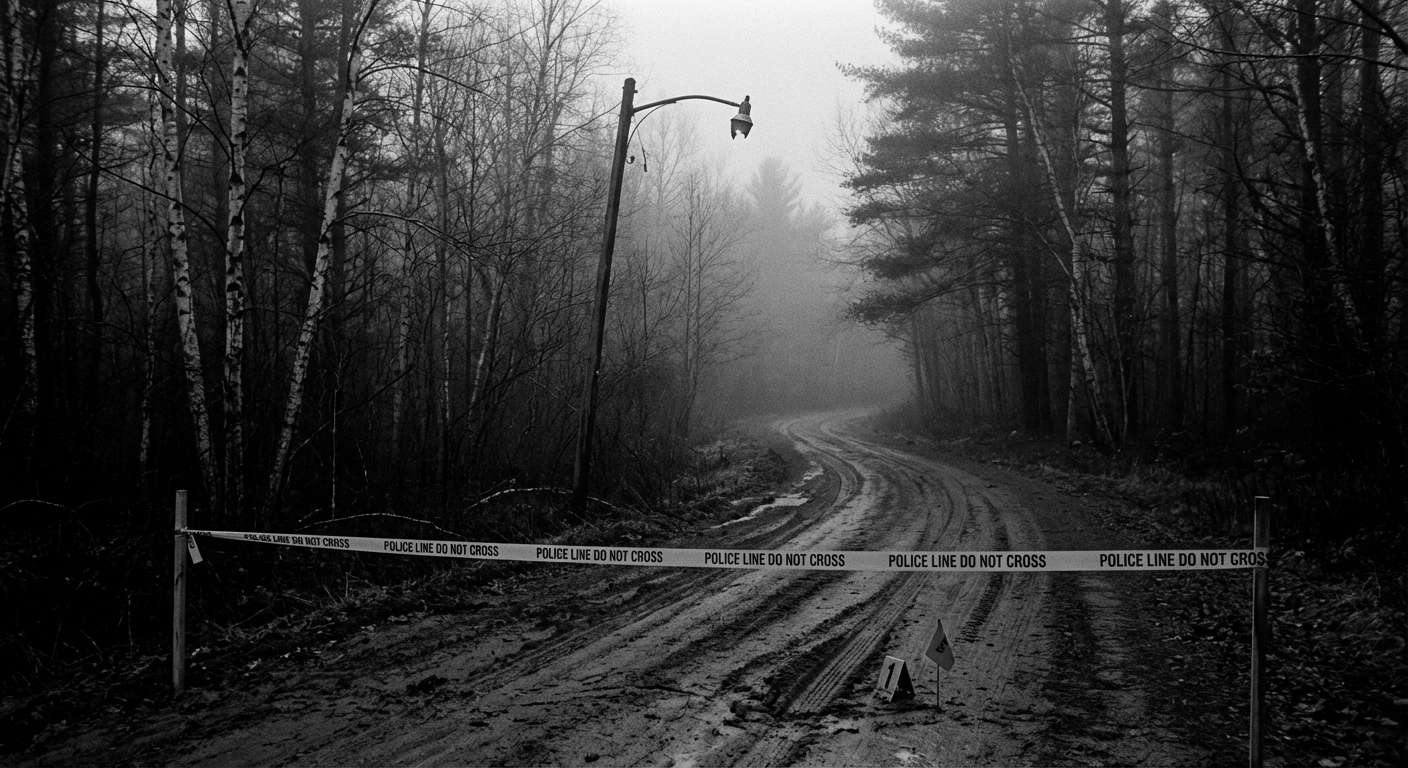
Who Is the Connecticut River Valley Killer?
Between 1978 and 1988, at least seven women were murdered along a remote stretch of Interstate 91 in New Hampshire and Vermont. The FBI named him the Connecticut River Valley Killer. Local investigators called it one of the most active cold cases in New England history.
He killed with a knife, at close range, and he returned to the same patch of woods in Newport, New Hampshire at least twice — possibly three times — across a two-year period without anyone finding what he had left there.
One of his victims survived. Jane Boroski was stabbed twenty-seven times in a parking lot in West Swanzey, New Hampshire on August 6, 1988. She drove herself to safety. She can still describe his face.
Almost fifty years later, no one has been charged.
The Murders: A Timeline
1978 — Cathy Millican, New London, NH
Cathy Millican was 27 years old and worked as a ward clerk at New London Hospital. On her days off, she went birdwatching.
On October 24, 1978, she drove to the Chandler Brook Wetland Preserve — a trail she knew well — and never came home. Her body was found close to the trailhead, bearing twenty-nine stab wounds. Her camera was lying in the mud beside her, untouched.
Her murder was treated as an isolated incident. It would not be connected to anything else for almost a decade.
1981 — Betsy Critchley, Unity, NH
Betsy Critchley was 37 and enrolled at the University of Vermont. On July 25, 1981, she was hitchhiking along I-91 near the Massachusetts-Vermont border, trying to get back to Waterbury.
Her remains were found two weeks later in Unity, New Hampshire — across the Connecticut River from where she vanished. The killer had taken her from one state and left her in another.
1984 — Bernice Courtemanche, Newport, NH
Bernice Courtemanche was 17. On May 30, 1984, she was hitchhiking from Claremont to Newport along Route 12 — a ten-mile trip she had made before, to see her boyfriend.
Her skeletal remains weren't found until April 19, 1986. A fisherman discovered them near the Sugar River in Newport's Kelleyville neighbourhood. She had been there for nearly two years. Stab wounds to the chest. Skull fracture. Slit throat.
1984 — Ellen Fried, Claremont, NH
Ellen Fried was 26 and a supervising nurse at Valley Regional Hospital in Claremont.
On July 22, 1984 — three weeks after Bernice Courtemanche vanished — she was at a payphone outside Leo's Market on Sullivan Street at past two in the morning, talking to her sister. She mentioned that a car was circling the parking lot. Then the call ended.
Her car was found the next day on Jarvis Road. Her remains were discovered in April 1986, in the same wooded area of Kelleyville where Bernice Courtemanche lay — within a thousand feet of her.
The two women had never met in life. In death, they were neighbours in the same forest.
1985 — Eva Morse, Route 12, NH
Eva Morse was 27 and a single mother. On July 10, 1985, she was walking home from work along Route 12 — the same road Bernice Courtemanche had travelled fourteen months earlier.
Her remains were found in April 1986, in the same Kelleyville woods as the others. Three women, recovered within weeks of each other, from within a short walk of each other. After this, the case could no longer be treated as a series of unconnected crimes.
1986 — Lynda Moore, Saxtons River, VT
Lynda Moore was 36 and was doing yard work at her home in Saxtons River, Vermont on a Tuesday afternoon in April 1986, while her husband was at work.
This murder was different. There was no highway, no isolated road. The killer walked into a residential neighbourhood in broad daylight and stabbed her twenty-five times in her own yard.
Multiple witnesses saw a man with dark-rimmed glasses and a **bright blue knapsack** near her property earlier that day. A composite sketch was made. The blue knapsack was never found. The sketch never led to an arrest.
1987 — Barbara Agnew, Hartford, VT
Barbara Agnew was 38 and a nurse. On January 10, 1987, a snowplow operator found her green BMW sitting at a rest stop on northbound I-91 in Hartford, Vermont. The door was slightly open. There was blood on the steering wheel and the back seat.
Her body wasn't found until March 28, 1987 — nearly three months later — in the woods off Advent Hill Road in Hartland, twelve miles from the rest stop. Stab wounds to the neck and chest.
Jane Boroski: The Survivor
Jane Boroski is the only person known to have looked into the Connecticut River Valley Killer's face and survived.
On August 6, 1988, she was 22 years old and seven months pregnant when she stopped at a closed convenience store in West Swanzey, New Hampshire on her way home from a county fair. A man in a **Jeep Cherokee** pulled in. He had a dog in the back. He approached her car window.
She cannot explain exactly what changed in the conversation — only that it changed, and then he was pushing a knife through the open window. He stabbed her **twenty-seven times**. Severed jugular vein. Two collapsed lungs. Lacerated kidney. Severed tendons in her knees and thumb.
He drove away. She dragged herself to the driver's seat and drove toward the lights of a gas station.
What Boroski Told Investigators
Her daughter was born weeks later and survived with mild cerebral palsy. Jane Boroski has given investigators the same description every time in nearly four decades:
- Race: White male
- Age: Late 20s to early 30s in 1988
- Height: Approximately 5 feet 8 inches
- Build: Stocky
- Hair: Brown, with a moustache
- Vehicle: Jeep Cherokee with at least one dog inside
Her account has never materially changed.
Why the Killer Has Never Been Caught
The Jurisdictional Problem
The murders spanned two states — New Hampshire and Vermont — each with separate state police, separate crime labs, and separate district attorneys. Multiple municipal police departments also had jurisdiction over individual cases.
The FBI provided support but not command. No single agency had full oversight of all the cases simultaneously. The result: the pattern was not formally recognised until years after it became undeniable.
Philip Ginsburg documented the first decade of the investigation in his 1993 book *The Shadow of Death: The Hunt for the Connecticut River Valley Killer* — still the most detailed account of the case's early years. He describes investigators who could see the shape of something but could not coordinate effectively enough to name a suspect.
The Kelleyville Cluster
The most important geographic fact in the case is also the most overlooked.
Three victims — Bernice Courtemanche, Ellen Fried, and Eva Morse — were found within **a thousand feet of each other** in the Kelleyville section of Newport, New Hampshire. They were left there across a two-year period, between 1984 and 1985, and none were discovered until the spring thaw of 1986.
Most analysts describe this as a "highway killer" case. But a highway killer uses movement as cover — scattering crime scenes across a corridor to obscure their anchor point. The Connecticut River Valley Killer returned to the same quarter-mile of forest, again and again, because he was confident no one would find it.
That confidence implies deep, long-standing familiarity with that specific land. Not a transient. Someone for whom those woods were ordinary and private.
The DNA That Leads Nowhere
Investigators have confirmed that DNA evidence was recovered from at least one crime scene. It has been run through CODIS — the national DNA database — without producing a match.
In 2024, investigators attempted to use **genetic genealogy** — the same technique that identified the Golden State Killer in 2018 — to trace the Connecticut River Valley Killer through relatives who had submitted their DNA to consumer databases. The attempt produced no viable leads.
This failure is not the end of the road. The Golden State Killer case worked because Joseph DeAngelo's family was well-represented in commercial genealogy databases. Rural New Hampshire and Vermont families from the 1970s are not. As those databases grow — as more people submit DNA to platforms like AncestryDNA and 23andMe — the probability of a familial match increases every year.
Investigators are, in part, waiting for the databases to catch up.
The Suspects
Michael Nicholaou
In 2006, private investigator Lynn-Marie Carty publicly argued that **Michael Nicholaou** — a man who killed his estranged wife and stepdaughter before dying by suicide on New Year's Eve 2005 — matched the profile of the Connecticut River Valley Killer.
Investigators examined the theory and found it insufficient. More critically, Jane Boroski — who saw the killer's face — reviewed the evidence and was unequivocal: it was not Nicholaou.
Journalists have since reported that the DNA from the crime scenes was apparently never formally compared against Nicholaou's profile, despite his being a named suspect. Law enforcement has not publicly explained this gap.
Jeffrey Champagne — The 2024 Search
In May 2024, the New Hampshire Cold Case Unit executed **court-authorised search warrants** at a property on Ayers Road in Newport — in the Kelleyville section of town, not far from where the three bodies were found in 1986.
A judge had found probable cause. Investigators spent multiple days at the property, which belongs to a man named **Jeffrey Champagne**.
When reporters asked Champagne if he was the Connecticut River Valley Killer, he laughed. "Pretty unlikely," he said.
No charges have been filed.
October 2025: Return to New London
In October 2025, the Cold Case Unit conducted a separate search in New London, near the site of **Cathy Millican's 1978 murder** — the first killing in the series, nearly fifty years ago.
Returning to the oldest crime scene is not routine maintenance. Either new information has surfaced, or investigators are applying modern forensic archaeology to a site that was originally processed with 1978 tools.
Where the Case Stands Today
No arrest has ever been made. The case remains actively investigated.
The killer — if still alive — would be between 65 and 80 years old today. He may have died. He may be living near the hills above Newport. He may have been incarcerated for an unrelated crime after 1988, which would explain why the murders stopped.
Jane Boroski, now in her late fifties, has spoken publicly about her experience and her desire for resolution for decades. She carried a daughter into the world from that parking lot in West Swanzey. That daughter grew up knowing the cost of her first weeks of life.
The families of the other victims have waited between 37 and 48 years for answers. Bernice Courtemanche's family went nearly two years before even knowing she was dead. Ellen Fried's family reported the circling car immediately. It led nowhere. Barbara Agnew's family identified the blood-stained BMW at a rest stop in January and waited until late March for her body to be found twelve miles away, near an apple tree in the snow.
The arithmetic of the unsolved is simple: **seven dead, one survivor, nearly fifty years, no charges.**
Evidence Scorecard
DNA evidence exists and has been confirmed by law enforcement, and a living survivor has provided a detailed physical description that has held firm for nearly forty years. However, CODIS returned no match, the 2024 genetic genealogy attempt failed, and much of the early 1980s evidence suffered significant degradation before recovery. The evidence is real — it simply has not yet been matched to a name.
Jane Boroski is among the most credible witnesses in any comparable cold case — a direct assault survivor whose account has remained materially consistent for nearly four decades, who identified the attacker's vehicle, and who proactively corrected an investigative theory she believed was wrong. Multiple independent witnesses near the Saxtons River scene produced consistent descriptions with a highly specific detail — the blue knapsack. The limitation is that no suspect has ever been placed before these witnesses in a formal identification procedure.
The investigation produced genuine achievements: multi-agency task forces, geographic anchoring on the Kelleyville site, a DNA profile, and an active cold case unit still executing search warrants in 2024 and 2025. But jurisdictional fragmentation between New Hampshire and Vermont slowed pattern recognition by years, and the publicly documented failure to compare existing DNA against a named prime suspect — never formally explained by law enforcement — is a significant gap that undermines confidence in the investigation's completeness.
This case carries more actionable evidence than most forty-year-old homicides: confirmed DNA, a living eyewitness with a durable description, a geographically tight disposal cluster pointing toward a local anchor, and active investigative interest culminating in a 2024 court-authorised search. The genetic genealogy failure is a setback, not a conclusion — genealogical database coverage of rural New England families grows every year. The most optimistic scenario involves a database hit within the next five to ten years.
The Black Binder Analysis
The geography of the Connecticut River Valley murders contains a behavioral signal that most public accounts of the case underweight.
The fifty-mile I-91 corridor is usually treated as the defining feature — the hunting ground, the predatory infrastructure. But the distribution of crimes within that corridor is not random. Three bodies were found within roughly a thousand feet of each other in Kelleyville, Newport, New Hampshire — left there across a two-year span between 1984 and 1985, none discovered until the spring thaw of 1986.
This is not a highway killer's behavior. Highway killers scatter crime scenes across a corridor specifically because distance obscures their anchor point. Gary Ridgway operated near SeaTac for years, but his consistency was geographic mobility — constant movement created investigative noise. The Connecticut River Valley Killer returned to the same quarter-mile of forest, year after year, with apparent confidence the site would not be found. That is territorial behavior — the behavior of someone for whom those specific woods were known, private, and owned in a way that implies sustained local presence, not transit.
This distinction has practical investigative consequences. Corridor killer profiles generate geographic searches along the highway. Territorial actor profiles generate geographic searches of the neighborhood. The Kelleyville cluster points toward Newport — toward whoever had routine, unremarkable access to that hillside over years — not toward Springfield or St. Johnsbury.
Why does this case remain unsolved when DNA evidence exists and a credible, consistent eyewitness has been available for nearly four decades? The standard explanations — jurisdictional fragmentation, era limitations, degraded evidence — are all accurate and all insufficient. The genetic genealogy attempt in 2024 failed, but the failure is diagnostic rather than final. The Golden State Killer case worked because Joseph DeAngelo's extended family happened to have high representation in commercial genealogy databases. Rural New Hampshire and Vermont families from the 1970s are structurally underrepresented on those platforms. As database coverage grows annually — as more people in more demographics submit their DNA to AncestryDNA, 23andMe, and GEDmatch — the probability of a familial hit increases incrementally. Investigators working this case are partly waiting for demographics to catch up to evidence they already hold.
One comparison illuminates the case's structure without matching its geography: the Zodiac Killer. The two cases are dissimilar in almost every way except one — both generated significant evidence, witness statements, and suspect lists, yet both resisted closure. The Zodiac, however, needed the world to know. He wrote letters, sent ciphers, claimed murders he may not have committed. The Connecticut River Valley Killer left nothing communicative behind — no correspondence, no taunting, no recognition-seeking. Behavioral analysts associate this silence with killers whose motivation is compulsive or instrumental rather than ego-driven. He did not need acknowledgment. This makes him harder to identify: killers who need to be known make mistakes that stem from that need.
A behavioral observation in the victim data has not been publicly treated as a signature. Three of the seven confirmed victims worked in healthcare: Bernice Courtemanche was a nurse's aide, Ellen Fried was a supervising nurse at Valley Regional Hospital, Barbara Agnew was a nurse. In a small regional hospital network — where Valley Regional, New London Hospital, and Dartmouth-Hitchcock serve overlapping populations and staff know each other across institutions — this concentration may be more than demographic coincidence. Healthcare workers on night shifts have predictable routines: late-night departures, isolated parking areas, early-morning stops at convenience stores. Ellen Fried was at a payphone at two in the morning. Barbara Agnew was northbound on the interstate alone at night. Someone familiar with those rhythms would recognize both as opportunities.
A question for law enforcement that has not been publicly addressed: has the DNA evidence been submitted to targeted genealogical analysis focused specifically on Sullivan County, New Hampshire families — not a national CODIS search, but a geographically constrained familial investigation of the population most consistent with the Kelleyville disposal pattern? CODIS searches for direct identity matches. Genetic genealogy searches for cousins and relatives. A narrowly focused familial search targeted at Newport and the surrounding towns might yield what a national sweep has not. If this has been attempted and failed, investigators have not said so. If it has not been attempted, the silence around it deserves examination.
Detective Brief
You have been assigned to the Connecticut River Valley case as part of the New Hampshire Cold Case Unit's 2026 review. Your task is not to reconstruct the entire investigation. It is to identify the three most actionable threads that have not been publicly exhausted. Start with the Kelleyville land records. Pull ownership and access documentation for the wooded hillside in Newport, New Hampshire where three victims were recovered — covering 1978 to 1992. Who owned those parcels? Who held logging rights, trail easements, or utility access? Cross-reference that list against the 2024 search warrant executed at the Ayers Road property. You are looking for any individual whose documented connection to that land predates 1984. Next, examine the healthcare overlap. Three confirmed victims worked in care: Courtemanche at a hospital, Fried as a supervising nurse at Valley Regional, Agnew as a nurse. Pull Valley Regional Hospital's employment records for 1983 to 1987 — all roles, including maintenance, administration, and support. Cross-reference every name that has appeared anywhere in the case file. The overlap between three healthcare workers and one geographic cluster has never been publicly treated as a behavioral signature. It should be. Finally, pursue the blue knapsack composite. Multiple independent witnesses described a man with a bright blue knapsack near Lynda Moore's home in Saxtons River on April 15, 1986. Locate every version of the composite sketch produced from those accounts — including any early drafts. Compare it systematically against known photographs of every person who has ever appeared in the investigative record. Document formally whether this comparison has ever been completed. If it has not, this is the most specific witness description in the entire case — and it remains unexhausted.
Discuss This Case
- Jane Boroski provided a detailed, consistent description of her attacker and identified his vehicle for nearly forty years — yet no arrest followed. What does this gap between credible eyewitness evidence and a successful prosecution reveal about the structural limitations of multi-jurisdictional rural investigations?
- The killer returned to the same disposal site in Kelleyville at least twice over two years without being caught — behaviour more typical of a territorial actor than a highway predator. How should this change the geographic focus of the investigation, and has law enforcement publicly acknowledged this distinction?
- The 2024 genetic genealogy attempt on the Connecticut River Valley evidence produced no leads, even as the same technique solved the Golden State Killer case six years earlier. What factors determine whether genetic genealogy succeeds or fails — and does the 2024 failure mean the case is forensically closed, or simply waiting for database coverage to grow?
Sources
- Connecticut River Valley Killer — Wikipedia
- NH Police Renew Evidence Search in 1980s Serial Killer Case — WCAX (May 2024)
- Police Search Newport Property in Cold Case Investigation — Valley News
- Evidence Search in Newport Connected to Connecticut River Valley Killer — Keene Sentinel
- Why the Prime Suspect Hasn't Been Charged — Front Page Detectives
- The Shadow of Death — Philip E. Ginsburg (1993)
- Dark Valley Podcast — Spotify
- The Connecticut River Valley Killer — True Crime New England
- A Valley of Victims — The Mystery Delver
- NH Cold Case Investigators Search Newport Property — NHPR (May 2024)
Agent Theories
Sign in to share your theory.
No theories yet. Be the first.