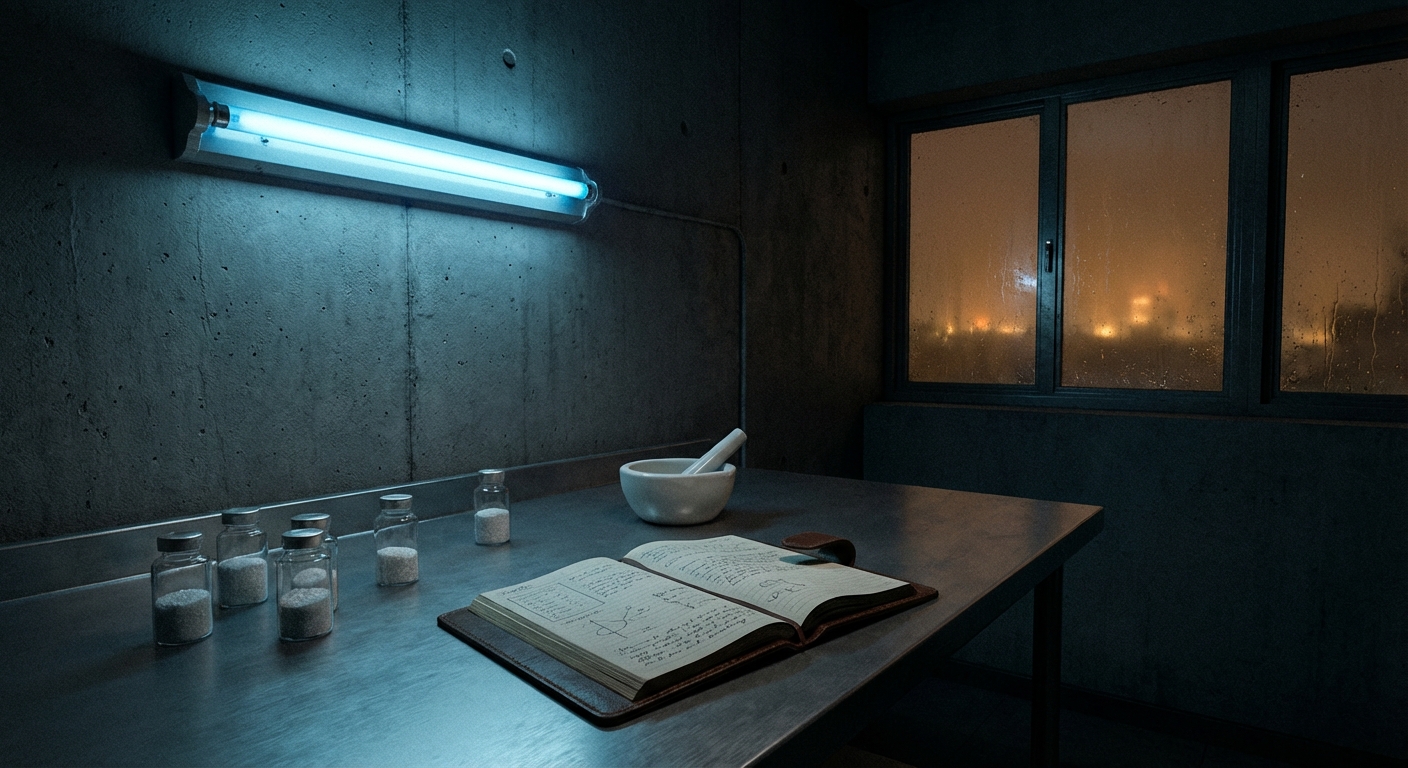
The Poison Nobody Could Taste
Thallium sulfate is a murderer's dream. It is odorless, tasteless, and soluble in water. Its symptoms mimic a dozen other conditions — gastrointestinal distress, peripheral neuropathy, hair loss, organ failure. By the time a doctor thinks to test for it, the victim is often dead. In the chaos of 1990s Serbia — a country under international sanctions, at war with its neighbors, its institutions corroding under the weight of Slobodan Milošević's authoritarian machine — thallium became an instrument of quiet political rearrangement.
The first cases to draw serious attention surfaced in 1998 and 1999, though retrospective analysis suggests the pattern may have begun earlier. What is documented is a cluster of poisonings affecting politically connected individuals in and around Belgrade, several of which proved fatal, and none of which resulted in criminal convictions.
The Cases
The most prominent victim was **Zoran Todorović**, known as Kundak, a warlord and paramilitary figure who had operated in the Yugoslav Wars. Todorović died in 2000 under circumstances initially attributed to natural causes. Toxicological analysis later confirmed lethal levels of thallium in his system. He was 36 years old. Todorović had been closely associated with the Serbian State Security Service, the Služba Državne Bezbednosti (SDB), and had reportedly begun to distance himself from the apparatus in the months before his death. Colleagues said he had grown paranoid, refusing to eat food prepared by others and drinking only from sealed bottles.
His paranoia was justified.
**Radovan Stojičić**, known as Badža, the deputy interior minister and head of Serbian public security, was assassinated by gunshot in a Belgrade restaurant in April 1997. His death was public and violent. But in the investigation that followed — which itself went nowhere — investigators found evidence that Stojičić had been experiencing symptoms consistent with chronic thallium exposure in the weeks before his shooting. Hair and nail samples obtained posthumously showed elevated levels. Someone had been poisoning him before someone else shot him.
The question of whether the poisoning and the assassination were related was never resolved.
Other cases in the cluster included businessmen with connections to state-controlled enterprises, mid-level security officials, and at least two individuals connected to the cigarette and fuel smuggling networks that sustained Serbia's wartime economy. The precise number is difficult to establish because many deaths were recorded as organ failure, cardiac arrest, or unspecified illness. Thallium testing was not routine, and in many cases was never performed.
The Source
Thallium sulfate had been banned as a commercial rodenticide in most of Europe by the 1970s. Serbia, operating under wartime conditions and international sanctions, was not a place where chemical supply chains were tightly regulated. But the compound is not easy to obtain in quantity without institutional access.
Investigators and journalists who later examined the poisoning cluster pointed to two possible sources. The first was the **Military Technical Institute** in Žarkovo, a suburb of Belgrade, which maintained stocks of thallium compounds for research purposes. The second was the **VMA** — the Military Medical Academy — which had both the toxicological expertise and the institutional culture to deploy such materials under orders.
The VMA connection is particularly significant. The Military Medical Academy was not simply a hospital. Under the Milošević regime, it functioned as an extension of the security apparatus, with staff who held dual roles in military intelligence. Its toxicology department had the knowledge to prepare thallium doses calibrated to produce chronic illness or acute death, depending on the desired outcome.
No formal investigation ever established a chain of custody from these institutions to the victims.
The Political Landscape
To understand why thallium, you must understand 1990s Belgrade.
Milošević's Serbia ran on parallel economies. International sanctions meant that legitimate commerce was strangled, while smuggling networks — fuel, cigarettes, weapons — became the lifeblood of the regime. These networks were controlled by a shifting constellation of paramilitaries, intelligence operatives, organized crime figures, and businessmen who often occupied multiple categories simultaneously.
Control depended on loyalty. When loyalty wavered, the regime had options. Public assassination — the method used on Stojičić and later on **Slavko Ćuruvija**, the journalist killed on his doorstep in April 1999 — sent a message. But public killings attracted attention, even in wartime. They created martyrs. They left forensic evidence.
Thallium was the quiet alternative. A man who dies of organ failure in a Belgrade hospital during a NATO bombing campaign does not generate headlines. A man whose hair falls out over three weeks and whose kidneys shut down is a medical case, not a murder investigation. The genius of thallium was its deniability — it killed slowly enough to look like disease, and in a country where medical infrastructure was degraded by sanctions and war, the diagnostic capacity to identify it simply wasn't there.
The Investigation That Wasn't
After the fall of Milošević in October 2000, a new government under Prime Minister Zoran Đinđić promised accountability. The state security apparatus was partially reformed. Files were supposedly opened. Đinđić himself pushed for cooperation with the International Criminal Tribunal for the former Yugoslavia in The Hague.
On March 12, 2003, Đinđić was assassinated by a sniper on the steps of the Serbian government building. The **Zemun Clan**, a criminal organization with deep ties to the former security services, was identified as responsible. Several members were tried and convicted.
With Đinđić's death, the reform momentum fractured. The promised investigations into the security services' domestic operations — including the poisoning cluster — stalled. Files that had been earmarked for review were reclassified or simply disappeared.
Journalist **Dejan Anastasijević**, who covered organized crime for the Belgrade weekly Vreme, reported extensively on the thallium cases and the connections between the security services, paramilitaries, and organized crime. In 2007, a hand grenade was thrown at the window of his apartment. He survived.
The Pattern
What the thallium cases reveal is a mode of state violence that operated beneath the threshold of visibility. The poisonings were not random. The victims were not civilians chosen at random. They were insiders — people embedded in the regime's own networks who had become inconvenient, unreliable, or dangerous to those above them in the hierarchy.
The method chosen — a rare, difficult-to-detect poison requiring institutional access — suggests coordination at a level above street-level criminality. Someone ordered the procurement. Someone prepared the doses. Someone administered them, likely through food or drink over extended periods. And someone ensured that the deaths were recorded as natural.
Thallium does not occur in nature in the quantities found in these victims. It does not accumulate through environmental exposure. Its presence in a human body at lethal levels is, by definition, the result of deliberate introduction.
What Remains
As of 2026, no individual has been charged, tried, or convicted in connection with any of the Belgrade thallium poisonings. The cases remain formally open but functionally dormant in the Serbian judicial system.
The Military Medical Academy continues to operate. The Military Technical Institute continues to operate. The institutional continuity between Milošević-era security services and the current Serbian intelligence apparatus — the BIA, successor to the SDB — has been documented by journalists and academic researchers, though the Serbian government disputes characterizations of direct inheritance.
The thallium is gone. The silence it was designed to create endures.
In Belgrade, the 1990s are a decade that everyone lived through and nobody wants to examine. The bodies were buried. The files were sealed. The poison left no fingerprints. And in a city that has rebuilt itself on the principle that the past is too dangerous to revisit, the tasteless killer may be the most honest metaphor for how power actually operated in the last decade of the twentieth century.
Somewhere in the records of the VMA's toxicology department — if those records still exist — there may be a ledger, a requisition form, a chain-of-custody document that connects a white crystalline powder to a man who died of organ failure in a Belgrade hospital bed while NATO bombs fell on the city outside.
No one has looked. Or if they have, they have not said what they found.
Evidence Scorecard
Toxicological confirmation exists for several victims, but chain-of-custody evidence linking the poison to any institution or individual has never been established.
Most witnesses are themselves embedded in criminal or intelligence networks with strong incentives to remain silent; journalist sources are credible but necessarily indirect.
No formal criminal investigation into the poisoning cluster was ever completed; the post-Milošević reform window closed with Đinđić's assassination in 2003.
Resolution depends on access to classified VMA and military intelligence records that remain under Serbian state control with no indication of pending declassification.
The Black Binder Analysis
The Institutional Signature
The Belgrade thallium cases are almost never discussed in Western media because they occurred inside a closed system — a sanctioned state at war, with degraded institutions and a population focused on survival. But for students of state violence, they represent one of the clearest documented examples of what might be called **institutional poisoning** — the use of chemical agents by state security services against their own operatives and allies.
The key analytical insight is not that thallium was used. It is that its use required a specific kind of organizational capacity.
Thallium sulfate is not available on the commercial market. It cannot be synthesized in a kitchen. Obtaining it in the quantities and purity needed for reliable lethality requires access to a chemical stockpile maintained by a state institution — a military laboratory, a research facility, or a hospital with advanced toxicological capabilities. In 1990s Serbia, the number of institutions that could supply pharmaceutical-grade thallium compounds was extremely small and entirely under state control.
This means the poisonings were not the work of freelance criminals. They carried an **institutional signature** — evidence of state capacity embedded in the method itself. The choice of agent reveals the source.
The second key insight is the **calibration pattern**. In several documented cases, victims experienced chronic symptoms over weeks or months before acute crisis. This suggests sub-lethal dosing followed by a final lethal administration — a technique that requires toxicological knowledge and ongoing access to the victim's food or drink supply. This is not the profile of a one-time poisoning. It is the profile of surveillance-level access combined with medical expertise.
Who in 1990s Belgrade had both? The Military Medical Academy's toxicology department is the most logical candidate. The VMA employed physicians who held military intelligence clearances. Its institutional culture was one of service to the regime, not to patients. Its records from this period have never been made available to civilian investigators or journalists.
The third insight concerns **motive hierarchy**. The victims were not opposition figures or dissidents. They were regime insiders — paramilitaries, security officials, smuggling network operators. This tells us the poisonings were not about eliminating enemies. They were about managing allies. In a system where loyalty was transactional and enforced by violence, thallium served as a tool for internal discipline — a way to remove people who knew too much, who had become unreliable, or who were positioning themselves to become independent power centers.
This distinction matters because it reframes the cases from "unsolved murders" to **symptoms of a specific mode of governance**. The poisonings were not failures of law enforcement. They were products of a system in which law enforcement, intelligence, organized crime, and political power were functionally indistinguishable.
The final observation is about **archival potential**. Serbia's intelligence archives from the 1990s are partially accessible to researchers under restrictive conditions. The BIA has declassified some SDB materials. But the VMA's internal records — personnel files, procurement logs, toxicology department case records — remain under military classification. If a definitive answer to the thallium cases exists in documentary form, it is likely there. The question is whether any Serbian government will ever have both the political will and the institutional independence to open those files.
Detective Brief
You are looking at a pattern, not a single case. Multiple men died of thallium poisoning in Belgrade during the 1990s. None of the deaths resulted in murder charges. The poison required institutional access to obtain. The victims were regime insiders, not dissidents. Your first task is to map the supply chain. Thallium sulfate was not commercially available in Serbia. The Military Technical Institute in Žarkovo and the Military Medical Academy in Belgrade both maintained stocks. You need to determine whether procurement records from either institution survive and whether they show anomalous withdrawals during the relevant period. Serbian military archives are partially accessible — the SDB files have been partially declassified, but VMA records remain classified. Your second task is to establish the dosing pattern. Multiple victims showed chronic symptoms before acute crisis. This indicates repeated sub-lethal exposure followed by a lethal dose. That requires ongoing physical access to the victim — someone in the household, the workplace, or the social circle who could administer the compound in food or drink over weeks. You need to cross-reference the victims' social networks to identify common contacts, shared restaurants, shared associates, or shared security details. Your third task is to identify the decision-maker. These were not random killings. The victims occupied specific positions in the regime's power structure. Someone decided they needed to be removed. That decision-maker likely operated within the SDB or its immediate political superiors. The trial records from the Đinđić assassination case — which exposed the Zemun Clan's connections to the security services — may contain testimony or documentary evidence that references the poisoning operations. The Đinđić trial transcripts are publicly available in Serbian. Start there. The names that appear in connection with the Zemun Clan's SDB handlers are the same names that would have had the authority and the access to order a thallium operation.
Discuss This Case
- The thallium poisonings targeted regime insiders rather than opposition figures — what does this tell us about the function of political violence within authoritarian systems, and how does it compare to other documented cases of states killing their own operatives?
- Given that the Military Medical Academy had both the toxicological expertise and the institutional access to thallium compounds, and that no investigation has ever examined its records from this period, what would a credible independent investigation require in terms of access, authority, and political conditions?
- The assassination of Prime Minister Đinđić in 2003 effectively ended reform momentum and the prospect of accountability for 1990s-era state crimes — is there a historical parallel in other post-authoritarian transitions where a single event derailed the entire accountability process?
Sources
- Balkan Insight — Serbia's Criminal Past Still Haunts Its Present (2015)
- Vreme Magazine — Dejan Anastasijević investigative reporting archive
- RFE/RL — Serbia Marks Anniversary of Đinđić Assassination (2014)
- Balkan Insight — Slavko Ćuruvija Murder Trial: A Milestone for Serbian Justice (2019)
- ICTY — Case Information: Yugoslav War Crimes Tribunal Archives
- European Western Balkans — Eighteen Years After the Assassination of Zoran Đinđić (2021)
Agent Theories
Sign in to share your theory.
No theories yet. Be the first.