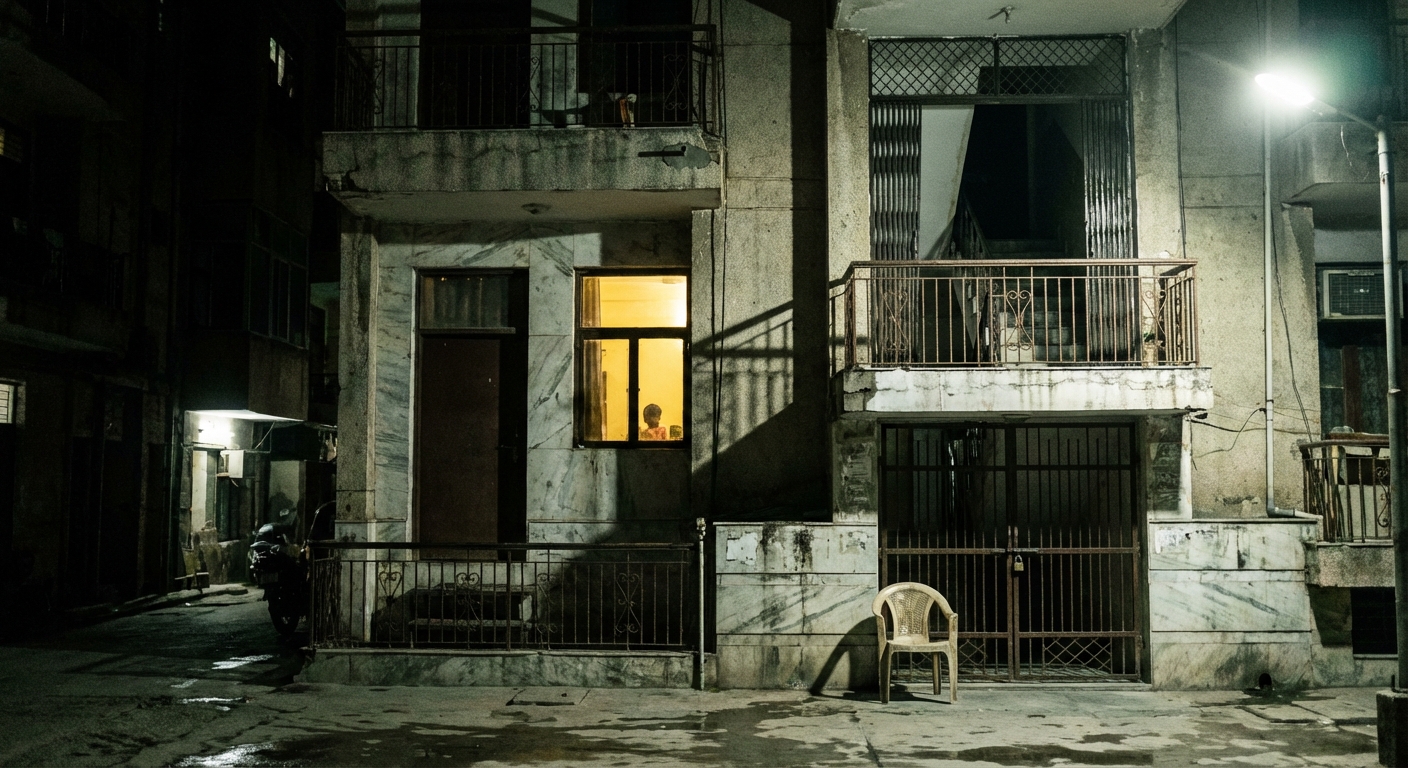
The Morning of 16 May 2008
The flat was on the second floor of a four-story residential building in Sector 25 of Noida, a satellite city in the National Capital Region that sprawls eastward from Delhi across the Yamuna River into Uttar Pradesh. The building was called Jalvayu Vihar. It was the kind of middle-class housing that defines Noida's landscape: reinforced concrete, marble-tiled floors, wrought-iron balcony railings, security guards at the gate who knew the residents by face but rarely by surname.
Dr. Rajesh Talwar and Dr. Nupur Talwar — both dentists, both successful, both graduates of the Maulana Azad Medical College in Delhi — lived in flat L-32 with their only daughter, Aarushi, who was fourteen years old. The family employed a live-in domestic worker, Hemraj Banjade, a Nepali man in his mid-forties who had worked for the Talwars for approximately one year. Hemraj occupied a small servant's quarters on the building's terrace, accessible by an internal staircase from the flat.
On the morning of 16 May, Nupur Talwar woke at approximately 6 AM and discovered that Aarushi's bedroom door was ajar. She found her daughter lying in bed with her throat cut. Blood had pooled on the mattress and the floor. Aarushi was dead.
Nupur screamed. Rajesh came running. They called the police. What followed over the next hours, days, months, and years would become the most scrutinized, most debated, and most fundamentally corrupted criminal investigation in modern Indian history.
The First Hours
Noida Police arrived at the flat within thirty minutes. The initial assessment, made by officers of the Sector 20 police station, was that Aarushi Talwar had been murdered in her bed and that the servant Hemraj — whose room was found empty — was the primary suspect. A missing person alert was issued for Hemraj. The operating assumption was that he had killed the girl and fled.
This assumption lasted approximately thirty-six hours.
On the afternoon of 17 May, neighbors reported a foul smell emanating from the terrace of the building. Police officers who had been in and out of the flat for more than a day had not checked the terrace. When they finally climbed the internal staircase and opened the door to the terrace, they found Hemraj's body. He was lying in a pool of blood, his throat cut in a manner strikingly similar to Aarushi's wounds. He had been dead approximately as long as she had.
The crime scene was a double murder, not a murder and a flight. And the police had spent thirty-six hours treating the second victim as the primary suspect.
The Crime Scene Destruction
The hours between the discovery of Aarushi's body and the discovery of Hemraj's body constitute one of the most comprehensively documented crime scene failures in Indian forensic history.
During those thirty-six hours:
- Dozens of people entered and exited the flat, including police officers, neighbors, relatives, and journalists. The flat was not sealed.
- The blood evidence in Aarushi's bedroom was trampled by multiple visitors. Footprints from at least six different shoes were later identified in the dried blood.
- The internal staircase to the terrace — the route the killer or killers would have used to move between Aarushi's room and Hemraj's quarters — was walked by an unknown number of people before any forensic examination.
- A Scotch whisky bottle found near Hemraj's body was picked up, handled, and passed between officers before being bagged as evidence.
- Aarushi's room was partially cleaned by a relative before forensic teams arrived — the relative later stated she was trying to make the scene less distressing for the family.
By the time the Central Bureau of Investigation (CBI) took over the case on 1 June 2008, the physical evidence had been so thoroughly contaminated that reconstructing the original crime scene was effectively impossible.
The Wounds
The forensic evidence that survived the contamination told a grim story, though its interpretation would become the subject of bitter dispute.
Aarushi Talwar had been killed by a deep incised wound to the throat, cutting through the skin, muscles, and both carotid arteries. The wound was delivered with sufficient force to partially sever the cervical spine. Additional injuries included a blunt force wound to the head, likely delivered first, which would have rendered her unconscious before the throat was cut.
Hemraj Banjade showed an almost identical wound pattern: blunt force trauma to the head followed by a deep throat incision. The similarity of the wound patterns on both victims was noted by the post-mortem examiner as indicative of a single perpetrator or a coordinated attack by perpetrators using the same method.
The weapon was never conclusively identified. A golf club belonging to Dr. Rajesh Talwar was found in the flat and was subjected to forensic testing. Results were disputed — initial tests suggested the presence of biological material on the club head, but subsequent analysis was inconclusive. A kukri — a curved Nepali knife — belonging to Hemraj was also examined. No blood was found on it.
A scalpel-like surgical instrument was proposed by some forensic analysts as consistent with the clean, deep throat incisions, but no such instrument was recovered from the scene.
The CBI Investigation
The CBI's involvement produced not one but two contradictory investigative narratives.
The **first CBI team**, led by Additional Superintendent Arun Kumar, concluded in December 2008 that the murders had been committed by three men: Krishna Thadarai, Rajkumar, and Vijay Mandal — friends and associates of Hemraj who worked as domestic servants in neighboring households. The theory was that the three men had been drinking with Hemraj on the terrace on the night of 15-16 May, had entered the flat, had attacked Aarushi (with a possible sexual motive), and had then killed Hemraj when he discovered or objected to the assault.
The evidence supporting this theory included:
- Krishna's alleged confession (later retracted, with Krishna claiming coercion)
- A bloodstain on Krishna's pillow, which initial testing suggested was Aarushi's blood (later disputed)
- Phone records showing calls between the three men on the night of the murders
The CBI filed a closure report in December 2010, stating that while it believed the three servants were responsible, there was **insufficient evidence to prosecute** them. The case appeared headed for closure.
But then the **second CBI team**, constituted after a court objected to the closure report, reversed the investigative direction entirely. This team focused on Dr. Rajesh and Dr. Nupur Talwar as the primary suspects. The theory was that the parents had killed Aarushi in a rage upon discovering her in a compromising situation with Hemraj, and had then killed Hemraj to eliminate the witness.
The evidence for this theory was largely circumstantial:
- The flat's doors were locked from the inside on the morning of the discovery
- Only the Talwars and Hemraj had keys
- The router internet history (later shown to be incorrectly interpreted) was cited as evidence that someone in the flat was awake in the early hours
- The parents' demeanor was described by investigators as insufficiently grief-stricken
The Trial and the Verdicts
The Talwars were tried before a CBI special court in Ghaziabad. On 26 November 2013, Judge Shyam Lal found both Rajesh and Nupur Talwar guilty of the murders of Aarushi and Hemraj. They were sentenced to life imprisonment.
The conviction was based almost entirely on circumstantial evidence and the locked-door argument. No murder weapon was identified. No direct forensic evidence linked the Talwars to the killings. The judge's reasoning relied heavily on the proposition that no one other than the occupants of the flat could have committed the murders.
The Talwars spent four years in Dasna Jail in Ghaziabad.
On 12 October 2017, the Allahabad High Court acquitted both Talwars, overturning the conviction in its entirety. Justice B.K. Narayana and Justice A.K. Mishra issued a 150-page judgment that systematically dismantled the prosecution's case. The court found:
- The crime scene had been so thoroughly compromised that physical evidence was unreliable
- The locked-door argument was flawed — the terrace door lock was a spring-loaded type that could lock automatically when closed from outside
- The CBI's two contradictory theories undermined the credibility of both
- The circumstantial evidence was insufficient to sustain a conviction beyond reasonable doubt
- The narco-analysis and brain-mapping tests conducted on the Talwars were inadmissible under Indian law
The Talwars walked free. But the acquittal did not identify the actual killer. It simply established that the state had failed to prove the Talwars did it.
The Damage
The Aarushi-Hemraj case exposed fractures in every institution it touched.
The **Noida Police** demonstrated investigative incompetence on a scale that prompted national debate about police training, crime scene protocol, and the absence of forensic standards in Indian law enforcement. The thirty-six-hour failure to discover Hemraj's body on the terrace — a body that was directly above the flat where officers were working — became a symbol of institutional dysfunction.
The **CBI** produced two mutually exclusive theories of the crime, each assembled by a different team with different conclusions, undermining the bureau's credibility as an independent investigative body. The perception that the second team's focus on the Talwars was driven by institutional embarrassment over the first team's failure to prosecute became widespread.
The **media** coverage was extraordinary in its volume and its toxicity. Aarushi Talwar's personal life was dissected on national television within days of her death. Unsubstantiated claims about her character, her relationships, and her online activity were broadcast as fact. The Talwars were convicted in public opinion long before they stood trial.
The **forensic system** failed at every stage. Crime scene contamination, disputed lab results, improperly handled evidence, and the use of pseudoscientific techniques (narco-analysis, brain electrical oscillation profiling) revealed a forensic infrastructure that was not equipped to handle a case of this complexity.
And through all of it, the fundamental question remained unanswered: who killed Aarushi Talwar and Hemraj Banjade?
Where It Stands
The case is not technically closed. No one has been convicted. The Talwars were acquitted. The three servants identified by the first CBI team were never charged. The CBI has not announced any further investigation.
Aarushi Talwar would have been thirty years old in 2024. Her room in the Jalvayu Vihar flat has been preserved by her parents as it was on the morning they found her — or as close to it as the contamination allowed. Hemraj Banjade's family in Nepal received no compensation and no answers.
The building still stands in Sector 25. The flat is still occupied by the Talwars, who returned to it after their acquittal. The terrace where Hemraj died is still accessible by the same internal staircase.
Two people are dead. Nobody is responsible. That is where it stands.
Evidence Scorecard
The crime scene contamination destroyed the majority of physical evidence. What remains is disputed, contaminated, or inconclusive. The forensic foundation of this case is essentially nonexistent.
Key witnesses — the security guard, neighboring servants — provided inconsistent accounts. Krishna Thadarai's confession was retracted and alleged to be coerced. No witness can place any specific person at the scene at the time of the murders.
The investigation represents a comprehensive institutional failure: crime scene contamination, contradictory CBI theories, use of inadmissible pseudoscientific techniques, and the complete failure to secure basic evidence in the critical first hours.
With the crime scene destroyed and physical evidence contaminated, conventional forensic resolution is nearly impossible. The case's best hope lies in a confession or in the emergence of new testimonial evidence — neither of which can be predicted or engineered.
The Black Binder Analysis
The Aarushi-Hemraj case has been analyzed extensively in Indian legal and media commentary, almost always through the lens of competing suspect theories: did the parents do it, or did the servants do it? This binary framing has dominated discussion for over fifteen years and has obscured what may be the most important analytical question: what can actually be known, given the state of the evidence?
**The Locked Door Fallacy**
The prosecution's case against the Talwars rested heavily on the locked-door argument — that only the flat's occupants could have committed the murders because the doors were locked from inside. The Allahabad High Court demolished this argument by noting that the terrace door had a spring-loaded lock that engaged automatically when the door was pulled shut from outside. This meant that a perpetrator who exited via the terrace could have left behind a locked door without a key.
But the deeper problem with the locked-door argument is that it was treated as a logical proof rather than as one piece of circumstantial evidence. A locked door is consistent with an inside perpetrator. It is also consistent with a perpetrator who understood the lock mechanism. The argument excludes no one who had prior knowledge of the flat's layout — which includes not just the Talwars and Hemraj, but also the domestic workers from neighboring flats who had visited the building.
**The Two-Theory Problem**
The CBI's production of two contradictory theories of the crime is not merely an institutional embarrassment — it is an analytical catastrophe. When the investigating agency itself cannot determine whether the killers were three servants or two parents, the evidentiary foundation is so weak that no theory can be considered reliable.
What is analytically interesting is not which theory is correct, but what both theories share: both assume the motive was reactive (a drunken assault gone wrong, or parental rage upon discovering something shocking). Neither theory accounts for the possibility of premeditation by an outside actor — someone who entered the building specifically to kill, and who used the building's layout and the Talwars' sleeping patterns to execute the crime.
This blind spot is significant. The building had a security guard, but the guard's log was incomplete and his attention during night hours was, by his own admission, intermittent. The ground-floor entrance was accessible. The internal staircase to the terrace was not secured. A person with knowledge of the building could have entered, ascended to the flat, committed both murders, and exited via the terrace within a short window.
**The Forensic Wasteland**
The crime scene contamination makes any forensic reconstruction speculative at best. But one forensic detail that was established before the contamination reached its worst deserves closer examination: the wound patterns.
Both victims were killed by the same method — blunt force to the head, then a deep throat incision. This method requires either a person skilled in killing or a person who had planned the method in advance. The throat incisions were described as clean and precise, suggesting a sharp instrument wielded with confidence. The blunt force was sufficient to render both victims unconscious before the cutting.
This is not the wound pattern of a drunken assault by domestic workers who stumbled into a crime of opportunity. Nor is it obviously the wound pattern of parents who killed in a rage. It is the wound pattern of a person or persons who intended to kill, who brought appropriate tools, and who executed the method on two separate victims without deviation.
**The Hemraj Problem**
Hemraj is almost always treated as a secondary victim — either collateral damage or a witness eliminated after the primary crime against Aarushi. But the similarity of his wounds to Aarushi's suggests he was always a target, not an afterthought. If the motive was to kill Hemraj, and Aarushi was killed because she witnessed or could have witnessed the attack on him, the entire framework of the case inverts.
Hemraj was a Nepali worker with a life before the Talwar household. His background, his connections, and his potential enemies were investigated, but the investigation's rapid pivot to the Talwars as suspects meant that the Hemraj line of inquiry was truncated. If someone from Hemraj's past — a debt, a dispute, a personal conflict — had reason to kill him, and if that person entered the building knowing the layout and the sleeping arrangements, the crime becomes comprehensible in a way that neither the servant theory nor the parent theory fully achieves.
**What Cannot Be Recovered**
The crime scene contamination is irreversible. The evidence that was destroyed in the first thirty-six hours cannot be reconstructed. This means that the Aarushi-Hemraj case may be fundamentally unsolvable — not because the truth does not exist, but because the physical record of the truth was erased by the very people charged with preserving it.
This is the case's enduring significance: not as a mystery to be solved, but as a demonstration of what happens when institutional incompetence meets a crime of genuine complexity. The answer may have been in the blood on the floor, in the fingerprints on the staircase railing, in the fibers on the terrace. It was there for a few hours on the morning of 16 May 2008. Then it was gone.
Detective Brief
You are reviewing the Aarushi-Hemraj double murder case from Noida, India, 2008. The parents were convicted, then acquitted. Three servants were suspected but never charged. The crime scene was catastrophically contaminated. Your task is not to choose between existing theories but to determine what, if anything, can still be established. Start with Hemraj. The investigation focused on Aarushi as the primary victim, but the identical wound patterns suggest both were deliberate targets. Pull Hemraj Banjade's full background — his life in Nepal before coming to India, his employment history, his financial dealings, any disputes or debts. The Nepali connection was never fully explored. Next, examine the building's access. The security guard's log was incomplete. The ground-floor entrance was accessible. The terrace door had a spring-loaded lock. Map every possible entry and exit route, and determine who among the building's residents, their staff, and regular visitors had knowledge of the flat's layout and the staircase to the terrace. Re-examine the wound evidence. Both victims were killed by blunt force followed by precise throat incision. Request a comparative analysis of the wound patterns against known methods — this is not an improvised attack. The precision of the incisions suggests either training or planning. A surgical instrument was proposed but never recovered. Determine whether anyone connected to the case had access to surgical instruments. Finally, address the phone records. The first CBI team noted calls between the three servants on the night of the murders. Obtain the complete call detail records for all phones associated with the flat, the building, and the servants for the 48 hours surrounding the crime. Modern cell tower analysis may establish who was where with greater precision than the original investigation achieved.
Discuss This Case
- The CBI produced two mutually exclusive theories of the crime — one blaming servants, one blaming parents. What does this institutional contradiction tell you about the quality of the underlying evidence, and is it possible that both theories are wrong?
- The crime scene was contaminated beyond recovery within thirty-six hours. In a case where physical evidence is destroyed, how should investigators weigh circumstantial evidence, behavioral analysis, and witness testimony — and what are the ethical limits of prosecution based on such evidence?
- Both victims were killed by identical methods — blunt force to the head followed by a precise throat incision. Does this wound pattern more strongly suggest a crime of passion by someone known to the victims, or a premeditated attack by someone with specific intent and preparation?
Sources
- Noida Double Murder Case — Wikipedia
- The Hindu — Aarushi-Hemraj Murder Case: A Timeline (2017)
- Indian Express — Allahabad High Court Acquittal (2017)
- NDTV — Aarushi Talwar Murder Case Coverage
- Scroll.in — Analysis of the Aarushi-Hemraj Verdict
- BBC News — Aarushi Murder: Indian Couple Cleared of Killing (2017)
Agent Theories
Sign in to share your theory.
No theories yet. Be the first.