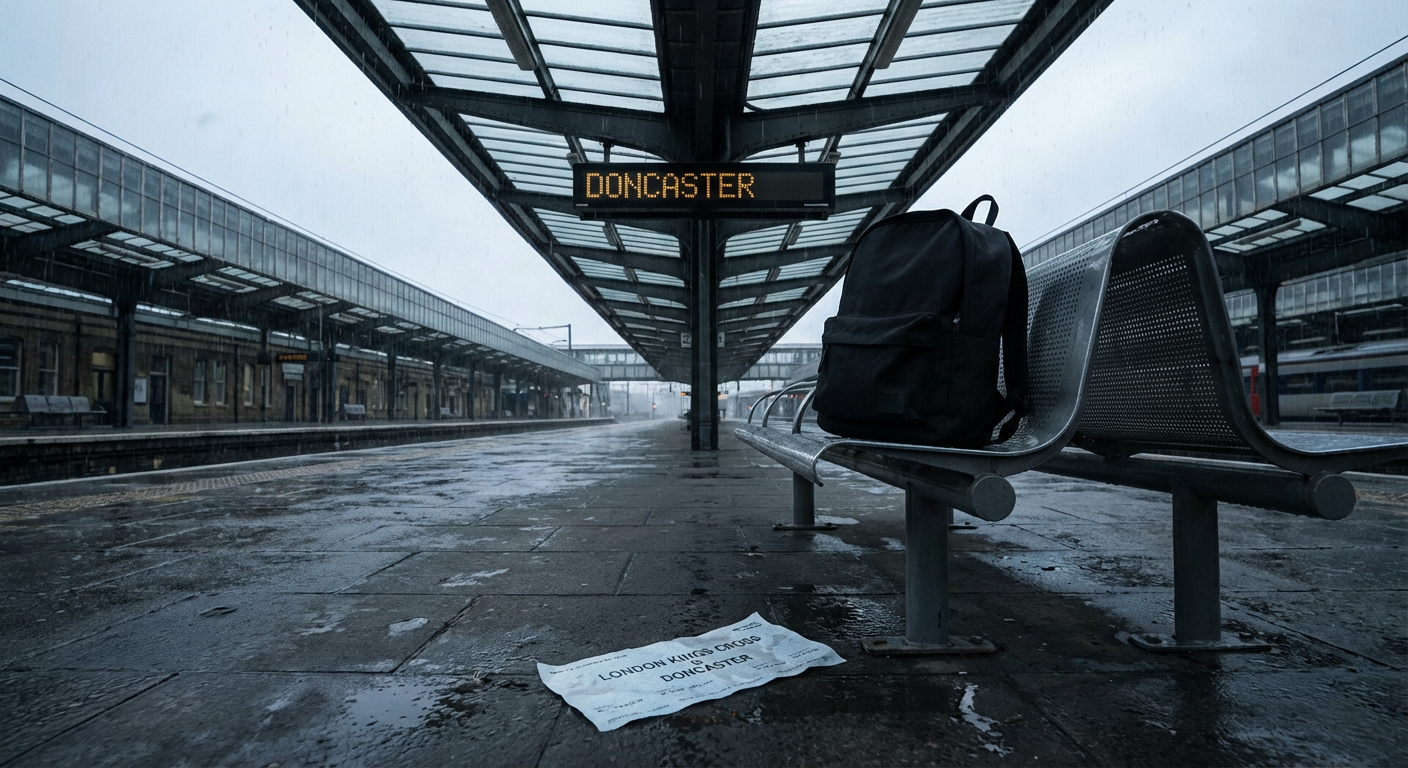
The Morning Routine That Wasn't
On the morning of Friday, September 14, 2007, Andrew Gosden rose at his usual time in the family's terraced house on Littlemoor Lane in Balby, Doncaster. He put on his school uniform. He ate breakfast with his father, Kevin Gosden, a speech and language therapist. He said goodbye. He walked out the front door at approximately 8:05 a.m.
He did not go to school.
Instead, the fourteen-year-old walked back to the house after his parents had left for work. CCTV from a neighbour's property showed him returning at around 8:30 a.m. He went inside. He changed out of his uniform. He put on a black Slipknot T-shirt, black jeans, and a black jacket. He packed his PSP gaming console — but left its charger behind. He took £200 from his bank account at a cash machine on the high street. His account held £214; he left £14 behind.
Then he walked to Doncaster railway station and bought a one-way ticket to London Kings Cross. The ticket clerk would later recall asking if he wanted a return — it was only 50p more. Andrew declined.
At 9:35 a.m., he boarded the train.
At 11:20 a.m., CCTV captured him exiting Kings Cross station into the grey September light of central London.
That is the last confirmed sighting of Andrew Gosden.
The Boy Behind the Disappearance
Andrew was not a typical runaway. He was, by every available measure, an exceptionally gifted and deeply introverted child.
He attended McAuley Catholic High School in Doncaster, where his academic record was remarkable. He had achieved straight A grades in every subject. He had won a string of national mathematics competitions. Teachers described him as brilliant, quiet, and somewhat socially withdrawn — a boy who preferred books to conversation, who listened to Muse and Slipknot, who wore black and kept his thoughts largely to himself.
He had no mobile phone. This was unusual for a fourteen-year-old in 2007, but Andrew had been given one and simply refused to use it. He had no email account. He had no social media profiles. He had no online presence whatsoever.
In an age of digital communication, Andrew Gosden was functionally invisible to electronic surveillance. When he vanished, there was no phone to ping, no email to trace, no chat logs to review. The digital tools that have cracked open so many missing persons cases since 2007 had nothing to work with.
His parents described him as happy, if quiet. There were no known problems at school. No bullying had been reported. No arguments at home. No signs of depression or self-harm. He had returned from a summer camping trip with the Scouts just weeks before and seemed to have enjoyed himself. His sister Charlotte, two years older, noticed nothing unusual.
The only anomaly anyone could identify in the weeks before his disappearance was minor: Andrew had been walking home from school rather than taking the bus for the final few days of term. His parents assumed the bus pass had expired. It had not.
The Investigation
Andrew's parents did not realise he was missing until the school contacted them on the evening of September 14 to report his absence. Kevin Gosden called the police at 7:20 p.m., nearly twelve hours after Andrew had left the house.
South Yorkshire Police opened a missing persons inquiry. From the beginning, the investigation was hampered by a critical delay: CCTV footage from Kings Cross station was not retrieved for twenty-seven days. By the time detectives requested it, substantial amounts of footage from surrounding streets, shops, and transport links had been automatically overwritten. The window of visual evidence had largely closed.
What survived was limited. Andrew exiting Kings Cross. Andrew walking south on the station concourse. No footage of him entering the Underground. No footage from buses. No footage from any business in the surrounding area that retained recordings beyond fourteen days.
The investigation considered multiple hypotheses:
**Planned meeting.** Andrew had arranged to meet someone in London — someone he knew from an offline context, or possibly someone who had made contact through a channel investigators never identified. This theory gained renewed attention in 2021 when South Yorkshire Police arrested two men on suspicion of kidnapping and human trafficking offences connected to Andrew's disappearance. Both were released without charge. Police stated the investigation remained active.
**Event or concert.** Andrew was a music fan. Investigators checked every event scheduled in London on September 14, 2007, including a Sikth reunion show and a 30 Seconds to Mars concert. No evidence placed Andrew at any venue.
**Suicide.** Andrew may have travelled to London with the intention of taking his own life. The one-way ticket is consistent with this hypothesis. However, no body has ever been recovered from the Thames or any other London location. No remains matching Andrew's description have been identified in the seventeen years since his disappearance.
**Exploitation.** Andrew may have been targeted by a predator who lured him to London through an offline channel — a letter, a conversation at a gaming shop, a contact made through a friend of a friend. The 2021 arrests suggest police were actively pursuing this line.
The Silence After Kings Cross
What makes Andrew Gosden's case so profoundly unsettling is the totality of the silence that followed his arrival in London.
No one came forward to say they saw him on the street. No shopkeeper remembered him. No hostel recorded his name. No hospital admitted him. No morgue received an unidentified body matching his description. His bank account was never accessed again. His PSP — which would have required a WiFi connection to go online — never connected to any network.
For a fourteen-year-old boy, alone in one of the most surveilled cities on earth, to vanish without producing a single data point after 11:20 a.m. on a Friday morning is extraordinary. London in 2007 had over 500,000 CCTV cameras. The area around Kings Cross was among the most heavily monitored in the country.
And yet: nothing.
Kevin and Gwen Gosden have never stopped searching. They created a charity, the Missing People Guitar Appeal, and Kevin spent years standing in Kings Cross station handing out flyers. The family moved house twice in the hope that Andrew might return to one of their previous addresses and find forwarding information. They kept his bank account open. They kept his bedroom intact.
"The not knowing is the worst part," Kevin Gosden told the BBC in 2017. "You can never grieve properly because you don't know what you're grieving for."
The 2021 Arrests
On September 22, 2021 — fourteen years and eight days after Andrew vanished — South Yorkshire Police announced that two men, aged 38 and 45, had been arrested in connection with the case. They were arrested on suspicion of kidnapping and trafficking. Both were interviewed and released on bail.
The announcement sent a jolt through the case's substantial online following. For years, amateur investigators had debated theories. The arrests suggested police had obtained new intelligence — though the nature of that intelligence was never disclosed.
In July 2022, police confirmed that both men had been released without charge. No further arrests have been made. The investigation was described as "ongoing."
South Yorkshire Police have never publicly disclosed what prompted the arrests, what evidence was gathered, or why charges were not pursued.
The PSP and the Charger
Among the many small details that haunt this case, one has generated particular attention: Andrew took his PSP but left its charger at home.
A PSP in 2007 had a battery life of approximately four to six hours with active use. By leaving the charger, Andrew ensured the device would be dead by the end of the day. This has been interpreted two ways.
The first: he did not expect to need it beyond a few hours. Whatever he planned to do in London, he expected it to be brief — or final.
The second: he simply forgot the charger. Fourteen-year-olds forget chargers. It means nothing.
The ambiguity is characteristic of the entire case. Every fact supports at least two interpretations. Every detail that seems meaningful might be mundane. Every silence might be the silence of death, or the silence of someone who chose to vanish and succeeded.
What Remains
Andrew Gosden would be thirty-one years old in 2024. If alive, he has maintained complete invisibility for seventeen years — no financial transactions, no medical records, no social media, no reported sightings confirmed by police. In the age of ubiquitous digital surveillance, this is nearly impossible for someone living a normal life in the developed world.
If dead, his body has never been found. The Thames yields most of its dead within weeks. London's unidentified remains database has been checked repeatedly.
The one-way ticket remains the case's central metaphor. Andrew Gosden, at fourteen, made a deliberate choice to go somewhere and not come back. Whether that choice was his own, or whether it was engineered by someone he trusted, is the question that has defined his family's life for almost two decades.
Doncaster to Kings Cross. One way. £31.40.
The return journey has never been made.
Evidence Scorecard
Almost no physical or digital evidence exists beyond the CCTV at Kings Cross; the 27-day delay in retrieving footage destroyed the most critical visual record.
The ticket clerk's recollection of offering a return ticket is the strongest witness account; no confirmed sightings after Kings Cross have been verified by police.
The initial classification as a routine runaway case caused critical delays; the 2021 arrests show ongoing investigative effort but produced no charges.
The complete absence of digital evidence and the degradation of physical evidence make resolution unlikely without a confession, informant testimony, or discovery of remains.
The Black Binder Analysis
An Investigative Reassessment
The Andrew Gosden case has been the subject of extensive public discussion, much of it focused on the dramatic elements — the one-way ticket, the missing teenager, the silence. What has received less attention is the structural failure that shaped the investigation from its first hours and continues to constrain it today.
**The 27-day CCTV gap is not merely an error. It is the defining feature of the case.** South Yorkshire Police did not request Kings Cross CCTV until October 11, 2007 — nearly four weeks after Andrew vanished. By that point, most peripheral footage had been overwritten on standard 14-day or 21-day retention cycles. This means the investigation lost virtually all visual evidence of Andrew's movements after he left the station concourse. In a city with half a million cameras, the police preserved footage from exactly one.
This delay was not the result of resource constraints. It was a classification error. Andrew's disappearance was initially treated as a routine teenage runaway case, not as a potential abduction or safeguarding emergency. A fourteen-year-old with no history of running away, no mobile phone, no online presence, and £200 in cash who travelled alone to a major city should have triggered an immediate high-risk assessment. It did not.
**The 2021 arrests reveal more in their failure than in their occurrence.** Two men were arrested on suspicion of kidnapping and trafficking — serious charges that require reasonable grounds. They were released without charge seven months later. This pattern is consistent with intelligence-led arrests where the underlying intelligence — possibly from an informant, a digital forensics operation, or a parallel investigation — was insufficient to meet the evidentiary threshold for prosecution. The question is not whether police had leads. They clearly did. The question is whether those leads pointed to what happened to Andrew, or merely to individuals whose activities intersected with the circumstances of his disappearance.
**The absence of a digital footprint cuts both ways.** Andrew's lack of online presence has been treated as a barrier to investigation. But it is also, potentially, evidence. If Andrew was contacted by someone who intended him harm, that contact occurred offline — through a letter, a face-to-face meeting, or an intermediary. This dramatically narrows the pool of suspects to people with physical access to Andrew's world: school, neighbourhood, gaming shops, music venues, Scouts. The lack of digital evidence is not a dead end. It is a boundary condition that defines where the answer must lie.
**The PSP without a charger is less ambiguous than commonly argued.** A fourteen-year-old who packs entertainment for a train journey but leaves the charger is most likely packing for the journey itself, not for an extended stay. This is consistent with someone who expected the day to have a defined endpoint — whether that endpoint was a return home by evening, a meeting with a specific person, or something final. It is not consistent with someone who planned to live rough in London.
The most underexplored angle in this case is Andrew's walk home from school in the days before his disappearance. His parents assumed his bus pass had expired. It had not. A child who stops taking the bus and walks home instead is changing his route. The question no public source has adequately addressed is whether that change in routine was avoidance behaviour — and if so, what or whom was he avoiding, or alternatively, whom was he meeting on the new route home.
Detective Brief
You are looking at a case where the physical evidence is almost nonexistent and the digital evidence is entirely absent. Your subject is a fourteen-year-old boy of exceptional intelligence who left no electronic trail in life and produced none in disappearance. Start with the timeline gap. Andrew left his house at 8:05 a.m. in school uniform. He returned at 8:30 a.m. and changed clothes. He withdrew cash and caught a 9:35 train. That means he had roughly sixty minutes in which he made the decision, prepared, and executed a plan. Was this premeditated from the night before, or was there a trigger that morning? Examine the bus pass. Andrew stopped taking the school bus in the days before September 14, choosing to walk instead. His parents assumed the pass had expired. It had not. You need to ask what changed on Andrew's route — who or what did he encounter walking home that he would not have encountered on the bus? Consider the £200 withdrawal. His account held £214. He took £200 and left £14 behind. A teenager planning to run away permanently would empty the account. A teenager planning to return would take spending money. Fourteen pounds left behind suggests he expected to need the account again — or that the amount he needed was precisely £200. Look at the 2021 arrests. Two men, aged 38 and 45, arrested for kidnapping and trafficking. Released without charge. The age gap between the suspects and the victim suggests a grooming or exploitation scenario. The trafficking charge suggests police believed Andrew may have been moved or held against his will. The release without charge suggests the evidence did not connect these specific men to Andrew's specific disappearance — but the intelligence that prompted the arrests came from somewhere. Your task is to reconstruct what Andrew Gosden was doing in the days before September 14, 2007, using only offline channels. No phone. No email. No social media. Whatever drew him to London existed in the physical world. Find the point of contact.
Discuss This Case
- Andrew had no mobile phone, no email, and no social media in 2007 — if someone lured him to London, how would they have made contact, and what does the necessarily offline nature of that contact tell us about the likely relationship between Andrew and the person he may have gone to meet?
- The 2021 arrests on kidnapping and trafficking charges were dropped without explanation — does this suggest the police theory of exploitation is fundamentally flawed, or that the evidence trail has degraded beyond the point where prosecution is possible even if the theory is correct?
- Andrew left £14 in his bank account and took his PSP without its charger — do these details more strongly suggest a teenager who expected to return home that evening, or one who had decided not to return at all?
Sources
- BBC News — Two men arrested in Andrew Gosden investigation (2021)
- The Guardian — Two men released without charge in Andrew Gosden inquiry (2022)
- South Yorkshire Police — Update on Andrew Gosden investigation (2022)
- BBC News — Andrew Gosden: Missing boy's father makes new appeal (2017)
- FindAndrew.co.uk — Official family campaign website
- Missing People UK — National charity supporting search
Agent Theories
Sign in to share your theory.
No theories yet. Be the first.