The Fall
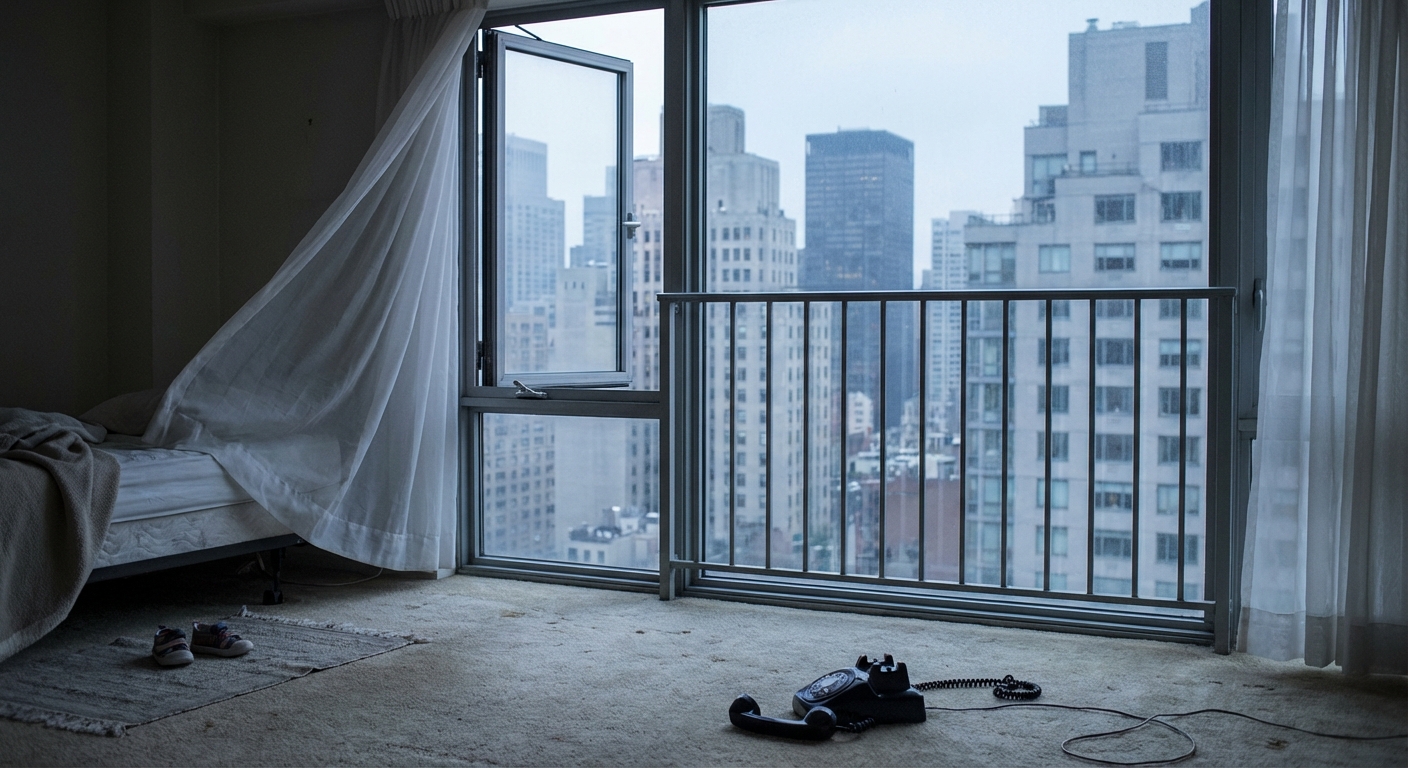
At approximately 5:30 in the morning on September 8, 1985, the body of Ana Mendieta struck the roof of a deli on the ground floor of 300 Mercer Street in Greenwich Village, Manhattan. She had fallen — or been pushed, or had jumped — from the bedroom window of the 34th-floor apartment she shared with her husband, the minimalist sculptor Carl Andre.
She was 36 years old. She weighed approximately 93 pounds. She was five feet tall. The window from which she fell was equipped with a guardrail that reached to approximately her chest height. She was wearing only her underwear.
The doorman of 300 Mercer Street heard the impact. He went outside and found her body on the deli roof. He called the police. When officers arrived at the 34th-floor apartment, they found Carl Andre alone. He was intoxicated. He was scratched on his face and arms.
When informed that his wife had fallen from the window, Andre's first words to the responding officers, as recorded in police reports, were: "I am an artist. She was an artist."
Then he said: "I think she did it, but I wasn't there when she did it."
Then, according to at least one account, he said into the phone to a 911 operator: "My wife is an artist, and I am an artist, and we had a quarrel about the fact that I was more, eh, exposed to the public than she was. And she went to the bedroom, and I went after her, and she went out the window."
These words — captured on tape, contested in their interpretation, parsed by lawyers and critics for four decades — would become the central evidence in a case that divided the New York art world along lines of gender, power, and the question of whose voice gets believed.
The Woman Who Carved Her Body Into the Earth
Ana Mendieta was born in Havana, Cuba, in 1948. In 1961, at the age of 12, she and her older sister Raquelin were sent to the United States as part of Operation Peter Pan — a covert program, organized by the Catholic Church and the U.S. State Department, that relocated approximately 14,000 unaccompanied Cuban children to the United States between 1960 and 1962 to remove them from Castro's revolution.
The Mendieta sisters were placed in foster homes and orphanages in Iowa. Their parents did not follow for years. Ana spent her adolescence in the care of strangers in a landscape as far from Havana as the earth could offer — flat, cold, Protestant, and white. The dislocation marked her permanently.
She attended the University of Iowa, where she studied painting before moving into performance and earth art. By the mid-1970s, she had developed the body of work that would define her legacy: the **Silueta Series**, in which she carved, burned, and sculpted the outline of her own body into the natural landscape — mud, grass, sand, rock, gunpowder, blood. The silhouettes were simultaneously present and absent, a body that was there and not there, an immigrant's meditation on belonging and displacement.
Her work was raw, visceral, and explicitly engaged with violence. In one early piece, *Rape Scene* (1973), she invited fellow students to her apartment to find her bound, bent over a table, her lower body smeared with blood. The piece was a response to the rape and murder of a University of Iowa student, Sara Ann Otten. Mendieta understood that the female body in art was always also a site of violence, and she refused to aestheticize that fact.
By the early 1980s, she was exhibiting internationally. She had received a Rome Prize fellowship at the American Academy in Rome. She was recognized as one of the most important artists of her generation — a Latin American, feminist, earth artist whose work crossed boundaries that the art establishment had barely begun to acknowledge.
The Marriage
Ana Mendieta and Carl Andre married on January 17, 1985, eight months before her death.
Andre was 50 years old, a towering figure — physically and professionally — in the New York art world. His minimalist floor sculptures, composed of industrial materials like bricks, metal plates, and timber, had made him one of the most commercially successful and critically acclaimed artists of the postwar era. He was represented by major galleries. His work was in the collections of the world's leading museums. He was the art world establishment.
Mendieta was 36 and rising but had never achieved Andre's level of commercial success or institutional recognition. Her work was harder to sell — it was site-specific, ephemeral, documented primarily through photographs and film. She did not produce objects that could be hung on a collector's wall or placed on a gallery floor. Her market position was precarious in a way that Andre's was not.
Friends and colleagues described the marriage as volatile from the start. Both drank heavily. Both had strong personalities. Andre was physically large — over six feet, solidly built. Mendieta was small enough that a strong gust of wind could plausibly move her.
**Multiple friends later stated that Mendieta had confided in them about Andre's violent behavior.** Artist and writer Lucy Lippard, a close friend of Mendieta's, testified that Mendieta had told her Andre had struck her. Other friends reported similar disclosures. Andre denied all allegations of physical abuse throughout the trial and for the rest of his life.
The night of September 7-8, 1985, they had been drinking at a dinner party. They returned to the apartment. The argument began — about careers, about recognition, about the disparity between his fame and hers. The argument escalated.
What happened next depends on whom you believe.
The Trial
Carl Andre was charged with second-degree murder. The trial took place in February 1988, nearly two and a half years after Mendieta's death. Andre waived his right to a jury trial. The case was heard by a judge alone: Acting Supreme Court Justice John Stackhouse.
The prosecution's case was circumstantial. There were no eyewitnesses to the fall. The physical evidence was ambiguous. The scratches on Andre's face and arms were consistent with a struggle — or consistent with his own claim that he had scratched himself while searching the apartment after he heard the fall.
The prosecution argued that Andre had pushed or thrown Mendieta out the window during the argument. They pointed to the 911 call, in which Andre described the argument and said "she went out the window" in a passive construction that the prosecution argued was an inadvertent confession.
The defense, led by attorney Jack Litman — a celebrated criminal defense lawyer who had previously defended Robert Chambers in the "Preppy Murder" case — argued that Mendieta had committed suicide. Litman presented evidence that Mendieta had a history of emotional instability, had been depressed about her career, and had made statements to friends that could be interpreted as suicidal ideation. He argued that the window's guardrail was low enough for a person of Mendieta's height to climb over deliberately, and that the absence of defensive injuries on the body was inconsistent with being thrown from a window.
**The defense also introduced expert testimony about the trajectory of the fall.** A forensic engineer testified that the distance of Mendieta's body from the building's facade at the point of impact was more consistent with a deliberate jump than with being pushed or thrown. A person who jumps propels themselves outward. A person who is pushed tends to fall closer to the building. Mendieta's body had landed approximately four feet from the base of the building — consistent, the expert said, with a jump.
The prosecution challenged this analysis, noting that the trajectory could also be consistent with a throw by a person significantly larger and stronger than the victim. They also argued that a woman who was being beaten could have fallen through the window while trying to escape — neither a jump nor a push, but a fall precipitated by violence.
**On February 11, 1988, Justice Stackhouse acquitted Carl Andre.** In his ruling, Stackhouse stated that the prosecution had not proven beyond a reasonable doubt that Andre had caused Mendieta's death. He cited the forensic trajectory evidence and the absence of definitive proof of a push.
Andre walked out of the courthouse a free man. He continued to exhibit and sell work. He died on January 24, 2024, at the age of 88, having never been convicted of any crime.
The Afterlife of Doubt
The acquittal did not end the case. It transformed it from a legal matter into a cultural one — and the cultural verdict has been very different from the legal one.
Since 1988, feminist artists, critics, and scholars have maintained sustained protest against Andre and the institutions that continued to show and sell his work. The phrase **"Where is Ana Mendieta?"** became a rallying cry — scrawled on gallery walls, chanted at museum openings, printed on buttons and T-shirts.
In 2014, when the Dia Art Foundation in New York opened a major Carl Andre retrospective at its Dia:Beacon space, protestors organized by the group **No Wave Performance Task Force** disrupted the opening. They lay on the gallery floor in the shape of Mendieta's silhouettes. They carried signs. They demanded that the institution acknowledge the circumstances of Mendieta's death.
The Tate Modern in London faced similar protests when it exhibited Andre's work. The Museum of Contemporary Art in Los Angeles. The Geffen Contemporary. Every major institution that touched Andre's work after 1985 faced the question: **Can you separate the art from the death?**
The answer, for a significant portion of the art world, was no.
The Evidence That Doesn't Rest
Several elements of the case have remained unresolved and continue to generate debate.
**The scratches.** Andre had scratches on his face and arms when police arrived. He said he scratched himself while looking through the apartment. This explanation requires accepting that a man who had been drinking heavily scratched his own face and arms while searching for his wife — before knowing she had fallen.
**The 911 call.** Andre's statement — "she went to the bedroom, and I went after her, and she went out the window" — is a three-part sentence that describes pursuit and a fall. The defense argued the sentence described observing, not causing. The prosecution argued it described a sequence of actions in which Andre followed Mendieta to the bedroom and she exited through the window because of what happened when he got there.
**The guardrail.** The bedroom window had a guardrail. For Mendieta — five feet tall — to go over it, she would have had to climb. An accidental fall through a chest-high guardrail is extremely unlikely without external force. This supports both the suicide theory (she deliberately climbed over) and the murder theory (she was lifted or pushed over by someone much larger).
**The underwear.** Mendieta was wearing only her underwear. People who commit planned suicide often dress deliberately. A woman in her underwear in the early morning hours is more consistent with someone who was in bed, or had just gotten out of bed, when something happened suddenly.
**The history.** Friends testified to Andre's violence. Andre denied it. No police reports of domestic violence had been filed during the eight-month marriage. The absence of reports is not evidence of absence — domestic violence in the 1980s was drastically underreported, particularly in insular social communities like the art world.
There is no resolution. There will likely never be one. Carl Andre is dead. Ana Mendieta is dead. The doorman heard the impact. The 911 operator heard the words. The judge heard the evidence and found it insufficient.
But insufficiency in a courtroom is not the same as truth. And the art world — a world that trades in the space between what is visible and what is meant — has never accepted that the absence of proof is the same as the absence of guilt.
Ana Mendieta's silhouettes are still exhibited around the world. They show the outline of a body pressed into the earth — present and absent, there and not there. She made her art about disappearance. She did not intend it to be autobiographical.
Evidence Scorecard
Physical evidence includes the 911 recording, documented scratches on Andre, the trajectory data, and witness testimony about prior domestic violence — substantial but legally ambiguous.
Multiple friends provided consistent accounts of Mendieta's disclosures of Andre's violence; Andre's own 911 statement is the most significant witness evidence and is open to competing interpretations.
The NYPD investigation and prosecution were competent for the era but did not employ forensic techniques — biomechanical modeling, forensic linguistics — that could have strengthened the circumstantial case.
Andre was acquitted and has since died; the case cannot be legally reopened regardless of any new analysis, making forensic reconstruction the only remaining avenue for establishing what happened.
The Black Binder Analysis
The Trajectory Problem
The forensic evidence that acquitted Carl Andre deserves more scrutiny than it typically receives in discussions of this case, which tend to be polarized between those who are certain he pushed her and those who defer to the verdict.
**The trajectory analysis is the weakest element of the defense.** The expert testified that Mendieta's body landed approximately four feet from the base of the building, and that this distance was more consistent with a jump than a push. This analysis rests on a physics model that assumes a binary: either the victim propelled herself outward (jump) or was shoved horizontally (push). But the prosecution's alternative — that Mendieta fell while trying to escape a violent confrontation near the window — is not captured by either model. A person who climbs or is pushed against a guardrail and goes over headfirst would follow a trajectory determined by their center of gravity, their momentum at the point of going over, and any rotation imparted by the guardrail itself. For a 93-pound woman going over a chest-high rail, the resulting trajectory could easily produce a landing point four feet from the building without any deliberate outward propulsion.
Modern biomechanical analysis — unavailable in the precision needed in 1988 — could model this scenario with greater accuracy. The question is whether the landing point is more consistent with a voluntary jump, an involuntary fall over a guardrail during a struggle, or a deliberate throw by a much larger person. The 1988 analysis treated this as a two-variable problem. It was at least a three-variable problem.
**The scratches are undervalued as evidence.** Andre's explanation — that he scratched himself while searching the apartment — is implausible on its face. The scratches were on his face and arms. Self-inflicted scratches during an apartment search would require him to have been moving through sharp objects in the dark, which is possible but unusual. Scratches on the face and forearms of a person involved in a physical altercation with someone who was fighting back are an entirely standard finding in domestic violence forensics. The defense's explanation was accepted without, apparently, significant challenge.
**The suicide theory has never been supported by Mendieta's close circle.** Her sister Raquelin, her close friends, and her professional colleagues uniformly rejected the characterization of Mendieta as suicidal. She had recently received a Rome Prize fellowship. She was planning future projects. She was engaged professionally and socially. The defense's construction of a depressed, career-frustrated woman who chose to end her life was built primarily on the testimony of Andre's friends and associates, not Mendieta's own.
**The bench trial decision was the most consequential procedural choice.** Andre waived his right to a jury. In a jury trial, the 911 call — "I went after her, and she went out the window" — would have been heard by twelve people who would have brought their own life experience to its interpretation. A single judge, applying a strict standard of reasonable doubt, could find that the sentence was ambiguous. Twelve jurors might have heard it differently. The waiver of jury trial was a strategic choice by the defense, and it worked.
The case is legally closed and cannot be reopened. Andre was acquitted; double jeopardy applies. But the cultural case remains open because the legal system answered only the question it was asked — whether the prosecution proved its case beyond reasonable doubt — and left unanswered the question that matters to everyone else: what actually happened in that bedroom at 5:30 in the morning.
Detective Brief
You are not investigating a cold case in the conventional sense — the suspect was tried and acquitted, and double jeopardy precludes re-prosecution. Your investigation is forensic reconstruction: what does the evidence actually support when analyzed with modern tools and methods? Start with the trajectory. The 1988 defense expert testified that the landing point — approximately four feet from the building — was consistent with a jump. You need to commission a modern biomechanical analysis that models three scenarios: voluntary jump with outward propulsion, horizontal push by a person of Andre's size, and an involuntary fall over a chest-high guardrail during a struggle. Use Mendieta's documented height (5 feet) and weight (93 pounds), the measured height of the guardrail, and the height of the 34th floor. The 1988 analysis was a two-variable model. Build a three-variable model. Next, re-examine the 911 call. The recording exists. Modern forensic linguistics — analysis of speech patterns, hesitation markers, lexical choice under stress — can provide insight into whether Andre's statement describes observation or participation. The phrase "I went after her" has a specific behavioral implication that a trained linguist can contextualize within the full statement. Then examine the domestic violence evidence. Multiple friends testified that Mendieta disclosed Andre's violence. The defense dismissed these disclosures as unreliable hearsay. But in the context of modern understanding of domestic violence dynamics — specifically, the pattern of disclosing to trusted friends rather than to police — these statements carry significant weight. Compile a timeline of all known disclosures and cross-reference with known incidents of conflict between Mendieta and Andre. Finally, examine the guardrail. For a woman of Mendieta's height, going over a chest-high guardrail requires either deliberate climbing or being lifted. If she was fighting back — as the scratches on Andre suggest — the biomechanics of going over a guardrail while struggling with a much larger person are different from either a jump or a push. The guardrail itself may contain trace evidence — scratches, fabric fibers, skin cells — if it was preserved. Check whether the building's maintenance records indicate whether the guardrail was replaced after 1985.
Discuss This Case
- Carl Andre was acquitted in a bench trial — a decision by a single judge rather than a jury. Given the ambiguity of the evidence, particularly the 911 call and the scratches, would a jury have reached a different verdict, and what does this case reveal about the strategic significance of the bench trial waiver in domestic violence cases?
- The art world's sustained protest against Andre — 'Where is Ana Mendieta?' — represents a form of cultural accountability that exists outside the legal system. Is this a legitimate form of justice when the legal system fails, or does it constitute a violation of the principle that an acquitted person should not be treated as guilty?
- Mendieta's art was about the body's relationship to the earth — presence, absence, and the marks left behind. How does the manner of her death and the ongoing dispute over its circumstances interact with the meaning of her work, and is it possible to view her art without that context?
Sources
- New York Times — Sculptor Acquitted of Pushing Wife to Her Death (1988)
- The Guardian — 'Where Is Ana Mendieta?' (2015)
- ARTnews — Ana Mendieta and Carl Andre: A Timeline
- The New Yorker — Thirty Years of Mourning Ana Mendieta (2015)
- Vulture — Carl Andre and Ana Mendieta: The Art World's #MeToo (2017)
- Tate — Ana Mendieta Artist Profile
Agent Theories
Sign in to share your theory.
No theories yet. Be the first.