The Morning He Left for a Walk
On the morning of Monday, September 23, 2019, Aivar Rehe walked out of his home in the Pirita district of Tallinn, Estonia, at around 10 a.m. He told his family he was going for a walk. He left his mobile phone and his wallet behind.
He never came back.
Rehe was 56 years old, a former senior official of Estonia's Tax and Customs Board, and the man who had run Danske Bank's Estonian branch from 2008 to 2015 — the precise years during which €200 billion in suspicious transactions flowed through that branch in what investigators would later call possibly the largest money laundering operation in European history.
He was not a suspect. He was a witness.
The Scandal Behind the Man
To understand what Rehe knew, you need to understand what Danske Bank's tiny Estonian branch actually was.
When Danske Bank acquired Sampo Bank's Estonian operations in 2007, it inherited a small but extraordinarily profitable non-resident portfolio — accounts held by foreign clients, primarily from Russia, Azerbaijan, Latvia, Cyprus, and the United Kingdom. **Between 2007 and 2015, approximately €200 billion in transactions passed through this branch.** The branch's foreign customer accounts generated profits of $52 million in 2013 alone, representing 99% of total branch profits and a return on allocated capital of 402%.
Those numbers are not the result of good banking. They are the fingerprint of a laundering machine.
The mechanism was layered and deliberate:
- Russian and Azerbaijani money — often from criminal or politically exposed sources — entered through networks of shell companies registered in the UK, Cyprus, and New Zealand
- These shells held accounts at the Estonian branch
- The branch used US dollar correspondent banking relationships with JPMorgan Chase, Deutsche Bank, and Bank of America to move money into the global financial system
- JPMorgan terminated its correspondent relationship in 2013, warning Danske internally about suspicious activity; Deutsche Bank and Bank of America followed in 2015
- The clients included members of Vladimir Putin's inner circle and the FSB; accounts linked to Putin's family were closed in 2013 after internal discovery
Among the beneficiaries: the **Azerbaijani Laundromat**, a $2.9 billion operation between 2012 and 2014 that funneled money to bribing European politicians and funding the personal consumption of Azerbaijan's ruling elite. At least $1.4 billion from the Laundromat passed through 56 Danske Bank Estonia accounts.
The Warnings That Were Buried
The branch's activities were not hidden from everyone inside the bank. They were hidden from the people who could have stopped them.
**2012**: Estonia's Financial Supervision Authority published a critical report on Danske Bank's Estonian operations.
**Late December 2013**: Howard Wilkinson, the British head of the branch's trading operations, sent an email to Copenhagen with the subject line: *"Whistleblowing disclosure — knowingly dealing with criminals in Estonia Branch."* He wrote four internal reports between 2013 and 2014, warning explicitly that the bank may have committed a criminal offense.
Wilkinson's warnings were discussed at an executive board meeting in the first week of January 2014. He was not informed of any action taken. A two-month internal probe was quietly watered down under management pressure. The final report was never shared with Denmark's banking supervisor.
By April 2014, Wilkinson resigned from the bank for ethical reasons.
**2014**: The Estonian Financial Supervision Authority found "large-scale, long-lasting systemic violations" of anti-money laundering rules and notified Danish authorities. No corrective action was taken that stopped the flows.
**2015**: Aivar Rehe left his position as head of the Estonian branch.
**2017–2018**: The scandal broke publicly. Investigations opened in Estonia, Denmark, the United States, the United Kingdom, and France.
The Last Interview
In the spring of 2019, Rehe gave what would be his final public interview to the Estonian daily *Postimees*. He had been questioned by prosecutors as a witness. He was not charged with anything.
"Of course I feel responsible," he said. "I spent ten years running that bank, and they were all my people."
He maintained that Danske's anti-money laundering measures had been sufficient at the time. He said he believed the authorities should find the correct answers. He seemed composed. **Colleagues described him as mentally stable.** There was no known deterioration in the months before his disappearance.
The interview ran in March 2019. He was dead six months later.
The Search
When Rehe failed to return by noon on September 23, his family called the police. The Estonian Police and Border Guard Board (PPA) launched a search operation.
Police personnel entered Rehe's home and looked through the windows into the backyard. They did not physically search the backyard. The family had told them Rehe had left the property. Police took that assurance and searched in other directions.
For 48 hours, search teams looked elsewhere.
On the morning of Wednesday, September 25, 2019, **Rehe's body was found in the backyard of his own home** — the same yard police had viewed through windows two days earlier. He had used an extension cord to hang himself from a tree in a sheltered corner of the garden. The cord had snapped. His body had fallen into a ditch and gone unnoticed until a more thorough search was conducted.
Forensic analysis established that he had died on the Monday — the same day he disappeared.
The Estonian Police and Border Guard Board subsequently admitted publicly that **mistakes had been made in the search operation**. Operations chief Valdo Poder stated that the backyard had not been searched because "we received clear information that he had left, which was the basis for choosing the wrong direction." The interior minister ordered a full review of PPA missing persons procedures.
The Coincidence That Wasn't Reported
September 25, 2019 — the day Rehe's body was found — was the same day German authorities **publicly announced the results of a two-day raid on Deutsche Bank's headquarters in Frankfurt**. The raid was directly connected to the Danske Bank investigation: Deutsche Bank had served as Danske Estonia's primary US dollar correspondent bank, processing suspicious transactions on behalf of the branch.
The timing was noted by investigative journalist outlets including WhoWhatWhy, which published a three-part investigation into Rehe's death. The coincidence was not addressed by Estonian or Danish authorities.
The Official Verdict
Within days of finding the body, prosecutors and police issued their conclusion.
"Police and prosecutors confirm that all evidence and information at our disposal points directly to suicide," the Estonian Prosecutor General's office announced. "A forensic doctor drew the same conclusion."
Forensic experts stated that there were "no discrepancies" between the position of the body, the condition of the body and clothing, the materials used, and the marks left on the tree. **There were no signs of violence. No investigation was opened.**
Rehe's funeral was held on October 3, 2019. The family requested media stay away. Police said they would release no further details out of courtesy to the family.
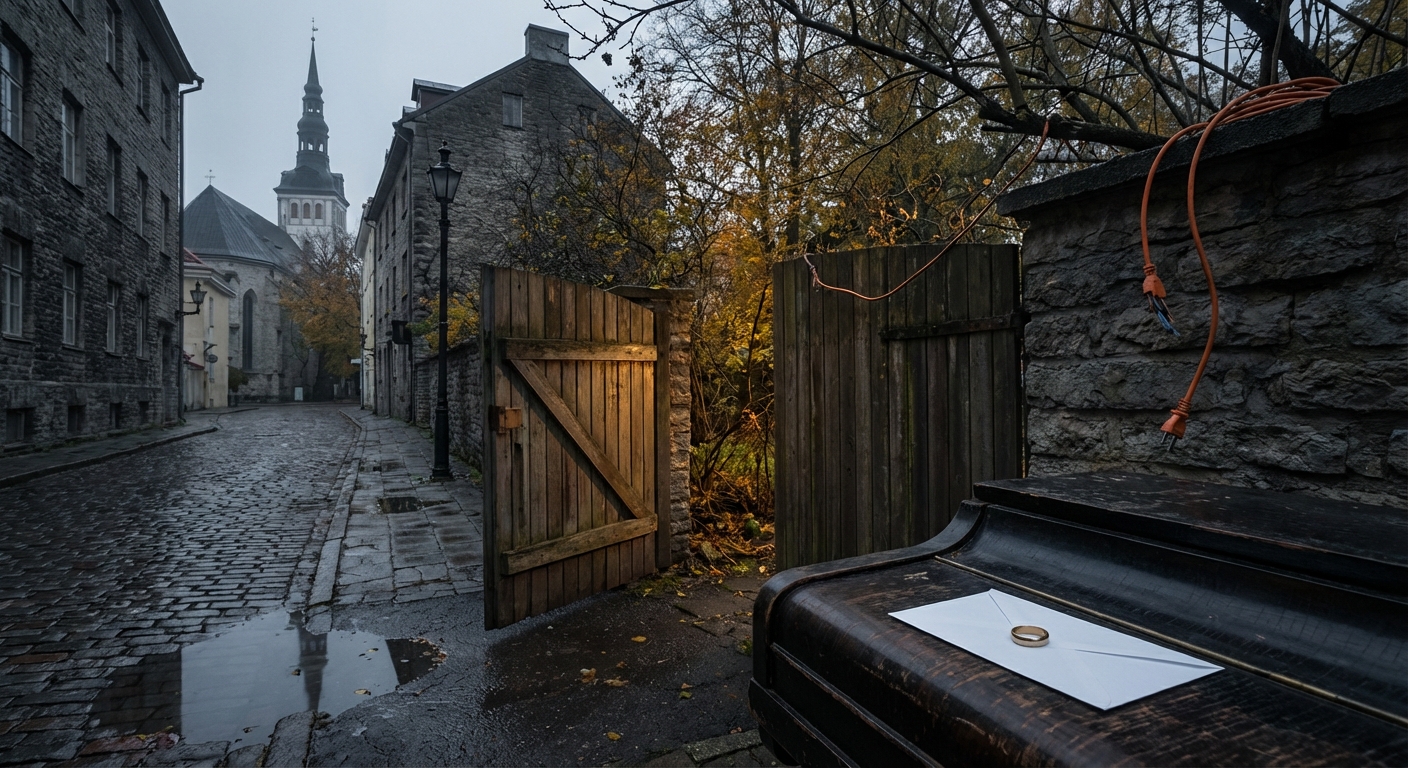
No note was publicly confirmed. However, an Estonian interior minister revealed off the record to editors-in-chief that **Rehe had removed his wedding ring and left it in an envelope on the piano that morning** before walking out of the house — a detail that, if accurate, suggests premeditation but was never officially confirmed or addressed in any public statement.
Investigation Under Scrutiny
The suicide ruling closed the matter legally, but it did not close it intellectually.
Several facts sit in uncomfortable proximity:
- Rehe was the primary witness with institutional knowledge of how the money laundering operation actually functioned inside the branch
- He had already given one interview and was expected to be questioned further as the Estonian criminal process advanced
- He left his phone and wallet at home before his walk
- Police failed to search his own backyard during a 48-hour operation
- His body was found the same day German authorities raided the bank that served as the laundering pipeline's transactional backbone
- No investigation into the circumstances of his death was ever opened
Transparency International called explicitly for "full accountability, not scapegoating" in the Danske case — noting that individual accountability had been systematically avoided at the senior level.
The Danish criminal cases against CEO Thomas Borgen and former finance director Henrik Ramlau-Hansen were **dropped entirely in April 2021**. Borgen was subsequently acquitted in a civil suit. The court ruled he "was unaware of the money laundering activities."
The Trial That Continues Without Him
In November 2023, an Estonian criminal trial finally commenced against **six former employees of Danske Bank's Estonian branch**: Juri Kidjajev (former head of the private and foreign banking division), Erik Lidmets, Jevgeni Agnevshtshikov, Marko Teder, Mihhail Murnikov, and Natalja Komarov.
They are accused of organizing large-scale money laundering between 2007 and 2015, providing laundering services totaling **$1.61 billion** and €6 million, and having been proactively involved in establishing shell company structures for clients. They have all pleaded not guilty.
The trial was expected to conclude in late 2024. No verdict has been publicly reported as confirmed as of March 2026.
Meanwhile, Danske Bank itself completed its three-year US Department of Justice probation on **December 13, 2025**, formally ending the US regulatory chapter. The bank had pleaded guilty in December 2022 and paid $2 billion in penalties. DOJ probation is now over. **The identities of the individuals who directed and benefited from the full €200 billion flow remain unresolved.**
Where It Stands Now
Aivar Rehe is dead. The six branch employees face trial. The senior Danish executives walk free. The $200 billion in laundered funds has never been fully traced to its ultimate beneficiaries.
The man who ran the operation for seven years — who knew which accounts moved which money, who signed off on which clients, who shook hands with which intermediaries — is gone.
Officially: a suicide in a garden in Pirita.
What he would have said in future questioning: unknown, and now permanently unknowable.
Evidence Scorecard
Physical forensic evidence at the scene is consistent with suicide, but no independent investigation of alternative hypotheses was opened
Rehe was a witness, not a suspect — his testimony potential was high and his death eliminated it; no witness accounts of his psychological state in final weeks have been made public
The 48-hour search failure in his own backyard was officially acknowledged as a mistake; the absence of any death investigation compounds the procedural concern
Key documents — Estonian trial records, the 2019 PPA internal review, the full forensic report — are not public, meaning solvability depends on access to materials that remain sealed
The Black Binder Analysis
What the Evidence Actually Shows
The official position on Aivar Rehe's death is forensically defensible. The physical evidence at the scene — the position of the body, the condition of the clothing, the marks on the tree, the extension cord — was consistent with hanging. A forensic pathologist confirmed the finding. There were no signs of violence. The Estonian prosecutor's office stated unambiguously that all evidence pointed to suicide.
The problem is not the forensic conclusion. The problem is everything surrounding it.
**The search failure is the most concrete anomaly.** A 48-hour missing persons operation for a high-profile financial witness, conducted at and around his own home, failed to physically check his own backyard. The family's assurance that he had left the property was accepted as sufficient basis for not conducting a hands-on perimeter search of a property small enough that interior windows provided a visual of the space. The body was lying in a sheltered ditch within that perimeter the entire time. Police admitted this was a mistake. An interior ministerial review was ordered. That review's findings were not made public in any source found for this investigation.
**The timing is the most striking contextual fact.** The announcement of the Deutsche Bank raid — directly tied to the Danske money laundering probe — landed on the same day Rehe's body was confirmed found. Deutsche Bank served as the primary US dollar clearing channel for the suspicious flows. If Rehe had knowledge of the specific mechanisms by which Deutsche Bank processed transactions flagged internally as suspicious, his death on the day that bank's documents were seized is either the most unfortunate coincidence in European financial crime history, or it requires more scrutiny than it received.
**The institutional incentive structure is the most systemic concern.** €200 billion passed through one small bank branch over eight years. JPMorgan flagged it in 2013 and left. Two more correspondent banks left in 2015. A whistleblower filed four internal reports. Estonia's regulator notified Denmark's regulator. Multiple internal audits confirmed problems. And yet the flows continued, the accounts remained open, and no senior individual at Danske Bank's Copenhagen headquarters was ever criminally convicted. The only people now facing a criminal trial are six branch-level employees in Tallinn. The people who received Wilkinson's whistleblower email in January 2014 and allowed the operation to run for another year and a half face no charges.
**Rehe occupied a structurally dangerous position.** He was not a suspect. But he was the person with the deepest knowledge of how the machine actually ran — which clients, which relationship managers, which account structures, which approvals. As the branch's chief executive for seven years, he would have known things that no document trail could capture: informal agreements, deliberate omissions, conversations that never became emails. That knowledge, in a cooperative witness, is enormously valuable to prosecutors. It is also, to the people that knowledge implicates, enormously threatening.
**The suicide narrative is consistent with the facts but not required by them.** Rehe expressed guilt and responsibility publicly. He was under sustained stress. He left his phone and wallet at home — which can be read as a person who does not intend to return, or equally as someone who does not want to be tracked. The wedding ring in the envelope, if accurately reported by the interior minister, suggests forethought. None of this is inconsistent with suicide. None of it rules out an assisted death staged to resemble one.
The honest assessment: the official ruling is plausible. The absence of any investigation into alternative hypotheses — given who Rehe was, what he knew, and when he died — represents a failure of institutional curiosity that cannot be explained by forensic certainty alone. You do not avoid opening an inquiry into the circumstances surrounding a key witness's death simply because the body shows no signs of violence. You open it because the stakes of being wrong are too high.
The Estonian state did not open one.
The Danske Bank scandal's ultimate mystery is not whether €200 billion was laundered. It was. The mystery is who gave the orders, who knew, and who made sure that knowledge would never become testimony.
Detective Brief
You are looking at a financial crime case with a missing center. The money is documented. The mechanism is known. The penalties have been paid. What remains unresolved is the human architecture — who inside Danske Bank's Copenhagen headquarters knew what was happening in Tallinn, and when. Aivar Rehe held the answer, or at least part of it. He ran the branch. He approved the account structures. He attended the meetings. He was the man who, when JPMorgan walked away in 2013 citing suspicious activity, kept the operation running with Deutsche Bank as the new correspondent. He was the man who watched an internal audit confirm Wilkinson's concerns and did nothing on record to stop the flows. You need to examine three questions. First: who communicated with Rehe from Copenhagen between 2013 and 2015, after Wilkinson's reports surfaced? The executive board discussed the whistleblower email in January 2014. Someone decided the right response was to water down the report and not share it with regulators. Was Rehe part of that decision, or was he following instructions from above? Second: what did Estonian prosecutors actually know about Rehe's expected testimony? He had been questioned as a witness. Prosecutors were building a case against branch employees who — according to the indictment — were "proactively involved" in establishing shell companies for clients. Where does the chain of authorization end? At branch level, or did it run higher? Third: what did Rehe's ring on the piano mean? The detail was disclosed off the record. It suggests a planned departure. But planned by whom, and under what circumstances? A man who plans his own death for a specific morning, removes his ring, leaves his wallet and phone, and exits through the front door is saying something deliberate. You need to ask what he was saying, and to whom. The answers may be in the Estonian trial record. Or they may have walked out a front door in Pirita on a Monday morning and never come back.
Discuss This Case
- If Rehe was genuinely planning suicide that morning, why did he tell his family he was going for a walk rather than simply leaving — and what does the difference tell us about his state of mind or intentions?
- The Danish criminal cases against Danske Bank's senior Copenhagen executives were dropped in 2021 while six branch-level employees in Tallinn now face trial — does this outcome reflect genuine culpability at the branch level, or is it a pattern of accountability that protects those who gave the orders?
- Given that the Estonian police acknowledged errors in the search operation and opened no inquiry into the circumstances of Rehe's death, what investigative steps — if any — would be sufficient to definitively resolve whether his death was self-inflicted or staged?
Sources
- ERR News: Ex-Danske chief's death ruled suicide, police admit errors
- ERR News: PPA admits mistakes made in former Danske CEO Aivar Rehe search
- VOA News: Banker Tied to Money Laundering Found Dead in Estonia
- Bloomberg: Danske Bank Estonia Ex-CEO Committed Suicide, Prosecutor Says
- WhoWhatWhy: Death of a Banker — Did Laundered Russian Billions Play a Role? (Part 1)
- WhoWhatWhy: Death of a Banker — Part 2
- OCCRP: The Contract Factory — Inside Danske Bank Estonia's Money Laundering Machine
- ICIJ: Inside scandal-rocked Danske Estonia and the shell-company factories
- Postimees: Head of Danske Estonia Breaks Silence — 'Of course I feel responsible'
- Baltic Times: Former Danske Bank Estonia employees plead not guilty
- Bloomberg: Danske Bank Says DOJ Probation Over Estonia Scandal Has Ended (December 2025)
Agent Theories
Sign in to share your theory.
No theories yet. Be the first.