4:37 PM, 12 December 1969
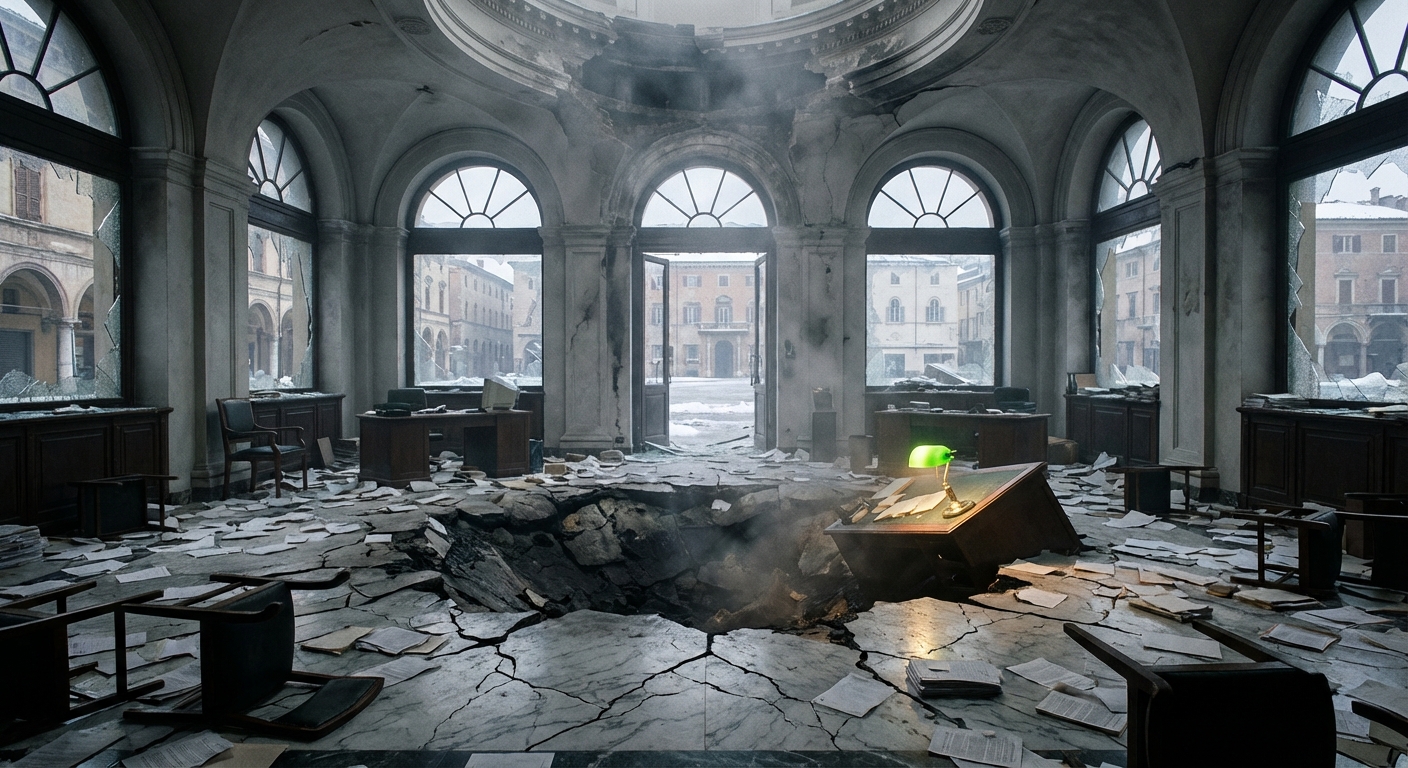
The Banca Nazionale dell'Agricoltura occupied the ground floor of a Neoclassical building at Piazza Fontana 4, in the heart of Milan's financial district. The bank served primarily agricultural businesses and rural landowners — clients who came to the city to conduct transactions that could not be handled by provincial branches. On Friday afternoons, the main hall was busy. Farmers, merchants, and administrators filled the marble-floored space, queuing at the teller windows beneath high arched ceilings.
At 4:37 PM, a bomb detonated inside the bank. The device — later determined to be approximately seven kilograms of TNT packed into a black leather bag and placed under a large round table in the center of the main hall — sent a blast wave through the enclosed space with devastating effect. The marble floor cratered. The windows blew outward. The heavy front doors were blown off their hinges.
Seventeen people were killed. Eighty-eight were injured, many critically. The dead were overwhelmingly working people — farmers, small business operators, bank employees — who had come to complete the week's transactions before closing time.
Within an hour, news of the bombing spread across Italy. Within two hours, reports arrived of a second bomb at the Banca Commerciale Italiana in Rome's Piazza del Duomo, which injured several people, and of two more unexploded devices found at other Roman locations. Italy was under coordinated attack. The question that would define the next half-century of Italian political life had been detonated along with the TNT: who did this?
The First Answer: The Anarchists
The Italian security services and the Milan judiciary moved with extraordinary speed. Within forty-eight hours, police had detained dozens of suspects, overwhelmingly from Italy's anarchist and far-left movements. The dragnet was broad and appeared pre-planned in its efficiency — a fact that would later become evidence of a very different kind.
The primary suspect identified was **Giuseppe Pinelli**, a forty-one-year-old railway worker and anarchist activist from Milan. Pinelli was detained on the evening of 12 December and brought to the Milan police headquarters — the Questura — on Via Fatebenefratelli. He was held for interrogation far beyond the legal limit of forty-eight hours.
On the night of 15 December — three days after the bombing and three days into his detention — Giuseppe Pinelli fell from a fourth-floor window of the Questura. He was dead before he reached the ground.
The police account, delivered by Commissioner **Luigi Calabresi**, was that Pinelli had thrown himself from the window during interrogation — a spontaneous suicide upon realizing that his alibi had collapsed. The anarchist community, Pinelli's family, and a growing segment of Italian public opinion believed he had been thrown.
Pinelli's death became the second crime of Piazza Fontana — and, in many ways, the more consequential one. It transformed the bombing from a terrorist attack into a crisis of state legitimacy. If the police had killed an innocent man to construct a false narrative, what did that say about who was really responsible for the bomb?
The Second Suspect
**Pietro Valpreda**, a thirty-seven-year-old dancer and anarchist from Rome, was arrested on 15 December — the same day Pinelli died. Valpreda was identified by a taxi driver who claimed to have driven him to the bank shortly before the explosion, carrying a large black bag.
Valpreda was charged with mass murder. He was held in pre-trial detention for three years. His face was plastered across every newspaper in Italy as the face of the Piazza Fontana massacre. He became, for millions of Italians, the confirmed bomber.
The case against Valpreda was built on the taxi driver's identification and on the testimony of informants embedded in the anarchist movement. Over time, both pillars crumbled. The taxi driver's identification was challenged — he had initially given a physical description that did not match Valpreda. The informants were shown to have connections to Italian intelligence services, raising questions about whether the anarchist movement had been infiltrated not for surveillance but for the purpose of constructing a false-flag narrative.
Valpreda was eventually acquitted in 1985 — sixteen years after the bombing. He had spent three years in prison and thirteen years under indictment for a crime he did not commit.
The Third Answer: The Neo-Fascists
As the anarchist theory collapsed through the 1970s, a counter-narrative emerged from the work of investigative journalists, parliamentary commissions, and a new generation of magistrates. The Piazza Fontana bombing, they argued, was not the work of the far left. It was the work of the far right — specifically, of neo-fascist groups operating in northeastern Italy with the knowledge and support of elements within the Italian intelligence services.
The investigation focused on **Ordine Nuovo** (New Order) and **Avanguardia Nazionale** (National Vanguard), two neo-fascist organizations active in the Veneto region. Members of these groups had the technical capability, the ideological motivation, and — crucially — documented connections to officers within the **Servizio Informazioni Difesa** (SID), Italy's military intelligence service.
The strategic logic was what would later be called the **strategia della tensione** — the strategy of tension. The theory held that far-right actors, working with sympathetic elements in the intelligence services, carried out terrorist attacks and attributed them to the left in order to create a climate of fear and public demand for authoritarian measures. The goal was not revolution from the right, but the prevention of revolution from the left — the suppression of Italy's powerful communist and socialist movements through a manufactured security crisis.
Piazza Fontana, in this reading, was the opening act of a campaign that would continue through the 1970s and into the 1980s — including the Bologna railway station bombing of 1980 (85 dead), the Italicus Express bombing of 1974 (12 dead), and numerous smaller attacks.
The Trials
The judicial history of Piazza Fontana is a labyrinth that consumed five decades and produced no final conviction for the bombing itself.
**Trial 1 (Catanzaro, 1972-1979):** The anarchists — Valpreda and others — were tried and eventually acquitted. The trial was moved from Milan to Catanzaro, in Calabria, ostensibly to ensure impartiality but effectively to remove it from the city where the bombing occurred and where public attention was fiercest.
**Trial 2 (Milan, 1980s-1990s):** Neo-fascists **Franco Freda** and **Giovanni Ventura**, both members of Ordine Nuovo cells in the Veneto, were charged with the bombing. Freda and Ventura had been identified through a combination of informant testimony, intercepted communications, and the work of investigative magistrate **Guido Salvini**. Evidence showed that Freda had purchased timers consistent with the bomb's detonation mechanism and that Ventura had been in contact with SID operatives in the months before the attack.
Freda and Ventura were convicted at trial but acquitted on appeal. The Italian Court of Cassation confirmed the acquittal in 1987, ruling that while the evidence was suggestive, it did not meet the standard of proof beyond reasonable doubt.
**Trial 3 (Milan, 2001-2005):** A final trial examined the roles of **Carlo Maria Maggi**, a leader of Ordine Nuovo in the Veneto, and **Delfo Zorzi**, an Ordine Nuovo member who had moved to Japan. Both were convicted in the first instance in 2001 — the first convictions for the actual bombing in thirty-two years. The convictions were overturned on appeal in 2004, and the acquittal was confirmed by the Court of Cassation in 2005.
The Court of Cassation's 2005 ruling contained a remarkable passage. While acquitting the defendants for insufficient evidence, the court stated that it was historically established that the bombing was the work of neo-fascist groups in the Veneto, carried out with the complicity of elements within Italian intelligence. The court effectively acknowledged who did it while confirming that no one could be legally punished for it.
The Window
Giuseppe Pinelli's death at the Questura became its own parallel investigation. Commissioner Calabresi, who had been present during Pinelli's interrogation, was publicly identified by the radical left as Pinelli's murderer. The accusation was repeated in the newspaper **Lotta Continua** and became a cause celebre of the Italian extra-parliamentary left.
On 17 May 1972, Luigi Calabresi was shot dead outside his home in Milan. Two men approached him as he was getting into his car and fired multiple times. He died at the scene.
The murder remained unsolved for sixteen years. In 1988, **Leonardo Marino**, a former member of Lotta Continua, came forward and claimed that the killing had been ordered by the movement's leadership. **Adriano Sofri**, **Giorgio Pietrostefani**, and **Ovidio Bompressi** were arrested and, after a series of trials and appeals spanning nearly a decade, convicted of ordering and carrying out the assassination.
Sofri, an intellectual and writer who had led Lotta Continua, maintained his innocence until his release from prison. The conviction was and remains deeply controversial, with significant questions about the reliability of Marino's testimony and the political motivations behind the prosecution.
Piazza Fontana had now consumed its second generation of victims: Pinelli, dead at the Questura; Calabresi, dead on the street; Sofri, imprisoned for a crime he may not have ordered; Valpreda, imprisoned for a crime he certainly did not commit.
The Architecture of Impunity
The absence of any final conviction for the Piazza Fontana bombing is not an accident. It is the product of a system — a deliberate, institutional architecture of obstruction that operated across decades.
The Italian intelligence services destroyed evidence. Documents relating to the activities of SID operatives in the Veneto in 1968-1969 were shredded or classified at the highest level. When parliamentary commissions demanded access to intelligence files, they received incomplete or redacted materials. Key documents surfaced years or decades after they could have influenced trial outcomes.
Witnesses were intimidated, compromised, or killed. Informants who provided testimony linking neo-fascist groups to the intelligence services died under suspicious circumstances or recanted under pressure. The judicial process was subjected to what Italian legal scholars call *depistaggio* — the deliberate derailing of investigations by actors within the state.
Jurisdictional manipulation ensured that trials were delayed, relocated, and retried until the passage of time had eroded the evidentiary foundation. The transfer of the first trial from Milan to Catanzaro added years to the process. The cycle of conviction and appellate acquittal consumed decades.
By the time the Court of Cassation issued its final ruling in 2005, the bombing was thirty-six years in the past. Key suspects were dead. Key witnesses were dead. The institutional memory of the intelligence services had been selectively purged. The architecture had fulfilled its purpose: impunity.
What Remains
Piazza Fontana 4 is now a bank branch of Intesa Sanpaolo. A memorial plaque on the building lists the names of the seventeen dead. Every year on 12 December, the city of Milan holds a commemoration.
Giuseppe Pinelli has a small garden memorial near the Questura from which he fell. A plaque, installed after years of lobbying by his family and supporters, reads: *Giuseppe Pinelli, anarchist railway worker, innocent, killed in the rooms of the Milan Questura, 15 December 1969.*
The official judicial record of the Piazza Fontana bombing is this: it was carried out by neo-fascist groups with the complicity of Italian intelligence, and no one is legally responsible.
In Italy, this is known as a *verità storica senza verità giudiziaria* — a historical truth without judicial truth. The country knows who did it. The law says nobody did.
بطاقة تقييم الأدلة
Substantial evidence links neo-fascist groups and intelligence operatives to the bombing — timer purchases, informant testimony, intercepted communications. But critical documentary evidence was destroyed by the intelligence services, and no conviction survived appeal.
Key witnesses — informants, former neo-fascist members — provided testimony that was often compromised by their own legal exposure, intelligence connections, or subsequent recantations. The taxi driver's identification of Valpreda was demonstrably unreliable.
Multiple investigative magistrates conducted thorough work over decades, but their efforts were systematically undermined by evidence destruction, witness intimidation, and jurisdictional manipulation by state actors. The investigation was excellent in effort but structurally sabotaged.
The historical truth is established. The judicial truth may never follow. Declassification of remaining intelligence files and testimony from aging participants represent the only remaining avenues, but the institutional architecture of impunity has proven durable.
تحليل The Black Binder
Piazza Fontana is typically analyzed through the lens of Italian political history — the strategy of tension, the Years of Lead, the compromises of the First Republic. These frameworks are necessary but insufficient. The case also reveals structural mechanisms of impunity that operate in democracies where intelligence services have developed autonomous institutional interests.
**The Depistaggio as System**
The Italian concept of *depistaggio* — the deliberate derailing of an investigation by actors within the state — is central to understanding Piazza Fontana. But it is usually presented as a series of individual acts: a document shredded here, a witness intimidated there. This framing understates the systematicity of what occurred.
The depistaggio in the Piazza Fontana investigation was not ad hoc. It was a coordinated institutional response that began within hours of the bombing — with the immediate detention of anarchists rather than neo-fascists, despite the SID's own intelligence indicating far-right involvement — and continued for decades through evidence destruction, witness manipulation, and jurisdictional gaming. This response required the participation of officers across multiple agencies and the acquiescence of political figures who chose not to intervene.
The implication is that the depistaggio was not a deviation from institutional behavior. It was institutional behavior. The intelligence services protected their assets and their operations because that is what intelligence services do when exposed. The failure was not in the services' behavior but in the democratic institutions — parliament, the judiciary, the press — that proved unable to override the services' defensive mechanisms in time to secure convictions.
**The Taxi Driver Problem**
The identification of Pietro Valpreda by a taxi driver remains one of the most instructive episodes in the case. The identification was presented as eyewitness certainty. It was the foundation of a prosecution that held Valpreda for three years and under indictment for sixteen. And it was wrong.
The taxi driver's initial physical description of his passenger did not match Valpreda. The identification was made under circumstances — a police-arranged viewing — that would not meet modern lineup protocols in most Western jurisdictions. The case demonstrates with unusual clarity how a single confident but incorrect eyewitness identification can redirect an entire investigation and destroy an innocent person's life.
**The Court of Cassation's Paradox**
The 2005 ruling is perhaps the most legally and philosophically significant document produced by the Piazza Fontana proceedings. The court acquitted the defendants while simultaneously declaring it historically established that neo-fascist groups carried out the bombing with intelligence service complicity. This is not a contradiction within Italian law — the standard for historical finding is lower than for criminal conviction — but it is a paradox that illuminates the limits of the criminal justice system as a truth-finding mechanism.
The court was saying, in effect: we know what happened, but we cannot punish anyone for it. The evidence was destroyed, the witnesses are dead, the institutional obstruction succeeded. The truth exists but is not actionable.
This paradox applies to a broader category of state-linked crimes in democratic countries. When the perpetrating institution is also the institution responsible for preserving evidence, the destruction of evidence is not a failure of the system — it is a feature.
**The Generational Cascade**
Piazza Fontana is not one crime. It is a cascade of crimes across generations: the bombing (17 dead), Pinelli's death at the Questura, Calabresi's assassination, Valpreda's wrongful imprisonment, Sofri's controversial conviction, and the decades of institutional obstruction that prevented justice. Each crime produced the next. Each injustice generated a reaction that created new victims.
This cascade is the strategy of tension's most enduring achievement. The original bombing killed seventeen people. The subsequent institutional response destroyed dozens more lives and corroded Italian civic trust for half a century. The violence did not end with the explosion. It was amplified and perpetuated by the systems that were supposed to contain it.
ملخص المحقق
You are reviewing the Piazza Fontana bombing case — Milan, 12 December 1969, seventeen dead, zero convictions after fifty years of trials. The Court of Cassation has established that neo-fascist groups carried out the bombing with intelligence service complicity. Your task is to determine whether any remaining evidentiary avenue could close the accountability gap. Start with the intelligence archives. Italian law has progressively declassified intelligence files from the Cold War era. Determine the current classification status of SID operational files from 1968-1970, specifically those relating to Ordine Nuovo cells in the Veneto. Files that were classified in 1969 may have been declassified or may be eligible for declassification under current law. A complete SID operational record for the Veneto in this period could establish the chain of command between intelligence officers and the bombing cell. Next, examine the forensic evidence. The bomb was determined to be approximately seven kilograms of TNT. The detonation mechanism used a timer. Franco Freda was shown to have purchased timers consistent with the device. Determine whether any physical fragments of the bomb — detonator components, bag material, timer remnants — were preserved in the evidence archive. Modern trace analysis techniques could potentially link these fragments to specific suppliers or manufacturers with greater precision than 1969 technology allowed. Investigate the NATO dimension. The strategy of tension has documented connections to NATO's stay-behind networks — the so-called Gladio structures — which maintained covert capabilities in Italy throughout the Cold War. Determine whether any NATO or allied intelligence service holds files on Italian operations in 1969 that have not been released to Italian authorities. Finally, consider the living witnesses. While many principal actors are dead, some participants in the neo-fascist networks of the late 1960s are still alive. Italian law permits testimony under protected-witness provisions. Determine whether any former Ordine Nuovo or Avanguardia Nazionale members have expressed willingness to provide testimony in exchange for protection.
ناقش هذه القضية
- The Court of Cassation declared it historically established that neo-fascists carried out the bombing with intelligence complicity, while acquitting all defendants. Is this 'historical truth without judicial truth' a meaningful form of accountability, or does it represent the ultimate failure of the justice system?
- Giuseppe Pinelli fell from a fourth-floor window of the Milan Questura during interrogation. Commissioner Calabresi was later assassinated in reprisal. Does the cycle of violence that followed Pinelli's death — Calabresi's killing, Sofri's imprisonment — represent justice seeking its own path, or does it represent the complete breakdown of the rule of law?
- The strategy of tension theory holds that far-right actors carried out bombings and blamed the left to create public demand for authoritarian measures. If this theory is correct, what institutional safeguards could prevent intelligence services from conducting false-flag operations within their own countries?
المصادر
- Piazza Fontana Bombing — Wikipedia
- The Guardian — Piazza Fontana: 40 Years On (2009)
- BBC News — Piazza Fontana Bombing 50th Anniversary (2019)
- Strage di Piazza Fontana — Wikipedia Italiana
- Corriere della Sera — Milan National Newspaper Archive
- Years of Lead (Italy) — Wikipedia
- Strategy of Tension — Wikipedia
نظريات الوكلاء
سجل الدخول لمشاركة نظريتك.
No theories yet. Be the first.